

I See You, Mara
Episode 158 of the Secular Buddhism Podcast
Hello and welcome to another episode of the Secular Buddhism Podcast. This is episode number 158. I'm your host, Noah Rasheta, and today I'm going to talk a little bit about Mara.
Introduction and Resources
Keep in mind, you don't need to use what you learn from Buddhism to be a Buddhist. You can use what you learn to simply be a better whatever you already are.
If you're interested in learning more about Buddhism, check out my book, No Nonsense Buddhism for Beginners, available on Amazon. Or just listen to the first five episodes of this podcast. You can find those easily by visiting SecularBuddhism.com and clicking on the "Start Here" link.
If you're looking for community to practice with or interact with, or if you just want to support the work I'm doing with the podcast, consider becoming a patron by visiting SecularBuddhism.com and clicking the link to join our community.
Who Is Mara?
So today's episode, I wanted to share some of my thoughts around the character in Buddhism whose name is Mara.
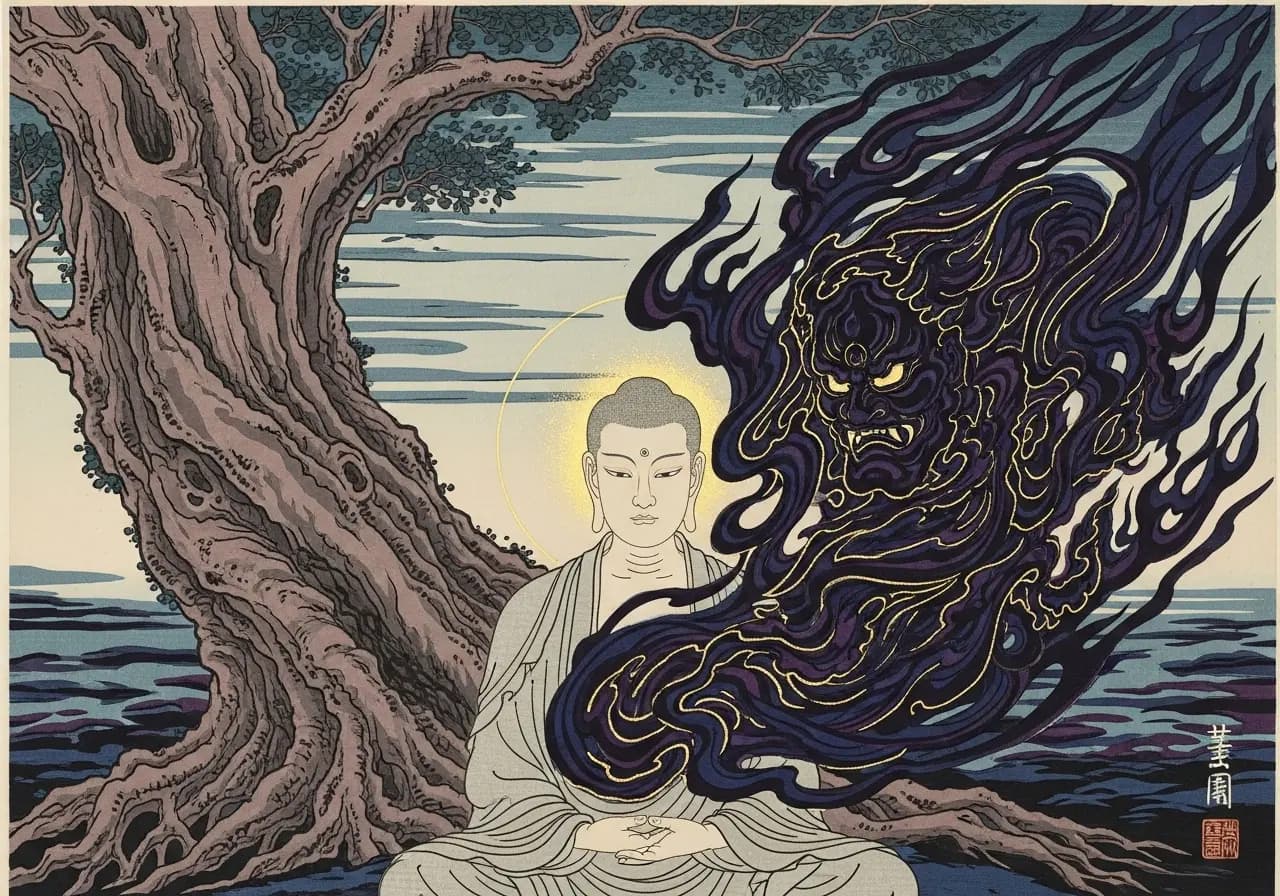
Well, Mara is a character in traditional Buddhism that has several metaphorical forms. There's Mara as the embodiment of all unskillful emotions such as greed, hatred, and delusion. There is also Mara as a metaphor for death. Mara as a metaphor for all conditioned existence—in other words, the conditioned mind that is blinded by ignorance and delusion. And there is Mara as the character that tried to prevent the Buddha from attaining liberation while he was meditating under the Bodhi tree.
This is the story that I want to share with you, and I want to extract from that story a teaching that has made a lot of sense to me. I'm just simply sharing my thoughts around Mara in general.
Mara has been described as the personification of forces antagonistic to enlightenment, and I kind of like that description. Rather than having to think of Mara as an actual character like you would in a lot of Western thought or Western religions—where you kind of have the antagonist to all good, right, like the devil—Mara somewhat fits in that role. Except, of course, you should know by now if you've been listening to the podcast that in Buddhism, it's not necessarily good and evil. It's more skillful and unskillful.
And again, I mentioned this in one of my books, but the notion of fact versus truth—I want to invoke here just to call to mind that this what you hear about Mara doesn't require us to say, "Well, geez, do I need to believe that there was a character named Mara?" No, this is very much, for me at least, very much like the story of the tortoise and the hare in Aesop's Fables.
There was a tortoise and a hare, and they raced. The hare kept stopping to rest because he was so fast he knew he would beat the tortoise. At the end of the day, the tortoise won because the tortoise never stopped—he kept going. The hare lost focus and didn't finish the race.
Now we hear that story, and we can extract a nice teaching out of that. Do we have to get entangled in the thought, "Well, did a rabbit and a turtle really race?" No, it doesn't matter. The point of the story was to illustrate the teaching. And that's how I view Mara in general.
I just wanted to start out with that as a caveat to explain where I'm coming from as I talk about Mara the character.
The Pivotal Line: "I See You, Mara"
So in the traditional story of the Buddha, there's a line that stood out to me. Let me give you a little bit of background.
The story kind of goes like this: the Buddha starts on this path seeking enlightenment. He spends several years as an ascetic monk, going to the extremes of giving up everything. Prior to that, he was at the other end of the extremes where he had access to everything, and he kind of discovers this middle way.
Now, in that process, there's a point in the story where the Buddha is sitting under a tree meditating. This is the story that's narrated of the moment of the Buddha achieving liberation or becoming enlightened. And just prior to that moment, Mara shows up—this character that's trying to do everything possible to prevent the Buddha from attaining enlightenment.
In the story, the way it's narrated in different traditions, there's a line that I think is very important. The Buddha looks at Mara and says, "I see you, Mara."
And that is the emphasis of what I want to share and talk about today—my understanding of what kind of truth I can extract from this story of the Buddha's interaction with Mara. It's this notion that by looking and seeing Mara, the Buddha was able to say, "I see you." In other words, "I see you for what you are."
And suddenly in that moment, all power goes away. All the power that Mara had over the Buddha goes away. And that, to me, is a very powerful lesson.
Western Culture and the Mara Within
I think in our culture, in Western thinking, we tend to do the opposite. We want to ignore the ugly, the scary, the uncomfortable truths about ourselves and about others.
But here we learn that the Buddha's approach was opposite. Rather than turning away, ignoring, or overcoming Mara by escaping Mara—no. The Buddha's approach was to look at Mara squarely in the eyes and say, "I see you, Mara. I see the ugly, scary, uncomfortable reality right before me, and I'm not going to turn away."
To me, the power of such things like Mara goes away once they are looked at.
The Lady Game: A Childhood Lesson
Now, as a kid, I used to play a game with our pet dog. We had a black Labrador, and her name was Lady—like Lady and the Tramp. Lady was a really fun dog. We used to run around the swimming pool, and she would chase us. And right as you would jump to get in the pool, she would nip at your feet.
We called this the Lady game, and friends would come over and we would challenge each other to see who could get out at one spot and make one complete round—run all the way around the pool and jump back in at the spot where you had started. And if you could do that without Lady catching you or nipping at your feet, then you would win the game.
It was really scary because you get out, and as soon as you start running, you hear her. She's running after you. She's barking. You know she's coming to get you. You know she wants to get your feet.
And I think for all of us, we all know this feeling of being afraid and running from that thing that we're afraid of. And the very act of running from it makes it scarier, right? Once you enter that escape mode—"Oh, I gotta run"—everything intensifies. It's even scarier than it would have been had you not run.
But with Lady, it was no different. You would get out and you would run, and as long as you ran and ran, she would chase you. But it happened one time that in the fear of "Oh, I'm not gonna make it. I might as well turn around and stop," I stopped and I turned around. And what did Lady do? She stopped chasing me.
It was like, "Oh, game over. Okay. Then she waited for the next person to get out and chase them."
And I think, without really knowing it at the time, there is a powerful lesson to be learned there about the nature of fear and the nature of the things that we tend to run from.
Meeting Mara Directly
I saw that again in this story of the Buddha. I think it would have been really easy for the Buddha to run from Mara, to be afraid of Mara. But that's not what happened.
The Buddha looked at Mara in the same way that I stopped running and looked at Lady. And Lady stopped chasing me, and now she's just my pet dog again.
And in the story of the Buddha, this happens. In fact, the Buddha even tells Mara, "I see you, and good on you for trying to distract me and trying to prevent me from achieving enlightenment. Because that's your job. You're doing what you need to do, and you should be the best Mara that you can be. And I'm gonna be the best Buddha that I can be."
According to the story, the Buddha ends up attaining enlightenment. It was not prevented by Mara because it couldn't be. The Buddha was being the Buddha, and Mara was being Mara.
I think there's a neat lesson to be learned there.
Acceptance Without Resignation
Now, I want to be careful here because I don't want this to be misunderstood. When I'm talking about seeing Mara and accepting what is, I don't mean that we should just roll over and allow harmful things to happen to us. That's not acceptance. That's resignation.
Acceptance is recognizing the reality of what is. If I walked to the beach and there was a shark in the water, and I saw a shark, well, I would need to understand that there's a shark in the water. That's seeing it for what it is. That's acceptance.
Now sure, that doesn't mean I'm just gonna sit here and allow this shark to eat me and say, "Well, you know, I'm just gonna accept things." That's not what acceptance means.
For me, acceptance is recognizing, "Oh crap, there's a shark. I gotta do what I need to do to survive." Either get out of the water, stay behind a cage, punch the nose—whatever it is that you do to get away from a shark. I don't even know, but I'm going to do that all without having to feel hatred. I can feel fear. I'm probably going to feel fear, but I don't need to feel hatred.
And that, to me, is the key here.
The Buddha didn't have to hate Mara as the personification of evil. No, it was the opposite. The Buddha wanted to understand it.
Understanding Over Hatred
In fact, if you think about a bear or a shark, the more you understand the nature of a bear or the nature of a shark, the more likely you are to avoid being eaten by it.
A bear, for example—people who know bears might know that under certain circumstances, let's say you stumbled upon a bear that has cubs, then the first thing you need to do is to avoid being the threat to that bear. So in the moment that you startle the bear and it comes to attack, the appropriate response might be to shrink down and to immediately show that you are no threat. And then the bear might leave you alone. You would know that because you understand bears.
But if you didn't know that, and your ignorance is what comes into play, and it says, "Oh, well, when the bear attacks, you fight back," well, now you're much more likely to suffer a worse experience in that encounter simply because you didn't know and didn't understand what was actually taking place. The bear was trying to defend its cubs.
So again, that's just another analogy that helps me understand that what I'm trying to achieve in all of this is greater understanding. But what I'm not trying to achieve is giving up and accepting things and saying, "Okay, well, the bear came to eat me, so I guess it's time for me to die." It's not that either.
And I think our encounters with Mara are the same. It's not an instance of resignation. It's the opposite. It's an instance of "Okay, I want to be more skillful, so I need to understand what is this Mara?"
Seeing Mara in Others
This Mara can come in the form of yourself with unskillful words, thoughts, or actions. But often it presents itself in the form of others—a coworker who comes and says this or that, and maybe makes you feel a certain way.
Seeing Mara would mean saying, "I see you, Mara. I understand what's happening here. I may not understand the causes and conditions that gave rise to this treatment or these words you're saying or whatever the interaction is that's taking place, but I wouldn't have to feel hatred."
It's not like saying, "I hate you because I would never say what you just said." Instead, I would think, "Wow, okay, I don't know what led to you saying that. But I would probably be able to say that too if I were you."
Meaning, if I had your upbringing, your beliefs, every life experience, and I was literally in your shoes. In other words, I am you.
I think for me that's been quite powerful—to see that and recognize that that is the nature of how things are, and to not get caught up in the game of "Well, I would never say that. I would never do that."
Personal Transformation Through Understanding
And to kind of wrap things up, for me in my own life, this has been a very powerful tool in my toolkit of using Buddhism to help me in everyday life. I've dealt with difficult emotions and difficult circumstances that at first made me want to turn away and even run.
Dealing with anger, for example, and feeling hatred for the first time in my life going through an ordeal—seeing hatred as this scary, ugly, uncomfortable monster that I needed to get away from. I needed to keep running from it.
It wasn't until years later, through encountering concepts like "I see you, Mara," that helped me understand that I needed to stop and turn around and face it. To look at it closely. To scrutinize: Where is this hatred coming from? Why do I feel this hatred?
And that is when the relationship I had with the emotion changed, and the association I had with the memory that invoked the emotion changed.
Because "I see you, Mara" is for me a reminder that we can turn towards the thing that we fear and start to see it for what it is. And it may turn out to be something other than what I originally thought it was.
Looking Beneath the Surface
In the case of something like fear or hatred, I may see hatred and then turn and look at it closely and realize that it's coming from a place of fear. And where does that fear come from?
Well, some examples of the things that we fear might be that I'm suddenly confronted with a situation where the story I have about reality is inconsistent with the reality that I'm in. Or the story that I have about myself is now inconsistent with the reality that seems to be painted.
Remember, at our root, I think all of us aspire to be viewed and to be seen and to be understood. We want to be liked, and we want to avoid being disliked. And sometimes life will present a set of circumstances where that becomes difficult. Now part of what we're experiencing is wanting things to be other than how they are.
"I want to be understood, and you're seeing me in this light, so now I'm mad at you." And what I'm really mad at is that you're not seeing me the way I want you to see me. And that might be it, you know. It could seem much more elaborate than that, but at its root it might be as simple as that: I just want to be seen and understood.
The Practice of Understanding
So I can start to do that from my perspective outward. I want to see things and understand them, not just treat them like, "Oh, there's Mara, the personification of all things that I hate."
No. I want to look at things and say, "I want to understand you. I don't want to hate you, Mara. I want to understand you and see where you're coming from. Why do you do what you do? Where does that come from? Why does this matter so much to you? Why does it matter so much to me that you're trying to do what you're trying to do to me?"
Things of that nature.
That, to me, is where the power lies in this story. And that's what I extract from this story when I hear it. I love that line: "I see you, Mara."
Closing Practice
So I hope that you'll take this throughout the next week or so and apply it in your own day-to-day life. Look at the things that you fear. Look at the things that you tend to run from. And ask yourself, "Is the running even helping?"
What would happen if I stopped and turned and faced the thing that I fear? If I looked at it closely and looked at it long enough that suddenly I start to see it for something different than what I thought it was?
And that, to me, is the power of the lesson of the interaction between Buddha and Mara—that one pivotal line where the Buddha looks at Mara and says, "I see you, Mara." And it's no longer "I'm running from you, Mara."
The game's over.
Alright, that's all I have for today's episode. I hope you enjoyed hearing some of my thoughts around the topic of Mara, and I hope this line sticks with you the way it has with me: "I see you, Mara."
Thank you for taking the time to listen, and I look forward to recording another episode at a future time.
Until next time.