

This Is Because That Is
Episode 157 of the Secular Buddhism Podcast
Hello, and welcome to another episode of the Secular Buddhism Podcast. This is episode number 157. I'm your host, Noah Rasheta, and today I'm going to talk about dependent origination. You could also call this episode "The Discourse of the Bowl of Chili."
As always, keep in mind: you don't need to use what you learn from Buddhism to be a Buddhist. You can use what you learn to simply be a better whatever you already are.
If you're interested in learning more about Buddhism, check out my book, No Nonsense Buddhism for Beginners, available on Amazon. Or you can listen to the first five episodes of the podcast by visiting SecularBuddhism.com and clicking on the "Start Here" link. If you're looking for a community to practice with or interact with, consider becoming a patron by visiting SecularBuddhism.com and clicking the link to join our community.
So let's jump into today's topic: "This Is Because That Is."
Making Buddhism Practical
One of the reasons I enjoy doing this podcast is that I've always been interested in sharing Buddhist concepts, ideas, teachings, and stories in a way that the average person can relate to and apply to everyday life. That's what I was seeking when I first started studying Buddhism and trying to incorporate these concepts into my own daily experience.
When I say "everyday life," I mean the lives of ordinary people—someone who goes to work, deals with coworkers, partners, parents, siblings. We're not people sitting in a cave in the Himalayas meditating. From the beginning, one of my goals has been to address this: not everybody has the ability to go on a silent retreat or head into the mountains to meditate. What about these concepts and ideas as they apply to everyday people?
That's one of my main goals with this episode—to discuss dependent origination in a way that's accessible and practical.
Understanding Dependent Origination
Dependent origination is a concept common to all schools of Buddhism. It's the Buddhist notion or doctrine that states that all phenomena arise dependent upon other phenomena. In other words: this is because that is, and this is not because that is not. If this exists, that exists. If this ceases to exist, that also ceases to exist.
It's a basic principle stating that all things arise in dependence upon other things.
You may hear this term in different ways if you read books on Buddhism. It's called dependent origination, dependent arising, interdependent co-arising, or conditioned arising. These are all different ways of explaining the same thing.
Why is this notion important to understand? Because of right view. In the Eightfold Path—the eight-spoke wheel of Buddhist practice—the first spoke is having right view, skillful view, or wise view (there are different translations). It essentially means there's a way of seeing things as they really are, and then there's how we ordinarily see things, which is different from how things actually are.
Seeing things as they really are—what does that mean? What are things really?
Things inter-are. Things are interdependent with their causes and conditions.
The Car Analogy
To illustrate this teaching, I've talked about a car in the past. A car is a thing that exists and it's real, but if you look deeply, you'll see there actually is no car. There's a motor, wheels, tires, and all the parts that make the car what it is, but none of those parts are the actual car. So it begs the question: what is the car?
If you see the car as the sum of all its parts—its causes and conditions—then you're seeing the car for what it really is. It's not just a thing existing on its own; it's a thing dependent upon other things. And those other things are dependent upon still other things. It doesn't exist separate from all the things that make it what it is.
This isn't unique to a car. That's how all things are. Many of the teachings you encounter in Buddhism aim at helping us start to see reality this way.
We have a tendency to see things as static, independent things. "There's this, but this isn't related to that." Buddhism says no—the way you want to start seeing things is that when you see this, you see it interdependent with that. In other words, constantly hold this notion in your mind: this is because that is. There's not this and that as two separate things. It's always this is because that is, or this is not because that is not.
The Bowl of Chili
In a study group we have on Patreon, we were discussing a book when something came up that I wanted to introduce here in the context of dependent origination: mindful eating.
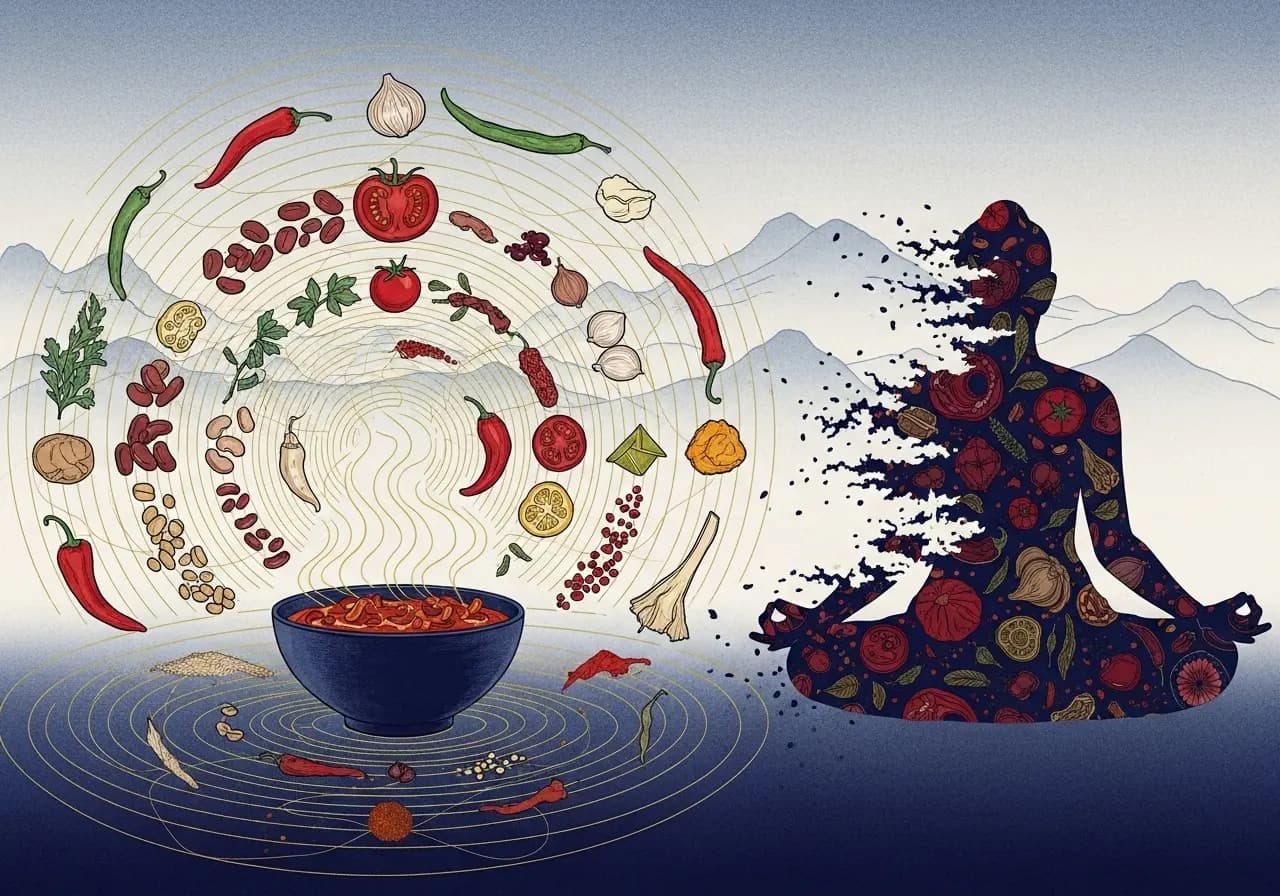
There are different forms of meditation practice: sitting meditation, walking meditation, eating meditation. In this case, someone named Rob was discussing mindful eating with a specific meal—a bowl of chili. He was recognizing in that moment that chili is a thing, but it's also not a thing. It's not a static, independent thing. It's something that has causes and conditions.
Chili comes together with processes and ingredients that make chili what it is: beans, tomatoes, spices, chili peppers, and everything else that goes into it. It's no different than the car. When he mentioned this, it struck me how simple and beautiful this teaching really is.
You can have a moment of awareness where you realize: Oh, wow, chili isn't chili. We call it chili for convenience—we've labeled it chili—but what is it really? You can do this with a car, with chili, with salad, with anything. What are the things that make it what it is? Well, it's the causes and conditions.
With chili, you have ingredients that make it what it is. Red chili versus green chili. But you also have the processes involved: the intensity of the heat, the duration it's cooked. The process that makes chili might differ from one person to another. But at the end of the day, this thing we call chili doesn't exist independent of all the things that make it what it is.
That is, in a nutshell, dependent origination.
Why This Matters in Everyday Life
How does this benefit me and my everyday life? What are some ways I can benefit from understanding this concept in my day-to-day experience?
Conditioned arising becomes really powerful for me when applied to emotions. Let me use fear as an example.
Suppose that in my upbringing, I was taught that red sweaters are bad. For whatever reason, red sweaters just mean trouble. So I grow up fearing red sweaters. Then one day, someone comes knocking on my door wearing a red sweater.
Fear is the emotion that arises. But it doesn't arise independent of its causes and conditions. There are causes and conditions here. In other words, there's nothing inherently wrong with a red sweater. The fear doesn't come from the sweater itself. It comes from the conditioning I received. The fear is conditioned by a belief I learned.
If I understand this—if I understand that this is because that is—then I can ask myself: Why am I afraid? What is the that that's causing this fear? The answer is: I was conditioned to believe red sweaters are dangerous. But I can examine that belief. Is it true? Where did it come from? Can I let go of it?
This understanding transforms how I relate to my emotions. Instead of just being overwhelmed by the fear, I can see the causes and conditions that created it. And when you see the causes and conditions clearly, you have the option to change them.
A Personal Example: Gordito
Let me share a personal example. I have a twin brother, and we were born prematurely. We were both very small babies, but he was smaller than I was. So we were both these tiny, skinny premature babies, and he was the skinnier of the two. His nickname became "Flaquito," which means "skinny guy" or "the little skinny one." And compared to him, I had a little more weight, so I became "Gordito"—"the fat one." When we were babies, that's how people distinguished between us.
There's no malice meant by it. It's just a label that was used. It stuck, and to our aunt, he's always been Flaquito and I've always been Gordito. It's a fond way of her remembering when we were these tiny babies that almost didn't survive.
I never had any qualms with being called Gordito because, compared to him as babies, I was the Gordito. It doesn't mean anything more than that to me. But my wife would not like to be called that in any context because to her it's offensive.
Applying the notion of dependent origination: the feeling offended by a nickname—the problem isn't the nickname. The problem is the belief behind it. In her case, there might be a belief that "I don't want to be called fat because that implies I'm not as good as the next person who's not fat" or something along those lines.
I think in Western and American culture especially, you might resonate with that. "I don't want to be called fat under any circumstances." Well, look at why. Probably because you hold a belief somewhere that being fat is not the right way to be. If you didn't have that belief, the word wouldn't matter. It wouldn't affect you.
In my case, I was able to understand: it doesn't offend me because I don't have a belief attached to it that there's anything wrong with being the heavier of the two twins. So it's fine that I'm called that.
This is the practicality of dependent origination applied to everyday life—where things are really happening. Emotions are arising, feelings, thoughts, which lead to words, which lead to actions. It's very beneficial to understand this process: this is because that is.
When whatever it is that you label as "this," look at the "that." Look at the causes and conditions that make this what it is.
Applying This Teaching
My invitation to you, if you were to take this concept and apply it as a practice for this week or for the rest of your life, is to keep this expression in your mind: this is because that is.
Try to see yourself as the bowl of chili. What are you really? Are you the beans? Are you the spices? Are you the chili peppers? Are you the salt? What exactly are you? Or with the car—are you the car, or are you the causes and conditions that give rise to the car?
Because in my opinion, this is the essence of what the Buddha discovered in that moment of enlightenment. I like to imagine a bowl of chili becoming self-aware and sitting there, very attached to the fact that it is chili. It identifies as separate from all the things that are not chili. And then while sitting in meditation, that bowl of chili has this moment of awareness where it recognizes: Oh my goodness, I'm not chili. I'm beans and tomato and peppers all cooked together and mixed. I'm not just chili. I'm so much more than chili. Chili is just the label I use for convenience because I can't go around describing myself by listing all my ingredients. We just say, "I'm chili."
We're not that different. When I try to understand myself in relationship to all the other things that are not me, the sensation of self arises and I say, "I'm Noah Rasheta." Well, that's just the name. I might say, "I'm all my memories." Well, those are just the memories I have. I'm these things I feel attached to. But by sitting in meditation and contemplating, I might recognize: I'm actually none of those things. I'm very much like the bowl of chili. I have causes and conditions. And that fundamentally changes my relationship to myself—to the notion of self that I hold.
The Deeper Layers
I wanted to bring all this up because I think it's common when we first encounter a notion like "no-self" in Buddhism, we think, "What does that mean? What do you mean no-self? I don't exist?"
It's not that. What we're really saying is: look deeply, understand that things inter-are, this is because that is, and then tell me what you really are. Because you may find you're not what you thought you were. In the very same way that the bowl of chili understands it's not chili, but all the things that make chili what it is.
This is practiced and explained in so many different ways. I'm just trying to explain it here in another one. I hope that these concepts and ideas have been helpful to you.
By understanding this notion of this is because that is—or what we call dependent origination—it may have some practical benefits in how you go about your day-to-day life, understanding all the things you interact with. We all encounter this or that in life, but we rarely focus on the deeper question: if this is, what is that? If this exists because of that, then I need to spend time looking at things through the proper lens of interdependence and causes and conditions.
It can be very powerful. Anger isn't a thing that exists independent of its causes and conditions. So what are those causes and conditions? You may discover that the anger you experience is actually grief, or sorrow, or embarrassment, or sadness, or pain. Now that's powerful because often we spend time fighting, resisting, or working with what we think is the thing without realizing that thing has much deeper layers and levels.
Anger is one thing, but why is there anger? You may discover there are deeper layers—a more beneficial place to work with might be the pain underneath it. If you work with the pain, the anger will go away instead of trying to make the anger itself disappear.
Those are the thoughts I wanted to share with you regarding this analogy and the concept of dependent origination—or dependent arising, interdependent co-arising, conditioned arising, however you want to phrase it. The notion is: this is because that is, and this is not because that is not.
If there's something you don't have in your life, look at the reasons why it's not there. Or if there is something you do have and want to understand, ask yourself: why do these things exist the way they are?
I hope you enjoyed listening to these concepts and ideas. I look forward to sharing more thoughts in another episode. Thank you for taking the time to listen. Until next time.