

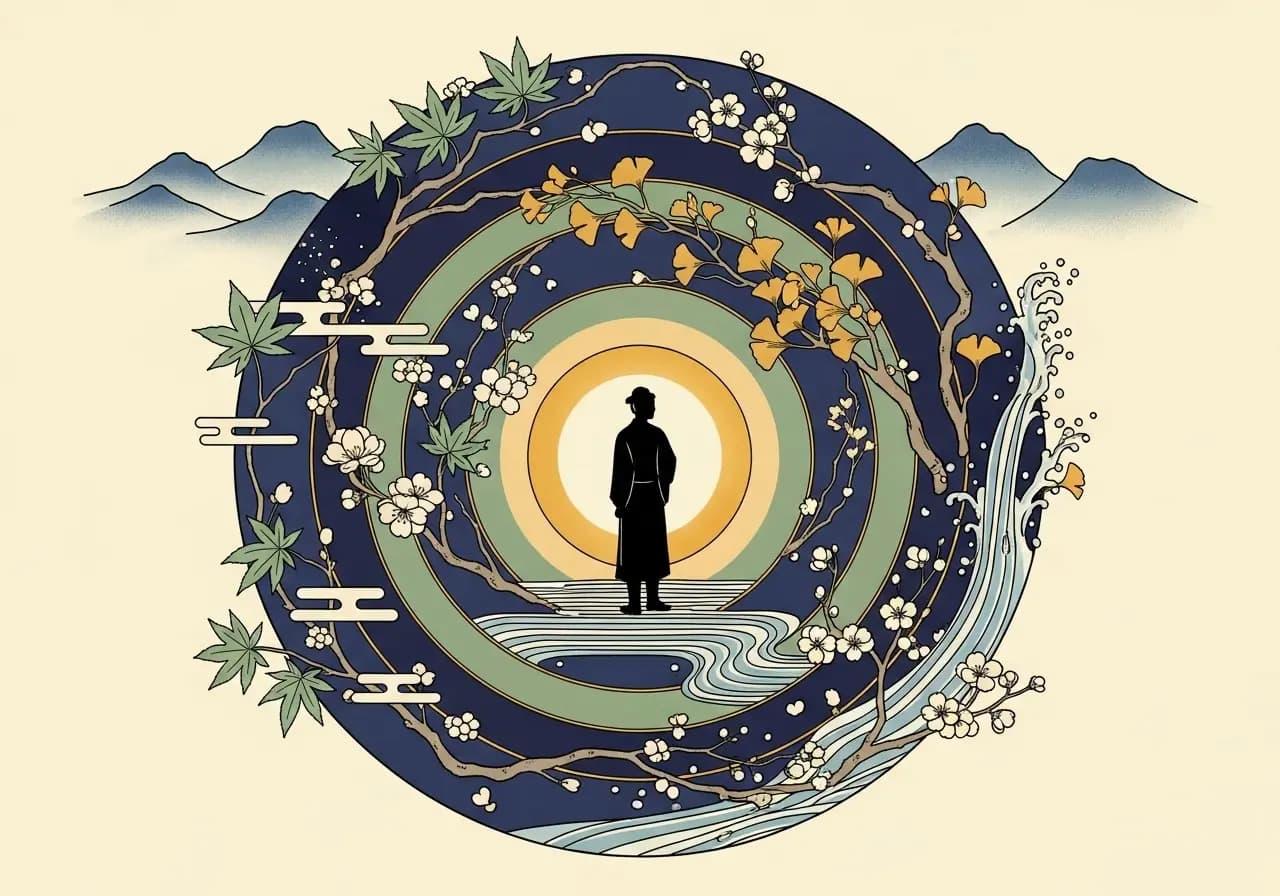
The Circle of Skills
Episode 156 of the Secular Buddhism Podcast
Hello and welcome to another episode of the Secular Buddhism Podcast. This is episode number 156. I'm your host, Noah Rasheta.
Today I'm going to talk about the circle of skills.
As always, keep in mind: you don't need to use what you learn from Buddhism to be a Buddhist. You can use what you learn to be a better whatever you already are.
If you're interested in learning more about Buddhism, check out my book, No Nonsense Buddhism for Beginners, available on Amazon. You can also listen to the first five episodes of this podcast. You can find those episodes easily by visiting secularbuddhism.com and clicking on the Start Here link.
If you're looking for a community to practice with and interact with, consider becoming a patron by visiting secularbuddhism.com and clicking the link to join our community.
How This Topic Came Up
So for today's podcast episode, I've been thinking about the concept of the circle of skills. And I want to give you a little background on why this topic popped up for me.
When I first learned to paraglide, my instructor, as I was finishing up training, gave me this neat little analogy that has stuck with me ever since. He said, "Now that you've learned the basics, imagine a circle. Inside that circle are all of the skills that you've acquired here during flight training. Now, for that circle to grow, you need to try things—maneuvers that are just outside of the circle of skills. And then when you achieve that, the circle grows."
He emphasized something crucial: "The trick is to slowly grow the circle. Don't attempt something that's way out of your circle of skills because that's what puts you in danger. It's very risky to do that. But if you slowly grow the circle of skills, it becomes much bigger over time. The key is to do that—to grow it slowly."
That stuck with me for years as I've spent more and more time in the sport, attempting different styles of flying, flying in different places, different conditions, different types of wings. Every single step that I take slightly out of the circle of skills makes the circle grow. And now I'm in a position where that circle of skills is significantly bigger than it was when I started.
I try to convey that same teaching to my students when they're learning to fly. The biggest mistake a new pilot could make is to assume that now that they know the basics, they can attempt something difficult or risky. That can jeopardize your safety and your enjoyment of the sport. You could get hurt. You could get killed. And that lesson has really stuck with me.
The Injury
It recently popped back into my mind as I encountered a new circumstance that I've been dealing with for the last several weeks.
About a month ago, I was conducting a training course, teaching students how to fly. I was riding my Onewheel—like an electronic skateboard, but with just one wheel. It's a balancing board. You balance on it and it propels you forward or back. It's a really fun tool I use in my training because I'm in a very big flat area, and when a student lands out kind of far, I can ride over to them. It's much more effective than running or walking.
So anyway, I was out conducting some training. A student had just landed. I was on the radio talking to the student, coaching them through the sequence for landing and the timing of when to apply the flare so that you land softly. As he landed, he landed fine. I was racing towards him, talking on the radio, telling him what he had just done and giving him pointers.
Suddenly I hit a soft patch on the ground. This was near a lake bed, and it had rained. This soft patch was kind of like mud, and my board stuck right into it. I kept going and flew right off.
When I landed, I landed on my shoulder and I separated my shoulder. At first I thought my clavicle was broken because the bone was sticking up in a way that it shouldn't. I had to go to the hospital and get it checked out. Sure enough, it was a shoulder separation. The bone didn't break, but the ligament that holds the clavicle down to the shoulder did break. That makes the bone pop up and stick out of place.
Long story short, for the next many days and weeks, I was dealing with recovery from an injury that was preventing me from being able to fly. This happened on day two of a training course—these are eight to ten days of training. So I had to continue training the very next morning, but I was doing everything with a sling. My arm was in the sling.
Starting the Rehabilitation
As I was going through all of this, I immediately started looking into the exercises and stretches for physical therapy for this kind of treatment. The doctor had told me I would most likely be in a sling for three to four weeks. I was looking forward to the four-week mark to do a family trip to Moab. My plan was to fly with my mom and take her up for her first ever flight with me. That was a milestone I was looking forward to, and I was disappointed that it was looking rather unlikely at the time.
So I started doing these physical therapy exercises knowing I needed to strengthen and regain mobility in my arm so that I would be able to fly.
As I was going through this, doing the exercises every day, it occurred to me how much this process of rehabilitation felt like Buddhist practice. And that's the topic I wanted to correlate in this podcast episode—the notion that in life, difficulties arise. Right? The core of Buddhist teachings is the Four Noble Truths, which say that in life, difficulties arise. We call this suffering—wanting things to be other than how they are. The moment we experience that feeling, that's something everyone's going to experience. Suffering has causes. When we understand the causes of suffering, then we can work towards the cessation of the causes of suffering. And there's a path that leads to that. So that in a nutshell is the Four Noble Truths.
Here I was in this set of circumstances where life presents a situation—an injury, in this case. So here I am with an injury that causes discomfort, and now I was going to start practicing the path that would allow me to become more comfortable with the discomfort that I was experiencing.
The Connection to Practice
As I was going through the rehabilitation process, doing these exercises and moving my arm and shoulder in certain directions, I noticed a significant amount of pain. And I would work through that pain until it eased off. And then the next day it would be a little bit easier. And this continued day after day.
That's where I made the connection. I thought: this is a lot like a mini lesson of what life is like. Life presents us with certain injuries—and it doesn't have to be physical. It can be emotional, spiritual injuries. You know, being brought up in a certain house, or things that happened to you in your youth, or certain experiences with friends. Everybody has their own circumstances that they encounter in life, and they kind of change everything.
In this case, the example was an injury from a fall that now affects my mobility. And now I'm working through that. Essentially, what I'm doing through physical therapy is becoming more and more comfortable with the discomfort. And in that process, becoming more and more able to move my arm again.
I thought about this circle of skills again. If the circle grows slowly, that's the skillful way to grow it. But if I try to jump out of that circle with a big leap, that wouldn't be skillful. And so it was with the physical therapy I was going through. I didn't try to do anything too crazy at the beginning. I kept the circle of skills that I had with my arm as it was small, and I continually worked on growing it. And sure enough, that's exactly what happened with time.
Every day improved. And by day seven, I was out of the sling. So I was one week in a sling. And then from day seven onward, I did exercises to regain the ability to stretch my arm all the way up over my head. By the fourth week when we went to Moab, I was feeling pretty confident that I would be able to fly because I had been doing all these exercises and stretches. Sure enough, I took my very first flight almost exactly four weeks from the day I was injured. It worked, and I was able to take my mom, my wife, all three of my kids, a niece. I took several people up during this trip and did tandem flights with them.
It was so rewarding to look back and think: had I not started that from day one of the injury, it's very likely I wouldn't have been in a position to do that by that date.
Applying This to Buddhist Practice
So it got me thinking about practice in general—the nature of practice. I think a lot of people when they first encounter Buddhism see the hope of having this really big circle of skills where they can deal with all the things life is going to throw their way. And there's a tendency to want to jump right to the big skill. It's like, "Oh, this stuff is interesting. I want to sit here and start meditating for an hour."
But that's like jumping too far out of the circle. It's not skillful. It won't be beneficial. You may burn out quickly and then you're done with the practice. It's very much the same as if I would have attempted very difficult maneuvers with my arms those first few days. It would be too painful, and then I'd be stuck having to spend more time nursing that injury because I would be making it worse.
But instead I took the approach of little by little—baby steps—but making continual progress. And I think that's the approach that works best for mindfulness as a practice.
Rather than setting these big lofty goals like "I'm gonna sit and meditate for two hours," don't do that. Just try to make little baby steps. Maybe you can think about mindfulness at least twice a day or three times a day and spend thirty seconds doing it. You can set a reminder on your phone. Every day at 2 p.m., your phone will chime. That's your reminder: "Oh, okay, that's right. I'm trying to be more mindful."
And it can start with very simple things. Ask yourself: what did it take for this moment to arise? What did it take for this thing to exist? Pick an object and start seeing the causes and conditions of that object or of that moment. In that moment of awareness, you may have some great insight. But what you'll be building is a new habitual tendency—to start to see things more often through the lens of impermanence and interdependence.
The Heart of Practice
I think one of the most basic forms of practice that's often overlooked is that all we're trying to do is return to the present moment and see in the present moment the connection of this with all the things that are not this.
This practice is talked about often. For example, looking at a leaf. You can look at a leaf, and as you sit there and think of the causes and conditions of that leaf, soon you'll see in the leaf the sun, the clouds, the rain. You'll see literally everything that it's taken for that leaf to be what it is. What happens is you start to see in the one thing all things. And that's one of the aims of Buddhist practice.
I feel like as a society, sometimes we're doing the opposite. We're trying to hone in on things and get to the essence of a thing. But in Buddhism, rather than looking for the essence of the thing, we're trying to zoom out—not zoom in. We're trying to zoom out so that you can eventually see in the one thing all things. And that is seen through the lens of interdependence.
Thich Nhất Hạnh would say, "All things inter-are." But how often do we see that? We usually see a thing for what it is and often overlook or fail to see how that thing inter-is with all other things. And I think that can be one of the focuses of our practice.
We don't have to sit in meditation for a long time. A lot of us live busy lives, and if we add that pressure that we need to be sitting and meditating for a long time, I don't know that that's actually beneficial for a lot of people. What may be much more beneficial is to focus on practicing seeing things a little bit more clearly.
This is the very first element of the Eightfold Path on the Buddhist path to awakening—it's called wise view or right view. And what is that view? It's to see things through the lens of impermanence and interdependence.
So anytime I look at something and see that thing, and I see in that one thing all other things, I'm looking through the lens of interdependence. This can be very powerful, whether it's looking at a set of circumstances that I'm in or a situation or a person that I'm dealing with. Seeing in that one thing its connection to all these other things can be very powerful.
The Circle of Understanding
I think that the concept of having a circle of skills can be beneficial. Maybe as a practitioner—someone who's striving to live a more mindful life—it's helpful to visualize it that way as a circle that you slowly expand and grow, rather than trying to make a big leap out of the circle to make it grow faster or bigger.
It's perfectly fine and acceptable and probably more skillful to think of incremental growth and baby steps growing the circle, rather than big exponential growth.
That's at least been the experience I've had in my own life as I've attempted to put into practice all of these ideas and concepts that I've learned from Buddhism.
I feel like at the end of the day, that circle of skills is also a circle of understanding. The more time I spend understanding the nature of my own mind, the more I understand the stories I've created about myself, the stories I've attached to, the stories I've created about others and about reality. And at the end of the day, I'm not seeking to change any of that. I'm just seeking to understand it.
Because the more I understand everything that's inside of that circle, the relationship I have with my reality changes. It's not that the reality changes, but the relationship you have with it changes. And that to me has been so beneficial in every aspect of my life—whether it's as a spouse, as a parent, as a son. All the different phases of ways that we go about experiencing life.
In Closing
I hope you'll be able to take these concepts—this specific concept—and use that analogy of the circle of skills. Apply it to all the areas and facets of your life where you're trying to grow your circle of skills. Whether it's skills with rehabilitation, skills with your career, skills with your job or profession, or the skills you have in the roles that you play as a spouse, as a sibling, and so on.
That's the concept, and that's really all I have to say about that.
I look forward to recording another podcast episode soon. I hope you are all doing well and you have a great week. We'll touch base again until next time.
For more about the Secular Buddhism Podcast and Noah Rasheta's work, visit SecularBuddhism.com