

The First Meditation
Episode 155 of the Secular Buddhism Podcast
Hello and welcome to another episode of the Secular Buddhism Podcast. This is episode number 155. I'm your host, Noah Rasheta.
Today I'm going to talk about a story called "The First Meditation."
As always, keep in mind: you don't need to use what you learn from Buddhism to be a Buddhist. You can use what you learn to simply be a better whatever you already are.
Finding Resources
If you're interested in learning more about Buddhism, check out my book, No Nonsense Buddhism for Beginners, available on Amazon. Or you can listen to the first five episodes of this podcast. You can find those episodes easily by visiting SecularBuddhism.com and clicking on the "Start Here" link.
If you're looking for a community to practice with and interact with, consider becoming a patron by visiting SecularBuddhism.com and clicking the link to join our community.
A New Format
So, today's podcast episode marks a bit of a shift. It's been a little while since I've done a podcast episode, and these tend to be getting more and more spaced out. I don't want to have such big spaces between episodes. My original intention was to do one every week, and I want to go back to that intention. But I think the format is going to change a little bit.
Rather than focusing on a longer topic, I'm just going to start doing shorter episodes, but more frequently.
We have an online community for podcast supporters, and we do a live call every Sunday at noon Mountain Standard Time on Zoom. The benefit of that format is that it's a group discussion centered around a topic. I'll present whatever the topic is for that week, but it acts as a neat way to set yourself up for the week—to have your mind focused on a topic and to practice mindfulness throughout the week based on that topic we talked about.
I'd like to introduce the same format here. I want to do these weekly and introduce just little thoughts or concepts—ideas that you can carry with you throughout the week. These essentially work as dharma talks, as we call them in Buddhism. It's like a short speech or a short story with the intention of giving you something to think about and to carry with you as you go about your day-to-day lives.
That's been one aspect of Buddhism or Buddhist practice that really speaks to me: taking these concepts and applying them to everyday life. I'm an average person living an average life with roles like parent, spouse, sibling, and child. I take these concepts into our normal day-to-day lives where we have jobs and we interact with other people.
It's easy to think of Buddhist concepts and ideas as big, esoteric ideas that somebody sitting in a cave in the Himalayas could wrap their head around. But for us everyday people living everyday lives, how can these actually be beneficial? That's what I'm really trying to do: extract these things and show how they work in day-to-day life for an average person. Because that's who I am.
The Story of the First Meditation
Today's episode, I want to talk about a story commonly referred to in Buddhism as "the story of the first meditation." This is the first meditation of the Buddha.
You can find this story in a lot of different sources, but one book where I've read it and liked the interpretation is Thích Nhất Hạnh's Old Path, White Clouds.
The story goes like this: When the Buddha was about nine years old, he wasn't known as the Buddha at that time. Remember, that's just a title that was given to him, not his name. His name was Siddhartha.
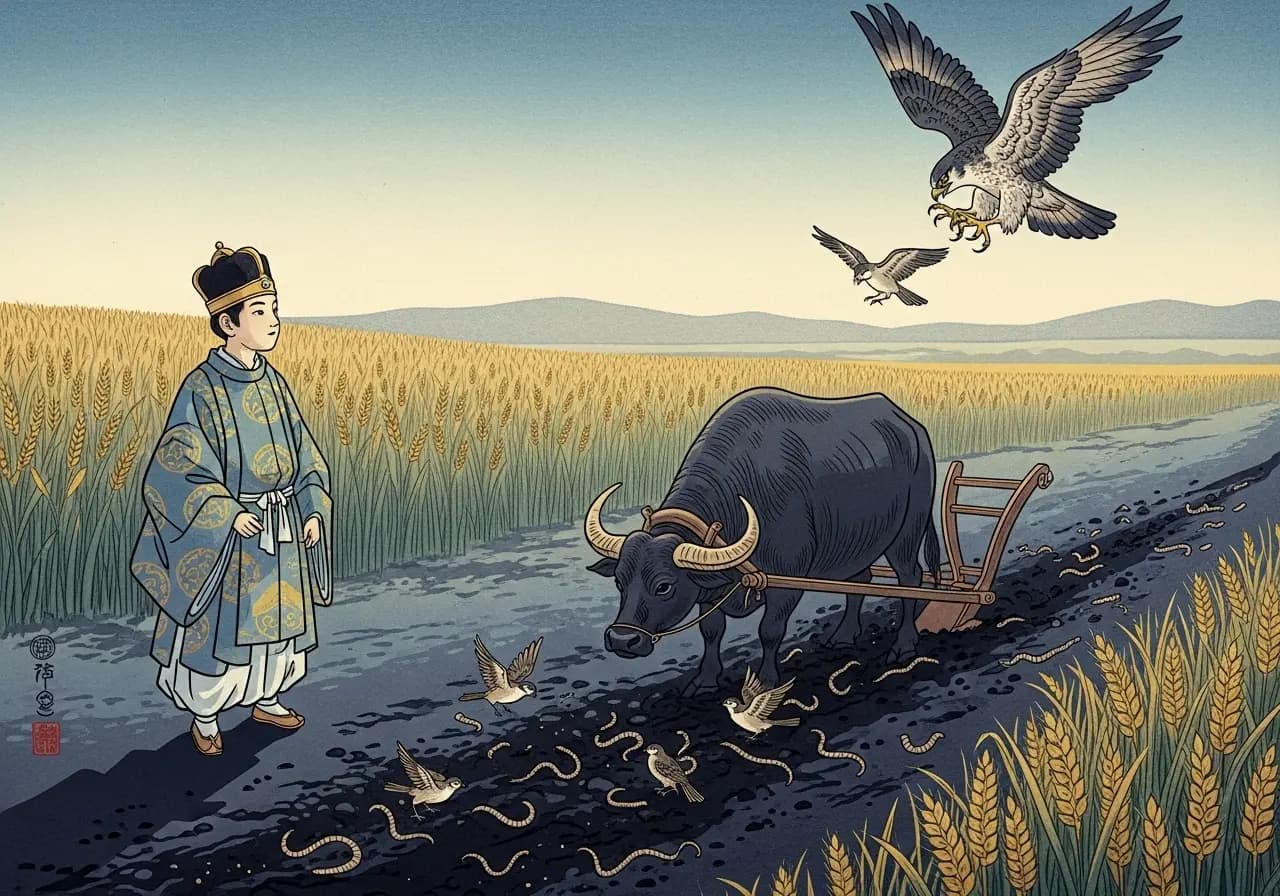
So Siddhartha, the nine-year-old, was out with his family. His father was King Suddhodana, and the king and the royal family were all gathered for a ceremony—the first ploughing of the season. As they're all gathered, Siddhartha notices that the man working with the water buffalo is working really hard in the midday sun. The man was hot and sweaty, and the water buffalo was also tired and working hard because it's pulling the plow through the earth.
As Siddhartha observes this, he notices something else. As the earth is being churned from the plow and turned over, worms that were underground are now being exposed to the surface. There were birds hovering by, small birds that were watching all this, and insects would swoop down and get the worms. Then, out of the blue, a hawk comes and takes out one of the small birds and flies off with it.
In that moment, Siddhartha recognized something profound. Each of them—the man working with the water buffalo, the water buffalo, the worms, the small birds, the hawks, the insects—they were all tied to the conditions of their specific lives. A worm was tied to the condition that it is a food source for birds. Without any effort on its part, it could suddenly be exposed to the birds because a water buffalo was pulling a plow through the field. And the water buffalo couldn't help but pull the plow because the human controlling it was having it do so.
The small birds are of the nature of eating worms, and they are also of the nature of sometimes being food for larger birds like hawks. Siddhartha observed that the conditions were different for all of them, and that they're different for everyone. Some animals enjoyed a greater degree of freedom and safety. For example, the peacocks in the royal gardens led what seemed like a better existence than that of the water buffalo, which was forced to pull the plow.
He noticed that it seemed to be the same with people. And I think perhaps the thing he noticed most was that all living things, all living creatures, wanted to avoid suffering. I think that sets him up for the understanding that later in his life he was going to be searching for a path that would lead to avoiding or eliminating suffering.
The Layers of the Story
This story has a couple of layers to it where we can extract some neat little lessons.
In Old Path, White Clouds, before this story is mentioned, there's another story where young Siddhartha was questioning the caste system. He wondered why it was that the Vedic scriptures could only be read by the Brahmins—the specific caste assigned to spiritual tasks. He wondered: Why can't I read them? Why can't my father or my mother read them? Why does it have to be someone from that caste?
I think he questioned that very early on, and it becomes a big part of his perspective later, as Buddhism develops. But anyway, after Siddhartha has this experience with the worms and the birds, he later tells his mom something interesting: "Reciting the scriptures does nothing to help the worms and the birds."
When I read that in the book, it stuck out to me. I believed that this understanding he had would evolve and shape one of the core Buddhist concepts: that intellectual understanding of things will never compare to experiential understanding.
He noticed something important. He could recite all the scriptures and do all the conceptualizing he wanted. But that does nothing to change the day-to-day reality of what it is to be a bird, what it is to be a worm, all the conditions that they are subject to because they are what they are. And because you're a human.
The Key Insight
This is where I want to steer the thought for today's episode: We are all subject to our own conditions as well.
I can't help but think the way that I think. I have an experiential understanding of what it is to be male, what it is to be a father, what it is to be an American citizen who speaks English and a Mexican citizen who speaks Spanish. These are aspects of my life that I understand from an experiential standpoint because I've experienced them. That's why I understand them the way I do.
But it's not the same as just having an intellectual understanding, like I might have if I tried to imagine what it would be like to be a Syrian refugee or to be anything that I'm not. I could try to wrap my head around it, but that will never be the same as being that thing.
This is something that gets carried on in Buddhist concepts and teachings, which is the importance of the experiential nature of understanding—specifically meditation. You can wrap your head around why meditation might be beneficial, but that will never replace the experiential understanding that comes from meditating and then understanding why it's beneficial because you've actually experienced it.
Two Major Takeaways
When I think about this and recognize that I am subject to the conditions which I have inherited—whether they be societal norms, family norms, or just the time and place where I live—it reminds me of two things.
First: The Blind Man and the Elephant
First, I'm like the blind man describing the elephant. Reality is like an elephant, and I can only understand it from the perspective that I have. That perspective will always be an incomplete perspective.
This makes me value and cherish other perspectives greatly, especially those that are different from mine. They may be describing the elephant of reality from a position that I don't see, that I don't understand, that I'm not standing.
It makes me value other people's input and not want to approach life thinking: "Well, if it's the way I think, it must be right. Everyone else must be wrong." No, I recognize my way as my way. But my way doesn't have to be your way. Your way is your way. I want to understand your way.
It also makes me less likely to want to sell my perspective. My only intent would be to help you understand why I have that perspective, not to convince you that my perspective is right. It's not right. It's incomplete. I can't help but see things the way I do, but that doesn't mean that's the only way to see things.
Second: Gratitude for Experience
The second thing is that it makes me grateful to experience new things.
It used to be that, like a lot of us, I wanted more of the pleasant experiences and less of the unpleasant experiences. When something pleasant happens, I'd think, "Yes, I like that. I want more of that." And when something unpleasant happens, I'd think, "I don't ever want to feel that again." That's the normal paradigm that I think a lot of us have.
The more time I've spent studying Buddhist ideas and concepts, the more I've found myself entertaining the idea that I am open to experiencing everything that life may throw my way. And when it does, as unpleasant as it may be, there's a part of me that feels grateful to say: "Ah, now I know what this is like. I've experienced it."
I've experienced this with big, strong emotions—betrayal, the loss of a friend. I've recently lost a friend. I've lost my father. And as painful and difficult as those experiences were and are, a part of me feels grateful to know what it's like now to lose my dad. That will, in some ways, make me more compassionate to other people when they lose a parent, or to someone who loses a friend, because now I know what that's like too.
Or when you've gone through a betrayal—well, now I know what that's like too. And there's that part of me that feels gratitude for life giving me an experiential understanding of something that I would have never understood had I not gone through it.
I hope that makes sense. It's not to say I hope these things happen to me. It's not that. It's that if they do, I'm grateful that now I know what that's like.
I've thought about this with other big ones too. Like, what would it feel like to lose a child? Well, that would be extremely difficult. I certainly hope I don't ever have to experience that, but I know some people do. I can have an intellectual understanding of what that might feel like, but it's not an experiential understanding.
If I ever did have that experiential understanding, as painful as it would be, I think a part of me would feel gratitude that now I can fully feel compassion for others who have also experienced that, are experiencing that, or will be experiencing that.
Carrying It With You
So those are the two big takeaways for me from this story of the first meditation. Take these ideas as something you can carry with you throughout the week and see if it affects the relationship you have with your thoughts, feelings, and emotions, and the circumstances or conditions that are unique to you.
Next time you experience a flat tire when you didn't want one, you may remember this and say, "Ah, well now I know what that feels like." Or when you lose a job. Not just unpleasant things, but the pleasant ones as well. If you happen to buy a lottery ticket and win, you might go, "Okay, well now I know what that's like."
Or when you find someone that you love. Or all the different things it can be, right? Finding a new dish at a restaurant that you're like, "Wow, now I know what it tastes like to have this meal."
That's one of the fun little ways to view this as a game, I think. For me at least, it changes the relationship I have with my pleasant and unpleasant experiences as they unfold. It's fascinating to me to think that I'm going through life experiencing conditions that are unique to me, and I get to experience them.
Some will be pleasant, some will be unpleasant. Some are going to hurt, some are going to be great. I'm open to all of them.
That mindset was very helpful for me recently, especially with losing my dad. Rather than having the typical aversion where we just at all costs want to avoid feeling hurt, feeling sad, or feeling down, why not embrace that and say, "Oh wow, I get to feel this now. I get to really feel it and not push it away, but allow it to just become a part of me."
The hurt and the pain and the sorrow are just as unique of an experience as the joy and the contentment of positive experiences or happy ones.
Wrapping Up
That's the idea I wanted to convey in today's episode. As I said, I'm going to try to keep these more frequent and perhaps a little shorter than before. But for today, that's all I have to share with you.
I look forward to sharing more thoughts in another future episode. Thank you for listening, and until next time.
For more about the Secular Buddhism podcast and Noah Rasheta's work, visit SecularBuddhism.com