

Taking the Long View
Episode 154 of the Secular Buddhism Podcast
Hello and welcome back to another episode of the Secular Buddhism Podcast. This is episode number 154. I'm your host, Noah Rasheta, and today I'm going to talk about taking the long view.
Keep in mind you don't need to use what you learn from Buddhism to be a Buddhist. You can use what you learn from Buddhism to just be a better whatever you already are.
If you're interested in learning more about Buddhism, you can check out my book, No Nonsense Buddhism for Beginners. It's available on Amazon, or you can also start out with the first five episodes of this podcast. You can find those easily by visiting SecularBuddhism.com and clicking on the Start Here link.
If you're looking for a community to practice with and to interact with, consider becoming a patron by visiting SecularBuddhism.com and clicking on the link to join our community.
Following Up on Not Knowing
As we jump into the topic for this podcast episode, in the last podcast episode, I talked about the beauty of not knowing. I talked about how the extinguishing of the question can bring about a stronger sense of peace and contentment than any answer could ever provide.
Today I want to follow up on those thoughts by discussing two additional concepts that I think play well into this overall strategy or practice of learning to take the long view.
The concept of taking the long view is very common in Buddhism. I encountered this when I was studying with Reverend Koyo Kubose in the lay ministry program that I did. He introduced me to a Japanese word called takan.
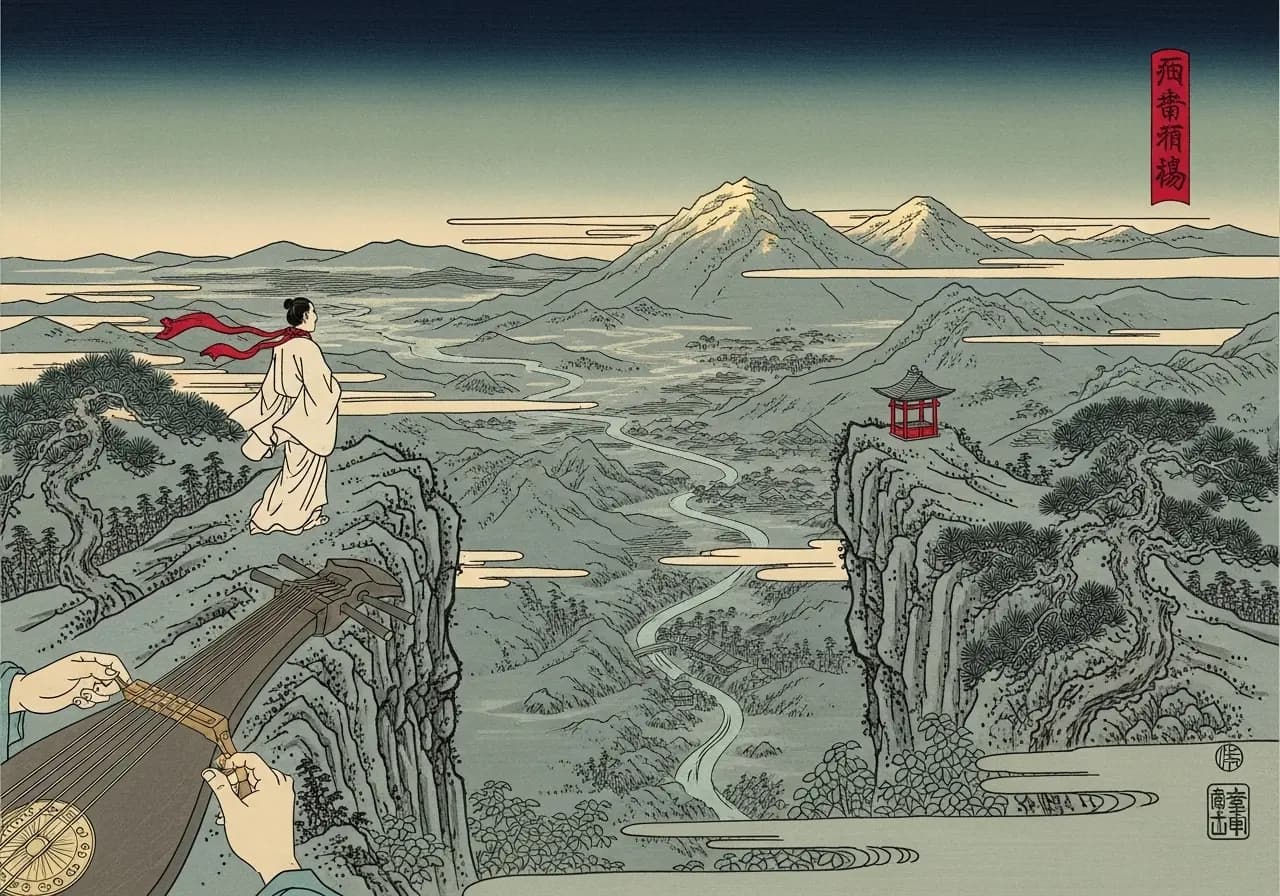
Takan means seeing things through philosophical eyes or with a bigger perspective. This is something that I experience, and all of you would experience it anytime you're really high, whether you go on a hike to the top of a very tall hill or a mountain, or anytime you fly in an airplane and look out the window and look down. This is something I experience every time I go paragliding. I can look down and see things from a higher perspective.
I remember one occasion when I was young and we were moving. Our neighbors were moving, and my mom and her friend—the neighbor who was moving—were talking. My mom said, "We're all like little ants going about our daily lives." That stuck with me.
When we're at ground level, it's easy to get caught up in the thick of things. Our view becomes more narrow and nearsighted because we can't really see the bigger picture. And I think for most of us, that's the perspective we have as we go through life. It's a very narrow view.
In this narrow view, we get caught up in the world of I and me—my feelings, my opinions, my emotions. Takan means to take the long view of things. It's to view the world with philosophic eyes or zoomed out. A wide view means that other people count just as much as we do. Their needs are just as important as ours.
Beyond Dualistic Thinking
I think dualistic thinking—such as "I am right" or "you are wrong"—only polarizes the problem and intensifies conflict. In fact, another neat acronym I learned from Koyo is WAR, which stands for "We Are Right." I think anytime we get caught up in this thinking of "we are right," war is what ensues the moment we're confronted with another perspective that also happens to have the same "we are right" attitude.
This notion of zooming out is powerful. Anytime you're traveling in an airplane and you're looking out the window, when you look down and see the little cars on the road or all the houses you're flying over, or even higher where you see cities and towns, it's very easy not to get caught up in whatever is taking place down there right now.
I like to imagine when I'm flying over and I see a car driving that whoever's in that car may be experiencing road rage, or they may be experiencing the joy of listening to a song while they drive. Any scenario, any set of circumstances that they may be experiencing—I don't get caught up in it with that person because I'm so much higher at that point. The perspective is different when I can see that car and the one in front of it and miles away I see more and more and more.
This ability to zoom out helps us not to get entangled in the moment and whatever it is that we're caught up in. It's an important part of the practice because, yes, for the most part, we go throughout our lives in that very narrow, zoomed-in view where I'm the one that's experiencing whatever I'm experiencing while I'm driving because a car just cut me off, or I'm enjoying the music of whatever I'm listening to while I drive. Or again, whatever the circumstances may be, I'm caught up in it because that's where I am. I'm in it. And I forget that there is a bigger picture.
The Parable of the Horse Revisited
This notion of the bigger picture arises again in that story I've shared multiple times in the podcast—the parable of the horse and "Who knows what is good and what is bad?"
As you'll recall, the way the story unfolds, there's one event that seems good, and then something else happens, and now it seems bad. Something else happens, and now it seems good. This goes on and on. The neighbor keeps running over saying, "Oh no, this is so fortunate for you," or "Oh no, this is so unfortunate for you." That neighbor is caught up in a much more narrow view—looking at this as it unfolds. This is all I see. What's happening right now is all I perceive.
Meanwhile, the old farmer has a more zoomed-out perspective. He says, "Well, who knows what is good and what is bad?" Because that perspective says, "Well, it's not just this. We don't know what this will cause."
In Buddhism, there's this notion that "this is because that is." I may know what this is, but I certainly don't know what that is. When I recognize the interdependent nature of things, I recognize that there's a very big, complex picture of interdependent things taking place. However I perceive this moment—the one that's happening here and now to me—I can't understand too far out the repercussions of what this means down the road.
So it allows me to have an open mind with curiosity to see: How is this going to unfold? What happens next?
You can apply this to anything. Imagine someone trying to survive in the ocean after a shipwreck. As intense and as difficult as that situation is, they may survive it and later be able to write a book about it. I'm not saying that things aren't good or aren't bad. You could also be shipwrecked and die. All I'm trying to say is that we are completely unable to see the full big picture. So the practice is to at least zoom out a little and not get so caught up in the moment as it is, because I don't know what happens next.
That is the powerful part of the story of the parable of the horse—we don't know what's coming next.
Resisting the "Happy Ending"
Now, I think it's also easy to get caught up in the mindset of "Well, it doesn't matter what happens next as long as it ends on a good note." This is a view that I think we've adopted in our society—as long as the story ends on a good note, then it's a good story.
But we need to be careful of that because the nature of reality isn't that things end up well. The nature of reality is that things come together and things fall apart, as Pema Chödrön often says.
When we understand that, we realize it's not about ending on a positive note where things end well. It's just about recognizing that the song goes on and things come together and then things fall apart and then things come together and then things fall apart. That's the nature of reality.
Taking the long view is recognizing that whatever moment I'm caught in—whether it's a moment of things coming together or, usually when we really think about these things, a moment when things are falling apart—it's important to recognize: This isn't the end. I don't know what comes next. I don't know what comes out of all of this. This will influence whatever that is. And I don't know what that is going to be. That's the future moment that will arise because of the present moment.
So it can be a very beneficial practice to take the long view and try to see things with a more zoomed-out perspective.
Not Too Tight and Not Too Loose
The other notion I wanted to tie into this overall discussion is the notion of not too tight and not too loose. I've talked about this in the podcast before, and there's a well-known story of a lute player or a sitar player—kind of like a guitar player—who was discouraged with his meditation practice. He went to the Buddha to ask for instruction.
The Buddha asked, "What happens when you tune your instrument too tightly?"
The musician said, "The strings break."
Then the Buddha asked, "Well, what happens if you leave the strings too loose?"
"When it's too loose, no sound comes out."
The Buddha said, "A string produces a tuneful sound if it's not too tight and not too loose. Ah, that is how you practice—not too tight and not too loose."
This is a notion that comes about over and over in Buddhist thought—not too tight, not too loose, or sometimes expressed as finding the middle way. Not too far in this direction and also not too far in that other direction.
I like the visual analogy of an instrument and the strings being either too tight or too loose. My son plays the cello. I've noticed that sometimes, no matter how you tighten the strings, even if they're just right, if you don't know how to play the cello, the sound isn't too pleasant. But with time and with practice, it becomes a pleasant thing.
My son's been playing for years now and he can play some songs that are very enjoyable to listen to—as long as the instrument is tuned properly. That's where this comes into play. If the tuning isn't right, it just sounds off.
It's also important to recognize that the tuning—the process of tuning—never ends. It's not like you tune the instrument, you get it tuned, and say, "Okay, well that's it. We're done. I never have to worry about that again." That works for now. You play the song, but next time you take the instrument out of the case or you've transported it in the car or you've gone to lessons that are about an hour away, the instrument needs to be tuned again.
With practice, like with meditation practice, it's the same. You're always making the assessment: Is this too tight or is this too loose? Am I trying too hard? Am I not trying enough? Should I be meditating or should I not be meditating? Somewhere in the middle is the correct tuning.
I like that visual analogy of an instrument because I think everybody has experience with listening to or perhaps even trying an instrument, even if it's just strumming a guitar or something like that.
Each Instrument Is Unique
Some additional thoughts that work well for me when I use this analogy and I visualize an instrument: the music of each instrument is unique. If I have a guitar and my neighbor has a cello and the other neighbor has a violin, the tuning of each instrument is going to be slightly different.
So it would be unskillful for me to expect that my tuning is the same appropriate tuning for the neighbor that's on a completely different instrument. It would also be unskillful for me to think that the tuning appropriate for me, getting ready to play classical music, is appropriate for someone who's getting ready to tune their instrument to play country music or a different style of music that requires a different type of tuning or plays in a different key.
I like to think about that—the tuning that may sound appropriate and correct for me may be influenced by my conditioning, the societal norms, the personal beliefs and views that I might have. All of that goes into play with me making the decision of what tuning is appropriate for me and the instrument of my mind, whether that be applied to how I do parenting, how I go about working, or of course meditation—how I practice being a more mindful person.
Don't make the mistake of comparing your process and the instruments that you are trying to tune to someone else's. This is a very introspective and personal process. You need to be the one answering the question for yourself: Is this too tight or is this too loose?
An Invitation
My invitation as you think about these concepts throughout the next couple of weeks: take a longer view and try to adjust the tightness of your strings to ensure that they're not too tight and also not too loose. And hopefully by taking a longer view, zooming out, having a bigger perspective, you'll be able to enjoy that peace and contentment that arises by not being so caught up in the narrow view, the thick of things.
Hopefully that makes sense. These are concepts that I like sharing. I like exploring these concepts and seeing how they affect me in my own day-to-day living. And I hope that these concepts help and affect you in your day-to-day living too as you navigate the circumstances and things that you're navigating in your own life.
That's all I have for this podcast episode. I look forward to recording another one sometime soon, and I hope you all have a great week. Until next time.