

The Beauty of Not Knowing
Episode 153 of the Secular Buddhism Podcast
Hello and welcome to another episode of the Secular Buddhism Podcast. This is episode number 153. I'm your host, Noah Rasheta, and today I'm going to talk about the beauty of not knowing.
As always, keep in mind that you don't need to use what you learn from Buddhism to be a Buddhist. Use it to be a better whatever you already are.
If you're interested in learning more about Buddhism, check out my book, No Nonsense Buddhism for Beginners, available on Amazon. You can also listen to the first five episodes of this podcast. To find those easily, visit secularbuddhism.com and click on the "Start Here" link.
If you're looking for a community to practice with and interact with, consider becoming a patron by visiting secularbuddhism.com and clicking the link to join our community.
The Art of Not Knowing
In his book The Compass of Zen, Zen Master Seung Sahn said, "I do not teach Buddhism. I only teach don't know." This is a quote I really like, and I want to share some thoughts regarding this notion of don't know.
What does that mean? "I only teach don't know."
Not knowing—the beauty of not knowing—arises when we understand that reality, as a complete picture, is unknowable. First, because it's always changing. And second, because we are limited in our perspective based on where we stand in terms of space and time.
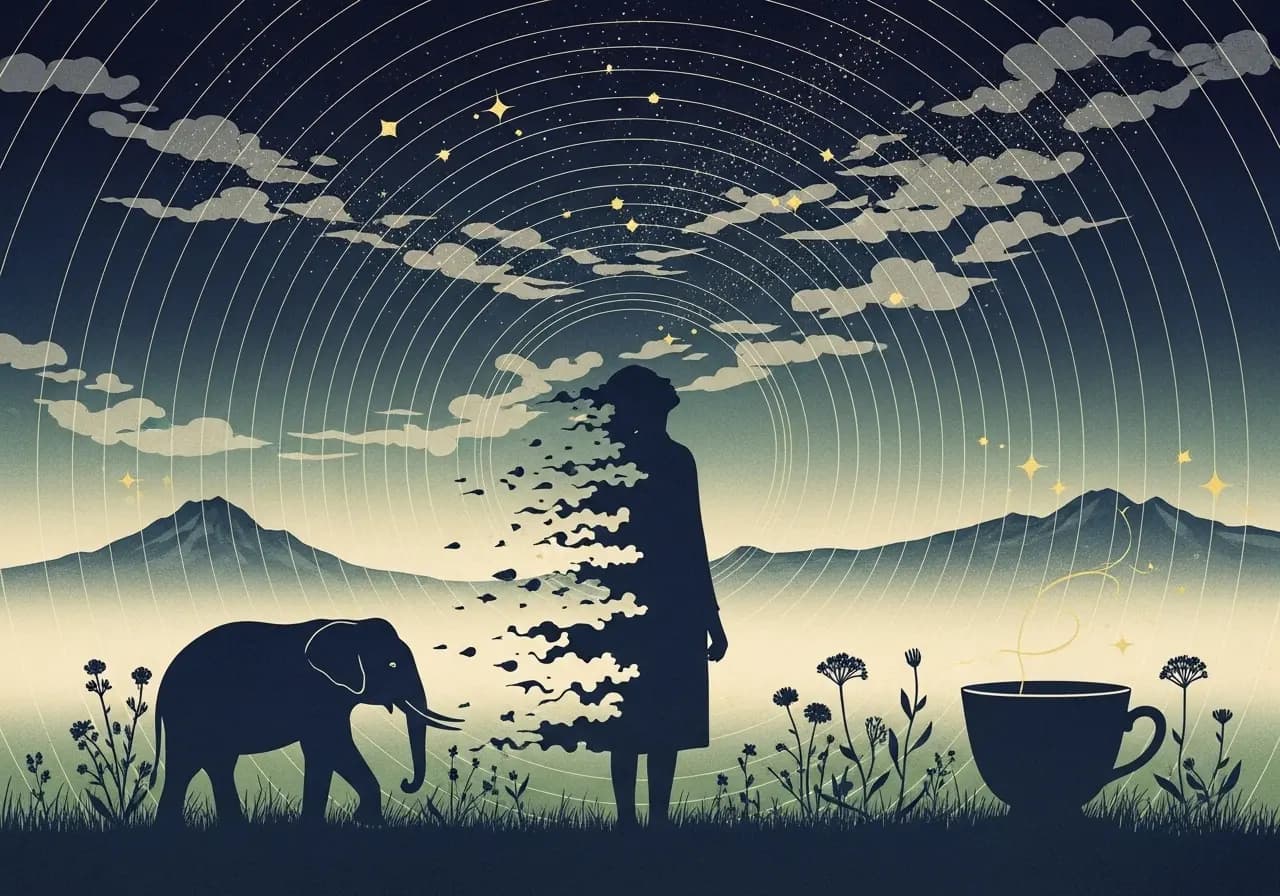
This is taught through a story in Buddhism that I've brought up multiple times on the podcast: the story of the six blind men and the elephant.
In this story, six blind men are trying to describe an elephant, and they're all describing different parts of it. None of them can give an accurate picture of the whole elephant because they're limited by where they stand. If I'm standing at the foot versus the back versus the front versus on top versus underneath, what I perceive and what I'm going to describe is different from what someone else will be experiencing at a different part of the elephant.
The key teaching with the six blind men and the elephant is this: nobody has the full picture. And that's how reality is. Reality in general is a picture that can't be seen as a whole. It's literally impossible.
The Limits of My Perspective
For example, I know what it's like to be me living in 2024—to be a male of a certain age, to be a parent. Everything that I perceive is based on where I am in space and time and the interdependent connections of all the things that make me who I am right now. I know what it is to be a twin, a brother, a son, a dad. But that's today's world.
I don't know what it's like to be someone who lived in the Middle Ages or someone who lived two hundred thousand years ago. I can imagine, but I can't know. And even in my own day and age, I don't know what it's like to be a Syrian refugee. I don't know what it's like to be a person of color. I don't know what it's like to be female. I don't know what it's like to be a mother.
There are aspects of reality that I can't access because of where I stand in space and time.
When I understand that, that's what I mean by the beauty of not knowing. It opens up a sense of curiosity. I can only go off what someone else can describe to me—someone who's standing at a different part of the elephant, describing what it's like to be female, describing what it's like to be anything that's not what I am. I can't know what that's like.
And that's what I mean when I say the beauty of not knowing arises when we understand that reality as a complete picture is simply unknowable. The blind men and the elephant is a good reminder of that. When we understand that analogy and how it relates to reality and to our day-to-day lives, I think we start to experience the beauty of not knowing.
The Cup Question
In the Zen tradition, a Zen teacher may hold up a cup and ask, "Is this a cup or is this not a cup?" They won't answer the question. It's left up to you to look at that cup and think: is it a cup or is it not a cup?
Well, it is a cup based on one perspective and one set of uses we give it. But it's also not a cup. It could be all the other things that it is that are not a cup. And there's no need for an answer because the question ends up being more enlightening than the answer.
The question speaks to the nature of how our mind works. We came up with the notion of "cup," and we stuck with that label and defined it. But cup is a concept, and concepts are tricky things. When we buy into the concept, we end up falling into the trap of thinking things are as we think they are. But that's the trap.
Is it really a cup? Or is it not a cup? However we think things are, they aren't. We're always making things up. Understanding can't help us in this process because concepts are the problem. We create concepts.
The Concept of Weeds
Another example of this is weeds. If I were to ask you, "What is a weed?" you can point them out. We even have names for them—dandelion, or whatever the name of the weed is. But at the end of the day, it's a concept we gave to it.
The only thing that separates a weed from a not-weed is that weeds are the plants we don't want. But they're all plants, and there's no inherent goodness or badness to the plant itself. The ones we want in the garden are not weeds. The ones we don't want in the garden we call weeds. But the weed is the concept.
When we start to understand that—that we create the labels, we create the meanings—nothing really is what it is. What is it outside of the concept we gave it? Ah, now you start to enter that world of not knowing. And that's where the beauty arises.
A Simple Misunderstanding
So there's something else that arises in all of this: what you think something is ends up being more important than what it actually is. And that can be problematic.
Here's a quick example that happened to me recently. My truck's horn doesn't do the short honk. When you press it, the minimum amount of time it honks is about one second or something like that. It's not enough for me to just tap the horn and do that quick little "tap tap" at the traffic light.
I discovered this when I was at a red light. The light turned green, and the car in front of me wasn't moving. I noticed they didn't realize the light had changed. I had every intention of just tapping the horn softly—a little "tap tap"—to let them know, "Hey, the light changed."
But that's not what happened. When I touched it, it honked long enough that it sounded like I was annoyed. The person started going, and I could see they were a little frustrated—like, "How dare you do that to me?"
I had this thought: "Wow, that's really interesting." Had it come across the way I intended—just a light tap—they would have known, "Oh, they're just trying to get my attention. Thank you." But it didn't come across that way. It came across like, "Hey, I'm really annoyed at you, so I'm gonna honk at you long and loud."
I realized there was no way for me to influence the reality of the story that was taking place. There was what I was hoping would happen, and there was what this person interpreted. That person behind me was really annoyed, and now they were embarrassed to pull up next to me. You could tell there was just this awkwardness.
I thought: that's so funny because that's kind of what life is like. We go about life making meaning. I decided this is what it means when I honk. The person interpreted this is what it means because they honked. And those are two different realities. We're caught in that all the time—the reality of how we think things should be, the reality of how things actually are, the reality of how we think others think things should be.
It's like layers upon layers of alternate realities. There may be some intersection between all of them, but for the most part, we're all living in our own little realities. And that's where this notion of not knowing becomes beautiful. I don't know why you honked at me. I don't have to get caught in that story.
The Freedom of Not Needing to Know
There are so many big questions that we have: Does God exist? What happens when we die? Is the universe infinite? What lies beyond what we know? I don't know the answers to these questions.
But here's the thing—and this is important—the approach of asking a question and receiving an answer might accomplish the same peace that comes from not needing to know, but they accomplish it from entirely different angles.
Say you have a big question. I can give you the answer, and you may have peace if you believe that answer is correct. Or I could work with you to the point where you no longer feel the question is relevant, and then you'll have peace because you don't care about the answer. You no longer care about the question.
That's what makes this notion of not knowing so powerful. You start to realize that life is so unknowable. Reality is so unknowable. I talk about life being like a game of Tetris. I don't know what piece shows up next. That's part of not knowing. But I'm not concerned because I don't have to know what piece shows up next. I know that I can deal skillfully with the pieces I have right now.
That sense of not knowing extends to everything. I don't know what happens when I die. I don't know what's out there that's greater than what we know. I don't know, and I'm perfectly content with not knowing.
The peace and contentment that I experience from not knowing is similar to the peace and contentment I would have from knowing. The difference is that it can't be taken away.
If I have the answer and something else comes along and introduces doubt, then I'm not sure. My peace goes away because it was hinged on knowing. But not knowing—the beauty of not knowing—that can't be taken away. I don't know, and I don't need to know. The answer could be right there in front of me or not in front of me, and it's going to do the exact same thing because I don't need to know. Because I understand that it's not a knowable thing.
If there is an answer from the Buddhist perspective, it's a concept in the same way we define weeds, the same way we come up with things to label everything.
The Practice of Not Knowing
Buddhism seeks to extinguish or blow out the need to know. Not knowing ends up becoming a beautiful thing.
From the Buddhist lens, if you were to ask, "What is true knowledge or true knowing?" the answer would be: not knowing.
This is a practice done so much in Buddhist practice, especially in Zen. You ask yourself questions like: What are you? What is this? I could look in the mirror, or I could look at my own hands and ask, "What is this? Who am I? What am I?"
The only honest conclusion I can come up with after an introspective session like that is: I don't know. But I am what I am. This is what I am. Who are you? I'm me, right? I can't be anything else.
There's this sense of beauty that arises in not knowing, and perhaps more importantly, in not needing to know.
Any answer you would give if you were entertaining the question "What are you?" or "What is this?" would end up dissolving once you put it under the microscope. Very much the same way as the car analogy I use a lot.
You take a car and deconstruct it into all of its parts. What is a car? Well, the car is a steering wheel and wheels and a motor and seats. But then you end up recognizing there is no car. There's a steering wheel and there are tires and—okay, well, then pick one of those things. What is a steering wheel? Oh, it's a piece of metal with leather wrapped around it. And suddenly there is no steering wheel, but there is leather, right?
You keep doing this. You take every part and realize things have causes and conditions. Everything is interdependent. The thing that seemed like the thing isn't the thing. There is no car. And yet, yes, there is a car. You can get in it and drive it. But it's not what you think it is. It's a concept.
Weeds are a concept. A car is a concept. And then suddenly you start to recognize: uh-oh, everything is like that. We go back to the original question the Zen master would ask by holding up the cup: "Is this a cup or is this not a cup?" That's the invitation to be introspective.
Abiding Nowhere
I want to end this train of thought with a quote: Abiding nowhere, awakened mind arises. This is a Zen quote. I can't remember off the top of my head who said it, but I love this quote.
Think about it. Where is nowhere? Nowhere. It's the place where language no longer operates and all certainty dissolves. That's a pretty cool place to be. A world of no concepts.
When I abide in that nowhere—that space of not knowing—that's where the awakened mind arises. Everything that has a concept, that is a label, that is meaning that we've given it—that's not it. Go beyond that. Go to the place where words can no longer be used. There are no concepts. If there are no words, then in that space, that's where the awakened mind can arise.
Now, that may sound a little esoteric, but I don't think it is. I think this is the world of experiential knowledge. It's the realm where you experience something so visceral that there are no words to explain it.
I remember feeling this holding my first child—the moment I realized I'm a dad. There were no words to explain what I was feeling and experiencing in that moment. There was only experiencing it. There have been other instances like that in my life. You can feel this sometimes looking at a sunset or standing at the edge of the ocean looking out at it. There are no words.
I experience this sometimes just looking at the cosmos, looking at the stars at night and taking it all in and recognizing: there are no words. That is the realm where the awakened mind arises, because you're abiding nowhere—meaning you're inside of no concepts.
Closing Thoughts
I hope some of that makes sense. I just wanted to share some thoughts on the overall topic of the beauty of not knowing.
I hope you can take these concepts and think about them over the next few weeks. What does this mean to you? And the next time you look at a cup, ask yourself: Is it a cup or is it not a cup? That's the little Zen inside joke.
Alright, that's all I have. I look forward to another episode. Thank you for listening, and until next time.
For more about the Secular Buddhism podcast and Noah Rasheta's work, visit SecularBuddhism.com