

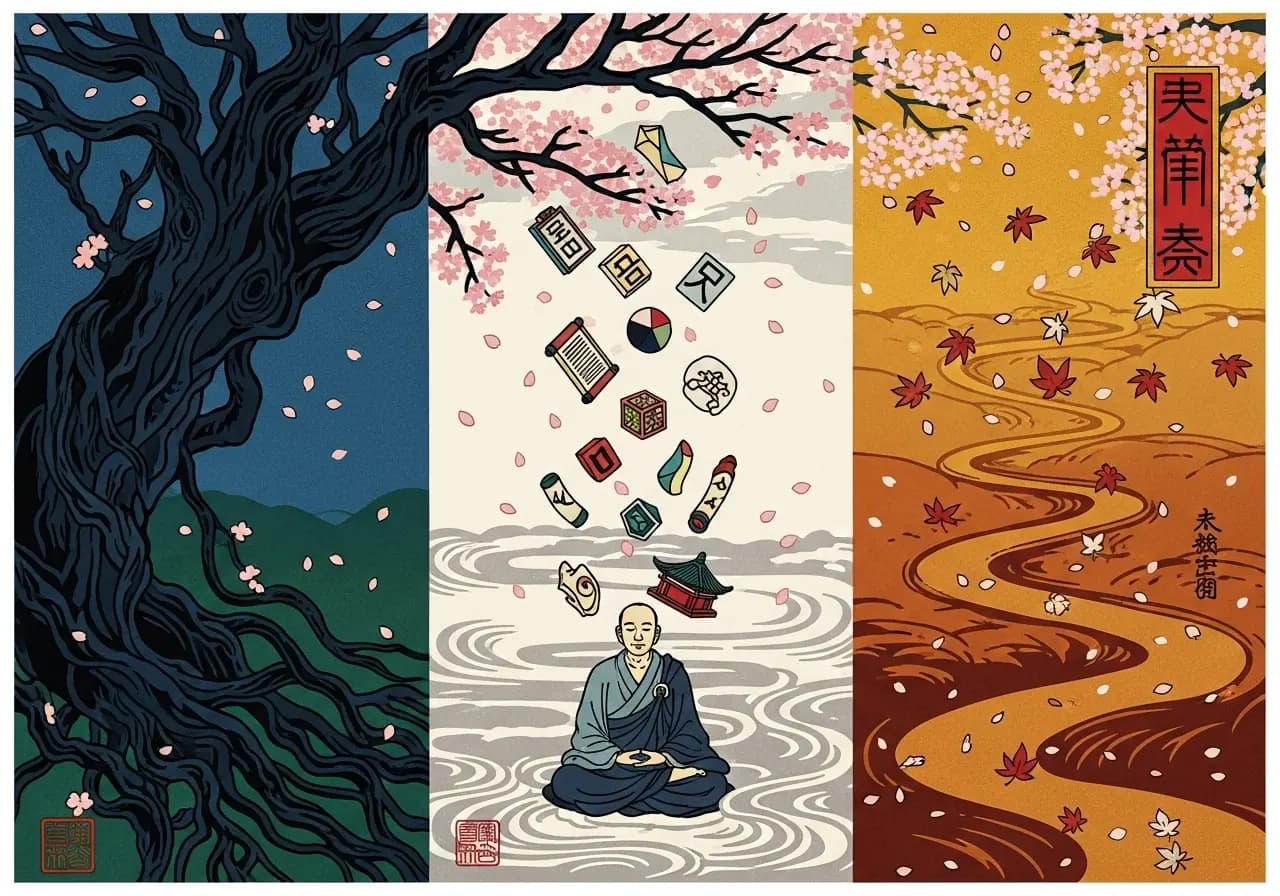
A Liberated State of Mind
Episode 152 of the Secular Buddhism Podcast
Hello, and welcome to another episode of the Secular Buddhism Podcast. This is episode number 152. I'm your host, Noah Rasheta.
Today I'm going to talk about a liberated state of mind.
As always, keep in mind: you don't need to use what you learn from Buddhism to be a Buddhist. You can use what you learn to just be a better whatever you already are.
Finding Resources and Community
If you're interested in learning more about Buddhism, check out my book, No Nonsense Buddhism for Beginners, available on Amazon. Or start with the first five episodes of the podcast, which you can find easily by visiting SecularBuddhism.com and clicking on the "Start Here" link.
If you're looking for a community to practice with and interact with, consider becoming a patron by visiting SecularBuddhism.com and clicking the link to join our community.
A quick note about that community: while the podcast hasn't been as regular as it normally is, the online community is more consistent. We have a weekly discussion every Sunday at noon Mountain Standard Time. We gather on Zoom to talk about concepts and ideas similar to what I present in the podcast. Unlike the podcast where it's just me talking, the Zoom calls allow a whole group of people to interact and discuss these concepts together. We do this every week, so if that sounds interesting or beneficial to you, you can learn more by visiting SecularBuddhism.com and clicking the link to join the online community.
A Brief Personal Update
Before I jump into today's topic, I do want to address something I know many of you have noticed: I've been away from the podcast for a little while.
As some of you know from recent episodes, after my friend Dustin passed away and then my dad passed away shortly after that, I took a break. Not just from the podcast, but from teaching paragliding and from all my normal daily routines. I needed to take a breather and hit the reset button, so to speak. That's why you haven't seen a podcast episode in a while.
But I'm back on the horse now and doing all my normal routines. This is the first podcast episode in a while. Tomorrow I start a new paragliding training course with four or five new students. In many ways, I'm getting totally back into the rhythm of things.
That break was very useful. It served the exact purpose I hoped it would. It felt like a reset—a time to gather my thoughts and just be with the emotional experiences I was having. This is a new chapter of life where I don't have my dad anymore and I no longer have my friend, one of my close flying buddies. I wanted to give that transition some space—some breathing room between the phase that ended and this new one that's beginning.
As I mentioned in a past episode, First and Last, we're always navigating that space between the first of something and the last of something. I wanted a little space between those two things. But I'm happy to be back. I'm excited to get into this routine again where I'm thinking about topics for the podcast and taking time to sit down and record those thoughts.
The Topic: Liberation
The topic that's been weighing on my mind lately is liberation. Part of why, I think, is probably because of the time of year here in the United States when we celebrate Independence Day. It's about freedom. And that gets me thinking: what is freedom, especially in the Buddhist context?
Liberation is a key word in Buddhist practice. It's kind of the reason you practice. I've done podcast episodes in the past addressing the concept of liberation, freedom, nirvana, and enlightenment. These are all somewhat along the same topic. I did an episode about the three doors of liberation, and I want to revisit that today.
I want to bring together the notion of liberation with three quotes that correlate to these three doors or three ideas.
Three Quotes on Liberation
If we're thinking about liberation in the context of Buddhism, I want you to keep in mind these three quotes. I consider them to be pretty profound and life-changing when you really get into the depth of what the implications are behind them.
The first quote is: "This is because that is."
The second one: "The symbol of a thing is not the same as the thing itself."
And the third: "Having no destination, I am never lost."
I've talked about each of these quotes at some point in past episodes, but I want to bring them all together today in the context of what Buddhism calls the three doors of liberation.
The Three Doors of Liberation
The three doors of liberation in Buddhism are no self, no form, and no goal. These three doors are often referred to as emptiness, signlessness, and aimlessness.
I'm going to go through each one, expressing my perspective on it now.
The key idea here is that meditating on these three concepts, we begin to see a reality that is a bit more skillful. We're always navigating the duality of reality as it is and reality as we think it is. Exploring these three doors, or entering through them—or meditating on these three concepts—is a way of interacting more skillfully with reality.
What happens is we start to experience the reality of impermanence without the fear or anxiety that is so common to those who are confronted with impermanence. Think of liberation not as a destination or a place we're trying to reach. Think of it more as a state of mind—a state of mind that is available to us right here and right now.
One of the ways to achieve this state of mind is to ponder or enter these three doors of liberation. When we fully understand the reality of emptiness, signlessness, and aimlessness, we become liberated from the type of thinking that has us trapped in the prison of our own mind—which is the prison of the conditioned mind.
Door One: Emptiness—"This Is Because That Is"
Let me start with the first quote: "This is because that is." To me, this quote expresses the notion of emptiness. It's about understanding interdependence.
A flower is made up of all non-flower elements. You don't have the flower if you don't have soil, rain, and sun. You don't have rain without clouds. You don't have clouds without the sun causing the uneven heating of the earth's surface. And all of these non-flower elements suddenly become the reason why there is a flower.
That can be a really powerful understanding of the nature of reality, especially in the context of what this means about self and the idea of no-self.
You can ask yourself, really at any given moment: who am I? Or what am I?
I've recently been thinking a lot about my past memories. During the stage when my dad was passing away, I spent quite a bit of time at home with my mom and my brothers. We looked through boxes of pictures and reminisced about our memories growing up. We had pictures of all kinds of different memories from different places, doing different things.
It was interesting to look at these pictures and see, in some sense, different versions of myself. There was me as a kid, me as a teenager, me as a young adult. And I was looking at these pictures thinking, "Well, which one is the real me? Was it the me as a kid? Was it the me as a teenager? Or is it the me right now, looking at these pictures?"
In a sense, the me that existed then is not the me that exists now. My body was different. My thoughts were different. My personality was different in many ways. My experiences were different. So in what sense can I say there's a continuity of self that has carried on from that childhood version of me to this version now?
If you really think about it, there's no solid, unchanging thing that you can point to and say, "This is me." This is the notion of emptiness in Buddhist philosophy. It's understanding that we don't have an intrinsic, solid, unchanging identity.
Now, this might sound a little depressing or nihilistic. You might think, "Well, if there's no self, what's the point of anything?" But actually, when you understand this deeply, it becomes quite liberating. It frees you from having to defend and protect this fixed idea of who you are.
Door Two: Signlessness—"The Symbol Is Not the Thing"
The second quote is: "The symbol of a thing is not the same as the thing itself."
This speaks to the notion of signlessness. We live so much in our heads, in the realm of concepts, symbols, and ideas about things, that we often mistake the symbol for the thing itself.
For example, think about the word "tree." When I say the word "tree," you don't actually experience a tree. You experience a concept, a symbol, a mental representation of a tree. But a real tree—the actual living thing with roots and leaves and branches—that's the actual experience.
In the context of my dad passing away, I was thinking about this a lot. We talk about death. We have this concept of death. We have ideas about it. We've heard stories about it. We've read about it. But the actual experience of losing someone you love is very different from the symbol or the concept we've created about that experience.
One of the things that struck me as I was with my family during this time was recognizing how much of what we call "life" is actually just our thoughts about life, our stories about life, our symbols and concepts about life—rather than the actual direct experience of being alive right here, right now.
Signlessness is about seeing beyond the symbols and concepts we've created, and experiencing things more directly. It's about seeing the flower without the name "flower." It's about experiencing the moment without the story we've attached to it.
When we can do this, we stop getting caught up in our mental constructs about how things should be. We can experience things more as they actually are. And in that, there's a great sense of freedom.
Door Three: Aimlessness—"Having No Destination, I Am Never Lost"
The third quote is: "Having no destination, I am never lost."
This speaks to the notion of aimlessness—and I've been reflecting on this quite a bit lately.
You know, I think there's an interesting shift that happens when you recognize that life itself is the goal. When we're young, we're taught to think about the future. We have goals. We want to achieve this or that. We want to get to a certain place. And that's fine. But at some point, if we're not careful, we can get so focused on where we're trying to go that we miss where we actually are.
I'm at a stage in my life now where I'm less focused on the destination and more focused on the journey itself. And it's changed my perspective considerably.
When I think about my dad passing away, one thing I've been reflecting on is how his presence in my life shaped me. And now that he's gone, I'm recognizing something interesting. In many ways, this moment right now—dealing with his absence—is itself a form of his presence. The impact he had on me continues to shape my life and my choices.
I've also been thinking about how we experience things. I think there's value in approaching life almost like a checklist. Not in a grim way, but in a way that says, "Well, I'm going to experience all of this." I'm going to experience joy and I'm going to experience sorrow. I'm going to experience connection and I'm going to experience loss. Rather than resisting these experiences, I'm going to go through them. It's like crossing off, "Okay, well, I've experienced that now."
I think there's something about that perspective that makes life more enjoyable as I come across all the things I'm going to experience.
It's kind of like what I mentioned with the game of Tetris, right? Life is like a game of Tetris. The goal in that game is to keep going. And in Buddhism, this is kind of like the expression "the path is the goal." If I have a goal, but I realize the path itself is the goal, that's aimlessness. It's I don't have anywhere to be because being is the goal. Wherever I am, that's exactly where I needed to be, because the path itself is the goal.
A Note on Ambition
Sometimes when we talk about this concept in Buddhism, people ask: "Well, if I'm aimless, am I going to lose my ambition? The ambition to strive for this or that? Do I just end up sitting there totally empty of any kind of ambition?"
We're taught to think that if we're aimless, we won't get anywhere. But there's profound wisdom in asking yourself: where am I going? Like, where do I need to be?
In my experience, it's not so much that we lose a sense of ambition. It's that the ambition gets redirected to more skillful things. It takes ambition to not want to be ambitious, right? There's no escaping ambition. It's like wanting to not want things—well, then you're still stuck wanting.
When we take on a practice like Buddhism, we don't necessarily lose ambition. I think it just gets refocused and redirected. Things that didn't matter suddenly matter, and vice versa. In my experience, that's how it is.
I used to have ambition for things that now I look at and say, "Nope, I have no desire for that anymore." But I now desire other things that I had never considered before. For example, desiring to just experience the full range of whatever life is going to throw my way. That's been a much more skillful ambition than the one I had before, which was to experience more of the pleasant things in life and less of the unpleasant. That wasn't a very skillful ambition because life is like Tetris and you can't control all those pieces. You are going to experience difficult things.
Using my dad as an analogy here, it was a pretty profound experience to go through the strong emotions of loss of someone so close to me without aversion to the unpleasantness of those emotions. In other words, leading up to my dad's passing, I wasn't afraid of or feeling aversion to the strong feelings I was experiencing. I knew that when the time came, I would feel tremendous loss. I knew I was going to feel strong emotions, cry, and that was fine. I was totally okay with whatever I was going to feel.
I think before, I would have had a hint of aversion toward these things. "I don't want to feel sad. I don't want to cry in front of people." And that only makes it worse.
This notion of aimlessness in that context is that there's no way I need to be. I don't need to look strong. I can look weak and just cry my eyes out. And that's totally fine because that's what I'm feeling right now. There's a huge sense of liberation that arises with that perspective.
Whatever it is I'm experiencing, that's what I'm experiencing. And there's no clinging to one thing and aversion from the other. It's like, nope, I'm just allowing myself to experience all of it.
The Good Old Days
Another thing I noticed while hanging out with my family during the weeks before and during my dad's passing: while looking through those boxes of photos, I recognized that there's sometimes a part of us that looks back longingly to a time in the past that we view as the good old days.
But there's also a sense of liberation that arises in recognizing that right now we're living the good old days that we'll one day look back on. That's what the present moment can be for a lot of us.
It can feel good to recognize that one day, I know I'll look back on this specific stage of life and treasure the memories I created when I was with my mom and my brothers going through the stage of my dad passing away. As unpleasant and difficult as that stage was, I was able to recognize in that moment that these are some of the good old days that one day I'll look back on—when my mom is passing, or if my brothers pass away, or any other future moment that will cause me to long for this present moment.
When I recognize there is nowhere else to be—there's only here and now—and that I'm perfectly content with being here now, that's when the sense of liberation arises in the context of aimlessness.
Wrapping It Up
So wrapping up this overall topic: as Alan Watts would say, "You are a function of what the whole universe is doing in the same way that a wave is a function of what the whole ocean is doing."
He goes on to say, "We do not come into this world; we come out of it. As leaves come out of a tree, as the ocean waves, the universe peoples. Every individual is an expression of the whole realm of nature, a unique action of the total universe."
For me, aimlessness is to understand deeply that there is no way I need to be. There's just this complete liberation in understanding that I can simply be, just as I am. It's like the art of befriending ourselves just as we are—which again is a notion that's common in Buddhism.
I'd like to wrap this up with another Alan Watts quote where he says, "The only part of you that needs fixing is the part of you that thinks it needs to be fixed."
That to me is the essence of freedom in the context of aimlessness.
Final Reflection
So we have these three profound ideas—the three doors of liberation in Buddhism: no self, no form, no goal, or emptiness, signlessness, and aimlessness. However you want to think about it.
Or think of the quotes: "This is because that is." "The symbol of a thing is not the same as the thing itself." And "Having no destination, I am never lost."
I hope you'll take these concepts and think about them in your day-to-day lives over the coming weeks and see how it makes you feel. See if you feel this sense of liberation that arises from having these perspectives and seeing the world or seeing reality in this light.
I'm glad to be back. I'm looking forward to exploring more topics and concepts and sharing them here on the podcast. And I want to thank you all for your patience and for giving me space over the last several weeks and months as I've been going through the notions and the processes, the ups and downs of dealing with the Tetris pieces that life is throwing my way and the ones I've recently put into their places on the Tetris game so I can keep going.
I'm very grateful to be living the life that I'm living and to have the connections and friendships that I have. Several of you who have reached out over the years and have been podcast listeners have become friends of mine. I'm grateful for each of you. You all know who you are.
Thanks again for everything. We'll connect again. See you next time, and have a great week.
For more about the Secular Buddhism podcast and Noah Rasheta's work, visit SecularBuddhism.com