

Observation and Action
Episode 151 of the Secular Buddhism Podcast
Hello and welcome to another episode of the Secular Buddhism Podcast. This is episode number 151. I'm your host, Noah Rasheta. And today I'm going to talk about the skillful practice of observation.
Welcome
As always, keep in mind you don't need to use what you learn from Buddhism to be a Buddhist. You can use what you learn to be a better whatever you already are.
If you're interested in learning more about Buddhism, check out my book, No Nonsense Buddhism for Beginners, available on Amazon. Or listen to the first five episodes of this podcast. You can find those easily by visiting SecularBuddhism.com and clicking on the link that says "Start Here."
If you're looking for a community to practice with or to interact with, consider becoming a patron by visiting SecularBuddhism.com and clicking on the link to join our community.
Recording Reflection
Alright, so for today's podcast episode, this is actually the second time I'm recording this. I just finished recording the entire episode only to discover that my microphone was muted. So here we go, round two.
One of the reasons I enjoy recording podcast episodes is because I consider each of these concepts as a tool. Imagine that you have a big toolbox and each concept is a tool that you can pull out. With one simple phrase—like "life is like a game of Tetris" or "the parable of the raft" or "who knows what is good and bad"—things like that. You take a concept and that one little concept you can unpack the whole teaching behind it. And that becomes a tool that helps you live more mindfully or to live your life in a way that perhaps would be better than it would have been had you not become aware of that concept.
That's my goal. I want to continue to introduce concepts or ideas, most of which come from Buddhism. These are concepts or ideas that I have encountered on my own path and enjoyed enough to want to share them in a way that I feel makes sense for anyone listening. You can unpack the concept and use it to improve your own life.
And that's what I have in mind for today.
The Concept: Observation and Action
The concept I wanted to share is the correlation between observation and action. Observation, as a practice, is a very active thing. It's not passive, and it's not a form of resignation. Think of a skilled observer who observes precisely in order to be more skillful in how they act. The observer is doing something very deliberate. It's not passive at all.
I've been reading a book called The Nature Instinct by Tristan Gooley, and this book really hits home on this concept of observation. The premise is that as a society, we're not really in tune with nature anymore. A big part of that is because we don't spend time out in nature observing all the little things that nature could teach us. We don't observe the constellations to navigate at night. Sure, it's something that can be done, but most of us don't do it simply because we've never spent the time to learn it or to observe long enough to realize the implications of what we're observing.
In the book, Gooley gives a lot of examples. For people who hunt, for instance, they analyze the landscape and know which way an animal might go. They observe the landscape and instantly know the cardinal directions—which way is north and which way is south. When you read about all these things and discover people who can tell you this or that by observing this or that, it almost comes across like magic. How do these people know these things?
Then he explains how they know, and it all makes sense. The key takeaway for me is that I just don't spend a lot of time observing, and I would have never even known that these things were knowable. But had I grown up observing, I would be able to do those things very proficiently as well.
I can see this in my own life, in my own little sphere, in the areas where I observe quite a bit. I've become an expert at whatever it is that I spend my time on. Same as you, right? Whatever your career is or wherever you focus your energy and time, that's something you're going to understand much more proficiently compared to someone who hasn't been spending time observing that thing.
The Horse and the Rider
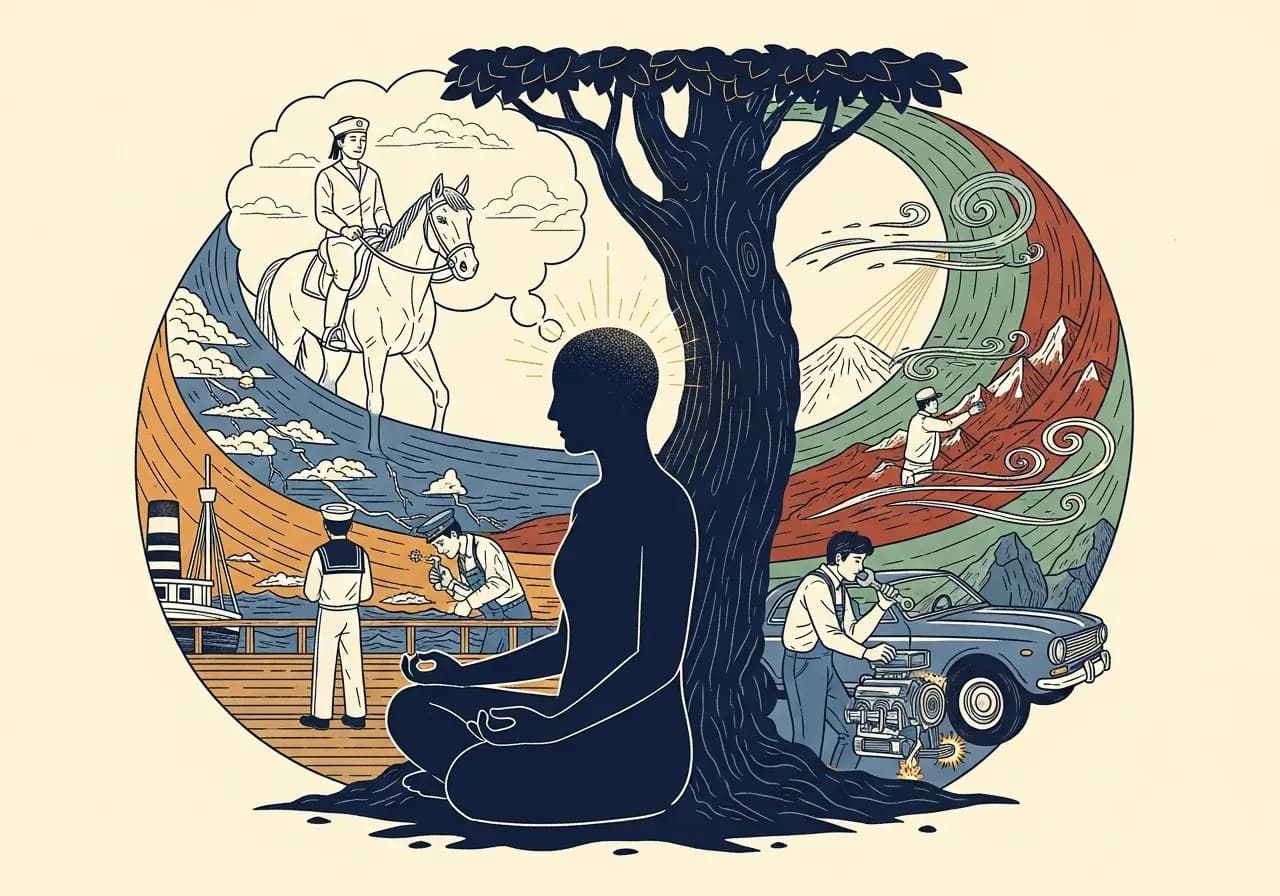
In other books, the mind is often referred to like a horse and a rider. The horse is the reactive part of the mind, and the rider is the more analytical part—we could call it the observer part of the mind. I like this correlation because what it tells me is that you can be the observer and at the same time remain neutral in your observation of whatever experiences you're having.
Imagine the horse and the rider, and the horse gets spooked by something. The horse starts bolting, and you as the rider—if you're just going along for the ride, you can observe the fact that you're going along for the ride. Like, wow, this horse is going faster. Oh, it feels like I'm gonna get bucked off. That's the observer observing whatever experience the horse is having, which is also your mind.
That's what's cool—we are both the horse and the rider. So for me, that understanding means I can be the observer and the experiencer at the same time. I can be the experiencer of a strong emotion, for example, and at the same time be the observer of the one experiencing that strong emotion.
I've mentioned this before in the podcast. It's like experiencing anger. While you're experiencing anger, you're able to notice, "Wow, I'm experiencing anger." And the observer of the experience is neutral, right? Because when I'm observing that I'm angry, the observer is not angry. The observer is just observing. Yet the experiencer—the horse in me—is still experiencing anger.
I think that's where sometimes there's a little bit of misconception. It's like, "Well, if I practice mindfulness, I won't experience anger." And that's not the case at all. It's that you will experience anger, but you'll be able to observe that you're experiencing anger as you're experiencing it. And what that does is make you less reactive.
If I'm going to go into reactive mode while I'm having a strong experience of an emotion, that's different than being capable of having a more deliberate action that can take place once I observe that I'm experiencing anger. So again, the whole point here comes down to how I act. Act is the key word here.
Observation and the Four Noble Truths
I think this goes hand in hand with the Four Noble Truths. Before I remind you of what those are, I want to emphasize that the art of observation is not to be passive. It's to be analytical and ultimately more skilled with whatever the next step is or the next action that we're going to take.
In the Four Noble Truths, we talk about the truth of suffering, the truth of the cause of suffering, the truth of the end of suffering, and the truth of the path that leads to the end of suffering. I like the way Stephen Bachelor correlates these truths to tasks—things that we can actually practice. He describes them as four tasks.
The first task is to embrace. Embrace the instance of suffering or embrace whatever it is you're experiencing.
Second, let go of what arises. The moment I allow myself to embrace whatever it is that's taking place, I let go of what arises next.
Third, see the cessation. See the cessation of suffering or see the cessation of reactivity.
And fourth, act. And to me, this is the most important one. I want to act skillfully with whatever it is life's throwing my way.
I use the Tetris analogy a lot. Life is like a game of Tetris. As I'm playing the game, imagine two different styles of play. One: every piece that shows up, I go into reactive mode and I'm screaming and yelling, "I don't like this piece." Because I'm so caught up in the reactivity, I cannot act skillfully.
This is actually a known thing with our brain. Any neuroscientist will tell you that those two parts of the brain—the horse and the rider—the horse always trumps the rider. When we're in reactive mode, that part of our brain that reacts trumps the part of the brain that can be the observer and act more skillfully. This is why you're far more likely to act unskillfully while experiencing a strong emotion like anger than you are to act skillfully while experiencing anger.
So the way we work with this, at least in the Buddhist context, if act is the fourth of those tasks, I want to act in a way that's more skillful than I would have acted had I not spent some time observing whatever it is I'm experiencing. Observation to me is the key. Where I spend time observing, I become more skillful. And you can see this in day-to-day life.
Observation in Practice
Look at a sailor or a mariner who spends a significant amount of time out on the ocean. They can tell you things about what's happening with the ocean or with the sky that you might at first glance think, "How do they know that? It's like magic." You know, like a sailor who can say, "Yep, there's a storm coming." And for the non-practiced observer who observes the sky and the sea, they might be like, "What? How do you even know that?"
But they know because they have observed. They detect all the little things—subtle changes in pressure, subtle changes in temperature or humidity, or whatever it is they're picking up on through observation. This correlates to anything, right? Whether it's a skillful mariner or a skillful mechanic.
The skillful mechanic can do the same thing. They listen to the pinging of your motor in your car and tell you, "Oh, here's what's wrong." And how do they know? Observation. They spent a lot of time listening and observing, and they can identify things that the untrained or unobserved ear can't.
And I see this of course in my sport as well. Someone who spends a lot of time on the side of a mountain or in a field observing the patterns of the wind can tell you things like, "Yes, it's gonna be a good flight tonight," or "Nope, it's gonna be bumpy air," or "Oh, over there is where the thermals are. If you go that way, sure enough, there you find thermals and you can soar up high." Where to the eye that hasn't observed these things, they may listen and say, "How? How do they know? It sounds like magic."
That's it. Observation is the key.
Inward Observation
Now imagine if I can observe and become an expert at one little facet of life through observation—whether it's reading the stars, determining weather patterns, or whatever the thing is—imagine how much more beneficial that practice is when I internalize it and become an observer of my own mind. I understand the nature of my own mind. I can experience a thought or a feeling or an emotion, and I know what's coming next because I'm an expert. I've been observing my own mind.
It's fascinating to me how rare this is. Most of us go through life without observing inward. We may observe things outward, but inward it's just reactivity. If I don't eat, then I get hangry. There's a direct correlation, right? There's reactivity. If I'm angry and you say something to me, I'm gonna react in a certain way. All of it makes sense, but rarely do we spend the time to understand, "Oh, this is why. This is what's happening."
I think hunger is just one of those common ones. How often do you interact with someone who may not be in their normal mood? And you might say, "I think you're hungry." Like we do this with our kids, right? "I think you need a nap. I think you need to eat something." But they don't know that about themselves. Well, we're no different. If we don't practice observation of ourselves, of the nature of our own minds, we go through life just like that—reacting to things without even realizing that we're reacting, or even worse, having no clue why we're reacting the way that we're reacting.
The Power of Observation
So observation, as a concept, I think is very powerful. The correlation between observation and action is a very powerful thing. I aim to be an observer of my own mind. I aim to be an observer of my habitual tendencies in life, everywhere there may be reactivity or, even worse, habitual reactivity. I want to understand that about myself. Why do I think what I think? Why do I say what I say? And why do I do what I do?
The more time I spend doing that—again, it's all with the goal of ultimately being more skillful in action. It's not about being an observer that's passive. It's not about observing so that I don't have to make a decision or that I can be resigned to whatever it is I'm experiencing. No, it's not that. It's that I want to be very skilled with and deliberate with whatever I do next or whatever I say next.
And the key to that starts with observation.
Closing
So I hope that you can take this concept or this idea of observation as a practice and apply it to your own day-to-day life. Ultimately, use this—like it says at the beginning of the podcast—as a way of becoming a better whatever you already are. That's all I have to say about this topic, and I hope this is something that can benefit you in your day-to-day life.
I look forward to recording more podcast episodes in the near future. Thanks for taking the time to listen.
Until next time.