

Buddha Nature
Episode 150 of the Secular Buddhism Podcast
Hello and welcome to another episode of the Secular Buddhism Podcast. This is episode number 150. I'm your host, Noah Rasheta.
Today I'm going to talk about Buddha nature.
As always, keep in mind: you don't need to use what you learn from Buddhism to be a Buddhist. You can use what you learn to be a better whatever you already are.
If you're interested in learning more about Buddhism, check out my book, No Nonsense Buddhism for Beginners, available on Amazon. Or you can listen to the first five episodes of this podcast. You can find those easily by visiting secularbuddhism.com and clicking on the link that says "Start Here."
If you're looking for a community to practice with and interact with, consider becoming a patron by visiting secularbuddhism.com and clicking the link to join our community.
Coming Back After Loss
It's been a few weeks since I've recorded a podcast episode. If you'll recall from the last episode, I had recently lost a friend in a paramotor paragliding accident. And as soon as I was wrapping up with that ordeal, on my way home, I found out my dad's health had deteriorated. I ended up catching the first flight out to Texas to spend time with him. After seven days at his bedside, unfortunately his battle with cancer finally ended, and he also passed away.
So the last few weeks have been a little rough in terms of navigating these strong emotional experiences and intense feelings. I have to say that once I came home from Texas, it took me a few days to get back into the swing of things. I think there are a lot of natural stages that you feel with grief and processing loss. There was certainly a period of time where I quite honestly didn't feel like doing anything. I was in a funk. And it's only in the last couple of days that I'm starting to feel like I'm back in the swing of things, feeling the excitement once again to get back to my schedule of recording podcast episodes.
I do enjoy doing these podcast episodes and sharing my thoughts and feelings. It's somewhat therapeutic for me to be able to share all of this in a public setting like this. So thank you for bearing with me these last few weeks as I've stepped away from the podcast. And thank you to everyone who reached out—people who were aware of the situation and sent me messages of condolence. That was very comforting for me.
So with all that said, I'm back in the saddle, so to speak, and I'm excited to be talking today about the topic of Buddha nature.
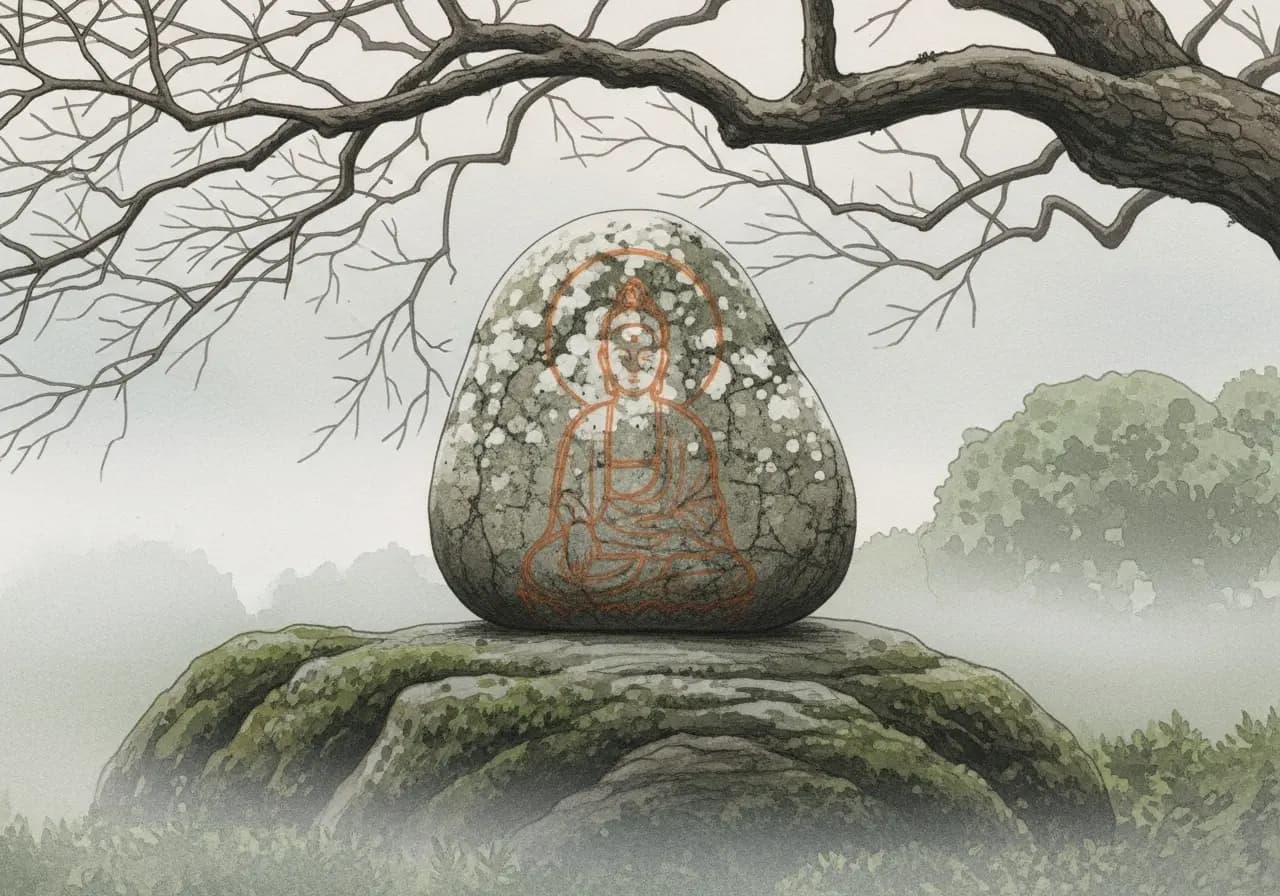
The Buddha Rock
This topic actually popped into my mind while I was in Texas. I spent, as I mentioned, seven days—my dad's last seven days—with his family at his side. My two brothers, my twin brother, my older brother, myself, and my mom were all there with my dad. It was a beautiful experience to spend that time with him as he gradually declined and ultimately passed. I was very grateful to have had that time with him, and not just with him, but with my siblings and with my mom. It was a very tender experience.
But while I was there, I was staying in touch with home, with my wife and with my kids. I received a phone call from my wife, just a regular update as we do when you're traveling. In the update, I was asking the kids how their day was going. My youngest daughter said, "Daddy, the Buddha rock—the painting on the Buddha rock—washed away." She said it with disappointment and sadness, anticipating that I would also be sad about this.
Let me rewind for a moment and tell you about this rock.
Many years ago, when I graduated from the lay ministry program, I went back to visit a class that was graduating after mine. While I was there, one of the activities they did was paint rocks. In the tradition that I studied with, there's a teaching that "the Dharma is my rock." The whole idea was that you would take a rock, paint something on it to remind you that the teachings of Buddhism—the Dharma, if we call it that—can work somewhat as a rock to anchor you in tumultuous times.
When the class was doing all this, I decided I would go along with them. I tried to paint a little Buddha sitting in meditation on this rock. This is comical if you know me well, because I can't draw at all. So imagine a stick figure Buddha painted on a rock with orange robes. You could tell what it was if you looked at it. I was very proud of my little stick figure Buddha painting on a rock.
I brought that home and had a little lesson with my family, explaining that these teachings anchor me somewhat like a rock is anchored and immovable on the ground.
Long story short, that rock ended up traveling with us. When we moved to Mexico, I took that rock from my desk. We have a spot in our backyard where my parents had a dog for many years, and when that dog passed—Tiny was her name—we buried Tiny in our backyard. She'd been back there for years. When we were moving to Mexico, I took this rock and I said, "You know what, let's take it outside and put it in the spot of the yard where Tiny is buried. It'll be like the Buddha is sitting there with Tiny." Tiny's spot already has a big rock that's kind of like the memorial stone. I took this little stone with the Buddha painting and placed it on top of the bigger rock that's Tiny's memorial stone. That's where it's been for years now.
Well, after a year back from Mexico, that rock has just been sitting there through seasons of sun and rain. The painting was coming off. So fast forward to this call while I'm in Texas—my daughter was pretty upset that the painting with all the sun and several winters had washed away. She was a little upset about that.
When she told me this—"Daddy, the painting has washed off the rock"—she said it with disappointment. I told her, "Oh good. Now that the painting has washed off, now you can actually see the Buddha in the rock. That's the real Buddha nature."
My wife was on the phone with me and she kind of chuckled. She said, "Well, of course you took that and turned it into a lesson about Buddhism and about Buddha nature."
When I got home, we went outside and looked at this rock. I explained it to my daughter. I said, "See how now that the painting is all washed off, now you can tell what it really is?" She said, "Yeah, it's just a rock." I said, "Exactly. That is Buddha nature."
Understanding Buddha Nature
This lesson, this little visual, has really stuck with me these past few days for many reasons. First and foremost, I recognize that I took this rock and I painted it. I'm the one that did the painting. I'm the one that turned it into a little stone that represents something else. That was meaningful. I enjoyed the visual of what it represented. But now I enjoy it even more because I see it for what it really is: it's just a rock.
You can see little traces of paint on it to remind you that it used to be a rock that was painted as something else. But now it's back to being just a rock. To me, that is the essence of understanding Buddha nature.
I feel like we go around as painters, and we paint on everything. We assign meaning to everything. And we ourselves, like these rocks, are painted on. We are painted on by society, societal norms and views, perhaps religious views, family norms. The very language that we speak, these words that we use to communicate with each other—all of this is painted on us. We're somewhat like that rock. We become something that now has meaning because of what's been placed on it.
This is what we would call conditioning.
According to Tricycle Magazine, Buddha nature points to the aspects of ordinary people that are in some way already the same as a Buddha. Some schools teach that Buddha nature is like a seed—the potential that we have that can be developed to become aware or to become Buddhas, to become awakened. But in other schools, Buddha nature is understood to be completely present, but obscured by our delusions.
To me, this is the concept that makes the most sense. It's very similar to a story I've shared in the past about a Buddha statue made of gold and covered in clay. Over time, everyone assumed it was a clay statue. But as the clay started to peel off over the years, eventually someone came to understand: "Oh, there's a gold statue under the clay statue." The clay is like our conditioning. Very similar to this story about the rock in my garden, the paint that was on the rock is the conditioning.
The conditioning was not placed there by the rock—it was placed by something else. In this case, it was me.
I feel like I am like that rock. I have mental conditions that have been placed on me through societal norms, my upbringing, my family values and views, and all kinds of things. And there's nothing wrong with this. You can't help but to have these things. We can't just erase all of that. But by understanding that underneath all of this conditioning, there's just me—that is the Buddha nature. At least that's how it makes sense to me.
Seeing Past the Paint
I wanted to share this because I think it can be a very powerful visual for how we view ourselves and also how we view others.
When I look at this stone in my yard, I see both the painting of the Buddha that has been placed on the stone, and I also just see the stone that's just a stone with paint on it. When I try to view people, I try to view it in that same lens.
There are people being just how they are, and then there are people with conditioning placed on them. These come in the form of views, opinions, and beliefs. These shape the individual to become something that maybe they aren't. Like the rock: it's just a rock. But you paint it like a Buddha, and now what is it? Well, now it's a little ornament. But I made it that.
It's helpful for me to view other people in the same lens. Every single one of us has been painted, and we view ourselves with our painting as if that was the real me. When in reality, that's just the painted you. What is the real you? I don't know. I don't even know if that's even possible to see. But I know that what I'm looking at is the painted version of you.
That helps me because if there's an aspect of the paint—let's say there's a really bright green paint that I feel an aversion to because I tend to like red paint—I can understand that it's not you that I don't like. It's the green paint that I don't like.
I think it's the same with views. You may have a very strong view that leans this way or that way—politically, ideologically, or religiously—and that I feel an aversion to. But that's not you, because you're not your views. In the same way that the paint on you is not you, the paint on the rock is not the rock.
So I think that's a fun way to visualize this concept and this teaching of Buddha nature. We can explore it by asking: What is my Buddha nature? What is your Buddha nature? And what part of me can start to recognize the part of you underneath the layers of paint?
That's the concept I wanted to share. For me, that's Buddha nature in a nutshell. And I think just having that simple understanding helps change the way we view things.
The Viewer, Not the Viewed
I do want to add here that when I look at a rock and it has painting, it's not about the rock and it's not about the painting. It's about me as the viewer. I'm the one that sees paint and I see a rock. I may not see the rock because I only see paint. The rock is always just the rock, and the paint is always just the paint.
I'm the one as the viewer who can separate the two and recognize: "Ah, that is a rock with paint on it." But someone else may view the same thing and say, "No, that's a little Buddha stone." Someone else may look at it and say, "No, it's just a rock." Someone else may look at it and say, "It's a rock with paint that looks like a Buddha." Different ways of viewing it—none of which have to do with the item itself. They all have to do with the viewer.
That's something I like to remind myself of constantly: I am the one doing the viewing. Everything that I perceive in my world and my sphere of reality, I am the one that's doing the interpreting. I'm the one that's making the meaning. I'm the one that's perceiving things.
And I'm far less concerned with what it is I'm perceiving than I am with understanding: How is it that I perceive? What influences the way that I perceive my reality? What views, beliefs, or lack of beliefs shape the way that I perceive my reality?
I think that's where the invitation can come in to make this a topic that you can sit with and explore. Think of the Buddha stone. Think of the concept of Buddha nature and you as the viewer. What does that mean to you?
That's all I have to share for today. Thanks again for listening. Until next time.