

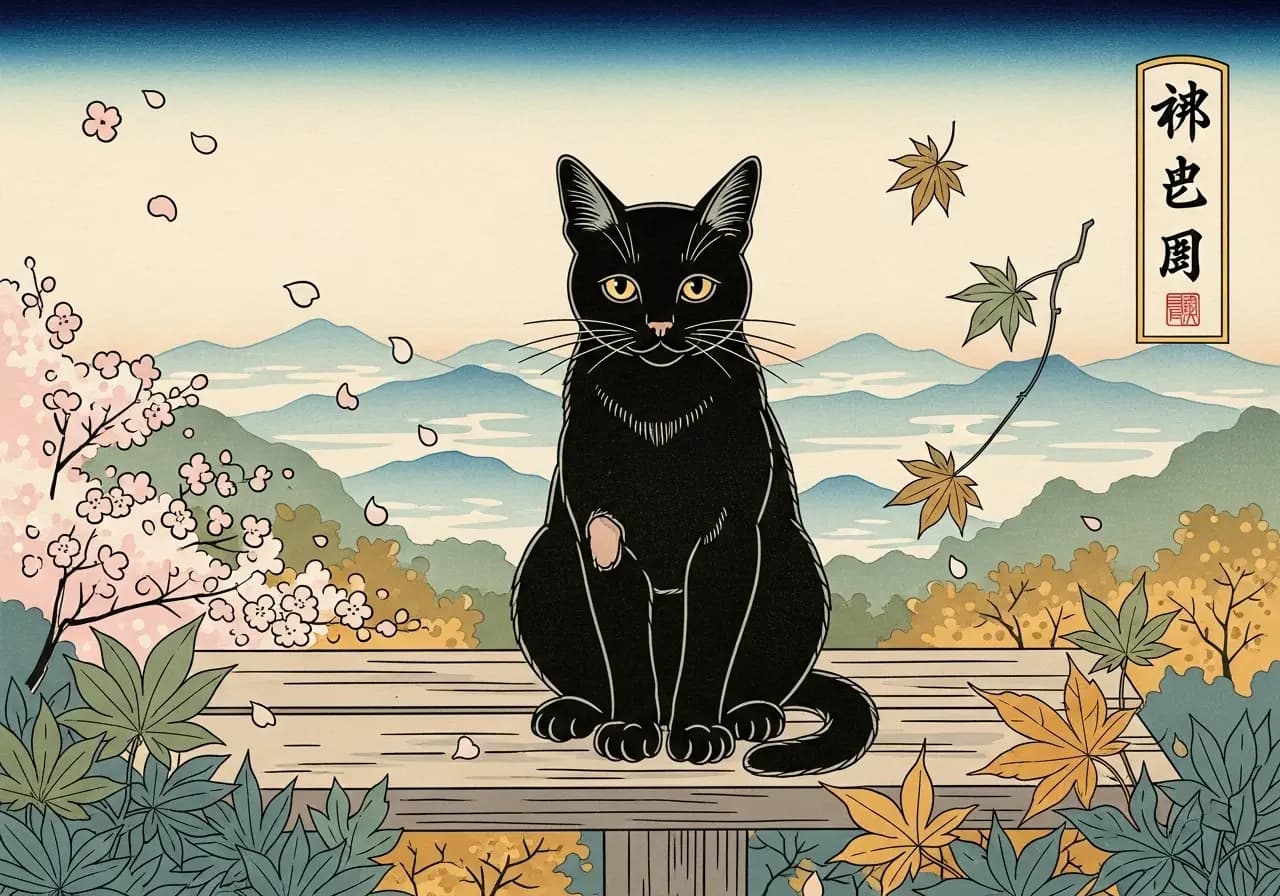
Dharma Cat: Finding Unexpected Joy in Difficult Circumstances
Episode 147 of the Secular Buddhism Podcast
Hello, and welcome to another episode of the Secular Buddhism Podcast. This is episode number 147. I'm your host, Noah Rasheta, and today I'm going to talk about how unexpected joy sometimes comes from difficult events.
Welcome
As always, keep in mind: you don't need to use what you learn from Buddhism to be a Buddhist. You can use what you learn to be a better whatever you already are.
If you're interested in learning more about Buddhism, check out my book, No-Nonsense Buddhism for Beginners, available on Amazon. Or check out the first five episodes of this podcast. You can find those episodes easily by visiting secularbuddhism.com and clicking on the "Start Here" link.
If you're looking for a community to practice with and to interact with, consider becoming a patron by visiting secularbuddhism.com and clicking the link to join our community.
A New Pet Cat
For today's podcast episode, I want to talk a little bit about a new pet that we have—a cat named Taz. Specifically, he's a three-legged cat. I want to tell you this story and tie it in with the overall idea that sometimes unexpected joy comes from difficult circumstances or difficult events.
I often refer to the analogy of life being like a Tetris game. The pieces that show up—we don't necessarily have control over what those pieces are. But when they do show up, we do the best we can with those pieces, making them fit the best way we can into the game. Before we know it, we're dealing with new pieces.
I really like that analogy, and I think it's important to recognize something: this isn't about liking the pieces that we get. It's about maintaining a little bit of open curiosity about what this piece may bring. Rather than being stuck in the moment thinking, "Here I am dealing with this piece that I really don't like," what if we could explore the idea that while we're interacting with this piece we don't necessarily like, what could come of this? Sometimes that mental exploration can give us a sense of hope. I want to talk about that a little bit.
The Backstory
Taz is the name of our cat. Now, let me give you a little backstory here.
I am allergic to cats. I am not the person you would picture having a cat, because first and foremost, I'm allergic to them. And second, I've never really identified with cats. They seem to have very interesting personalities—they come around when they want something from you, and then they're gone once they get what they want. At least, that's been my perspective of them throughout most of my life growing up. That's why I would consider myself much more of a dog person.
My wife is even less of an animal person than I am. She's what you would imagine someone who just doesn't like animals to be like. She's the last person I would have ever imagined having an animal.
So that's where we were about six months ago. The kids have always wanted a pet. We've toyed with the idea of one day having an outdoor dog, but it's too much work for our lifestyle and where we live. It gets too cold in the winter, and it would be too much work. So we opted not to have a pet dog. My wife grew up with a pet dog, and I also grew up with a pet dog. So that would have seemed like the natural fit.
But one day, the kids were asking if they could maybe get a cat. What happened was my wife's aunt had a cat who had kittens. She started calling all of the cousins, and suddenly all of them were getting cats. When our kids found out that all their cousins were getting cats, they started begging us if we could go pick up one of these new kittens.
My wife jokingly said, "Well, ask your dad." She was pretty sure I was going to say no, because I'm allergic to cats. But I surprised everyone by saying, "Well, sure, maybe we can." She looked at me with this look of concern, like, "What are you talking about?"
We decided that if it was an outdoor cat—if it lived outside and we just built a little home for it with a heated pad and other things to help with the temperature, since it does get cold here where we live—then maybe it would be wise to have a cat that patrols around the house. We live in a rural area, out in the fields where there are mice, and those mice sometimes get into the house. So the idea was that an outdoor cat would be our first line of defense.
The kids were very excited to know we were going to get a cat. So we went up to the aunt's house to look at these kittens. She had already given away the ones she needed to the other cousins. There were two left that she wanted to give away to someone. We decided it might be best to take two instead of one, because if we got just one, it might be lonely outside and run away. If we had two, they could entertain themselves and would be less likely to run away since they'd have each other.
So we took the two cats home and started our plan right away—having them live outside. Within a week and a half or two weeks, things were going well. But then we had to go on a trip. I was doing a paragliding trip in California, last August or September. Since the cats had only been at our house for a couple of weeks, we took them to our cousin's house and asked them to take care of them. We didn't want to leave them here because it was too new a place for them, and we knew it was very likely they would go missing.
When we drove home from our trip, we found out that one of the cats had gone missing. This was Taz, the little male cat—the black cat. We came home. We hadn't fully bonded with these cats yet. So it was like, "Well, that's really sad." But we thought they were always meant to be outdoor cats anyway. The one cat that was left was the spunky, vibrant one that did all the hunting. She had already been catching a lot of mice for us.
The kids were sad, and we didn't know what happened to Taz. We spent a lot of time searching the streets and fields around here, calling, leaving food, with no sign of him.
About two days later, we got a phone call. A neighbor down the road informed us that he had been hit by a car. She was the one who found him. He was injured pretty badly. They took him to the vet, gave us their information, and we called. Sure enough, he had come in with serious injuries. They had to amputate one of his front legs, but he was recovering nicely.
We informed them that we were the owners. At this point, there had been a lot of work done on him, and he had become a very expensive cat. We brought him home and took care of him. He had to stay indoors, so long story short, we ended up with a three-legged cat and some very high bills. It was a new experience—dealing with the discomfort of a situation we didn't want to be in.
The Unexpected Lesson
What happened next was quite the lesson for us. That's why I called this episode "Dharma Cat." Dharma is a word used for teachings. And this was the cat that was giving us teachings on the nature of reality.
We took him in, and he had to be indoors while healing. We bought a very nice air purifier for allergens, ran it in our room, and kept the door closed. He had a cage outside in the living room area where he healed from his injuries.
In the many weeks that we had him, my wife became a cat person. To me, that's the funniest part of this entire story. Imagine someone who really, really dislikes animals and then becomes a cat person. If you knew my wife, you'd understand how remarkable that transformation was.
She befriended and fell in love with this little cat. Luckily, his personality contributed to the whole thing because he's a very sweet, very mild and tender cat. We took him into our home, and he became part of the family. He healed with his missing paw, and fortunately, everything else healed completely. His back paw that had been injured and his right side—everything healed. He ended up being a very normal cat who just has three legs instead of four. He gets around just fine. He's outside hunting mice with the other cat.
This experience has now been six or seven months of us having cats. Taz is our little Dharma cat. He's the cat that taught me that I can love cats. He taught my wife that she can love animals and that she can love cats.
Finding Meaning in Uncertainty
I've thought about this a lot in the months since all this has happened. As we go through life and things happen, we find ourselves in circumstances we don't want to be in. In that moment, it's very easy to want to reject the Tetris piece—to say, "This is what I'm dealing with, but I don't want this."
Had someone told me six months ago what was about to happen—the day I found out we had to amputate his leg, all the challenges that would come with him—and then said, "But you'll fall in love with this cat. He'll teach you a lot about life, about resilience, about mending, about adaptation to life circumstances." I would have said, "Oh, okay. I didn't expect that."
And here I am in the present, looking back. We're really good at looking back and connecting the dots. Looking back, we can see, "Oh, okay, I'm glad that happened because I learned this," or "That happened, which led to this." But we're not very good at it in the present moment.
So the concept I wanted to share in this podcast episode is this: what if in the present moment, when confronted with difficult or uncomfortable circumstances, we could recognize that we have uncertainty about what this is going to do for us? And what if holding space for that open curiosity could change the relationship we have with the circumstances we're facing right now?
A Practice of Forward-Looking Gratitude
One of my common practices in mindfulness or meditation is looking back in the present moment and seeing the causes and conditions that allowed this moment to be what it is. It's the practice of looking back, seeing the interdependent nature of things, looking back and connecting the dots backwards. That's been a very powerful technique to feel gratitude in the present moment for everything in the past, even the unpleasant moments.
But this technique does the same thing, except looking forward. It's saying: in this present moment, whatever this thing is that I'm doing or going through, what's going to come of this? What will come of this? That's the question I like to sit with.
And the answer is: I don't know. The uncertainty, I think, is what's powerful here. So what it leaves you with is possibilities—the open possibility of who knows what will come of this. It may be pleasant things. It may be unpleasant things. You may think it's bad now, and it's going to get worse. Or you may think it's bad now, but in the end, this will all be worth it.
We don't know. Both scenarios are equally uncertain.
Looking back, I can recount so many of the difficult moments from my past—things I've gone through that I would never want to go through again—and they are very directly connected to how things are now. I think of this podcast as an example. Had I not gone through the difficulties I went through in my marriage and in my faith transition back in 2010 to 2012, I would have never explored Buddhism. I would have never started a podcast. Now I hear from people by email all the time who mention how grateful they are for encountering the podcast, a book, or any number of things I've done since that difficult period—things that have brought improvement to someone else's life.
It's fascinating to think that none of that would have happened—at least not the way it did—had I not gone through what I went through. And that gives me a sense of gratitude for the difficulties I've endured.
Lessons from My Career
This has happened in my career too. I had a business that I really enjoyed—manufacturing photography accessories and tripods. Little did I know that the difficulty of going through the failure of that company, the collapse of that company, would eventually lead to something I enjoy even more.
I wouldn't have known that at the time. Even had someone told me, I would have been like, "I don't know about that." And yet, here I am now running my flight school, teaching paragliding and paramotoring—something that almost feels unfair to call it "work." And yet, that's what I do for work. I would much rather be where I am now than where I was then. But I couldn't have arrived at this place had I not gone through that.
And what does that say about the future? Again, there's the uncertainty. What if there's something else I would enjoy even more? I don't know that because I'm not there yet. Or it could be something much less pleasant that leads to something more pleasant, which leads to something less pleasant, which leads to something more pleasant.
That's the point: life goes on. The Tetris game goes on. Pieces show up, and we never know what will come of this piece that's falling right now—the one we're dealing with in the present moment.
Closing Reflection
I hope that this idea may resonate for you as you analyze and examine the circumstances you're in, whatever those circumstances may be. Whether they're pleasant ones or unpleasant ones, hold space for that question: "I wonder what will come of this?"
The moment you bring up that question and open your mind to the almost infinite possibilities of what may come, I hope that will give you more open space in your mind to accept what comes next. See that next piece and not dread it so much—even if it's going to be an unpleasant Tetris piece that shows up. You don't know what comes next.
And that's the situation we're always in: never knowing what comes next.
Thank you for listening. I hope you enjoyed this episode, and I look forward to recording another podcast episode soon. Until next time.
For more about the Secular Buddhism Podcast and Noah Rasheta's work, visit SecularBuddhism.com