

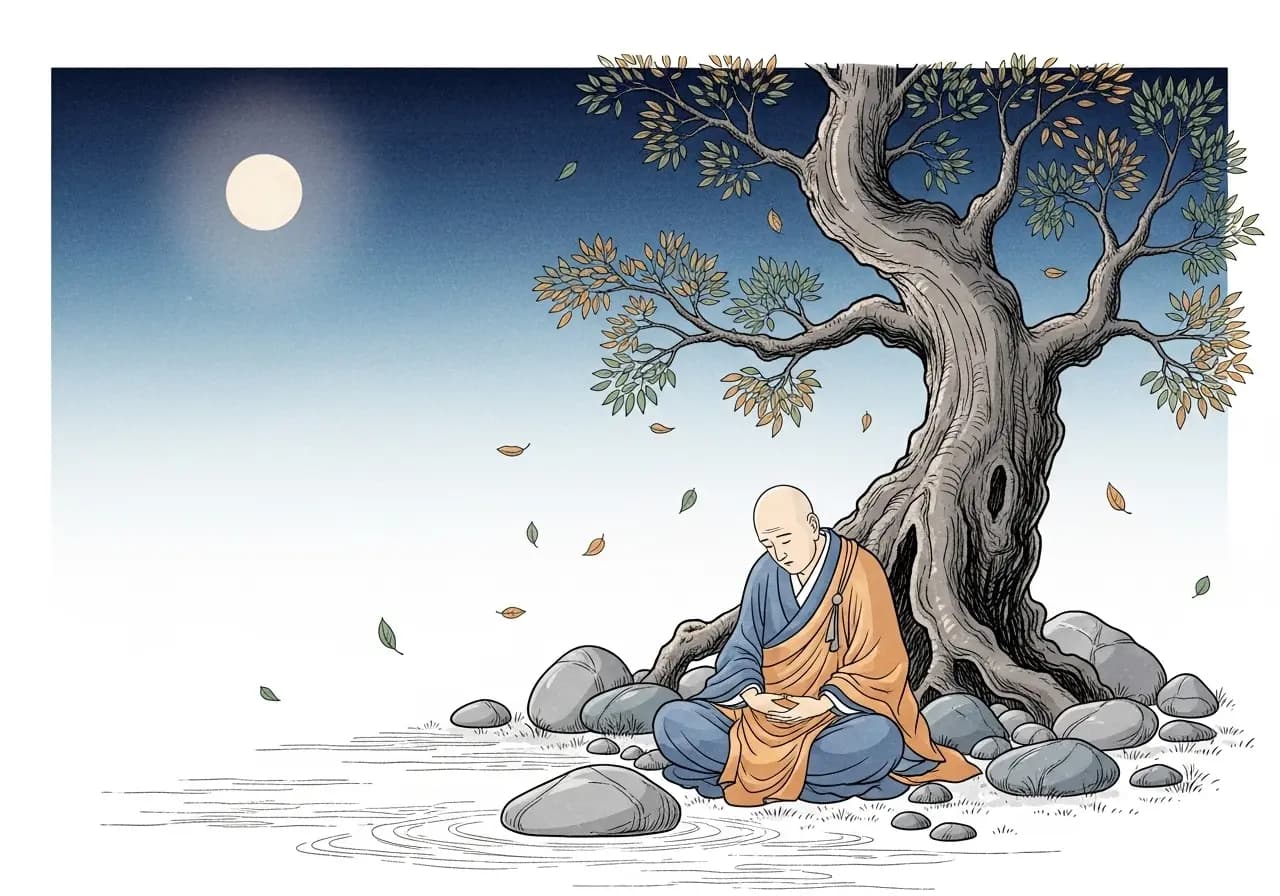
The Quest for Answers
Episode 145 of the Secular Buddhism Podcast
Hello and welcome to another episode of the Secular Buddhism Podcast. This is episode number 145. I'm your host, Noah Rasheta. Today I'm going to talk about the quest for answers.
Welcome and Resources
Keep in mind: you don't need to use what you learned from Buddhism to be a Buddhist. You can use what you learned to be a better whatever you already are.
If you're interested in learning more about Buddhism, check out my book, No-Nonsense Buddhism for Beginners, available on Amazon. Or start with the first five episodes of this podcast. You can find those easily by visiting SecularBuddhism.com and clicking on the "Start Here" link.
If you're looking for a community to practice with and to interact with, consider joining our online community. You can find this by visiting SecularBuddhism.com and clicking on the link to join our community.
What Drew Me to Buddhism
In this podcast episode, I wanted to talk about the concept of the quest for searching for answers. What drew me to Buddhism initially is the fact that Buddhism will readily acknowledge and accept the fact that there are no answers to a lot of life's questions.
Just to give you a little bit of backstory: it was roughly in 2012 that I was going through an existential crisis, so to speak. The religion of my upbringing wasn't making sense to me anymore. I felt as though the rug had been pulled out from under my feet, and I went into searching mode. I wanted to find the answers to the questions I was wrestling with—those big existential questions. Who am I? Why am I here? What happens when we die? Which is the true path or the right way? Things of that nature.
The Great Courses Lecture
While I was in this searching mode, I remember listening to an audio lecture series on The Great Courses. The title was something like The Meaning of Life Presented by the Major World Religions. There were presenters essentially answering life's big questions. At the time, I didn't know much about Buddhism. I had encountered it the way most people do—occasional quotes from the Dalai Lama or things like that, which were usually well-received. But other than that, I didn't really know anything about it as an ideology.
I remember taking copious notes during this lecture series. It was presenting the answers to life's big questions and essentially the meaning of life. You would listen to the presenter on a specific ideology—Christianity, for example—and I would take my notes. Really, it just became a matter of deciding: do these answers make sense to me or not?
I remember that feeling of, "Well, I don't know about that," with each of the presenters and each of the ideologies. When I encountered the chapter on Buddhism, I remember one of the very first things the presenter said was: Buddhism doesn't have answers to these questions. Instead, they're going to flip it on you and say, "Who wants to know?" or "Where do these questions come from?" The whole emphasis goes back onto the question, not onto the answer.
I remember that really stuck with me because that was a foreign concept for me at the time. Being a seeker, I was all about the answers. I was looking for the answers. Here suddenly I was being presented with an entirely new approach: What if it's not about the answers? What if it's all about the questions?
Bodhi Day and the Quest for Understanding
This is a topic I want to share because December is an important month celebrated in some schools of Buddhism. We have in December the celebration of Bodhi Day, which is the day the Buddha was enlightened. In other traditions, this is celebrated in early January. Either way, this topic is a meaningful one for this time of year.
I've thought a lot about this in my own personal life—this whole notion of being a seeker, trying to understand, trying to attain the answers to life's big questions. Then having the script flipped on me back in 2012, which led me down the Buddhist rabbit hole, so to speak. It was this invitation to learn more about Buddhism by looking at the questions, not the answers.
I think it's a meaningful topic. What drew me to Buddhism was my search for answers. I want to correlate this with a couple of teachings and stories that I've encountered since that time in 2012 as I started studying Buddhism. Eventually, I went down the path of becoming a lay minister and just devouring Buddhism pretty much since 2012—to the point where I felt comfortable enough to start sharing Buddhism and these concepts and ideas, whether in books or on the podcast.
The notion of questions and answers is a big one for me.
The Zen Story: The Monk and the Stones
There's a story I've been looking for ever since I first encountered it. I forgot where I first saw it, but I wanted to reference it in this podcast episode. To paraphrase the story:
A monk was trying to achieve enlightenment. He asks the teacher he's working with, "How can I achieve enlightenment?" The teacher says, "Oh, that's quite easy actually. Meet me at the top of this hill every day and bring me a stone. Once you have the correct stone or the correct rock, I'll be able to share this with you and you'll be enlightened."
The monk was pretty excited to hear that, so he starts taking stones every day up to the top of the hill where the teacher is waiting. Every day, he gets the same answer: "No, that's not the right stone. Go find the right stone."
He goes back down, and every day it's the same process. This goes on for weeks, then months, then months into years. This monk, every day carrying up stones, every day getting the same answer—that's not the right one. He's trying heavy ones, sharp ones, smooth ones.
One day, out of pure frustration, he climbs the hill with what I imagine was a very heavy stone. It's the same answer: "No, that's not the right stone." Out of frustration, he just drops the stone and says, "I'm done. This is ridiculous. I'm not bringing any more stones up this hill. There is no right rock."
The teacher tells him, "Yeah, you're right."
At that moment, the monk becomes enlightened.
Of course, when they tell you these stories, they just leave it open-ended that way. You're left as the listener to think: What's the rest of the story? What does it mean to be enlightened?
The Rock, The Question, and The Path to Peace
In a very real way, we end up going on that journey with our questions. Any time we have a big question—whether it's the big existential ones or others that may not be quite as existential but are certainly relevant in our day-to-day lives—we have these questions and we present answers, likely with stones. Is this the right one? Then under scrutiny—whether from ourselves, our religious authorities, friends, or someone else—the answer gets shot down and we're told, "No, that's not it." And you keep going, right? You keep going up this hill with more and more and more stones.
Sometimes you'll think, I think I do have the right one. But in reality, for most of these questions, there is no correct answer. There is no correct stone or correct rock.
That's how I think of enlightenment. That's why I think this concept works really well with the notion of celebrating Bodhi Day—the enlightenment of the Buddha. What does that mean, that he was enlightened? What was he enlightened to?
I like to think of it like this: the path to peace is not what we might think. We assume having the answer is the path, but I think it's more along the lines of no longer having the question.
When I imagine the Buddha—you see him in paintings—he's always depicted as having this ultimate sense of peace, this ultimate serenity. I don't like to imagine he's sitting there in peace and serenity because he secretly knows the answer to whatever life's question was. I like to imagine that what really happened is he no longer wrestled with the question.
If you think about it, there are two main approaches to peace in life:
First Path (Most Religions): If you have a difficult question you're wrestling with, one path—which I would say is the normal path of most religions—is to give you answers. When you have the answers, if you're satisfied with them, you feel a sense of satisfaction. You believe you have the correct answer, and then you're left with a sense of peace. The peace doesn't necessarily come from having the right answer. It just comes from having any answer—as long as you believe it's the correct one, you're going to feel that sense of peace.
Second Path (Buddhist): Buddhism goes a different route. It's not about having the right answer. It's about minimizing the relevance of the question. You reach the point where the question no longer matters, and then you have that same sense of peace.
The Fragility of Answer-Based Peace
Now, taking this back to that Zen story of the monk carrying the rocks up the hill: it's the same thing, right? The monk could carry the rock up the hill, and if at some point the teacher says, "Hey, that is the correct rock," the monk would feel relief. Oh, yay. I don't have to carry these rocks anymore. I have the right one. That monk would have had a sense of peace. It would have been like, I did it. I got it. This is the right one.
But that peace would crumble the moment that comes into question. Someone else comes along, maybe another teacher, and says, "I don't know that that's the right rock." Now the whole inner turmoil starts over again. He's going to be questioning: What if this isn't the right rock? What if the right rock is one that's one pound heavier or something? There he is in the midst of the turmoil again, wondering if he should start bringing rocks up the hill again.
That's the danger of having peace come from the answer or from having the right rock.
The Peace of Letting Go
Now, the other path: this monk carries the rock to the point where he's exhausted and he drops it. He's not going to bring another rock up. He's done. He's totally dropped the game of bringing rocks up the hill. That could also be a sense of peace—because he's no longer even going to attempt to bring the right rock anymore. He's given up on the quest.
There is no right rock is where he has ended, mentally. If there is no right rock, then I don't need to keep bringing these things up the hill. I'm done.
That could also be a sense of peace—the peace of no longer having to worry about carrying rocks up the hill. Now, that peace could also be disturbed if you were to start doubting again: Well, maybe there is a right rock. Maybe I should keep trying. Maybe he takes a break, and then maybe in several months he starts taking rocks up the hill again.
But the Buddhist path, to me, is very much the path of dropping the rocks. Very much the path of dropping the questions.
The serenity of the Buddha—and I would imagine this is the serenity I observe in other great teachers of the past, present, and future—that inner peace doesn't come from harboring answers or from thinking they have the answers to any of life's big questions. I genuinely think it comes from no longer having to wrestle with those questions. The questions become irrelevant because they're so anchored in the here and now that there is no internal struggle saying, Oh, what if I don't have the right answer? Because the question is not even there, itching to be answered anymore.
That to me is the beauty of this path: the path to peace is not in having the answer. It's in no longer having the question.
The Big Questions Become Ordinary
This is certainly relevant with the big existential questions: Who am I? Why am I here? What happens when I die? We want the answers to those things, but the true peace would come from not having to worry about who I am or why I'm here or what happens when I die. If I genuinely no longer wrestle with the question, I'm going to have that peace and serenity.
But to me, where Buddhism becomes extremely relevant in day-to-day life is in how this applies to our everyday questions. Maybe they're not quite existential in nature, but they're still relevant questions we wrestle with:
- Am I likable?
- Am I doing the right thing?
- Am I worthy?
- Am I raising my kids the right way?
- Am I on the right religious path?
- Do I have the correct political views?
- What if I had done this differently?
- What if I had married this other person?
- What is this person thinking of me?
- Do my friends like me?
Let's take that last one as an example: Does so-and-so like me?
The peace could come from having the answer—or at least thinking you have the answer. And the answer is yes. So-and-so says, "Yes, I do like you." Oh, okay. Well, now I'm at peace. I'm not wrestling with that question.
But then how do you know that they're telling the truth? Did they say that just to be nice? Do they really like you? There's no way to have that true certainty because you can always encounter the doubt that's going to make you question the answer.
Again, then you're back at square one: you don't really have the peace that you wanted.
Now, the other alternate path—the Buddhist path—we would say: What if the question didn't matter? What if the need to know what he or she thinks of you wasn't a need that you actually struggle with anymore? It's no longer a relevant question. It's not something that you're wrestling with internally.
Well, then you would have that same sense of peace. But this one can't be rocked because the answers are irrelevant. The answer could be, "Yes, they like you," or "No, they don't like you." It wouldn't matter either way, because the question of Am I liked? isn't one that carries much weight anymore.
That's a fascinating concept. And when I take this and apply it into my own personal life and how Buddhism has benefited me in a day-to-day setting, this is where the rubber meets the road, so to speak.
My Personal Journey: Seeking Validation
It's not so much the big existential questions—although that was certainly a big part of it for me. But with time, after the big existential questions went away, I started wrestling with just the day-to-day questions.
Am I raising my kids the right way? This was a big one for me.
But what really stuck with me was this: How can I ensure that my family members, my in-laws, my neighbors, people in my immediate circles of friends like me? Do they validate me?
I wrestled with this because in those circles, I no longer share the same ideological views as they did, and I felt judged. I felt like I was being looked at as someone who is a traitor almost—not quite a traitor, but with disappointment, like How could you be so naive to be duped? Now you're on the wrong path? That's how I perceived people viewed me, especially in those closer inner circles.
I didn't like that feeling. One of the questions I wrestled with quite regularly was: Do they validate the path that I'm on?
As long as the answer was no, I still don't think that they do. Well, then there was all the stuff that comes with not having a question answered—and me trying to do things to ensure that somehow, in some way, I could finally answer that question by saying, Yes, they actually do validate the path that I'm on.
But that's not what happened. It's not what I anticipate will ever happen.
Dropping the Rock
What actually ended up happening is I stopped relying on what that answer is and I focused on the question instead. Why do I feel the need to be validated? Why is it so important for me to feel like others will validate the path that I'm on?
The more I sat with the question, the more irrelevant the question became—to the point where the question went away. Now it's not a question that I wrestle with.
In fact, I would say the answer is probably still no and will always remain no. They're not going to validate the path I'm on because they think the path they're on is the correct one. Of course, the one I'm on isn't correct. But the need to feel that validation has gone away.
It was never about the answer. It was about understanding the origin of the question. That's an internal thing. The peace and serenity that ultimately came to me never had anything to do with the answer. It came entirely with understanding and eventually dropping the question—kind of like dropping the rock instead of walking up the hill every day saying, "Hey guys, do you respect me now? Look at this rock I'm holding."
The answer is no. But there was no rock that I could bring that would have made them feel that way. I felt that same sense of frustration, and eventually I dropped the rock and thought, I'm done. I'm not going to bring any more rocks up the hill. I'm not going to try to do anything to make you validate me because I don't think that you can.
Then peace came out of that.
Skillful Versus Unskillful Questions
Again, this is taking the notion of the quest for answers and turning it into the quest for understanding the questions. I think that's a much more Buddhist path—rather than looking for answers, we're exploring the questions.
When I think of the Buddha or any of the great teachers of the past, present, or future, I like to imagine that sense of peace, that sense of calm, does not arise from having the answers to any of life's questions. Instead, it comes from no longer wrestling with the questions themselves.
I think uncertainty and the space of not knowing—that is the domain where they are comfortable. The space of discomfort. This is a notion that's talked about quite regularly in Buddhism. It's one that I've emphasized quite regularly on the podcast: stepping into groundlessness, becoming comfortable with discomfort.
All of these things center around this great notion: If I know that there are questions that cannot be answered, then why am I still looking for the answers? Why not instead focus all my energy on understanding why those questions even mattered?
When I understand myself and where the questions come from, then what can end up happening is minimizing those questions or making them irrelevant. I don't know if the questions go away. I think one of the things to be human is to question things. One of the things to be human is to assign meaning to things. It's not necessarily that I'm going to want to or succeed in eliminating all the questions.
What actually ends up happening is the questions remain, but they're so irrelevant that for me to think What happens when I die? is on the same level as What am I going to eat for dinner tonight? I'm not losing sleep over that question.
Sure, it's a question that's there. I'm going to give it a little bit of thought and a little bit of mental energy. But if I settle on, Oh, I'm going to eat this for dinner, and then the plans change—no, actually I'm going to eat that for dinner—it's okay. No big deal. I changed plans. I pivot.
Well, for me, death is the same. What happens when I die? I don't know. I'll figure it out when it happens. I might not notice anything because maybe nothing happens. But if something did happen, well, guess what? I will pivot in that moment and say, "Oh, okay, alright. It was the Hindu explanation. Alright, then let's go with it." Or it was something none of us had ever thought about. Or it's literally nothing and nothing happens.
I don't know. But I don't lose sleep over it the same way I'm not losing sleep over the question of What am I going to eat for dinner two weeks from now? Sure, it's a question, but it's not an important question.
To me, that's the beauty of this path: the irrelevance of the questions. It's not about the answers.
Knowing When to Question
Now, I'm a fan of questioning. I'm a fan of skepticism. I think it's important to highlight here the issue of detecting which questions I have in life are skillful questions and which ones are unskillful questions.
I think it's skillful to wonder: Am I raising my kids the right way? Could there be a more skillful way to raise them? I'll read books about parenting and extract concepts and say, "Okay, well, I want to integrate this into my parenting style"—not because it's the right way, but perhaps it's a more skillful way than I had been doing.
I don't want to minimize the notion of questions. I don't want to say, "Let's get rid of all questions." That's not what Buddhism does for me personally.
It's about recognizing that some of the questions I spent time wrestling with were unskillful questions to be entertaining, while there were probably more skillful ones I could be focusing on—ones that would be more relevant in my day-to-day life.
This goes back to skillful versus unskillful: Which questions are skillful? Which ones are unskillful?
Nirvana: The Extinguishing of Craving
Now, referring to this month and next month when we celebrate Bodhi Day—the enlightenment of the Buddha—the concept in Buddhism is called Nirvana. Nirvana is a word that's translated most commonly as "extinguishing" or "blowing out."
In most schools of Buddhism, they would say there was an extinguishing of craving, right? If we talk about the Four Noble Truths—the truth of suffering, the truth of the causes of suffering, the truth of the cessation of suffering, and the truth of the path that leads to the cessation of suffering—you could argue that Nirvana is the extinguishing. It's the blowing out of all craving.
Without craving, there is no suffering, because suffering is wanting things to be other than how they are. If I don't want anything to be other than how it is, what do I end up with? Peace and serenity. Things are just as they are in the present moment.
To me, I think this notion of Nirvana and extinguishing is very relevant to the notion of questioning. What happens with time and with practice is perhaps the question isn't so intense anymore because there's an extinguishing—there's a blowing out of that candle, so to speak. That intense desire to know the answer to something that can't be known—that goes away.
You'll realize it was never about the answer. It's always been about the question.
The Peace Beyond Answers
I imagine that the fire of the unskillful questions the Buddha was wrestling with were extinguished because he came to understand the irrelevance of the questions. Like the monk who was carrying the rocks, he just dropped them and said, I'm done with this. I'm not bringing any more rocks up the hill.
For the Buddha, it was probably: I'm done wrestling with these questions. These are things that are unknowable. If they are unknowable, then I don't need to know the answer. The moment you no longer feel the need to know the answer, serenity and peace is what you're going to experience—because there's no inner wrestling, no inner war going on with that quest, that seeking for answers.
I think it can be that way for us. As we practice and apply Buddhist concepts and teachings in our lives, what we'll start to experience is a softening of that deep need to know.
What we'll end up with is a greater understanding of why we tend to be creatures who want to know things. But there are things that we'll never fully know. There are things that we can never fully control:
- How I perceive myself
- How I perceive that you perceive me
- How I perceive life should be versus how life is
All these games that we get caught up in—where we are the ones on the quest, seeking answers. I hope that we can shift gears and focus a little bit more energy on understanding the questions.
The more I understand my questions and why these questions matter so much to me, the more I may start to find that some of the unskillful questions I've been wrestling with will go away. I will have a sense of peace—a peace you would have if you had the answer. But it's even infinitely more powerful because it's not based on the answer. It's based on the question. That's been my experience as I practice these things.
The Fragility of Certainty
I often say: the people out there who feel like they're in a good place in life because they have the answers don't realize how fragile that peace is. Because the moment those answers come into question, the inner peace is gone.
I don't think it's about having the right answers. It's the fact that they have any answer. This is why you have people who are very content in almost any ideology—because they feel they have the right answer. But what happens if that answer comes into question? Now the whole thing crumbles.
On the Buddhist path, that doesn't happen so often because it was never about the answer. The answer can come into question, and so what? Then okay. Well, then that's not the answer. But there's not this great need to know the answer. There's this great desire to understand the question.
I think that's a much deeper sense of peace and joy that can arise from being so anchored in understanding your question that nothing can come along and shake you in terms of the answer.
Closing Reflections
That's what I wanted to share with this podcast episode. I hope you enjoyed this topic.
It's been a while since I've recorded a podcast episode, and I'm hoping to become a little bit more regular with the recordings from here on out, especially coming into the new year. This will probably be the last episode for this year. What a year it's been—2020 will go into the history books.
I look forward to next year and all the new podcast episodes and things that will come about in 2021. For those of you listening who've been joining me along this journey with the podcast episodes, I wish you happy holidays and a happy new year. I look forward to next year and all the new things that will be in store.
Take care, everyone. Thank you for taking the time to listen.
Until next time.
For more about the Secular Buddhism Podcast and Noah Rasheta's work, visit SecularBuddhism.com