

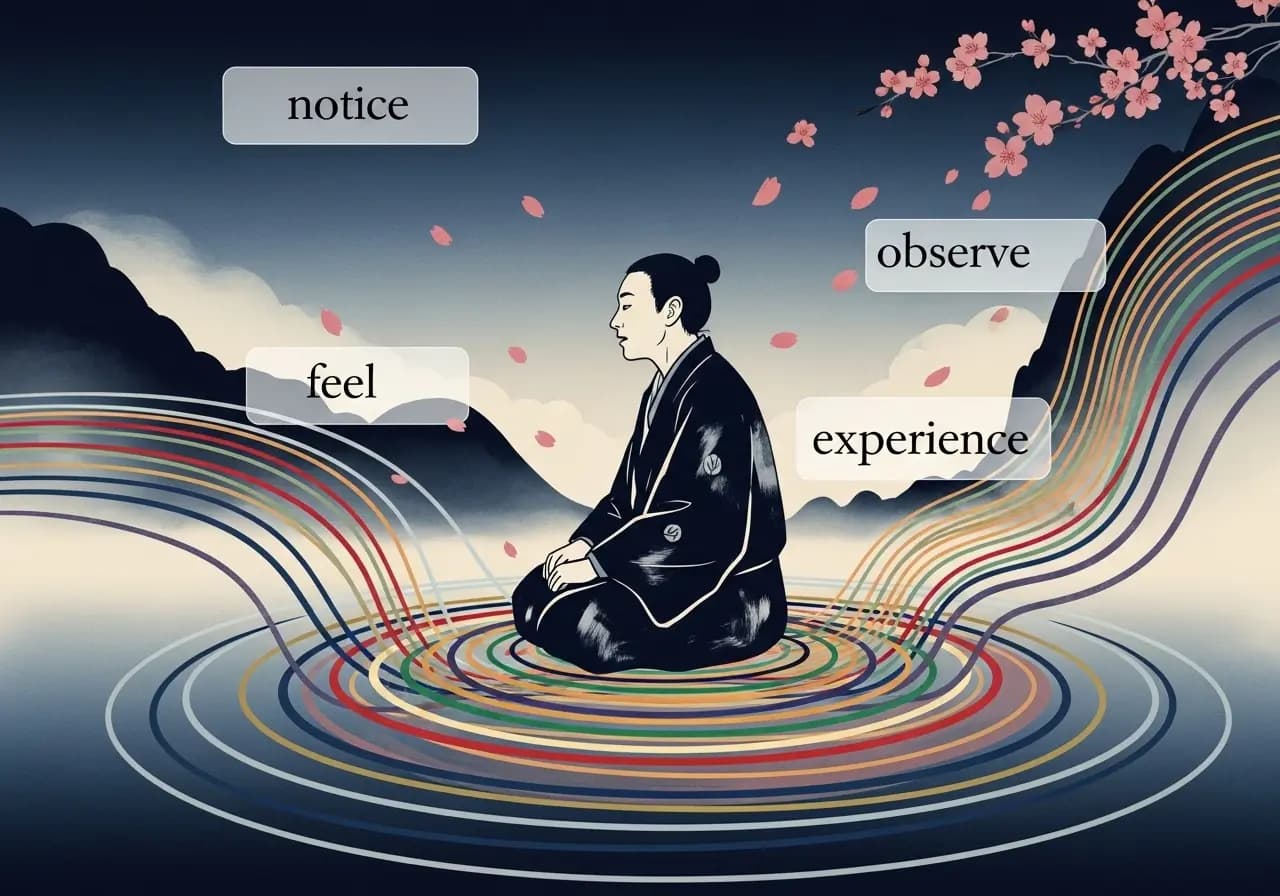
The Game of Emotions
Episode 144 of the Secular Buddhism Podcast
Hello, and welcome to another episode of the Secular Buddhism podcast. This is episode number 144. I'm your host, Noah Rasheta. And today I'm going to talk a little bit about emotions.
Keep in mind, you don't need to use what you learn from Buddhism to be a Buddhist. You use what you learn to be a better whatever you already are.
If you're interested in learning more about Buddhism, check out my book, No Nonsense Buddhism for Beginners. It's available on Amazon. Or check out the first five episodes of the podcast—you can find those easily by visiting secularbuddhism.com and clicking on the link that says "Start Here." If you're looking for a community to practice and interact with, consider becoming a patron and visiting secularbuddhism.com to join our community.
Getting Back to It
I've been interacting quite a bit with our online community over the last several weeks, and one of the topics that keeps coming up in our live Sunday discussion calls is the notion of emotions—how we experience them and the relationship we have to them. I wanted to share some of those concepts and ideas that have emerged from our community conversations.
The Unexpected Gift of Feeling
This all started with an experience I had with a good friend of mine who has been struggling with mental health issues. He spent a good portion of the year—probably the full year—really battling depression, taking a lot of medication for anxiety. He ended up in a place where he was very numb. Very numb for quite a long time.
As he slowly emerged out of this in recent months, he told me about this really neat experience. He was suddenly upset about something, but he was experiencing a lot of gratitude in that moment. He said, "I'm actually feeling something. I'm so excited that I'm mad because I've been numb for so long that it just felt good to feel something, even if that feeling was anger."
That interaction stuck with me. It left me thinking about the relationship we have with our emotions—how we cling to some emotions and want more of them, while we shoo other emotions away and don't want to experience them. But in my friend's case, he was suddenly very grateful to experience an emotion that normally he probably wouldn't have wanted to feel. He appreciated it precisely because it had been absent for so long.
That got me thinking about the relationship I have with my emotions, and it sparked something around the Buddhist perspective of mindfulness as it pertains to our feelings. I wanted to explore that.
Playing the Game
One idea that developed from this was what I'm calling "the game of emotions." Here's how it works: What if our goal in life was to simply experience and take in every possible experience of what it means to feel alive? What if we committed to experiencing the full spectrum of human emotion?
If that were a game I was playing—where my goal was to experience all the emotions one could experience—then I'd want to catalog them all. And to make the game more fun, let's say I wanted to experience each emotion a certain amount of times per week. It's an interesting reframe.
Think about what happens when an emotion arises. If happiness arises, of course I'd experience comfort around that emotion. But what about anger? What about sadness? Sure, it would still be an unpleasant emotion, but there would almost be an aspect of gratitude that co-arises with it. I'd say, "Oh good. I'm experiencing anger. And I wanted to experience this a certain amount of times this week."
You see, if the game is that I want to experience every possible emotion, that perspective shift alone would make me grateful I'm experiencing anger—much like my friend experiencing anger and simultaneously experiencing joy and gratitude around the fact that he was feeling something, anything, after that long period of numbness.
I think that's a really neat thought. What it does for me is help me remember that there are multiple layers of experience unfolding when we experience a thought, a feeling, or an emotion.
Layering the Observation
Recently, someone in our online community shared an image that really captured this beautifully. It's a simple cartoon with two panels. On the left, there's a little figure with a thought bubble that says "I'm not good enough," and their face looks sad. On the right, it's the same figure, but the thought is layered—three layers deep.
The outermost layer says, "I notice that."
The middle layer says, "I'm having a thought that."
The innermost layer says, "I'm not good enough."
I thought that was a really neat visual way to understand mindfulness and how it applies to our thoughts, feelings, and emotions.
When the thought "I'm not good enough" arises, mindfulness means: "I notice that I'm having the thought that I'm not good enough." Because it comes in layered that way, the noticing itself is neutral. There's no sadness in the observation. There's distance between the experience and the observation of the experience.
If I stay only at the inner layer—"I'm not good enough"—that's sad, especially if I believe that thought. But if I can step back and observe it, I create some space. And in that space, things shift.
The Full Experience of Being Alive
This connects back to the idea of playing the game of emotions. If my goal is to take in the full experience of being alive, then that encompasses the entire range of what it means to be alive. It means that when I experience a flat tire or the loss of a loved one or the loss of a job—or the joy of watching a sunset or whatever the experience is—I'm cataloging these as, "Wow, I get to have another experience."
Some experiences will be pleasant. Some won't be pleasant. But it's not about only having pleasant experiences or avoiding unpleasant ones. The game is about cataloging all of them.
I personally practice this from time to time. When I have a new experience I haven't had before, I add it to my list. For instance, I was driving along the highway one time and a semi-truck blew a tire. The tire rolled into my lane and I dodged it, but it hit my trailer.
Sure, I reacted and had all the thoughts, feelings, and emotions that arise from an experience like that. But what arose relatively quickly, once I pulled over, was: "Huh, I've never had this experience." I thought, put that on my list—like a little bucket list. Okay, I got that experience out of the way. Now I know what that feels like.
And again, a sense of gratitude co-arose with whatever other emotions I was having. Much like my friend experiencing joy and gratitude alongside anger. The emotions weren't in opposition—they existed together.
The Shift in Perspective
So here's the fun concept I want to leave you with: What if you were committed to accepting the full range of experiences of being alive? Next time you experience any emotion, any thought or feeling, what if you viewed it from the lens of, "I'm open to experiencing all of them"?
What if you were really tallying which emotions you've experienced and how often? Would there be a part of you that experienced a little bit of joy around the fact that you're experiencing discontent? Like, "Oh, there. I got that one off the list. Anger—oh yeah, I felt that one this week. Okay, that one's checked off. Sadness, joy... all of them."
It's a fascinating thought experiment because it really plays on this notion that the experience of having an emotion is one thing, but the relationship you have to that emotion will often determine whether you cling to it or feel aversion toward it.
The Underlying Story
I think a lot of the time we're caught up in a world where the underlying story we tell ourselves is: "I should feel this and I shouldn't feel that. I should feel more of this. I should do whatever it takes to feel more of this. And I should do whatever it takes to avoid feeling that."
We put emotions into two columns: the ones we want and the ones we don't want.
But what if the underlying belief—that some feelings and emotions are good and some are bad—is what's actually flawed? What if that belief is what's causing an unskillful relationship with our emotions?
What if the belief was different? What if the belief was: they're all good and you're supposed to feel all of them at some point? Until you do, you haven't fully lived?
If that were the belief, then when you experience an emotion, you'd say: "Ah, okay. Yeah, that's not pleasant, but I'm going to put this on my little list. Check mark next to it. Because yay, I finally got to experience that." It's just a different game with different rules.
Applying the Practice
So that's the idea of the game of emotions that I wanted to share in this podcast episode. What I hope is that you'll consider this next time you're experiencing a strong emotion. Ask yourself: What relationship do I have to this emotion? And if I were just chalking these up on a list, would I feel any kind of gratitude or joy around the fact that I'm actually feeling that emotion—however unpleasant it may be?
I think you would. At least that's what I've experienced in my own sampling of this as a concept and an idea.
A Koan to Contemplate
I also want to end this episode by introducing a koan for you to think about going into next week's episode.
I believe I've shared this one before, but it's probably been long enough that it's worth sharing again. And I do want to emphasize something: because you are always changing and life is always changing, anytime you encounter a concept, an idea, or a teaching in Buddhism, it's like you're encountering it for the first time. You're not the same person who encountered this the last time you heard it. So every meeting with a teaching is fresh.
Here's the koan:
There is nothing I dislike.
That's it. That's the whole thing. I'll share some of my thoughts on it next week. But I hope you'll sit with it for a bit. Give it some thought. See what it means to you.
Until Next Time
Well, that's all I have for this podcast episode. Thanks again for tuning in. I'm excited to be getting back on track—I've been on the road quite a bit the last few weeks, but I'm hoping to have time to catch up on several podcast topics I've written down and have been ready to share with you.
Thanks again for taking the time to listen. Until next time.
For more about the Secular Buddhism podcast and Noah Rasheta's work, visit SecularBuddhism.com