

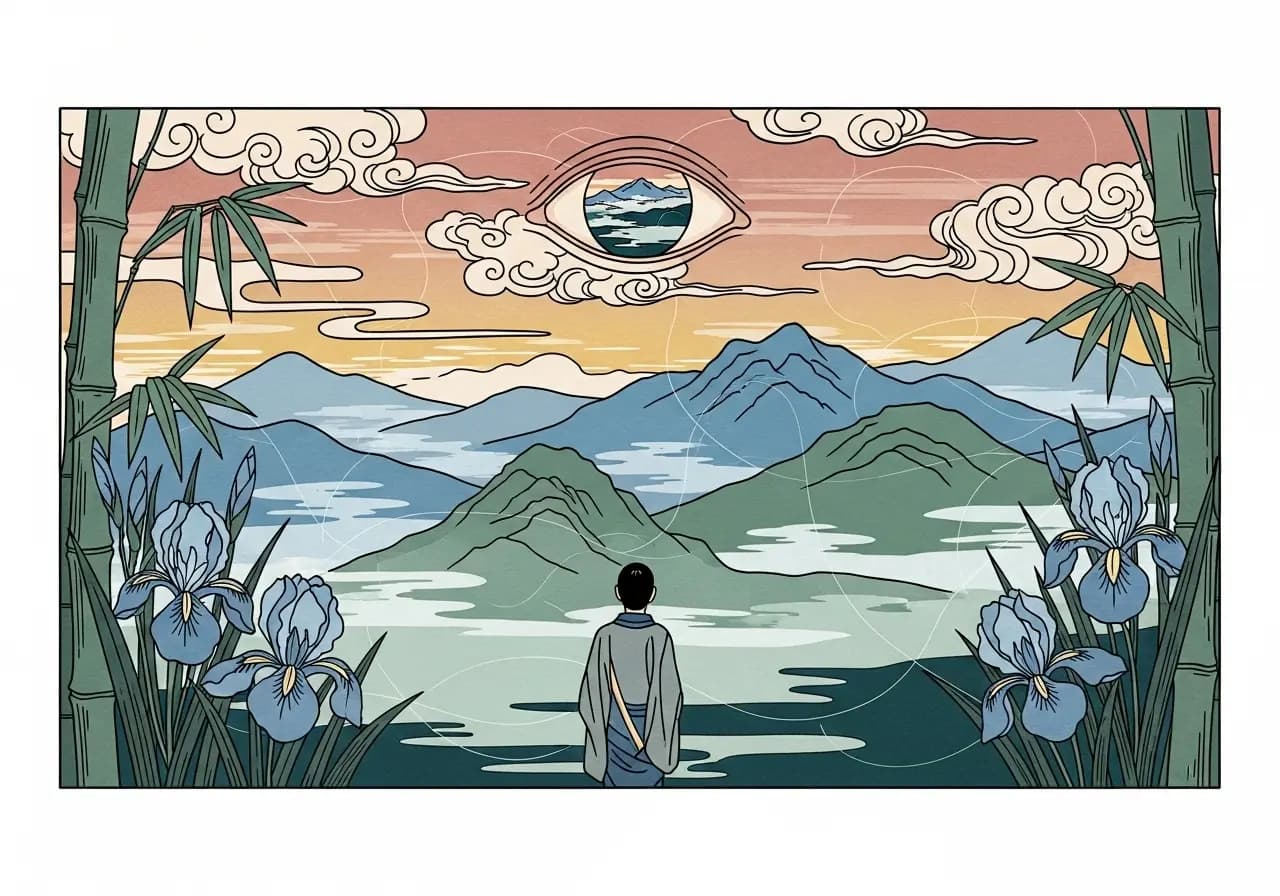
Eye of the Beholder
Episode 143 of the Secular Buddhism Podcast
Hello, and welcome to another episode of the Secular Buddhism podcast. This is episode number 143. I'm your host, Noah Rasheta, and today I'm going to share some thoughts around the topic of perception.
Welcome
As always, keep in mind: you don't need to use what you learn from Buddhism to be a Buddhist. You can use what you learn to be a better whatever you already are.
If you're interested in learning more about Buddhism, check out my book, No-Nonsense Buddhism for Beginners, available on Amazon, or start with the first five episodes of this podcast.
Also, I've got a new online workshop called Mindfulness for Everyday Life available on Himalaya, a new educational audio platform. You can find it at himalaya.com/mindfulness. If you want to give it a try, you can use the promo code mindfulness for a 14-day trial to listen to my workshop and hundreds of others.
If you're looking for a community to practice with and interact with, consider becoming a patron by visiting secularbuddhism.com and clicking the link to join our community.
Perception and the Five Aggregates
In this podcast episode, I thought it would be fun to share some thoughts regarding perception, specifically from a Buddhist perspective. If you recall the Buddhist teaching of the five aggregates—these are form, feeling, perception, mental formations, and consciousness. These five aggregates are the bundles or heaps that make up who we are, or perhaps how we are. The implication here is that perception plays a key role in how we go about experiencing our reality.
I want to correlate all of this with an expression I'm sure you've heard: beauty is in the eye of the beholder. This expression suggests that beauty doesn't exist on its own, but it arises in the one doing the observing. I think that's a fascinating thought, and I want to correlate it with the Buddhist understanding of the role perception plays in how we experience things.
A Trip to Moab: Where Beauty Begins
All of this started recently with a trip I was on. I was in Moab, which, if you don't know, is a very scenic place in Utah famous for the arches and several other national parks. The thought that occurred to me—of course, I'm experiencing Moab from the air, from a powered paraglider—was one I've had many times while traveling: "Wow, this is such a beautiful place." And that was followed pretty quickly by the thought that people come from all over the world to see this.
Then came the reminder that any place like that—this one happens to be very unique and beautiful—but all places are beautiful in their own way.
I remember one time when I was traveling in Bali, walking through rice paddies on a day trip. I would see the locals tending to their crops, and I felt somewhat overwhelmed by the landscape and the beauty of the place. It just felt like such a neat experience. The thought occurred to me that if I could pick someone from here, out of their rice paddy, and take them to my home, they would probably have a similar feeling walking through the streets and trails behind my house—thinking how neat it is to recognize that beauty is in the eye of the beholder.
For someone who's a local there, this scenery that to a visitor is so unique, so different, and so beautiful—to them it's just an ordinary day-to-day view.
The same thing happens to me. My normal view where I live may become ordinary, and I think I have to go far to experience beauty. When in reality, that beauty is everywhere because it's in the eye of the beholder.
Beauty, Film, and Meaning
So that's what was happening this past week as I was experiencing the beauty of Moab, and I started to formulate thoughts about how they relate to Buddhist teaching, which is what I want to share with you.
When we think of beauty, it's not just a painting, for example, that you look at and think, "Wow, what a beautiful painting." But we do this with all things, right? Film is a good example. I'm sure you've watched a movie at some point that moved you to tears. Maybe it was a message or just the story that really moved you.
Now, with a painting or a movie, if I were to tell you, "Hey, there is a movie out there that will profoundly change your life," and then I tell you which movie it is—it won't work the same way. You might go watch it and say, "That didn't do it for me. I didn't like that movie." I'm sure you've experienced this where a friend builds up a movie and tells you, "You have to see this. It's such a good movie." Then you watch it and think, "Yeah, it was all right." And they're stunned. "What do you mean it was all right? It's my favorite movie."
Or sometimes it goes the other way. Maybe you had an experience with a movie, a song, or a painting in a museum that really moved you, and then you try to share that with someone and they just don't experience it the same way.
I think there's something important to recognize there. With paintings, for example, if I were to tell you, "The most beautiful painting in the world, the one you will recognize as the most beautiful, is the Mona Lisa"—that may not be true for you. You might go see it and think, "Nah." But then you watch some other painting in a museum or some other movie in a theater, and you're like, "That is the one. That is the best movie I've ever seen, or the most beautiful painting I've ever seen."
The reason is because, again, beauty is in the eye of the beholder.
The Role of Genetics and Taste
Food is another example that resonates really well for me in understanding this notion of the eye of the beholder. If I taste something I really enjoy, I recognize that it's just me. I can't help it that this specific thing tastes really good to me.
I remember doing a 23andMe DNA test that gives you health traits. I remember reading through it and finding mention of a gene I have. The description said that I'm likely to either enjoy or dislike bitter tastes. It specifically mentioned Brussels sprouts as an example—that I probably like Brussels sprouts.
I remember thinking how fascinating that was because I actually really do like Brussels sprouts. There are people who don't like them at all. It might be because they don't have the gene that lets them taste that bitterness in the way I do. Or backwards—they have the gene that makes them taste the bitterness more intensely, which is why they don't like it.
I can't remember the exact mechanism, but I remember being fascinated by the thought that it's just a gene—something I inherited—that makes me like or dislike a specific flavor like Brussels sprouts.
If that's true with something like food, how much more so is that true with other things we perceive as pleasant or beautiful or unpleasant and ugly? So again, this notion that beauty is in the eye of the beholder isn't just about beauty. It's really saying anything that you perceive is in the eye of the beholder. Ugly is in the eye of the beholder. Good is in the eye of the beholder. Bad is in the eye of the beholder.
The Madhupindika Sutta: The Honey Ball Discourse
I love taking this train of thought down the path of Buddhist understanding. The thoughts I'm going to share come from what's called the Madhupindika Sutta, the Honey Ball discourse. It's an actual discourse attributed to the Buddha, and I want to share some thoughts regarding it.
In the Honey Ball discourse, we learn about the role that perception plays in our understanding of reality. Perceptions are meanings, and they are subjective and dependent upon our sense faculties, which in our case are limited and conditioned.
What do I mean by limited? Take sight, for example. The sense organ that does the seeing is the eye, and our eye—the human eye—is limited in distance. We can see comfortably a certain distance, and then beyond that, we need binoculars or a telescope. Other animals, like an eagle or other birds of prey, might have the ability to see much greater distances than we do. Therefore, the way they perceive is different than the way we perceive.
In terms of color, this is also fascinating. A quick search indicates that a healthy human eye has three types of cone cells, each of which can register about 100 different color shades. Therefore, most researchers estimate that humans can distinguish about a million colors.
Now, compared to our measly three color-receptive cones, a mantis shrimp has 16 color-receptive cones. They can detect 10 times more color than a human and probably see more colors than any other animal on the planet. They can see in ultraviolet, in infrared, and even polarized light.
So the way a mantis shrimp perceives is very different than the way a human perceives. If you've ever seen a picture of the universe from an infrared camera, you know what I'm talking about. Just imagine if you could see in infrared—you would perceive things in a very different way than someone who can't.
This is a fascinating understanding of the nature of perception and how it correlates to reality. Think of a dog, for example. A dog can smell much, much more than we can. A dog can smell drugs in a suitcase. A dog can smell a fire hydrant and know who or what passed by several hours ago. The way it perceives reality is very different from the way we perceive our reality because of the differences in our sense organs.
Another example is a bat. A bat perceives sound in a very different way than we do. A bat can use the sound it hears to make a mental image of what's around it and use that to determine where it is. We don't do that as humans. That's just another example of the differences in how we perceive.
The Process: Sense Organs to Beliefs
Back to the Honey Ball discourse. We learn that dependent on the eye and forms, eye consciousness arises. Eye consciousness arises from a sense base, an object, and the meeting of the three is what is called contact.
Think of it like this: with contact as the required condition, then there's feeling. What one feels, one perceives. What one perceives, one thinks about.
So the process works like this: I have an eye, and the eye sees something—the form. There's the eye, there's the form, and then eye consciousness is what arises. It's the recognition of what I'm seeing. The teaching goes on to talk about this with all the other sense organs—nose, taste, and so on.
But what I want to highlight is the correlation between contact, feeling, perception, and thought. The moment contact happens—which is the meeting between the eye and what the eye is seeing—eye consciousness arises. The connection of all those things is called contact. Through contact, feeling happens. Through feeling, perception happens. Through perception, thought happens.
Let me unpack this a little bit.
Contact is the eye that does the seeing. The object is the thing that's being seen. The eye consciousness that arises—in other words, the recognition that the thing doing the seeing is aware of the object that's been seen. That process, as it happens, gives way to a feeling.
This feeling often depends on the conditioned mind. For example, my mind is conditioned by memories. It's conditioned by genetics. So again, using genetics as an example: as taste happens and I'm tasting a Brussels sprout, the feeling that arises is, "I like this. I like this flavor." Or it could be the opposite: "I don't like this flavor."
Or if I'm talking about other factors like memories: I might see something that reminds me of something scary, so the feeling that arises is fear or aversion. I don't like this. Or the opposite—there's a mental association with what I'm seeing that connects to a past experience that was pleasant. So now the feeling is, "Oh, this is pleasant. I want this." So that's feeling.
Then feeling gives way to perception. Perceptions are tricky because they don't give you ultimate reality. They don't give you absolute truth. All they can give you is a subjective readout of where you're coming from—all your past experiences and genetics coming together in this specific moment in time.
So in this one moment, the position might be: I like the Brussels sprout. Or the opposite. All of my memories, genetics, past experiences arise to give me: I don't like what I'm seeing, I'm going to run away from it.
Then with that comes thought. I think we can call thought an opinion or even stronger—a belief. The belief is Brussels sprouts are good, or snakes are dangerous, I need to run. Or whatever belief suddenly arises through this mental process.
The Ending of Quarreling
So if this is the mental process we're all stuck with all the time, what the Buddha taught is: how can this process be ended? Well, through a shift in perception caused by the way we relate to our feelings.
The Honey Ball discourse starts with someone asking the Buddha, who is out starting his day routine, stretching or something. He asks, "Hey, what do you teach? What is your doctrine?" And the Buddha replied: "The sort of doctrine where one does not keep quarreling with anyone, where perceptions no longer harass us such as my doctrine, such as what I proclaim."
This person doesn't quite understand what that means. But later, one of the Buddhist followers, a monk, explains in greater detail. He goes on to explain the correlation between each sense organ and what it's perceiving. He explains: dependent on eye and forms, eye consciousness arises. And ear and sounds, ear consciousness arises. And so on. Nose and smells. Tongue and tastes. And intellect and ideas.
I really like this teaching because it shows the understanding that senses correlate to feelings, which correlate to perception, which ultimately correlates to beliefs or positions—taking a position, having a view, having an opinion. Then what you can practice through all of this is the idea of non-attachment.
I understand that when something happens and I sense something, I'm going to intuitively create a view. And I will tend to want to hold onto my view. But it's as if the Buddha was saying, "I know that about myself, and I know how to release my mind from holding onto the views or beliefs that it will inevitably create as it goes about sensing everything. Because of this, I'm no longer snared in any of these views, opinions, and beliefs as they arise in my mental processes."
To me, this is incredibly fascinating. In the Avengers movie, Dr. Strange can look into the future and see all the possible scenarios and outcomes. That ability empowers him. I think it's similar to this. If we're able to see all the possible positions that we can create and recognize the dilemma we're in—we'll see what's happening—but what does that take you toward?
This is the heart of the doctrine of no quarreling that the Buddha was talking about. It's almost as if the Buddha was saying: All that action, all that effort of taking a position—where does that take you? It takes you to another place, another position, arguing with people. Why don't you just come out of needing to have a position to hold onto in the first place?
Because the Buddha understood that the way our sense organs correlate to perceptions, and ultimately to beliefs and views—to me, this is the heart of this understanding. Understanding this doctrine, you recognize that everything and anything you can hold onto can't be ultimate truth. It can't be absolute truth because it's just a mental game that's happening. It's a mental labeling based on a perception based on where you happen to be in space and time. And space and time is always limited, and it's always subjective.
This is how it is because I'm here and because it's now. But it would be another way if I was there and if it was then.
Do you understand that? It correlates very well with the notion of the blind men and the elephant—where I stand in place and time and what I'm sensing determines how I perceive, which ultimately determines all of my views, all of my opinions, and all of my beliefs.
I think that's why the Buddha said: "This is the end of taking up rods and bladed weapons, of arguments, quarrels, disputes, accusations, divisive tale-bearing, and false speech. This is where these unskillful things cease without remainder, and that is what I teach."
No Quarreling—Inside and Out
I think it's interesting that when asked what he teaches, his focus was a doctrine without quarreling. Right away, I would think: that means I don't have to quarrel with others because I understand that my understanding of reality is subjective. It's based on my sense organs and how I perceive my senses. And yours is based on yours and how you perceive. Therefore, I don't need to quarrel with you.
But I'd like to take that a step further. I'd like to imagine that the Buddha was implying this doctrine of no quarreling wasn't just with other people and other positions, because I recognize that all those positions are subjective.
I think he was implying the doctrine of no quarreling happens internally. I don't need to quarrel with my own views. I'm going to have senses that lead to perceptions that lead to thoughts that lead to beliefs that may contradict other perceptions, other thoughts, and other beliefs that I hold.
I might hold both of them. The quarreling that happens inside—that's the quarreling that ends up going away. It goes away through this understanding that everything that arises is dependently arisen. It's impermanent. And it's not actually me. It's the notion of no-self, and it passes.
So what does that mean? Well, it means there's no perception to defend because through insight into perception, the mind can essentially give up the game of labeling. What it achieves is a sense of liberation and a sense of peace.
I think that's what the Buddha taught: if you do the practice that takes you to that, you'll know this for yourself. Very much the same way you know a painting is beautiful—not because someone told you, but because it's what you perceive. It's the recognition that beauty is in the eye of the beholder. And so is ugliness. And so is everything else that we perceive.
The Subjectivity of All Things
What I perceive is in the eye of the person doing the perceiving. That, to me, is a really profound understanding. What is right? What is good? What is beautiful? What is correct? What is incorrect?
To a great extent, it all remains in the eye of the beholder. That, to me, is the essence of what this sutta—what this discourse—is about: the Honey Ball discourse.
You can read that one in greater detail on your own if you want to. But those were the thoughts I wanted to share with you regarding perception.
As you go through life—and I'm doing this myself—and I perceive things, my perception leads to a mental formation that leads to a view. I take a position and I say, "Yes, this is beautiful."
My practice of non-attachment then says, "This is beautiful, but is it really? Is it really?" Because it is to me, but that doesn't make it absolute. That makes it subjective because I understand how senses work. I understand the correlation between my senses and my perceptions, and my perceptions and my thoughts, and my thoughts and my beliefs. All of that leads me to a position, but I don't need to defend my position because it's not a position I'm invested in.
To say this is beautiful is to say this is beautiful to me. Or this is ugly—this is ugly to me. Or this tastes good—this tastes good to me. Or this tastes bad—this just tastes bad to me. It's not an absolute thing. It's a relative thing and a subjective thing.
That, to me, is the correlation of this expression: the eye of the beholder.
Closing
So hopefully you can take all these thoughts and ideas and apply them somehow to your day-to-day life and your day-to-day experiences. As you go about sensing through your sense organs—sight, smell, hearing, touch, and even mental processes—I think this is a really powerful understanding that helps you to practice non-attachment.
So there you go. Those are my thoughts on perception and the eye of the beholder. That's all I have for this episode. I hope you enjoyed it. Until next time.
For more about the Secular Buddhism podcast and Noah Rasheta's work, visit SecularBuddhism.com