

Mindfulness for Everyday Life: Part One
Episode 140 of the Secular Buddhism Podcast
Hello and welcome to another episode of the Secular Buddhism Podcast. This is episode number 140. I'm your host, Noah Rasheta.
Today I'm taking a quick pause from the ordinary format of the podcast to let you know about my new Mindfulness for Everyday Life workshop.
As some of you may recall, in the past I used to travel and host in-person mindfulness workshops. After some time, I stopped doing those due to time constraints and logistics. For a couple of years now, I've had the goal of creating an online audio version of the workshop that would include concepts and ideas along with actual practices, guided meditations, and exercises to help you learn how to apply mindfulness for everyday life.
After several months of planning and working, I'm excited to announce that I've partnered with Himalaya Learning to produce a 20-part workshop called Mindfulness for Everyday Life.
What you're about to hear is part one of this 20-part series. I hope you enjoy this 15-minute episode and decide to listen to the rest of the course.
Welcome to the Mindfulness for Everyday Life Workshop
This workshop is split into approximately 20 episodes, each about 15 minutes long. This first episode is about the word mindfulness itself.
When we talk about mindfulness for everyday life, I think it's important to first define what mindfulness actually is and why we would even want to practice it. Let's jump into that now.
What Is Mindfulness?
I want to share some concepts and ideas that will help you wrap your head around the overall idea of mindfulness. Mindfulness is a set of practices inspired mainly by teachings from the East, particularly from Buddhist traditions. But it's more than that—it's a form of understanding the nature of our own minds. You could say it's almost a philosophy, a way of life. And mindfulness enhances everything we do in our lives.
I'm sure you've heard the word mindfulness before. That's probably why you were interested in this workshop in the first place. But when we hear the word mindfulness, it probably makes us think of some kind of concept. To be mindful is... and you fill in the blank. What does that mean for you?
When we're talking about mindfulness the way it was understood in the Eastern traditions from which this practice comes, mindfulness is the non-judgmental observation of the present moment. It's a way of being.
Imagine being able to sit with an experience you're having. Let's take, for example, a strong emotion. As you go about your day-to-day activities, something happens. Let's say you're driving and a car cuts you off. The first thing you experience is some form of an emotion—maybe frustration, maybe downright anger. And the emotion that we're experiencing is typically strong.
Now, mindfulness practice is the ability to observe the present moment in a non-judgmental way. But that doesn't mean that if I'm mindful, when a car cuts me off, I'm not going to be upset. That's not exactly how it works.
The way it actually works is this: when I'm driving and a car cuts me off and I suddenly realize I'm angry, I can observe in a non-judgmental way the emotion I'm experiencing without being angry at the fact that I'm angry.
Typically, when we encounter a strong emotion throughout the day, we have a feeling about that emotion. Anger, for example, is something we typically feel aversion to. We don't like that we feel angry. It's an unpleasant feeling. So when the feeling arises, we have an aversion to it, which immediately sets us up for a secondary layer of experience.
There's the initial experience of anger—that's what I'm experiencing. And now, because I'm experiencing the unpleasantness of the anger, I'm also experiencing an aversion to my anger. In other words, I'm either mad that I'm mad or something along those lines.
Mindfulness is essentially the practice that allows us to remain with the first layer of experience we're having. It's a really powerful thing.
The Space Between Stimulus and Response
Viktor Frankl, the Austrian psychologist and Holocaust survivor, said this: "Between stimulus and response there is a space. In that space is our power to choose our response. In our response lies our growth and our freedom."
I really like this quote because it helps me understand what's going on in terms of practicing mindfulness.
I like to think of my day-to-day life as a series of stimulus and response. All of us experience this as we go throughout our day. Let's say you go to work and your coworker says something to you, or your boss says something to you. There you go—that's the stimulus. Next is the response.
I may respond, and I'm not talking about necessarily responding with words. It may be that I'm responding immediately with thoughts. Like, I'm angry that my boss said this or did that. And immediately when I experience that anger, that's another stimulus and another response. I'm experiencing anger—that's the stimulus. What's my response to experiencing anger? For most of us, it's an aversion to the anger we're feeling.
And this cycle goes on and on throughout our days. Stimulus, response, stimulus, response, stimulus, response—all day long, on and on and on for our entire lives.
So mindfulness as a practice, you can think about it as a tool that teaches us to be able to—even if only for a moment—put little gaps between stimulus and response. Gaps where we're suddenly able to observe in a non-judgmental way whatever is occurring in the present moment.
This is beneficial when we're experiencing difficult things, but it's also beneficial when we're experiencing pleasant things. To be able to mindfully observe the awe and wonder that I'm experiencing when I'm looking at a sunset or observing a shooting star in the sky, or holding your child that was just born. You can imagine all the pleasant and positive things, as well as all the difficult and what we would call negative things.
So that's essentially what mindfulness is. Keep that in mind.
Why Practice Mindfulness?
Now I want to explain a couple of ideas and concepts to help explain why we would even want to practice mindfulness.
The Muddy Jar
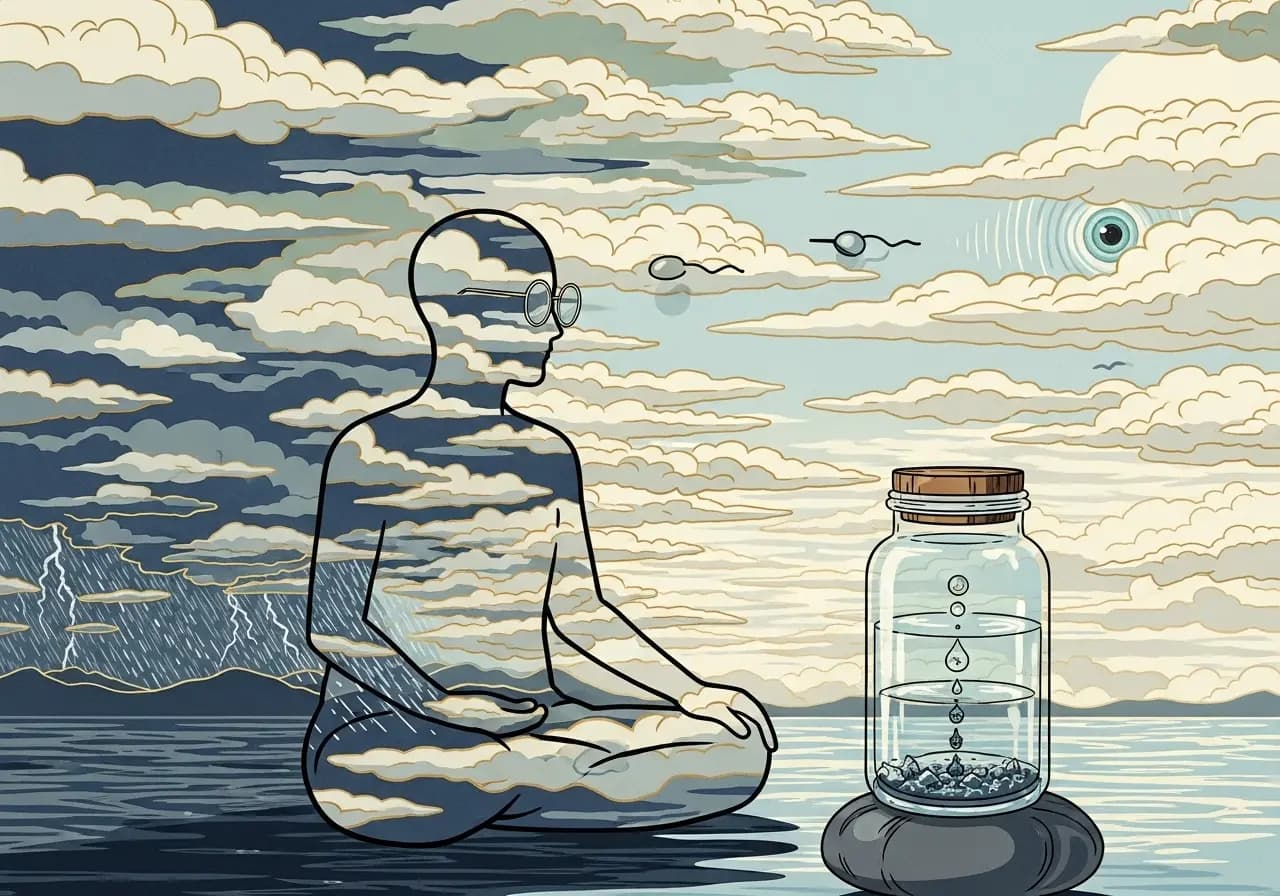
The first concept is what I call the muddy jar. This comes from Alan Watts, who says that the mind is a lot like a jar of muddy water. The best way to clear it is to leave it alone.
I like this specific analogy because often when it comes to mindfulness, we think of it as something we're doing. In other words, here's normal me, but the mindful me is different, right? The mindful me isn't going to be angry. The mindful me is going to be okay with whatever life throws my way. So we approach mindfulness as if it's something we need to do.
But in reality, it's more like the jar of muddy water. If you leave it alone, with time, the sediment drops and you start to have more clarity. You can see in the water and see what's actually there. When it's agitated, the water is just murky all around. But it's with time and leaving it alone that you can start to see a separation between the water and whatever was floating in it.
Our mind is similar from the mindfulness perspective. It's not so much that we're trying to do something or will ourselves to be mindful. It's not that. It's that we're trying to learn to sit and observe. And what are we observing? Anything that's taking place in the present moment—whether that be external things or, more importantly, the internal things: the thoughts, the feelings, and the emotions that arise in me. I can observe those things in a non-judgmental way.
And through practicing this observation with enough time, it's like that murky water. It's not agitated anymore. It becomes more clear. And when things settle a bit, then there's clarity and I can see. I can gain insight into the nature of my own mind.
So that's where mindfulness becomes a really powerful tool. It's not going to make me better at the things I do. It's about giving me greater insight into the nature of my own mind. Why do I say the things I say and do the things I do? Why do I feel the things I feel? And so on.
And if you think about it, that is infinitely more powerful than gaining any kind of external insight.
I think sometimes we approach mindfulness because we want something. If I could be more mindful, then I'll be a better employee and I'll be getting a raise. Or if I could be more mindful, then things won't bug me and I'll finally be happy. Or something to that effect.
And it's not that those things are things we shouldn't wish for or aspire to. It's just that we're kind of missing the point of the tool. The point of the tool—if mindfulness were a tool—is that you're peeking into the nature of your own mind and gaining insight and understanding into the inner workings of your own mind. And that, to me, is more important and more powerful than the other things.
Observing the Clouds
Another analogy that I think is helpful when we're talking about mindfulness is the analogy of visualizing the clouds in the sky.
If mindfulness practice is the art of the non-judgmental observation of the present moment, we all know what this is like because we've all sat and looked at the clouds. When we look at clouds, we typically don't look at a cloud and say, "Well, that one's too puffy. I don't like that cloud. That one's too tall. That one's too..." whatever, right? We don't do that with clouds.
And here's where the important distinction comes in: we don't have judgments with clouds because we don't have expectations of what a cloud should be. We just observe how a cloud is. This one may be puffy, another one may look like a rabbit, another one may be whatever. The point is that I'm just observing, and in the act of observing there is no judgment.
So if I were to sit outside and observe the clouds for a moment, I would be practicing mindfulness. It's the non-judgmental observation of the present moment.
Now take that way of thinking and apply it to the observation of what's taking place in your own mind: thoughts, feelings, emotions, opinions, beliefs. All these things float in our mind similar to the way clouds do. Thoughts, for example, they arise, they linger, and then they go away or get replaced by other thoughts. Very much the same way clouds arise and linger and transition and move.
So visualize it this way: if I'm sitting there observing the clouds in the sky, I'm practicing mindfulness. But then you apply that inward to the thoughts, feelings, and emotions that you're experiencing.
Looking Through Tinted Glass
Another helpful concept here with mindfulness as a practice is the example of looking through tinted glass. Bring to mind a pair of glasses—whether it's sunglasses or regular glasses. Sunglasses are actually a good example because they have a tint. And the tint can be helpful if you're out in the bright sunlight. The sunglasses will alter what you see so that you can see more comfortably.
But any form of tint is affecting what actually is versus how I perceive what actually is. Let's take a strong tint, for example—yellow glasses or red-tinted glasses. If I'm looking through a pair of glasses that have a colored tint, let's say red, then everything I look at, everything I see is tinted with red. And it's not because of how things are—it's because of how I'm seeing things.
In much the same way, we move through life looking through our own tinted glasses. Our beliefs, our conditioning, our past experiences all tint the way we see the world. Mindfulness helps us become aware of those tinted lenses so we can see more clearly.
The Magic Eye Picture
The final analogy I want to share about mindfulness is the analogy of those pictures from your youth. Do you recall those? There used to be pictures made up of a bunch of little dots or strange patterns. At first, it looked like you weren't looking at anything. But if you learned to focus your eyes behind the painting—in other words, beyond the painting—then you could suddenly see an image that would pop out. Usually it was the outline of something.
So you would look at this random picture that looked one way, but then if you looked at it long enough and focused your eyes a little bit differently, suddenly you could see something appear. And that something was there all along, but we couldn't see it until we shifted our focus or changed the way we see things.
That, to me, is the final analogy that works well with what we're trying to accomplish with mindfulness as a practice.
The way we perceive life right now is like looking at that painting. It looks a certain way, and there may be something there we don't see. But mindfulness as a tool will help us develop our sense of perception to the point where, before we know it, we may see something we hadn't seen before. We may notice something we hadn't noticed before.
And this is where mindfulness becomes a really valuable skill and tool, because at any given moment there are incredible things going on in each of our lives. And a lot of times we simply don't notice them. We simply don't see them. And this is because of our inability to focus or see beyond the superficial level of what we're looking at.
Just like with that painting: if I only look at the surface, I don't see it. But when I learn to look a little bit deeper and focus my eyes on a point behind the painting, suddenly a new picture emerges. And once you can do that, once you can see it, you can never unsee it. Every time you look at one of those paintings, you'll be able to see what's there because you know how to see differently.
The Heart of It All
I want to share a quote from Mingyur Rinpoche. He says: "When we take the time to look at the way we see things, the way we see things changes."
That's what we're going to do in this workshop. Mindfulness as a practice is the non-judgmental observation of the present moment. And what will happen is that we're going to take the time to look at the way we see things, and the way we see things will change.
That doesn't mean the things will change, but the way that we see things will change.
So these are the concepts and ideas of this first episode. In part two, I'm going to share some exercises and guided meditations for how to start practicing mindfulness in your day-to-day life.
About This Course
What you just heard was part one of a 20-part series. Each episode is roughly 15 minutes long, and you will listen to ideas, concepts, meditations, and exercises for how to apply mindfulness to everyday life.
Himalaya Learning is a new educational audio platform specializing in audio courses that focus on lifelong learning, business, personal development, and more. It features courses from some of the world's greatest minds, including Tim Ferriss, Malcolm Gladwell, Elon Musk, and others.
To listen to the rest of this course, visit himalaya.com/mindfulness and enter the promo code mindfulness at checkout to get your 14-day free trial of this course and all of the other courses available on Himalaya Learning.
As I mentioned, this was a pause from the ordinary podcast episode format. But now that I've completed this online course and it's available through Himalaya Learning, I'm going to be returning to the normal podcast format. You can stay tuned for more Secular Buddhism podcast episodes very soon.
Thank you for taking the time to listen. Until next time.
For more about the Secular Buddhism podcast and Noah Rasheta's work, visit SecularBuddhism.com