

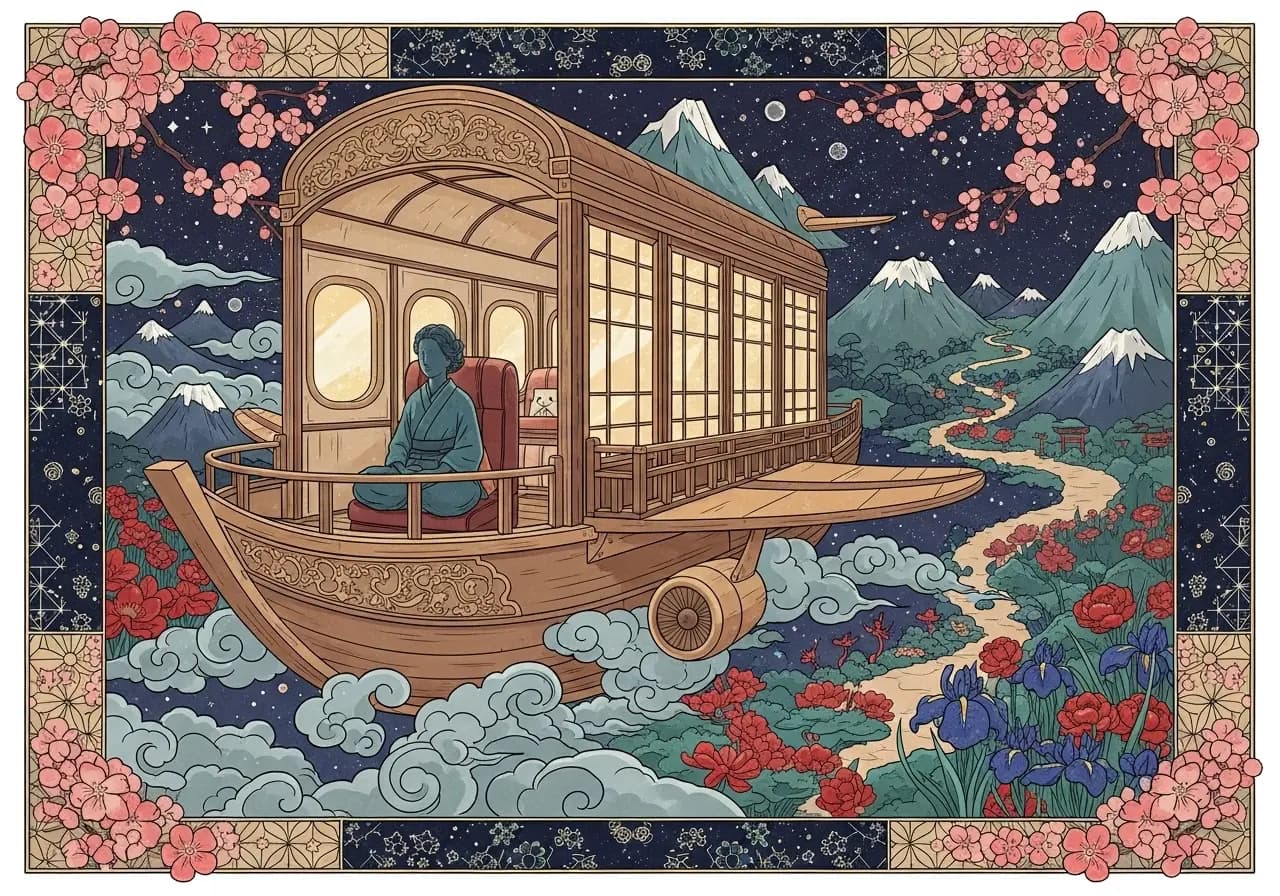
The Journey of Life
Episode 14 of the Secular Buddhism Podcast
Hello. You are listening to the Secular Buddhism Podcast, and this is episode number 14. I'm your host, Noah Rasheta, and today I'm talking about the journey of life.
Welcome
Hey guys, I'm excited to be recording this podcast episode this week. It's been difficult for me because I'm traveling this week and next week. Between shows, I'm in Hong Kong and Beijing attending trade shows, and I'm trying to find the right time to record a podcast episode. It's been hard to prepare, and it's been hard to feel completely awake because it's opposite of the time I'm used to. My body is thinking I'm supposed to be asleep, but I'm really awake. It's made for an interesting experience trying to have the clarity of mind to convey what I'm trying to convey in a podcast episode, so this may be shorter than my normal episodes.
What I really wanted to discuss is the analogy of life—the journey of life—and what that experience is when compared to the analogy of flying over here. On my way here, when I got on the plane, the lady I was sitting next to right away said, "Man, this is a crappy airplane." I kind of paused for a minute because I was thinking, what is she talking about? Why is this crappy? Then she went on to tell me about the last flight she was on that had every screen, every chair with its own personal screen. This one was an older plane without that.
As she was explaining everything and telling me how unhappy she was about being on this flight, it occurred to me to tell her something she must not have known. You don't need your own screen anymore. If you have a tablet or a smartphone, you just log into the Wi-Fi, and there you have the whole system. Access to movies, videos, and everything directly on your personal device.
I explained that to her and showed her how to log into the Wi-Fi on the airplane. And then she was all smiles, enjoying her trip again. Suddenly, she had gained knowledge that made the experience different for her, and I thought, man, there's got to be a lesson in that. As we go through life on the crappy plane, maybe the right knowledge will help us realize, "Oh, this actually isn't as bad as I thought."
Drawing Lessons from the Flight
I had that in mind throughout the rest of the flight, and I kept drawing lessons from the experience of being on it. I thought, isn't life a lot like this journey? We start at one point, and we all end at the same point. We start with life, and we end with death—at least, that's the experience we're having in the present moment. That's how we know it starts and ends, and that's all we know. What we know that we have right now is just the present moment.
Throughout the entire flight, I kept thinking about that. I would look at the clock, and in this case, I knew exactly how much more time I had. Four hours left, six hours left, twelve hours left—it was a fourteen-hour flight. I kept thinking about how all I really know is what I have at this specific moment.
At one point on the trip, there was turbulence, and the plane kind of started shaking. I'm thinking, oh, I hope it's not like this the whole time. But there's no guarantee. The moment I started experiencing that turbulence, I was thinking it could be like this for the next five hours. And I was like, "Oh, that would be horrible." But that's what we do in life, right? Turbulent times come up, and we're thinking, oh great, that's it. Life's going to suck forever. And it doesn't. Then it stops. And when it stops, I have no indication of whether or not there will be turbulence again, or if it's going to be the same or worse than it was last time. That's all part of the journey—you're just going through it, waiting to figure it out and see what's going to happen next.
Then, looking around the flight, I thought about how interesting it was that there are people having an entirely different experience of this whole ordeal. Some people up in first class—their chairs turn into beds. They're asleep, enjoying the flight way more than those of us in the back. And then there are people in the very back, some stuck in the last row where the seats don't recline quite as far, right next to the bathroom with people always standing next to them.
I thought, that's kind of how the experience of life is. Some people get to go through it first class, and others don't. The different events that happen along the way are part of it. Some people sit there anxious, biting their nails for the entire flight, thinking, "I cannot wait for this to be over." Others don't mind at all. Some are in a hurry, some are just relaxed. But in the end, we all get there, to wherever there is. And throughout the entire journey, all that you really have is the present moment.
All We Really Have
I wanted to talk about that—the concept of being alive, and the concept that all we have in this journey is like being on the plane. The only thing that we have is the present moment. And it's the fact that you're sitting on a plane, flying through the air. That is the miracle. That's what makes the experience miraculous. You're sitting in a tin can flying through the air.
The experience of being alive is the same. The miracle is that we're alive at all. The fact that we exist is the miracle, and we're on a rock floating through space. And here we are. We don't know how long, we don't know hardly anything, but we're flying through space on a rock. And that's what makes it so incredible.
When we can grasp the importance of the present moment—because the present is all that we have—I think that we can enjoy it more.
It's interesting to think about the present moment and to recognize that the present is an experience you've never had before, and that you'll never have again. Whatever we're going through as we're going through it is unique because it will never happen again and it's never happened before. It only exists here, and it only exists now.
We can look forward to things in the future, and then when those things come, we're experiencing them in the present, because it's always the present. That's all we have. There's no such thing as future or past. These things exist conceptually in our minds, but the experience is only there in the present. We experience the present, and it will always be the present. We'll wake up tomorrow, and it's the present. If you could go back in time, you'd be in the present again. It's always the present.
The Eternal Present Moment
What are the implications of understanding the eternal present moment? When we can start to see today as the most unique today that there's ever been—and because this today, right now, is the today that I have. Tomorrow's just another today. And that one will be just as unique as the one that you have right now. But the one that you have right now is the only one that you can have. You'll never be able to have anything other than what you have in the present moment. That's what can make the present so meaningful—we make it meaningful when we understand how unique it is.
When we start to grasp the uniqueness of life—and I talked about the uniqueness of every moment—it also extends out into the uniqueness of this very life you're experiencing. This is the only life that you're experiencing. It's not a matter of thinking, well, what happens after this life, or was there life before this? It doesn't matter. What you know, what you have right now, is a unique life that will never be repeated in the same way it is now, because it's only experienced in the present moment.
One of the things that happens when we sense that, when we sense the uniqueness of the present moment, is that I think we have a determination to really live—to authentically live in the present moment, to just live authentically in general. We want to make the best of the life that we have, and we want to be the very best version of us that we are. It's not necessary to get caught up in the idea of how it should be, or what we should be, or how we should be. We become content with just being whatever we are.
Becoming Yourself
This is exemplified in a quote by Pablo Picasso. I imagine his mother was able to recognize in him this tremendous talent. Whatever you do, you just do it. This is amazing. And he says, "My mother said to me, if you are a soldier, you will become a general. If you are a monk, you will become the pope. Instead, I was a painter, and became Picasso."
I love that because the lesson it's giving is that he could be anything, and what he became is him. He became Picasso. When we hear that quote and we see it and we think, I want to be like Picasso, then we miss the whole point of the quote. The point isn't that we should try to be like Picasso. The point is that he found himself in the process of being able to be anything. The best anything he could have been, he became the best him that he could be, which is Picasso.
That's how it is for us as we go through this journey of life. We have the opportunity to be the very best version of you that you can be because all you can ever be is you. That's what makes you so unique—there is no other you like you. You're the only one that's ever been and ever will be.
As you go through life and you're experiencing life in the present moment, and you really get that, then all of a sudden, life becomes miraculous. It becomes miraculous because it's unique. It will never happen again.
When I think about that from my perspective—experiencing life through a lens that will never be repeated—it makes everything so beautiful. I think that's really the essence of what it means to become enlightened. It's to be able to just learn to be with what is, to see and experience everything as it is, without any of the conceptual attachments that we typically add. To think, well, that means I'm supposed to all of a sudden be happy, or then I'll always be joyful—those are concepts. There is no right way, wrong way of living life. You experience life, and you experience it in the uniqueness of the present moment, however that moment is.
So that means when you're unhappy, you recognize, I'm unhappy. When I'm mad, I recognize I'm mad. That's just how the present moment is for me. When I'm happy, I'm experiencing happiness, and I'm experiencing all of it, however it is, always with the awareness that this is the only moment I have—the present moment.
The Oneness of Uniqueness
Everyone, every single one of us, is unique. And yet, every single one of us is the same. It's our uniqueness that makes us the same. It's the recognition of the difference that is our oneness. I love that concept.
When you walk into a garden and you're enjoying the garden, it's because the garden is made up of uniqueness. There are flowers—some are red, some are blue. There are bushes, there are trees, different kinds of trees. Even inside of the oneness of the tree, there are different elements: the trunk, the leaves, acorns, whatever it is. It's the uniqueness of every component that makes up the whole that makes it all the same thing. It's the garden, you know? I'm enjoying the garden. But there's no such thing as garden. There's everything that makes up the garden.
It's the same for us as we go through life. There's just life. And here we are, we're a part of it. We're like on this flight, on this plane, that without any effort on our part, we just suddenly came into existence here. It has nothing to do with your willpower or anything to do with you at all. It has entirely everything to do with the actions, the causes and conditions, the actions of others that made you come into existence.
Yet I find it so interesting how we suddenly are here, existing, for no reason, with no effort on our part, and yet we develop this sense of ego where life is so important. Here I am, I'm here, and what are you guys going to do when I'm gone? We go through life with that mentality of, what is life going to be without me? How is it going to manage? And yet it does, because it's never been about you. And that's exactly what makes you so special—it's that there's nothing special about you. It's our uniqueness that makes us so unique. We realize that we're all the same. We're all unique.
I think that's what makes life so beautiful. I love knowing that if something were to happen to me—I thought about this on the flight over—if something were to happen to this flight and all of a sudden I'm gone, nothing changes. Life goes on. That's the beautiful thing of life.
The Magic of the Present Moment
I think I'll go into that in more detail in a future podcast, addressing the whole concept of life and death. But what I really wanted to convey with this podcast is the understanding of the eternal present moment. The understanding of the uniqueness of the present moment. And that the journey of life, the whole point of it, is the journey. It's the fact that in the present moment, you are experiencing the journey of being alive.
This is something that you experience moment-to-moment in a way you've never experienced before. Because every moment is different, every moment is changing. The moment that you blink and take a breath, it's a whole new moment. That's what we can awaken to—the reality of the ever-changing nature of the present moment. And yet, the present moment's all you'll ever have. You'll never have anything other than the present moment until you no longer are experiencing life the way that you are now.
I hope that with that understanding can come an awakening of sorts to the magic of reality—the magic of the present moment and the beauty of every moment. Even the beauty of the moments that aren't beautiful. They're still beautiful because they're not beautiful. And they're beautiful because they are beautiful. What makes them so beautiful is that they're unique. Every single moment is a new, unique experience that we've never had before.
Closing
That's what I wanted to talk about in this podcast episode, and I hope this has been an enjoyable podcast that hasn't been too all over the place. Like I mentioned before, I apologize because I'm not fully adjusted to the timezone, and I feel like I should be sleeping. I'm trying to cram this in before I get up tomorrow and try to be awake when I feel like I'm supposed to be asleep. So I apologize for any cloudy thinking that may be going on in this podcast episode.
But thanks again for tuning in, and please remember to share the podcast, write a review if you like it, and share it with someone who you might think would enjoy this or benefit from the topics that we discuss. Thank you very much for being a part of this journey with me, being on this flight of life, and I look forward to whatever comes ahead.
Thanks. Until next time.
For more about the Secular Buddhism Podcast and Noah Rasheta's work, visit SecularBuddhism.com