

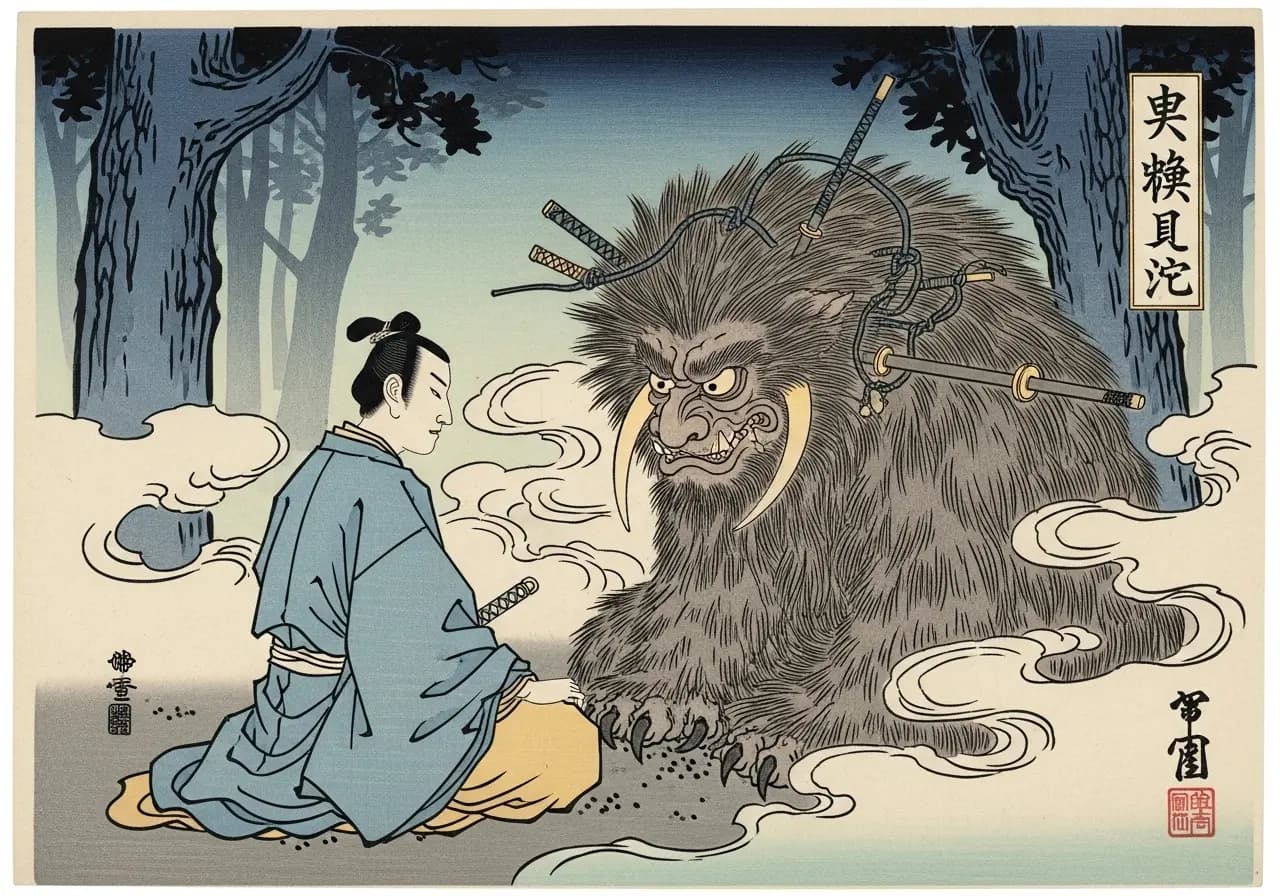
Sticky Hair Monster and the Battle Against Our Thoughts and Emotions
Episode 138 of the Secular Buddhism Podcast
Hello, and welcome to another episode of the Secular Buddhism Podcast. This is episode number 138. I'm your host, Noah Rasheta, and today I'm going to talk about Sticky Hair Monster and the battle against our thoughts and emotions.
Keep in mind: you don't need to use what you learn from Buddhism to be a Buddhist. You can use what you learn to be a better whatever you already are.
If you're new to the podcast, episodes one through five are a good place to start to get an introduction to all of the key concepts, ideas, and teachings. Or you can visit SecularBuddhism.com and click on "Start Here."
If you're looking for an online community to practice with and interact with, consider becoming a supporter of the podcast by visiting SecularBuddhism.com and clicking on the top link that says, "Join our online community on Patreon." Something new to the community: we're now using Discord. The Discord app and platform allows us to engage in a much more efficient way. We have chats around different topics, podcast episodes, and all things related to Buddhism and life in general. If you're looking for a community, join us there.
Now let's get started with the podcast episode.
Reflecting on Joshu's Mu
In the last podcast episode, I shared a Zen koan called Joshu's Mu, and I want to share a couple of thoughts about it. The koan itself goes like this:
"Joshu was a famous Chinese Zen master who lived in Joshu, the province from which he took his name. One day, a troubled monk approached him intending to ask the master for guidance. A dog walked by. The monk asked Joshu, 'Has that dog Buddha nature or not?' The monk had barely completed his question when Joshu shouted, 'Mu.'"
I want to share some thoughts that come from the book Zen Koans written by Gyomay Kubose. Of all the koans, Joshu's Mu is the most famous. It's extremely popular with Zen masters, who frequently assign it to novices. As Kubose writes, "If the student tends properly to business, Mu comes to resemble a hot iron ball stuck in his throat. He can either swallow it nor spit it out." The importance of Joshu's Mu is its succinct, one-syllable revelation of Buddhism.
Understanding Mu
Here's a little background, and again, all of these thoughts come from the book Zen Koans by Gyomay Kubose. He explains: "Mu is the negative symbol in Chinese meaning 'not' or 'no thing.' Mu is also a basic concept in oriental philosophy. There is a relative Mu and an absolute Mu. The relative Mu in Chinese characters is the opposite of U, the letter U, which means 'is.' The absolute Mu of Zen Buddhism transcends 'is' and 'is not.'"
In order to understand this koan, it's necessary to be aware of this distinction. When the monk asked Joshu, "Has that dog Buddha nature or not?" he was asking not only from the standpoint of his own troubled mind, but also from the basic Buddhist teaching that all beings have Buddha nature. Joshu realized this. His Mu as an answer was a blow aimed at breaking or untying the monk's attachment to that teaching. The essence of Buddha's teaching is non-attachment.
All human troubles and sufferings, without exception, are due to attachment. And here's the thing: even attachment to the idea of non-attachment is attachment. Joshu wanted the monk to transcend the relative world, transcend the teachings, transcend Mu, transcend Buddhism, and gain the free and independent world of enlightenment.
Satori, or enlightenment, is this new dimension or perspective in life. Ordinary human life is always attached to the relative—to "is" and "is not," good and bad, right and wrong. But life itself is constantly changing. The condition of society changes. Right and wrong often change. Every situation is different according to time and place. Static concepts are not appropriate to life.
Thus, Mu is crucial. It offers no surface upon which the intellect can fasten. The word Mu must be experienced as the world of Mu.
Why This Matters
Those are the thoughts from Gyomay Kubose regarding Joshu's Mu. I wanted to share this koan because, as the book mentions, it's perhaps the most famous of all the koans. To have a little bit of background, you need to understand the answer.
Essentially, what's happening is you have a teacher being asked a question by a student, by a novice monk. The question is so out of place because the Buddhist teaching of Buddha nature states that all beings have Buddha nature. It's like someone coming along and asking a very obvious question, which they should already know the answer to.
According to the teaching that all beings have Buddha nature, the answer to the question "Does a dog have Buddha nature?" is obviously yes. But Joshu knew that the monk was asking an obvious question. Instead of giving the obvious answer, he gave an answer the monk was not expecting: he shouted "Mu," which means "No" or "No thing."
In the tradition of koans and in the tradition of Zen, this is the shock and awe approach. The shock is that this isn't what I was expecting.
Here you have this novice monk asking a question, getting an answer he's not expecting, and it leaves him confused. That's the exact state that koans, and oftentimes Zen in general, want to leave you in. The point is to break you free of the conceptualizations you're making in your own mind.
If I know the obvious answer is yes, and I'm immediately hearing someone shout that the answer is no, what that does is leave me thinking, "Wait a second. But I thought..." I'm guessing that's exactly what the monk did right away. He was like, "Wait, but, but," trying to recall, "But this teaching says this."
And that's exactly what the master wants—to leave you very confused for a moment. Because in that confusion, you transcend the world of "is" or "isn't." To me, it's almost a way of saying, "Let's entertain the question again. Was that even an appropriate question? Was it a relevant question? Because if it's not, what benefit does it give you if I were to answer it for you?"
That's what the master is hoping to do. He's answering the question with what you're not expecting, which is the only thing you can do to make someone really start to think.
I would suppose that maybe this monk, with time, could walk away and realize, "Okay, well, that was dumb to ask him that. Because his answer doesn't matter. What if the answer is no? What if the answer is yes? Well, what does that say about your Buddha nature?" I think that's along the lines of what this koan was trying to convey.
Applying This to Daily Life
I like to think of this koan and apply it to my day-to-day life. The answers that we often seek to find about life are, you could almost say, silly questions. I've experienced this firsthand, right? Going through a faith crisis, then becoming a seeker, looking for another worldview that might make more sense.
When you're on that path of seeking and you're looking for answers to life's big questions, Buddhism comes along and it does this: it gives you the answer Mu, which is to say, you're not going to get the answer that you wanted. And in not having the answer that you wanted, you're left with one option: let's entertain the question. Where did the question come from? Does that question even matter? What would happen if you did answer that question? Then what?
I think that's what this koan does. It immediately brings you back to, "Wait, let me think about that question a little bit more." That is the koan, Joshu's Mu.
Hopefully, this koan made you think, and you'll remember it in future instances when questions come to mind. You can assign a little bit more value to the question and a little bit less value to the answer. And that, to me, is Buddhism in a nutshell. It's all about the questions, not so much about the answers.
The Story of Sticky Hair Monster
Okay, with that said, I do want to share a couple of thoughts about a story—an old Buddhist story. I'm going to call this "Sticky Hair Monster." I think the original story is called "Prince Five-Weapons," and I might be wrong, but I think this comes from the Jataka Tales. I came across it a long time ago and encountered it again in a book called Buddha at Bedtime.
The book contains a lot of little stories, and I've been reading these stories for years now to my kids at night. I went through a phase where every night we would read one. It's been a while since I've read them, but one of the stories that really stuck with me is the story of Sticky Hair Monster. It's become a fun story that I revisit and play the game often with my youngest daughter, who's four.
We play this game where I'm Sticky Monster and she's trying to escape from me. But I think there's a really valuable lesson in the story. Let me share it with you. This comes directly from Buddha at Bedtime:
The Story
It was a beautiful sunny afternoon when a boat carrying Prince Hector came from overseas into the harbor. Before the young prince left the vessel, the captain warned him, "Your Highness, while you have been away training to be a warrior, an evil monster called Sticky Hair has come to live in the forest. So I advise you not to take that route to the palace. Instead, go the long way home around the mountains."
"Thank you for your advice," replied Hector. "But I'll be fine. I want to get home before sunset, and I have all my weapons if I need them. After all, I'm a trained warrior. I'm not afraid of a silly old monster."
And the young prince strode boldly on into the woods. Just as Prince Hector was beginning to think that the monster didn't exist, he reached a clearing in the forest, and there stood the most gigantic, ugly creature he had ever seen.
The monster was as big as a house and completely covered in matted hair. It looked like a living, breathing, but very horrible haystack. The creature had a huge head and stared at the prince with eyes as big as dinner plates. Two big orange tusks stuck out of its enormous mouth, and its teeth were green and revolting. Its belly was big and round like a beach ball and covered in large pale orange spots.
"Grrr," roared Sticky Hair. "What do you think you're doing in my wood, little man? You look like a tasty morsel, and I'm going to eat you for dinner!"
"I'm not afraid of you, you horrible old monster," replied Hector. "I'm a warrior. I can easily defeat you with my sword. I dare you to fight me."
Swiftly as the wind, the prince leapt forward and thrust his sword at the monster. But to his surprise, it just stuck to the creature's sticky hair.
The prince left his sword there, quickly rolled out of the way, got to his feet, and grabbed his bow. He shot arrow after arrow at the monster, but like the sword, each one just became tangled in its sticky hair. The prince was astonished.
"Ha-ha-ha," boomed Sticky Hair. "You're a very funny little man. You'll never beat me."
Then he shook himself from his ugly head down to his big smelly toes, and all the prince's arrows dropped to the ground.
Hector now had only his club left for protection, so he swung it at Sticky Hair with all his might. But it too became caught in the monster's hair and was pulled from the prince's strong grip.
"I'm not defeated yet!" he shouted. "My weapons may be useless, but I'm young and strong, and I'll fight you with my fists!" He cried as he ran and leapt on the monster and got firmly stuck.
Even now, as Prince Hector dangled from the creature's sticky hair, he continued to act fearlessly. So much so that the monster started to wonder exactly what gave him such courage.
"Why are you not afraid of me, little man? I could gobble you up in a snap and a crack," he threatened fiercely.
Still hanging from the monster's tangled hair, Hector was busy thinking about what to do next. All of a sudden, it came to him. He realized that he would have to use his brains to outwit the creature instead of his weapons.
He shouted up to Sticky Hair, "I'll tell you why I'm not afraid of you. My skin is coated in poison, so if you eat me, you'll die. I dare you to eat me."
Sticky Hair didn't believe Hector at first, but the more the prince insisted, the more worried the monster became.
"I'd like to eat him, but I can't risk getting poisoned," he muttered.
Reluctantly, he pulled the prince from his matted coat and set him on the ground unharmed.
"Well, fearless little man, you've convinced me. You're telling the truth, and I don't want to die, so I suppose I'll have to let you go," he said grudgingly.
Hector was delighted. Not only had he outwitted the monster and saved his own life, but he had also learned an important lesson: that the most powerful defense had been inside him all along—his own intelligence, not his strength and not his weapons.
Looking up into the monster's big eyes, the young prince said, "I'm very grateful to you, Sticky Hair—not just for releasing me, but also for teaching me that I don't have to fight to be brave, strong, and clever. Would you like to know my secret? If you promise not to eat me, I'll tell you as a reward for sparing my life."
Surprised, Sticky Hair agreed. Although the monster had never been defeated until that day, he had always been frightened of people. In fact, he had only attacked people to stop them from attacking him. But now the creature was eager to learn to be fearless like Hector, so he let the young prince become his teacher and friend.
And the strangest thing happened. The more Sticky Hair learned how to use his brain, the less he felt the need to harm others. Using his intelligence brought the creature great happiness, and gradually he was transformed from a scary, lonely monster into a friendly forest giant.
Prince Hector let all the local people know that the monster had completely changed, and gradually they became his trusted friends, bringing him food and living with him in peace and harmony. And the new eager-to-please Sticky Hair repaid their kindness by protecting them and guiding travelers safely through the forest.
The Deeper Meaning
And then the book goes on to say: "Sometimes it feels like there's no option but to fight our way out of a difficult situation. A wise person knows that it's their intelligence, not their physical strength, that will help them win in the end."
That's the version from Buddha at Bedtime. The original story, the way it's been shared and passed down—the story of Prince Five-Weapons—is essentially stating that of all the weapons you can possess, the one that is more powerful than all the others is the mind. That's the old story of how Prince Five-Weapons didn't kill Sticky Hair, but instead taught him the ways of peace and enlightenment.
There are other minor variations of the story. All in all, the story of Sticky Monster has been a fun way for me to convey this concept to my kids: the moral is that often the only way to win a fight is by not fighting. It's by using your brain, your intelligence. And to me, this somewhat echoes the idea from the last podcast episode—the idea of nothing being something. Often, by doing nothing, we are doing something.
Fighting Versus Understanding
I think in our culture, we're generally of the mindset of conquering and overcoming. And sometimes we approach Buddhism in this very same way. It's like we're going to overcome the ego, and we're going to conquer our selfishness or conquer our negative attributes. The thoughts and feelings and emotions that I don't like—I'm going to force them out and away from me. I'm going to win over them.
And when we do that, we're setting ourselves up for the same mistake that Prince Hector and Sticky Monster had: Sticky Monster can't be beat. You can approach Sticky Monster with all the weapons you have, and the result is going to be the same. They're going to get stuck, and it doesn't do anything to this big monster.
The harder that you try, the harder that you fight, it doesn't do anything. You're still going to fail. But what happens when we approach the situation differently? Rather than overcoming, what if we approached it with the attitude of trying to understand and trying to befriend?
This reminds me of what Pema Chödrön says: "Meditation practice isn't about trying to throw ourselves away and become something better. It's about befriending who we already are."
The Paradox of Peace
I encounter this concept quite a bit in my interactions with podcast listeners and supporters who reach out and want to discuss specific situations or circumstances they're going through in their lives. I encounter this especially with anger, where somebody is experiencing a set of circumstances and causes and conditions that are creating anger in their life. And often, they're angry at the fact that they're angry.
Or if you're upset, you might be upset that you're not at peace. It's just this interesting place to be because the only real peace that we can have comes when we're at peace with the fact that we're not at peace.
And the reason that works is because life is always changing. Again, like the Tetris game analogy, there's a new piece on the horizon. Every time the new piece shows up, it's a whole new game. You're always playing a new game. And that's exactly how life works.
Life is always changing. You're always dealing with something new. Today it might be the loss of a job, or the loss of a loved one, or a flat tire on the road, or a coworker that annoys you. Or you might be dealing with a really good job and you're happy with it. Or you're dealing with a worldwide pandemic or whatever it is. It's always changing.
And the fact that it's always changing means you always get to revisit this and say, "Okay, now how do I play the game?" And you can literally do this minute by minute because every minute life has changed. All it takes is awareness to see that.
When we're angry at the fact that we're angry, we're compounding the situation. Anger is natural. And if I'm experiencing anger and I'm okay with the fact that I'm experiencing anger, then there's no problem. Sure, I'm angry, but there's no problem with being angry. So life is good. I'm at peace.
And before I know it, the causes and conditions of the anger might be gone, and then anger is gone, and I'm okay that I'm not angry. Again, I'm at peace. I'm at peace when I'm angry. I'm at peace when I'm not angry. And that, to me, is at the heart of what the story of Sticky Monster is trying to get at.
We Are Both the Prince and the Monster
The twist, I think, in the story is that we are Sticky Monster, or Sticky Monster is us.
I think Robert Wright talks about this in his book Why Buddhism is True. He talks about the modules of the mind. The concept of the modules of the mind is the understanding that I have many different aspects of me that make me, me. There's the me that is in the role of a parent, of a dad, of a brother, of a son, of a podcaster. Of all the things that I do that make me, me—these are the various modules of the mind.
And within these modules are the thoughts and the feelings and the emotions and the memories. These are what in Buddhism we would call the five skandhas—the different things that make you, you. And yet you're not any of them.
But when I understand that about myself, when I realize that I'm experiencing anger, it's something that I'm experiencing, but I'm also the observer of the experience. And I'm also the one that feels, "I like this or I don't like this."
And all of that's okay if I just observe it. And what it leaves me with is this important understanding: just like with Sticky Monster, the monster is the monster. I can't change the fact that it's ugly, that it stinks, that its hair is sticky, or all the things that are unpleasant about it. But what I can change is recognizing that this thing isn't going away and I can't fight it away. I'm left with one option: I can befriend it and try to understand it.
And all of this happens by using the weapon of the mind—not the traditional weapons that you would think of as weapons. And that's what happens in that story.
To me, the moral of the story is that I am the prince, but I am also Sticky Monster. Certain parts of my mind—when I'm experiencing anger—there it is. That's the big Sticky Monster. I'm angry, and I don't like that I'm angry. Well, there I am. I'm fighting the thing that I cannot win.
But if I'm okay that I'm angry now, I'm at peace again. And there are the two things: there's the prince and Sticky Monster. There's the observer of the anger I'm experiencing, and there's the anger I'm experiencing.
And those two things can sit there side-by-side, perfectly at peace and content, because there's nothing wrong with being angry. There's nothing wrong with sitting next to the monster. It's fighting the monster that creates the problem.
And I think it's the same with our thoughts and feelings and emotions. Fighting my emotions, being angry that I'm angry—that aggravates the problem.
Playing the Game with My Kids
That's the key takeaway for me with this specific lesson—the story of Sticky Hair Monster. And I've been working on this story for months now with my own kids. We play this game called Sticky Monster, where I'm Sticky Monster and they're all trying to fight me. Well, they can never beat me, and I always trap them and then hold them.
But they've learned that the trick is they have to start asking me questions: "Where are you from, Sticky Monster? How old are you, Sticky Monster? How do you feel today?"
And as they talk to me, I start answering their questions and I loosen the grip. And then at the end of the game, we're sitting next to each other, and they keep talking to me. That's when they can slowly walk away. But in the game we play, if they try to run, if they try to escape me, or if they try to fight me, they don't win.
I'm hoping that with time, this little game and this little story will transition into a deep understanding of the nature of life—with them and the relationship they have with their own thoughts, feelings, and emotions.
The Core Teaching
And I think that's the final thought I want to share here: we're not trying to change our thoughts and feelings and emotions as we're experiencing them. All we're trying to do is change the relationship we have with our thoughts, feelings, and emotions as we experience them. Because to me, that's the key. That's the difference between running and fighting Sticky Monster and just exerting all your energy—that's pointless because you're never going to win—versus sitting and talking to Sticky Monster, using your mind, understanding, and befriending.
And again, to me, the twist is the recognition that I'm actually both. I'm the prince and I'm Sticky Monster. And I've been fighting myself this whole time, which makes the fight that much more ridiculous when I think about it that way.
That's all I have to share about the concept of Sticky Monster and the relationship we have to our thoughts, feelings, and emotions.
A Koan to Contemplate
Before ending this podcast episode, I want to leave you with another Zen koan to think about. This is one that I think I've mentioned before. I can't remember. I'm reaching that stage where I can't remember what things I've said before and what things I haven't. But I guess it never hurts to mention things more than once.
The Zen koan I'd like to leave with you at the end of this podcast episode to think about is called "No Beard." It goes like this:
"Wakuan complained when he saw a picture of bearded Bodhidharma. 'Why hasn't that fellow a beard?'"
That's it. That's the end of that koan. I'll share my thoughts on that one in the next podcast episode.
As always, thank you for listening. Until next time.
For more about the Secular Buddhism Podcast and Noah Rasheta's work, visit SecularBuddhism.com