

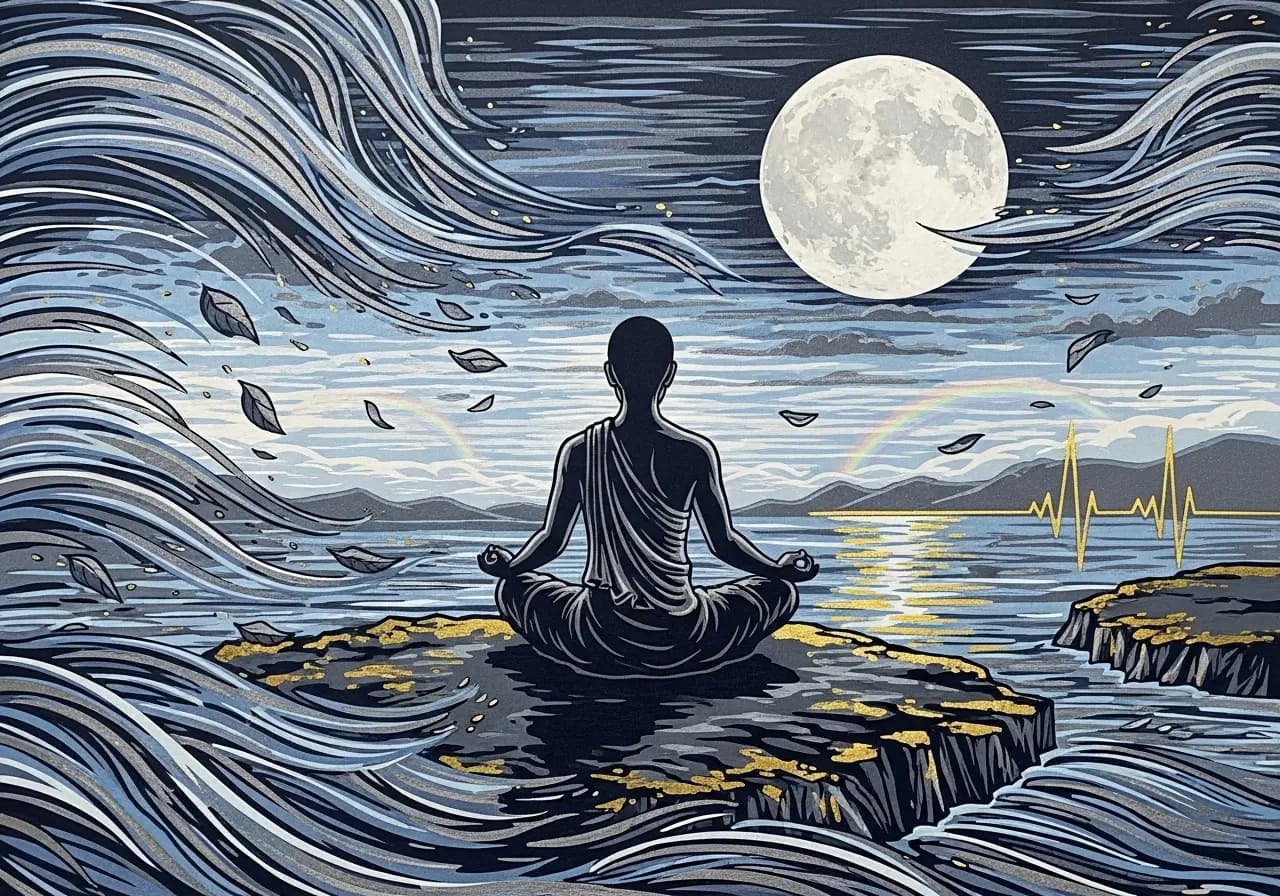
The Beauty of Nothing
Episode 137 of the Secular Buddhism Podcast
Hello, and welcome to another episode of the Secular Buddhism Podcast. This is episode number 137. I'm your host, Noah Rasheta, and today I'm going to talk about the beauty of nothing.
As always, keep in mind you don't need to use what you learn from Buddhism to be a Buddhist. You can use what you learn to be a better whatever you already are.
If you're new to the podcast, check out episodes one through five, or visit secularbuddhism.com and click on "Start Here," which will give you easy access to those foundational episodes. If you're looking for an online community to practice with and interact with, consider becoming a supporter of the podcast by visiting secularbuddhism.com and clicking on the top link that says "Join our online community on Patreon."
Revisiting the "Every Day Is a Good Day" Koan
In the last podcast episode, I shared a koan that goes like this: Unman said, "I do not ask you about 15 days ago, but what about 15 days hence? Come, say a word about this." Since none of the monks answered, he answered for them: "Every day is a good day."
The "Every Day Is a Good Day" koan is one I've really enjoyed. In fact, I have it written in Japanese on a poster board on my wall—"every day is a good day"—and this has become a way of thinking, a concept that I like to keep at the forefront of my mind. When I'm experiencing what I would consider to be a good day or maybe a bad day for me, I remind myself that it's likely a good day for someone else, and vice versa.
The idea that every day is a good day, because it's always based on perspective, place, and time, has been helpful for me to develop a more skillful understanding of what "good" means and what a "day" actually is.
Community Thoughts on the Koan
I wanted to share some of the thoughts that came from the Patreon community, and I want to build on those conversations.
Duchenne said: "I can't escape thinking that hope is at the center of this koan as well as the irrelevance of the past and the future. However, I don't commonly see hope as a big part of Buddhism in general. Hope seems judgmental and perhaps leads to dissatisfaction about the way things are."
I want to share a couple of thoughts about this notion of hope in Buddhism.
In Buddhism, it's important to remind people that the Buddhist view always pertains to the present moment. So when we approach concepts like hope or hopelessness, we're always speaking about the present moment specifically. The idea isn't that I shouldn't have hope for things in the future. Rather, it's that if I can experience hopelessness in the present moment, what I'm experiencing is a moment of not needing things to be any different than they are.
Think about it this way: when we define suffering, we say that suffering arises the moment we want things to be other than how they are. There's nothing wrong with that. It's okay to experience suffering. It's unavoidable, actually. The moment we want things to be other than how they are, we experience suffering.
But here's what we can do. In the present moment, if I realize that for this one single moment, I don't need anything to be other than how it is, I'm experiencing hopelessness. Now, hopelessness has a bad reputation and a negative connotation in our society, and it's strange to tell someone that you're aspiring for hopelessness. But remember, this isn't about the future.
Even in Buddhist thought like the Metta prayer, where you say, "May you be happy. May you be free from suffering. May you be at peace," that expression implies a wish that I have for you in the future. But as far as the practice goes, when I'm trying to experience hopelessness, it's right now in this present moment. It's the radical acceptance of how things are.
Robert's Perspective on Time
Robert from the community said: "Thanks for the episode. The koan makes me think of two things. One, there's no such thing as a bad day because even if you're having a bad day, billions of others might be having a good one. And two, time is a concept. Its existence relies on humans believing in it. There are no good or bad days because, beyond our perception, there are no days."
I like that he brings awareness to this idea of time. If I say "Every day is a good day," yes, the idea of a day is something that is a concept. We distinguish what a day is based on the rotation of the sun. We've decided that's the definition. But where do you really draw that line?
What if it was 25 hours in a day and on that 25th hour something great happened? How do you define what makes a day good and what makes a day bad? Is it 10 good things and two bad things? Is it 12 bad things and one good thing? What would make it good or bad?
And then you have to break it down further. Well, is it by hour? What would make every hour a good hour? What would make every minute a good minute? Every second a good second? Where do we draw that line?
The emphasis from the Buddhist perspective is always pertaining to the present moment, and any moment can be a good moment if I bring awareness to it and mindfulness to that moment. If you'll recall, the very definition of mindfulness is the non-judgmental observation of the present moment. So if I'm observing the present moment with non-judgment, it's not good or bad—it's just the moment that is. And in doing so, yes, I could say every moment is a good moment. But that's the koan, right? Because who says what's good? Who's to say what's good and what's bad?
Heather's Insights on Presence
Heather said: "This koan about good days and bad days brought a few interesting things to my thoughts today. First, it made me think of the parable about the two neighbors. Whenever something happened—such as a horse running away or a son being pardoned from joining the army because he broke his leg—the neighbor simply replied, 'Who knows what is good and what is bad?' Through this story, we realize that not everything is as it seems at first, so it's not wise to label things as good or bad. Also, we should take into consideration that what is good for one person may be bad for another. Finally, most of what I've been learning about Buddhism—I'm fairly new to the practice—emphasizes being present in the moment, not dwelling on the past or worrying about the future. So perhaps this question isn't really a question at all. It's a reminder that we should be here in the present moment, fully awakened."
I wanted to build on Heather's thoughts about the concept of the present moment. From the Buddhist perspective, it's always anchored in the present moment. So if that's the case and I'm anchored in the present moment, then a concept like "every day is a good day" comes down to a single question: What about this moment?
If this moment is good or bad, well, what about the next moment? If that moment is good or bad, what about the next one? Because we can't pause time, we're stuck with this constant observation that the meaning I'm giving to a moment is just that—it's the meaning I'm giving to it. The moment I've done that, it's gone, and I'm onto the next moment and the next moment.
When I start to see it in light of trying to be in the present moment, suddenly all the other concepts you'll encounter in Buddhism start to make more sense. Going back to the concept of hopelessness: well, sure, if I'm hopeless in this moment, what about the next moment? Oh, maybe that one I'm hopeful. What about the next one? Maybe that one I'm hopeless again. What if I'm switching back and forth literally moment to moment in half-second increments?
Because there's no fixed time and everything's always changing, notions like this start to make more sense in terms of the present moment.
The Beauty of Nothing
Now I want to tie this into the topic I really want to share today: the beauty of nothing.
This is just a stream of thoughts, but the concept of nothingness in Buddhism is quite fascinating. First, you would have to entertain the question: is nothing something?
Because if you have an answer to that question and you tell me what nothing is, well, then now nothing is something, right? The idea you have about what nothing is—that is something. It's a concept. It's an idea. So the idea of nothingness from the Buddhist perspective puts you in this world of non-duality again, which asks: is nothing something? And I would argue that it is.
So then there's no such thing as nothingness. Nothingness is somethingness. And that's pretty interesting to think about.
Practicing Nothingness
One thing I wanted to share, where this starts to apply more in our day-to-day experience, is the practice of trying to do nothing. I just got off the phone not long ago with a podcast listener who's a patron, and we wanted to discuss this concept of nothingness. We had a really fun conversation around this and talked about some of the ways that this concept of nothingness can be beneficial in everyday life.
The first question we explored was: how do we even practice nothingness? Because if I'm thinking about trying to make time for nothing, I'm going to struggle if I really believe that nothing is devoid of something.
What that means to me: if I sit here and think, "Okay, I'm going to do nothing," what am I actually doing? I'm doing something. I'm thinking of doing nothing, which is something. It's a lot like a catch-22. It's similar to asking, "What is the sound of silence?" Well, listen to silence and you're going to hear something—whether it's the ringing in your ears or the faraway sounds of cars honking.
The idea that there's always some kind of sound taking place. Even if you say, "Okay, what is the sound or frequency of the radiation that comes from the sun and shoots right through the earth?" We're experiencing that at any given moment, and there's a frequency associated with that. Whether I can perceive it or not doesn't matter, but there is always some form of sound.
I think this concept with nothingness is the same. To want to experience nothingness is to experience somethingness. I'm going to experience something by trying to do nothing.
This could be as simple as: okay, I'm going to sit here and do nothing, and then I get distracted watching a little ant on the ground. I follow along and watch, and I realize that in this moment of nothingness, there's a whole lot of somethingness taking place. I can hear the rustling of the leaves on the trees outside the window. In my moment of doing nothing, I observed that there's a whole lot of something.
That's where this becomes powerful. In my external observation of nothingness, what I observe is a lot of somethingness. But now take this a step further and go inward.
In my intent to observe nothingness taking place in me, what will I observe? A whole lot of somethingness. I may observe my heartbeat or the rumbling sounds in my stomach or the sound of my breathing or the observation of thoughts that don't stop. The thoughts are always going, always racing. Even if I have the thought that I'm not having thoughts, that's a thought. I had the thought of not having thoughts.
That is the dilemma with the concept of nothingness. And what makes the idea of nothingness so beautiful is that nothing is actually something—quite a bit of something.
Connecting Nothing to Non-Self
So I was having all these thoughts with the notion of nothing, and then I thought I would like to correlate this with a bigger topic in Buddhism: the concept of no-self or non-self. And I think if I can conclude that nothing is something and I take that line of thought and apply it to something like the sense of self, now I'm actually onto something pretty fascinating.
The idea of non-self means that self is nothing from the Buddhist way of thought, which means that self is something. If anything, it's a concept. It's an idea, and it's always changing and always evolving.
One way that I like to think of this is the way that I perceive a rainbow. The other day, my daughter, who's four, we saw a rainbow and she said, "Can we go to it?" And I had to explain to her, "Well, the rainbow is something that we see, but it's not actually there. You don't get to go touch it. The closer you get to it, it disappears because you only see a rainbow—not because it's there, but because of how we see it."
Of course, to a four-year-old, this whole notion is like, "Okay, that's too much." But it got me thinking. When I perceive a rainbow, the causes and conditions arise and suddenly I perceive the rainbow. I don't think it's much different when I perceive the sense of self.
The causes and conditions arise—I exist, I'm born, my brain processes thoughts, experiences, feelings, and emotions—and this whole combination of experience that I'm having gives rise to the sensation of a sense of self. It's very similar to the sensation of, "Oh, there's a rainbow, something that I can perceive."
Now I go chasing after it and I'll never find it. I think that's the same dilemma we're in with a sense of self, which is what the Buddhist view of non-self is trying to get at.
It's not that there is no self. It's that the perception we have of self is different from what we think it is. In other words, the sense of myself is not what I might think it is. It's not a permanent thing and it's not an independent thing. It's an interdependent, transitory thing that's always changing.
The Illusion of Fixed Personality
This to me is a fascinating way to look at it. I might think, well, there are aspects of me that seem fixed—like my personality, for example. But it's not that fixed. Many people will encounter some kind of big experience that can change their personality. Just yesterday I heard about someone who had a good friend with a certain personality and way about him. He went to rehab because he was dealing with a strong addiction to drinking and smoking, went through the whole program, and came out of it as a different person. His personality had changed.
Now, some of us may not go through something that dramatically changes our personality. A big crisis can do it. People who endure some kind of trauma may have a different personality. Most of us will have the same personality that we've always had, and it will seem like, "Well, that's kind of a permanent thing." But it's not.
What was your personality before the day you were born? Or the day before you were conceived? Or the day after you die? There's no permanence in there, the same way that the koan evokes when it asks, "What was your face before you were born?"
But what I'm trying to get at with this line of thought is that even things that may seem fixed and permanent aren't fixed or permanent when it comes to this concept of the sense of self.
And as long as the causes and conditions are there to see the rainbow, you're going to see the rainbow. So there's no need to deny what I'm perceiving. I can say, "Yeah, I see that rainbow. I totally see it. But I know that it's not what I might think it is."
That's where the value comes in. I start to see through that illusion and recognize it's what I'm seeing that matters, not what's actually there. It's because of how I see that I perceive what I'm perceiving.
Hopelessness and Skillful Action
Another way I wanted to share some thoughts about this idea of hopelessness—or really any concept in Buddhism—is if we apply it to the present moment and along the lines of skillful versus unskillful action, then we have something actually beneficial and useful to work with in our day-to-day life.
The analogy that popped into my mind was this: if I'm out on the ocean in a boat and suddenly I realize I'm caught up in a storm—a hurricane—a sense of hopelessness might mean, "Oh, that means I'm not going to do anything because I guess I'm just going to die out here." Well, that's pretty grim.
But the Buddhist view of hopelessness would be, "Okay, I'm recognizing I'm out here in a storm and there is nothing I can do about wishing it away. I cannot pray it away. I'm caught up in the storm. There's no denying that." That's where acceptance kicks in.
"Okay, if I'm caught in a storm, what can I do?" The moment I accept that I'm caught in the storm, I can start to be more skillful. "Okay, well, I better bring the sails down. Or I better call an SOS on the radio. Or I better strap myself to the railings of the boat so a wave doesn't knock me over." There are a whole bunch of things I can do. But those things are only going to happen once I recognize this is indeed the situation I'm in.
So the idea of hopelessness in Buddhism is more along those lines.
Someone in the Patreon community said she likes the expression "wishlessness," which I agree with. I like that. It's a moment where I'm experiencing wishlessness—I don't need to spend time wishing that it was any other than how it is. I'm just going to say, "This is how it is in the present moment, and if I'm caught in a storm in a boat in the ocean, then I'm going to do the things that I know are skillful to do in that moment rather than sit there wishing I wasn't in the storm."
Because no amount of wishing is going to make that storm go away.
The Beauty of Nothing Is the Beauty of Something
So that's along the lines of what I wanted to share in terms of the beauty of nothing. To me, the beauty of nothing is the recognition that the beauty of nothing is, in fact, the beauty of something. There's always something.
Those were some of the thoughts that I wanted to share. This podcast episode was inspired by recent phone call conversations, and I wanted to share a bunch of those thoughts with you.
I hope you enjoyed this episode. I want to close with another koan that you can think about between now and the next podcast episode. This is one of the big koans. I would say perhaps of all the koans, this one is the most famous—at least in Zen circles. This is the koan called Joshu's Mu.
Joshu was a famous Chinese Zen master who lived in the province of Joshu, from which he took his name. One day, a troubled monk approached him intending to ask the master for guidance. A dog walked by. The monk asked Joshu, "Has that dog a Buddha nature or not?"
The monk had barely completed his question when Joshu shouted, "Mu!"
That's the koan. I will explain more about it and share some of my thoughts about it in the next podcast episode.
Thanks again for listening, and until next time.
For more about the Secular Buddhism Podcast and Noah Rasheta's work, visit SecularBuddhism.com