

Mountains and Rivers Sutra
Episode 136 of the Secular Buddhism Podcast
Hello, and welcome to another episode of the Secular Buddhism Podcast. This is episode number 136. I'm your host, Noah Rasheta. Today, I'm going to share some thoughts regarding the Mountains and Rivers Sutra.
Keep in mind, you don't need to use what you learn from Buddhism to be a Buddhist. You can use what you learn to be a better whatever you already are.
If you're new to the podcast, check out episodes one through five, or visit SecularBuddhism.com and click on "Start Here" so you can get an introduction to the basic concepts and teachings and why I'm even talking about Secular Buddhism in the first place. If you're looking for an online community to practice with and interact with, consider becoming a supporter of the podcast by visiting SecularBuddhism.com and clicking the link that says "Join Our Online Community on Patreon."
Community Reflections on the Poem "Only This"
In the last podcast episode, I shared a poem called "Only This" by Rikyū. The poem goes like this:
First you heat the water. Then you make the tea. Then you drink it properly. That is all you need to know.
I wanted to share some of the thoughts that were discussed in our online community forum on Patreon, just to expand a little bit on the ideas shared in this poem.
The first thought comes from Marella, who says: "The poem makes me think about how difficult it is to relax in the present moment and just be or do one thing at a time. The way that poem lists the actions makes me think about multitasking, or our failed attempts at it, since it's not actually possible to multitask. It also reminds me of Thich Nhat Hạnh's story in his book Living Buddha, Living Christ, when the Buddha was asked, 'Sir, what do you and your monks practice?' He replied, 'We sit, we walk and we eat.' The questioner continued, 'But Sir, everyone sits, walks and eats.' The Buddha replied, 'When we sit, we know we are sitting. When we walk, we know we are walking. When we eat, we know we are eating.'"
Sophie goes on to say: "It immediately makes me think of wholehearted presence and the need to only ever do what we're doing in the present moment. So often we jump ahead and live in the future or dwell on the past, but really all we need to know is what we are experiencing moment to moment, because that's all there ever is. Also, when we do each thing with intention and we don't rush, life becomes poetic. Even something as simple as making a cup of tea can become art."
I like Sophie's thoughts here, especially this comment that life becomes poetic and that something as simple as making a cup of tea can become art. That's a fun way of thinking about this.
Mike says: "The poem feels peaceful to me. I like the feeling of a warm cup of tea in my hands. I enjoy blowing on it and feeling the warmth coming off of it. I love just waiting for it to cool down and having a friendly conversation with a loved one. This poem reminds me of all those things without even mentioning most of them. That makes me feel peaceful. I quite like it."
Understanding the Poem "Only This"
When I think about this poem, "Only This," I really like the simplicity of it. It alludes to interdependence—the nature of interdependence—that things have causes and conditions. Before arriving at the moment of drinking the tea, you have to make it. And in order to make it, you have to heat the water. I love that it ends with "That is all you need to know."
For me, this is a poem that invites me to think of the interdependent nature of things and what the steps are required to arrive at whatever the final thing is that I'm trying to do—in this case, enjoying drinking the cup of tea.
Of course, you could read into this quite a bit, because in Japanese culture, drinking tea is a big thing, right? There's even the tea ceremony. So I do think there's something to read into this line when he says, "Then you drink it properly." What does that mean to drink the tea properly? Well, I don't know. I'm not an expert on that. But for me, this poem is quite simple and quite profound, which leads me to the topic that I wanted to talk about in this week's podcast episode.
Dogen and the Mountains and Rivers Sutra
The Mountains and Rivers Sutra is a teaching that was written by Dogen. Dogen lived in Japan in the 1200s and is the founder of the Sōtō Zen school of Buddhism, which is the largest of the three major forms of Zen Buddhism. He founded a monastery in the mountains. For Dogen, the practice of sitting meditation and the experience of enlightenment were essentially one and the same. Knowing that the path that leads to enlightenment is enlightenment—that's a very simple and a very profound teaching for me.
In the Mountains and Rivers Sutra, after a long teaching about mountains and about water, Dogen teaches that in the end, mountains are just mountains and waters are just waters. I think in that statement, it's very simple and very profound. I wanted to share some of my thoughts about this.
There's a book called Pointing at the Moon by Jay Garfield and Graham Priest. In chapter six, it opens with this statement: "Before I studied Zen, mountains were mountains and water was water. After studying Zen for some time, mountains were no longer mountains and water was no longer water. But now, after studying Zen longer, mountains are just mountains and water is just water."
This expression has stuck with me since I first heard it several years ago. In fact, I'm pretty sure I've mentioned this in the podcast before. But the expression—or the concept or the idea—that mountains are mountains, then mountains aren't just mountains, and then mountains are just mountains again... this is an expression that really resonates with me. I want to share a couple of reasons why.
The Heart of Dogen's Teaching
Dogen taught that when we know something intimately, it ceases to exist and so do we. He alludes to a concept in this sutra that really speaks to me. In the teaching, he says: "Water's freedom depends only on water."
The first time I heard that, I thought, "What does that mean? Water's freedom depends only on water?"
Well, if we think about this, what we perceive always depends on us as the one doing the perceiving. This is something that echoes throughout a lot of Buddhist teachings—that what I perceive has more to do with how I perceive than what the thing actually is that I'm perceiving.
Take water, for example. When we perceive water, it gets attached to a story that has meaning. A farmer praying for rain perceives water once it starts to rain and might think, "Okay, I'm being blessed. I needed this rain." Meanwhile, another farmer who was trying to dry out their hay might be praying for the rain to stop. When he receives the water or sees the rain, he might be thinking, "Oh, I'm being cursed," or something like that. Anything that we perceive will be interpreted through the lens of us as the one doing the perceiving.
So in this expression "water's freedom depends only on water," to me, it means that water is free to just be what it is. When it allows itself to just be what it is, it depends only on itself.
This expression is quite profound to me when I think of it in the context of myself. My freedom depends only on myself. That's a concept and a teaching that's certainly echoed in a lot of Buddhist teachings—to say your freedom depends only on you. For me, this is a very powerful thing.
I think that perhaps the Mountains and Rivers Sutra is not about mountains and rivers at all, but perhaps the mountains and rivers themselves are a teaching.
Flying Through the Valley
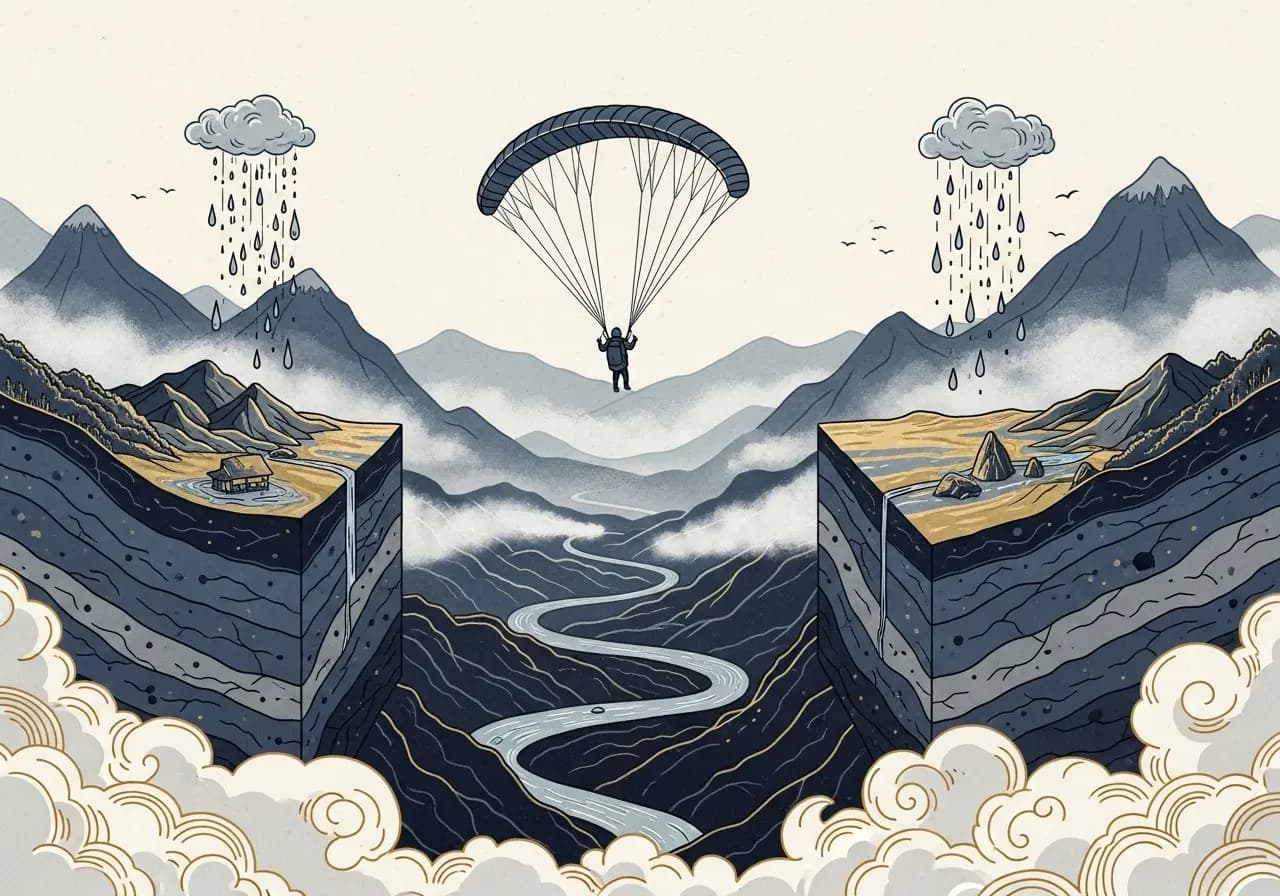
Earlier this week, I went to fly my paramotor—a paraglider—here in the valleys where I live. I often go somewhere far away to fly for an hour and a half, but a couple of days ago, I took off here in my own little valley and flew through it. My valley is surrounded by mountains and has rivers that flow through it.
I had been reading—or at least pondering—this topic of the mountains and rivers for several weeks now. I knew I wanted to do a podcast episode on it, but I was trying to wrap my head around what my actual thoughts were about this whole teaching and this whole concept, especially this notion of mountains being mountains and water being water, and then not being that, and then being that again.
I was flying among the mountains, looking down at the river, and it was just a really neat experience. I thought, here I am, dangling from these cords attached to a piece of fabric that allows me to fly through the air. This simple contraption is so simple, and yet it's not simple at all. It's extremely complex. The detail and the intricacies of how the design unfolded for a paraglider wing—I mean, think about the years and years of progress that have gone into making this piece of fabric a safe thing to fly with. That's where it kind of clicked for me, this concept of mountains being mountains, mountains aren't just mountains, and then mountains are just mountains again.
For me, what this hints at is the direct correlation between how incredibly complex something is and at the same time how simple that is. Then there's the middle way.
Mountains Are Not Just Mountains
Now, I'm going to use the mountain as an example. When I look at a mountain, if I just see the mountain, I'm missing a lot, right? I'm missing the relationship that the mountain has to the tectonic plates. Let's take the Himalayas as an example. You have two tectonic plates, and one of them is ramming into the other and pushing up the earth. So you have this whole chain of mountains that we look at and say, "That's a mountain." But what we don't see is that this is the spot where two continents or two landmasses are crashing into each other. So in that case, yeah, the mountain is not just a mountain.
Same with the river, right? A river is just a river, but when I really look deeply, the river is not just a river. The river is also the rain, the clouds, everything that that path of water has ever gone through to be in that specific moment in time. It's the river. It's what we would call the river. So sure, from one lens, I could look at it and it's accurate to see just the river. From another lens, I could look at it with its causes and conditions and its interdependencies, and wow, this thing isn't just a river—it's so many other things.
Then I can scale back again and say, "But yeah, it is just a river." That to me is a fascinating way of trying to perceive life. We're always balancing this—whether it's looking at mountains or looking at rivers or analyzing where a thought came from or what emotion I'm experiencing or what feeling I'm having. Yes, anger is just anger. But then I can look at anger and perceive something deeper. Anger attached to fear, fear attached to uncertainty. So then suddenly anger is not just anger. But then I can throttle back again and realize, but in the end, anger is just anger. It's just an emotion.
The Middle Way
This is what I love about Buddhism. The concept of the middle way—where somewhere between the incredibly simple thing (a mountain is a mountain), there is a web of extremely complex interdependencies. In that lens, a mountain is not just a mountain. And then I can study it a little bit more and I'm back to a mountain is just a mountain.
This is very Buddhist, right? To say a mountain is just a mountain and a mountain is not just a mountain and a mountain is just a mountain. It's the dichotomy of duality—the complexity of things and the simplicity of things at the same time. It's fascinating for me to think of something like a river and a mountain being beyond what it is, but then also just being what it is.
But for me, that becomes even more powerful when I apply it to other things—like a person, right? You're just you and you are not just you and yet you are just you. I'm just me and I am really not me. I'm just me. Somewhere right in between the complexity of who I am and the simplicity of who I am, there we are. That's somewhere in the middle of that.
Depending on the day, I'm either that complexity. I guess I'm both, right? I'm always the complexity of everything that makes me, me, and the simplicity of what makes me, me. I love holding both of those thoughts in that same space.
The Six Blind Men and the Elephant
I like to think about the parable of the six blind men and the elephant. I know I reference that one a lot, but it's true that when we perceive something, we are bound by space and time and the ability that we have to perceive. I can only perceive things the way that I can perceive.
Now, I may imagine another creature that can perceive something on the infrared spectrum. I can't—I'm not capable of it. So who's to say that my perception is whole? It's certainly not whole. I can only perceive in the way that I can perceive, and yet this other animal next to me may be perceiving something that I can't, because it sees on an infrared spectrum and I don't.
That again reminds me that I'm the blind man perceiving the elephant, which is reality in a limited scope. Everyone else will perceive it from their vantage point, and their reality seems real and my reality seems real. Both of those realities are completely simple and at the same time incredibly complex. And they're incomplete, right? Because I can only perceive the way that I can perceive, and I can't even perceive what I don't know. That is a very, very, very big world—much bigger than the world of the things that I know I don't know. That's even bigger than the things that I know that I do know.
I love thinking about that and holding all of that in my mind—holding space for all of that.
The Kōans of Our Lives
I think this kind of gets at the heart of Dogen's teaching in this Mountains and Rivers Sutra. When he says "thoroughly study the mountains," I think he means for us to take these mountains and rivers as the kōans of our lives. That's one of the things that I'm trying to accomplish in this podcast. I'm always talking about these concepts, these ideas, these ways of thinking, because at the end of the day, I agree with Dogen that the path is the goal. The mountains and rivers of our lives—the very simple things that we perceive—are not simple at all, and at the same time are just very simple things.
This is a fun thing to entertain in my mind. Going back to Dogen, when we know something intimately, it ceases to exist and so do we. There's a kind of merge between what's being perceived and the one that's doing the perceiving. And again, this echoes the teachings in Buddhism in the expression that what we are seeking for is who is seeking. It's like the thing that you're looking out to find at the end is the one that's doing the searching in the first place—it's you.
Everything that we're looking for out there—what you're going to find at the beautiful end—that's not it. What you're going to find that's beautiful is the one that was doing the searching in the first place.
Living in the Middle Way
I'm just trying to share some of my thoughts about this Sutra. It can be a little confusing, because I don't have all of these things written down. I'm just sharing my thoughts in this moment, which are incredibly simple and at the same time incredibly complex. I'm very grateful for that—the ability to remain there in the middle, the middle way.
So more than anything, I wanted to express some of these thoughts with a little bit of my gratitude and appreciation for Buddhist teachings, for people like Dogen, who can take a concept, expand on it, and thousands of years later—well, not thousands, from the 1200s until now, okay, hundreds of years later—or we can go back further, thousands of years, teachings that come from the times of the Buddha himself.
I just think it's really cool that all this time later, someone can be sitting under a paraglider wing, literally flying over mountains and rivers, thinking about the Mountains and Rivers Sutra that was written in Japan so far away from where I am and at a time so much before now. And I feel connected to that teaching with a sense of gratitude, like, "Wow, thank you for giving these thoughts, putting them out there, and they've made their way to me. I've somehow found them, and I get to ponder some of these same questions."
I want to echo that yes, mountains are just mountains and waters are just waters. At the same time, mountains are not just mountains and waters are not just waters. And also at the same time, mountains are just mountains and waters are just waters.
Closing Kōan
Those are the thoughts I wanted to share with you today. Thank you again for taking the time to listen. I want to leave you with another Zen kōan to ponder on between now and the next podcast episode. This one is called "Every Day Is a Good Day." I know I've talked about it before, but this is the official kōan the way it goes:
One man said, "I do not ask you about fifteen days ago, but what about fifteen days hence. Come, say a word about this." Since none of the monks answered, he answered for them: "Every day is a good day."
That's all I have for today. Thank you for listening. Until next time.
For more about the Secular Buddhism podcast and Noah Rasheta's work, visit SecularBuddhism.com