

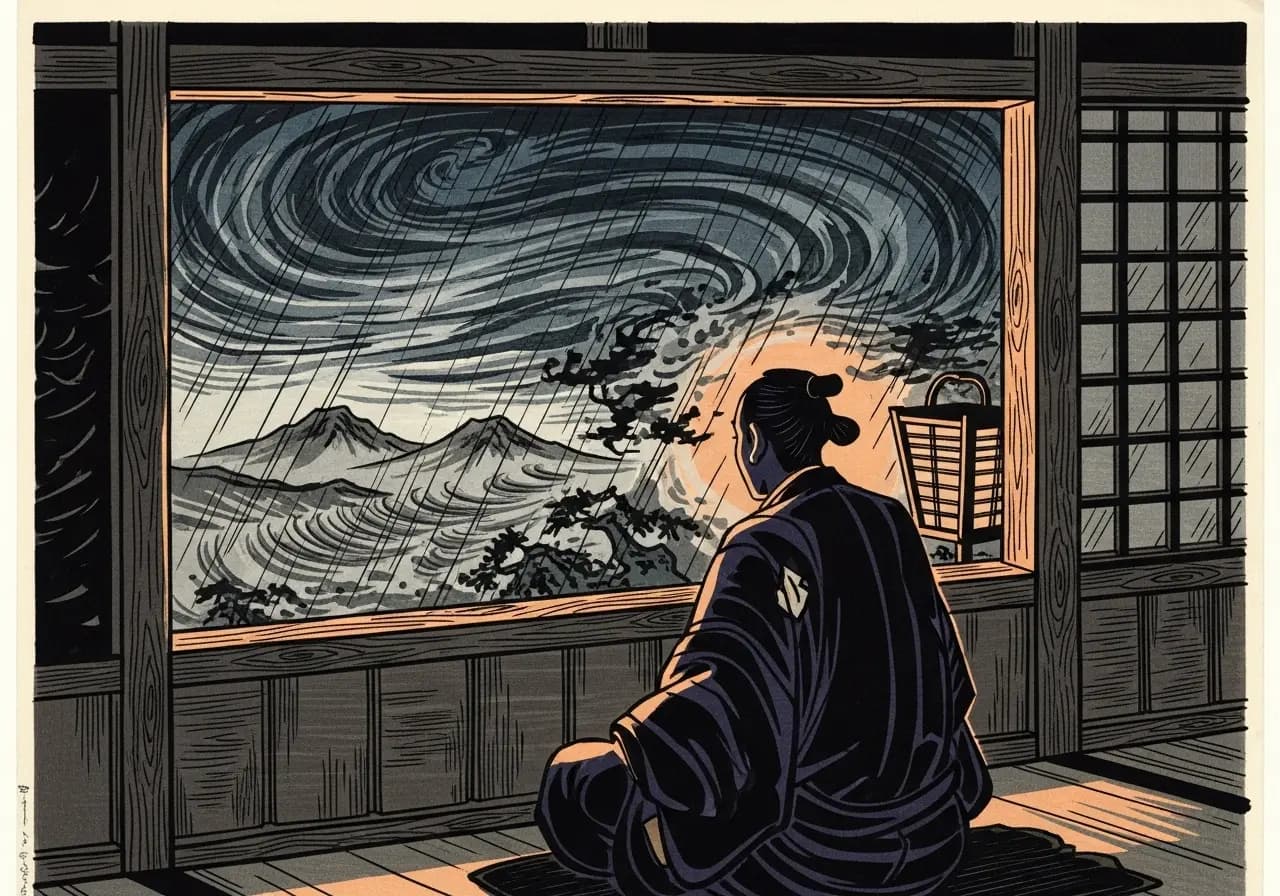
Weathering the Storm
Episode 135 of the Secular Buddhism Podcast
Hello, and welcome to another episode of the Secular Buddhism Podcast. This is episode number 135. I'm your host, Noah Rasheta. Today I'm going to talk about the weather of the mind.
Keep in mind, you don't need to use what you learn from Buddhism to be a Buddhist. You can use what you learn to be a better, whatever you already are.
If you're new to the podcast, check out episodes one through five for an introduction to the main concepts and teachings of Buddhism, or visit SecularBuddhism.com and click on "Start Here." If you're looking for an online community to practice with and interact with, consider becoming a supporter of the podcast by visiting SecularBuddhism.com and clicking on the top link that says "Join our online community on Patreon."
Reflections on Last Week's Koan
Before jumping into today's topic, I wanted to discuss the koan that was shared in the last podcast episode. It goes like this:
"As the roof was leaking, a Zen master told two monks to bring something to catch the water. One brought a tub, the other a basket. The first was severely reprimanded. The second highly praised."
I want to share some of the thoughts that were discussed in our Patreon community, because there are always good perspectives shared there.
Darlene shared this: "This koan makes me think of the emotional enlightenment you discussed in the episode. We think that happiness comes from clinging to pleasant emotions, but that actually causes suffering. In the same way, if the roof is leaking, accepting that it is leaking and water will get on the floor because that's what happens when the roof leaks. If we catch the water in a tub, it will eventually overflow. In the end, we can't deny our emotions because they will find us somehow. We can find peace by accepting them wholeheartedly."
Tani offers this perspective: "I wonder if this koan speaks to our tendency to try to control our emotions. If the roof is leaking, we must wait until the rain is over and fix the roof. Work on the source of the anger or pain. Bringing a tub will only result in a harder time removing it, or it will overflow later, causing a bigger mess. The basket, I'm imagining one of those meant to carry water from the well to the house. So it holds the water, but not as much as the tub may. It might require more trips outside to dump the water, but it doesn't let us ignore it for too long. We still have to pay attention to the basket and water. In this way, instead of trying to stop emotions from happening, we need to weather the storm as best we can, and then work on the source of the pain and emotions when things are clear, if possible."
And then Mike shares this thought: "Maybe I'm doing this wrong, but I seem to be interpreting each of the most recent koans the same way. In most of them, I see it as a reminder to not look for wisdom in others, but to look for it in yourself instead. In this case, the answer of the tub was clearly the more appropriate tool for catching water, but the student who chose that was severely reprimanded. There's no reason to reprimand this student. He chose an appropriate tool for achieving the particular goal. Perhaps the student's only error was in believing the Zen master to be more of a master than himself."
I really liked the ideas that were shared. These are only three of the several thoughts that were shared in our Patreon community, but I particularly liked Mike's thoughts here at the end.
My Thoughts on the Koan
I wanted to share some of my own thoughts about this koan. First, I think that we tend to make meaning of things, and we make assumptions without knowing all the details. So we fill in the gaps. I think it's what we do. It's a human thing.
With a story like this, we immediately make assumptions. If there's a hole in the roof and water is coming in, we paint a whole picture around that. We assume that water must be leaking on the floor, and we need to bring something to catch the water so that it doesn't leak on the floor. A tub in this case. But what does a tub even mean? Is it a bathtub? Because if we were to consider a bathtub on one hand and a basket on the other, it very much could be that the tub was the wrong answer because it was too big. The thing is, we don't know.
So we paint the story. We fill in the details, and then we make assumptions based on all of these details that we just don't know. We're really good at making meaning of things, and because of our discomfort with not knowing the details, we fill in the gaps.
And that's what this story reminded me of—the fact that I don't know the details. I mean, first of all, why do we even assume that just because the master reprimanded one and praised the other, that one was wrong and one was right? What if the one who brought the basket had been struggling in class and had been getting everything wrong and was feeling really down? Maybe the Zen master decided to praise him this time so he wouldn't feel so bad, and reprimanded the one who brought the tub because he always gets things right and maybe needed to feel a little more humbled. The point is, we don't know. Who knows? We don't know the details.
We get so little information out of this story, and then we fill in the gaps. And sometimes we do that in life. Taking very little information about an overall story, we make meaning. And as soon as we make meaning, we fill in the gaps, and we might just be making wrong assumptions. That's what I thought about as I was listening to this one.
It does seem like the obvious answer is the tub, unless you give me more details. Again, is this a bathtub we're talking about? Is it a little tub? Is it a basket that has holes in it, or is it a basket that's capable of carrying water? I don't know any of the details. I just know that I immediately made an assumption, and that the point of this koan is to make me stop in my tracks and say, "Hmm, I don't know about this." And that's kind of what it does, especially when you hear that the basket was praised and the tub was not.
So what does the koan make you think of? What does it cause you to think about? Again, with all koans, really what matters is: what does the story tell you? What does it help you think about? Or what does it make you feel?
The Weather of the Mind
The topic I had in mind for today's podcast episode has to do with weather—weathering the storm, the weather of the mind. This comes from an experience I've had in the past couple of days while I'm out here training a couple of new students who are learning how to paraglide.
There's an expression that I really enjoy, and I think it comes from a Buddhist teacher or practitioner. It says, "You are the sky. Everything else is just the weather." I love that.
In the training program that we do to learn to paraglide, there's a lot of ground school where you learn about weather, how to forecast the weather, and how to make proper decisions about when and where to fly. And I always tell students that perhaps the most important decision that you'll ever make as a pilot is the decision to not fly. There are certain circumstances and weather phenomena where you're not going to want to be flying because you do not want to be in the air wishing you were on the ground. This is a very important decision to make as a pilot, especially for the very light or ultra-light aircraft that we fly—paragliders.
Now, I kind of pride myself on my ability to be very good at forecasting the weather. For me, I have a threshold, and I know that if the conditions are beyond my threshold, I will not fly. When I got into the sport and decided I wanted to fly, I knew that the reason I was getting into this was to have fun. So the litmus test that I use before every flight is I decide: "Is this going to be fun?" And if the answer is yes, then I proceed. If the answer is no, then I don't do it, because that's the whole reason I got into this—to have fun.
So when the weather reaches a point where I know it's going to be bumpy or the wind might be too strong, I don't even attempt it. And I've never gotten into any trouble because I never pushed myself. This ability to forecast the weather has saved me from a lot of situations where I could have been in the air wishing I was on the ground.
Preparing for the Storm
I mentioned that I'm out here teaching this course. And today we had forecasted the weather. I knew that there was going to be a storm passing through, and we've had very strong gusts of wind. Right now it's actually raining. I don't know if you can pick up that sound in the microphone, but it's been raining and very gusty for the last several hours.
I had this mental correlation as I've been sitting here, weathering the storm. I was thinking, "I could have been out there. I could have been caught unaware of the storm and then dealing with inconveniences simply because I was not aware." For example, all of my equipment was outside. I have totes with paraglider wings, several paramotor rigs, all the gas cans—lots and lots of gear. It's all been sitting outside because we're doing this course.
Well, in observing the weather, which I check several times a day, I knew that rain was in the forecast and that it was coming. As soon as I knew that, I made all the decisions about the things that needed to be done to make sure that when the storm came, it wouldn't be more than an inconvenience of time. Because we've been out here for days now working on this training, and sure enough, that's exactly how it unfolded.
By the time the storm came, the tents were down. All the gear was safely stored inside the trailer. And it's been nothing more than an inconvenience of time that we could have been practicing or flying, but we can't because of the weather.
The Parallels With Life
But this got me thinking about the parallels between this situation and how we approach life. I think people who are capable of forecasting the weather of the mind can take preemptive steps and precautions to avoid any inconveniences for the moment when that proverbial storm hits.
And I'm sure all of us have experienced that feeling of being caught in the storm—the emotional storm that is suddenly there. A lot of times it's there because we're not very good at forecasting it, or we're not very skillful with understanding our mental weather patterns. But all of us experience this.
Imagine being able to be more skillful with forecasting our own mental weather. I thought, as I was preparing for all this with the actual weather, how cool would it be to be able to forecast the emotional storms that we have coming up in our lives? And I think to a certain degree, we can.
If we know ourselves well, we may know, for example, that if I haven't had breakfast today, I'm much more susceptible to that emotional storm that could hit when a car cuts me off. But I know that about myself. So perhaps I'm going to drive with a little bit more caution and not be in such a hurry.
Or the big, clear example would be if I understand myself and my emotional weather patterns, I may know when is the most appropriate—or perhaps the least appropriate—time to have a discussion with a spouse, a parent, or a child about a difficult topic. Because it's going to be much harder to navigate that when the conditions are not ideal. In the same way that for me and my students as paraglider pilots, it's much more difficult to navigate the skies under the wrong conditions.
So part of what makes that experience so pleasurable and enjoyable is that we do it during the right conditions. And I think in a way it could be that simple—to think, "Oh, if I have to have a discussion with my spouse about this sensitive topic, well, let's do it when the conditions are more favorable and not when there's a gust front coming in." It's kind of a fun way to make that mental analogy. It works for me and my mind.
So the idea would be that knowing yourself and knowing the weather patterns of your own mind—that's kind of at the heart of what we're trying to accomplish with a lot of these practices. The whole notion of what we're doing is that we're learning to understand ourselves a little bit more so that we can be more skillful. Skillful with how we navigate life. Skillful with how we navigate the small, day-to-day decisions, whether it's talking to your kid's teacher at school, talking to your spouse, talking to your boss, or having to bring something up to a co-worker.
We can do things more skillfully, and very much like the decision of knowing when not to fly, I think it's important to know when not to bring up a certain topic or when not to have a certain emotional conversation that needs to be had—because maybe the conditions aren't favorable. And that was a fun mental correlation.
Finding Refuge in the Mind
The funny thing is, I've been saying all of this while sitting here in my camp trailer in the middle of a storm, and the winds have been gusting to thirty, even thirty-five miles an hour at times. At one moment I decided to leave the trailer and go sit in my truck because it felt a little more stable and safe there. This trailer is just rocking back and forth.
As I was sitting here, I had this thought: I can look out the window and I can see the storm and I can see everything happening around me. Some of the tin from one of the roofs of the hangar about a hundred feet away—I saw it come off the roof, and that was kind of scary to watch. The whole time I was thinking, "There's stormy craziness outside, but I am somewhat finding refuge here inside."
And then I had this mental correlation: that's kind of how my mind is. My mind can be the refuge that I go to, to observe the weather patterns. And this is why I like that quote that says, "You are the sky. Everything else is just the weather."
That was a fun correlation to think: "Here I am, observing a storm and finding somewhat of a refuge in a safe place." And in my real life, it can kind of be that way at times—finding myself in the storms of emotional discomfort or whatever it is I'm weathering. Weathering that storm by being in the safety of my own mind as the observer. The one that's just watching, watching it all unfold, watching the mind as the sky and everything else as the weather.
That's the correlation I wanted to make. That was kind of the topic that I came up with because, like I said, I'm literally sitting here in a trailer weathering the storm, and I thought it would be a fun correlation to make with everything else.
Closing Thoughts
That's actually all I have for this podcast episode. And as always, I want to thank you for listening. I hope that these concepts and ideas can give you pause and give you a way of thinking of things slightly differently.
And of course, if you want to support the work I'm doing with the podcast, you can consider becoming a Patreon supporter and joining the online community where we discuss the koans and these podcast episodes and much more. There's even a weekly study group there. You can learn more about all that on SecularBuddhism.com.
I've enjoyed sharing these koans. I have another one I want to share with you today. It's called "Rikyu's Poem," and the title is "Only This." Here's how it goes:
"First, you heat the water. Then you make the tea. Then you drink it properly. That is all you need to know."
That is his poem: "Only This."
I look forward to hearing your thoughts about the poem and discussing my thoughts about it in the next podcast episode.
Thanks again for listening. Until next time.
For more about the Secular Buddhism podcast and Noah Rasheta's work, visit SecularBuddhism.com