

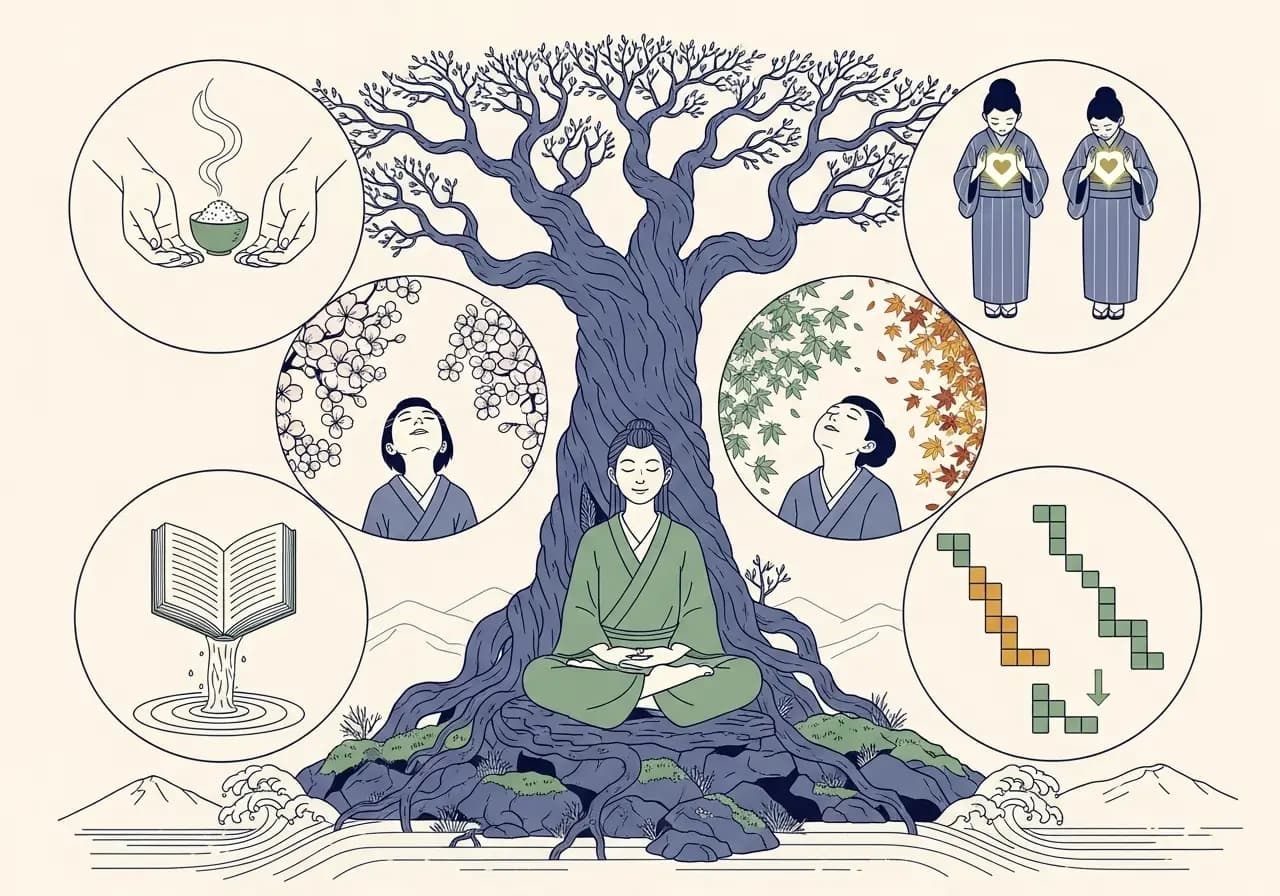
Five Daily Life Guidelines
Episode 133 of the Secular Buddhism Podcast
Hello, and welcome to another episode of the Secular Buddhism podcast. This is episode number 133. I'm your host, Noah Rasheta. Today, I'm going to talk about five daily life guidelines.
Keep in mind: you don't need to use what you learn from Buddhism to be a Buddhist. You can use what you learn to just be a better whatever you already are.
If you're new to the podcast, episodes one through five give a good introduction to the basic teachings and concepts of Buddhism. You can visit secularbuddhism.com and click on the "Start Here" link to get started there. If you're looking for an online community to practice with and interact with, consider becoming a supporter of the podcast by visiting secularbuddhism.com and clicking on the top link that says, "Join our online community on Patreon."
Reflections on the Koan
Before jumping into today's topic, I want to talk about the Zen koan that I shared in the last podcast episode. The koan says: "When the many are reduced to one, to what is the one reduced?"
I want to share some of the thoughts that came from community members on Patreon regarding this koan.
The first one comes from Lauren, who says: "To me, this week's koan made me think of the interdependent nature of reality. I also thought about the often-used car analogy. If you are taking a car apart piece by piece, when does it stop becoming a car? The many car parts are often reduced to the concept of a car in our minds, but the reality is that each component is unique and interdependent with all things. So I think it's a lesson to remind ourselves that every concept we have of a physical thing or an idea is made up of subcomponents, and those are made up of subcomponents, and so on. This is so we can be mindful of what it took for this thing, this concept, this moment to arise so we may act more skillfully by having right view in the world."
Marella says: "I really like this koan, as it makes me think about the concepts of oneness, interconnectedness, and non-self all in one sentence. If the sense of separation between self and other disappears, then there is no one left, at least not in the same way as before the many were reduced to one. This doesn't mean that the one is reduced to nothing, but rather that the one has become the many."
Then Matt says: "I am reminded of the story of the blind men and the elephant. In this situation, reducing the number of blind men would reduce our understanding of the elephant. I really love this koan. It also made me think of how a forest benefits from a diversity of species. A reduction of species makes the forest less able to cope with change. I think humanity is learning this from the internet. We can become trapped in thought bubbles on the internet. Reducing the views that we are exposed to makes us more vulnerable."
I enjoyed the thoughts shared on the Patreon community—specifically those from Lauren, Marella, and Matt—and I wanted to share some of my own thoughts regarding this specific koan. I agree with what was shared: the invitation of the koan is to see the interdependent nature of things.
What's fascinating to me, when we start to think about this in terms of the one and the many, if you think about it in terms of a line that goes up or a line that goes down, you end up at the same place. You end up at the point of uncertainty and the point of not knowing.
So if I take the car as the analogy: a car is a concept. It's an idea. And yet, it's a thing. It's real. But I could reduce it to all of its parts, and I end up with another concept—for example, an engine. The engine of the car. Now it's not the car, it's the engine. But you do the same thing there. Reduce the engine to its parts. Oh, well now I have pistons and all these other parts of an engine. Take the piston and reduce it to its parts, and at some point you go all the way down to the lowest known particles that we know of. Then, what are those made of? And you're still left with, "Well, we don't know." We just know as far as we can go, there are these things—I think it's quarks—but you get to that point and ask: well, what are those made of? What are those composed of? Is there anything smaller? And again, the answer is: we don't know. At least not for now.
But if you go up the line, it's the same thing. Many states make a country. Many countries make a continent. Many continents make a planet. Many planets make a solar system. Many solar systems make a galaxy. Many galaxies... and you go up, up, up, up, up until you say, "Okay, we've got the universe, and the universe is expanding."
Now you can go into the theoretical explanations beyond that. What if it's a multiverse? What if it's strings or bubbles? Whatever the various explanations of what there could be with multiverse theory, you end up at the same place: we don't know.
I think it's kind of fun to think about that in terms of this koan, with the many and the one. What you have is the many and the one, the one and the many, the many and the one. It just depends how you want to define it. Many states make up one country. But if you reduce the country to its parts, you have many states. Well, reduce the many states to their parts. Well, many counties. What about the many counties? Many cities. What about the many cities? And it goes on and on and on.
But what we have are just concepts and ideas. So that's what's fun to think about in terms of this specific koan: when the many are reduced to one, to what is the one reduced? For me, this is an invitation to see the interdependent nature of things.
Today's Topic
Those are my thoughts about the koan. Now I want to jump into the topic for today's episode.
I've been thinking a lot about different topics, and I keep a list where I have ideas for episodes. For some reason, I thought I'd share this one today. This is a list that I first encountered when I was doing my lay ministry program with Bright Dawn. This was one of the teachings from the Bright Dawn Way of Oneness Buddhism, and I really enjoyed it. I wrote it down, and I've thought about it over the years—what it means to me. I thought I would share it with you today. These are what I call five daily life guidelines.
I must say real quick that when I first heard about these as guidelines, it made me think of that scene in Pirates of the Caribbean where Keira Knightley's character, Ms. Turner, is trying to get Captain Barbossa to follow some specific rules or codes. She invokes the Pirate's Code. He retorts with, "First of all, you have to be a pirate to follow the Pirate's Code." But then he says something that always stood out to me. He says, "And thirdly, the code is more what you'd call guidelines than actual rules."
This is something that I think about often with concepts in Buddhism. There is no compelling force in Buddhism. There are no commandments. It's not like a hard set of rules. Almost everything that we learn about in Buddhism is in the context of being guidelines.
So when we think about these in terms of guidelines, remember: there is no compelling force. There's no rigid requirement to follow these things. But I enjoy these guidelines. I think they're worth thinking about on a daily basis. So I want to share them with you. These are the five guidelines that I learned about.
The Five Daily Life Guidelines
One: Consume Mindfully
The first one is the guideline to consume mindfully. When we talk about consuming, we're not just talking about consuming food. I do think it's wise to eat sensibly and to not be wasteful, not to take a whole bunch of food on my plate knowing I'm probably not going to eat it all. There's some sensibility and skillfulness with that. But this goes into other things as well.
The fact is, we can pause before we buy something and see if breathing is enough. Sometimes we buy things because we feel that we need to have something that's going to make us feel a certain way.
This is actually exactly how marketing works. The goal of marketing is to make you feel the pain point in your life that you are experiencing because you do not have this specific thing—this house, this phone, this vacation, this whatever it is that we're trying to market to you. I know this because I come from a marketing background. I worked at an advertising agency, and marketing has been one of my specialties throughout most of my career. So I know that the proper technique to get somebody to buy something is to help them feel the pain point and highlight it. Your life is the way it is because you don't have this. We don't say it exactly like that, but we make you feel it. Then the solution is, well, you buy this product or you buy this service or whatever the thing is. And guess what? Then life's going to be good.
So to consume mindfully is to pause before we're going to buy into something and see: why do I really want this? What's the real motivation behind me acquiring this thing, whatever it is? And again, I'm not saying that buying anything is bad. I'm just saying it's very skillful to know why we're going to buy something. In our society, sometimes we don't entertain the thought of why we're buying something. We just buy it because we want it.
Another form of consuming mindfully is paying attention to the effects of the media we consume. When we consume content and acquire content through various sources—whether it be books, podcasts, television shows, music, social media—there's a way to consume more mindfully. Again, it's not that one or another is bad, but: what does it do to you to consume what you're consuming?
I know people who really struggle with the emotions and feelings they experience by watching the news. And it seems like a really skillful thing would be to just stop watching the news, and yet they can't. It's like, "There's this thing that I hate, and I got to keep watching it because I hate not having it, and I hate having it." It's just really strange. And there may be a much more skillful approach, which is: well, then stop consuming that thing that makes you feel that way.
Again, I'm not saying we need to do any of these things. These are just guidelines. It's all about you understanding yourself and then consuming mindfully based on what you know is best for you.
It would be highly unskillful for someone who's allergic to peanuts to decide, "Well, I'm still going to eat peanuts anyway because I like the flavor." It's not that that's good or bad—it's just that it's highly, highly unskillful. Why would you do that? But we do that all the time with many things that we consume. So: consuming mindfully.
Two: Share Loving-Kindness
The second one is to share loving-kindness. These are five daily life guidelines, and to me, share loving-kindness means to consider other people's views deeply. I like the keyword deeply. Because oftentimes I think about my views and how meaningful my views are to me. We all have meaningful views. Our way of interpreting reality is real to us.
Now, nobody goes around living their life saying, "I know that my way of interpreting reality is wrong, but I'm going to stick with it anyway." Why? Nobody does that. Because we all genuinely think that our way of experiencing and interpreting reality is the correct way. And you can see this in any form of ideology, right? Everybody believes that their way is the right way.
So to consider other people's views deeply, for me, means I'm going to go beyond the view itself. To view it deeply means: where did this view come from? What are some of the causes and conditions that gave rise to this view? You know, you go down layer by layer by layer. We don't know the answers to all these things. You can't know all of them, but you know that there are causes and conditions. Understanding that helps me to not get so hung up on whatever the view itself is.
I can talk to someone who might have a very strange view that makes no sense to me, but I can see it deeply and understand that view has causes and conditions. I may not understand those causes and conditions, but knowing that there are causes and conditions—and that those causes and conditions have causes and conditions—changes the relationship that I have with the specific view. I think that's really helpful when we're talking about political views or religious views. Those are always hot topics.
Sharing loving-kindness also means that we work for peace at many levels. It means that I'm trying to experience more joy and less negativity with my interactions with other people.
Another component to sharing loving-kindness, for me, is recognizing that it takes bravery on my part to be kind and compassionate. Here's a quick example to give some context. It's the way that we interact with people like homeless people. In Pema Chödrön's book When Things Fall Apart, she has a section where she's talking about what happens when we see someone on the street who is homeless. Most of us tend to not want to look at them, especially if you don't have anything to give them, because it's awkward and it feels uncomfortable to not be able to help.
It's not that we go around saying, "Oh, I don't want to help you." Maybe some people do. But for most of us, what we feel is: I wish I could do something, but I can't. I'm not in a position to. I don't have the money. I might not have cash on me. So I'm just going to avoid looking at this person because I can't help them anyway—which is actually sad because it kind of makes them feel invisible.
So the idea of bravery and compassion—or what I call brave compassion—is recognizing that for me to look at this person in the eyes and just acknowledge them and say, "Hi, how are you?" or "I hope you're having a good day," or just offer a smile, it takes a little bit of bravery. Because there's going to be a little bit of awkwardness—the awkwardness of: I don't have anything for you or I can't do anything for you, but I'm okay with the discomfort of that awkwardness because I'm brave. So I'm just going to share that compassion and share the smile.
That's how I think about it: brave compassion. So that second daily life guideline is to share loving-kindness, to be willing to share that kindness with other people even when it's hard to do because it's uncomfortable at times.
Three: Practice Gratitude
The third one is to practice gratitude. This is always a good one, right? We can respect the people that we encounter because everyone and everything is a teacher. This is a helpful one for me. When you encounter someone that's unpleasant—a coworker, the annoying person in the store, or whatever it is—we can start to see these people as teachers. What can I learn from this? What can I learn from this behavior I'm experiencing? When we have that mindset of learning, then you can have gratitude. Thank you for teaching me how not to be. Or thank you for teaching me... I don't know, whatever the lesson is that you get. If you're the one who can make a lesson out of anything and learn from anything, then it's natural to feel a sense of gratitude towards whatever situation, scenario, or person.
We can be equally grateful for the opportunities and the challenges. I think it's very easy for us to be grateful for opportunities. That's natural. But it's not very common for us to feel a sense of gratitude for our challenges, and yet the challenges are often the more formative of the two.
I've had plenty of nice opportunities and positive experiences in life that I was grateful for, and I've also had many challenges or situations that were extremely painful and difficult. At the time, I didn't feel a sense of gratitude for them. And yet, those events are the ones that went on to forge something much more significant and larger for me in terms of my character or in terms of life changes that I can look back on.
If I'm being very honest with myself, I would have to say I am much more grateful for all of the challenges than I am for the opportunities, because the challenges are the ones that really helped me learn more about myself or really helped me to grow. So when we practice gratitude as a daily life guideline, we're looking at both the opportunities and the challenges and trying to practice gratitude towards both.
There's a quote I like to share in terms of gratitude. This is by David Steindl-Rast. He says: "In daily life, we must see that it is not happiness that makes us grateful, but gratefulness that makes us happy." I think that's so true. If we can develop practicing gratitude, we'll find that we tend to be more happy going through life—not because we're happy, but because we're grateful. It's the gratefulness that makes us happy. And I think a lot of times we have that mixed up. We try so hard to find ways to be happy when instead we should just try to find more things to be grateful for.
Really, what is there to not be grateful for? Anything that teaches me something is something I can be grateful for. So yeah, there's a lot to be grateful for if you just think about it.
Four: Discover Wisdom
The fourth one is to discover wisdom. To me, this is about finding the connections between the teachings and our own life. And like I said, anything can teach us. Anything can be my teacher. So when I make the correlation between that thing that's teaching me something and what that means for me in my life, that's a matter of discovering wisdom.
I find I discover wisdom in the little things: the wisdom of being annoyed at the red light, the wisdom of dealing with the coworker that makes annoying sounds or whatever the situation is. There's wisdom to be had there if we're willing to look.
Now, another concept here related to discovering wisdom is that we should not become attached to our conclusions. When we see something and say, "Oh, I've gained some insight," that's fine. There's nothing inherently wrong or dangerous with gaining insight. But how attached are we to the insight that we gain?
This, to me, is like the blind men and the elephant. I gain wisdom when I feel the elephant and discover, "Yep, these are... the elephant consists of all these little stringy things." And then later, I might discover, "Yeah, that's the tail. That's just the hair on the tail, and that's only one part of the elephant." But to me, that might be the only real part. But how attached am I to my conclusion? If I'm attached to my conclusion, then I don't want to hear from the other person who's saying, "No, it's not. It's one big sidewall"—the one who's feeling the side of the elephant.
So let's not get too attached to our conclusions. We can always keep the beginner's mind, the empty teacup. As soon as the teacup's full, there's no more room for more tea. So we keep it empty. That, to me, is not becoming attached to our conclusions.
There's a quote that I think goes well with this concept of discovering wisdom. It's a Tibetan proverb that says: "If I know I will die tomorrow, I can still learn something tonight." I love that thought. I'm always trying to learn something new. I'm always trying to read a new book, listen to a new podcast, or do something that teaches me something, because I've come to understand that there's so much out there to be known. And there's so very little of it that I'll ever get to know, that it's just exciting to learn something new. It's exciting to gain any kind of insight about any kind of topic. That has affected the type of content I watch. I enjoy documentaries that teach me things because I know that's something I'll never even get close to scratching the surface of knowing—all the things there are to know. And that's true whether I'm thinking of one specific topic or subject, or just in general, all that there is to know about anything. We'll never get there.
Five: Accept Constant Change
The fifth one is to accept constant change. To me, this means it's an invitation to be open to whatever arises in every moment. Again, this is cultivating the beginner's mind. But to me, I like to picture this with the Tetris analogy.
I'm going through life, and the Tetris game is always changing because new pieces are always showing up. So I don't want to get stuck for too long. We all get stuck from time to time. When that piece shows up, we're like, "Ugh! I almost had this figured out, and then that showed up. Why did that have to show up?" And sure, I might be stuck there for a few seconds as that piece is coming down and I'm trying to figure out where to put it. But don't get stuck there too long because then comes the next piece.
This is equally applicable to when the piece shows up that you didn't want as it is to the piece that shows up that you did want. You're like, "Finally! I got the pieces that I need. Everything's finally going to work." And yeah, it might. Then it shows up, and they all lock into the same place, and everything's good. That line disappears from your game. Because that's the way the game works, right? And then it changes again.
So don't get stuck too long. Because when it's good, it's good while it's good till it's not good. But when it's bad, it's also bad while it's bad till it becomes good again. That's just the nature—as Pema says—of things coming together and things falling apart. And that is life, right? Things come together, and then things fall apart, and then things come together, and then things fall apart. And it goes on and on and on until our game is over.
I love to think about that when I think about Tetris.
Closing
I want to close this with an invitation to keep going. Keep going. Keep going. Always keep going.
So these five daily life guidelines are: consume mindfully, share loving-kindness, practice gratitude, discover wisdom, and accept constant change. These have been fun for me over the past several years to think about often—daily, really—because they are useful guidelines. And with time, they become a little bit more habitual in the way they affect how we interact with people, with situations that we're going through in life, and with life in general.
So my invitation to you is to think about these five daily life guidelines and see if any of them seem like they would be good or relevant for you to apply into your day-to-day life.
Final Thoughts
And that is all I have for this podcast episode. As always, I want to thank you for listening. If you want to support the work I'm doing with the podcast, you can consider becoming a patron and joining the online community where we discuss these koans, podcast episodes, and more. There's even a study group and book club. You can learn more about all of this by visiting secularbuddhism.com.
If you enjoyed this podcast episode, feel free to share it with others, write a review, or give it a rating on iTunes. And that's all I have for now, but I do look forward to recording another podcast episode soon.
Before I go, here is another Zen koan for you to think about:
Once, Mazu and Baizhang were walking along and they saw some wild ducks fly by. "What is that?" the master asked. "Wild ducks," Baizhang replied. "Where have they gone?" "They have flown away," Baizhang said. The master then twisted Baizhang's nose. And when Baizhang cried out in pain, Mazu said, "When have they ever flown away?"
Till next time.
For more about the Secular Buddhism podcast and Noah Rasheta's work, visit SecularBuddhism.com