

Nowhere to Hide, Nothing to Hold
Episode 132 of the Secular Buddhism Podcast
Hello, and welcome to another episode of the Secular Buddhism podcast. This is Episode number 132. I'm your host, Noah Rasheta, and today I'm going to talk about vulnerability. Keep in mind: you don't need to use what you learn from Buddhism to be a Buddhist. You can use what you learn to be better whatever you already are.
As a friendly reminder, if you are new to the podcast, episodes one through five are a really good place to start to get a general understanding of basic Buddhist concepts and teachings. You can visit secularbuddhism.com and click on the "start here" link to find quick access to those first five episodes.
If you're looking for an online community to practice with and interact with, consider becoming a supporter of the podcast by visiting secularbuddhism.com and clicking on the top link that says "join our online community on Patreon."
With that, let's jump into the discussion around the Zen koan that was shared in the last podcast episode:
Elder Ting asked Lin-Chi, "Master, what is the great meaning of the Buddhist teaching?"
Lin-Chi came down from his seat, slapped Ting, and pushed him away. Ting was stunned and stood motionless. A monk nearby said, "Ting, why do you not bow?" At that moment, Ting attained great enlightenment.
Working with the Koan
I want to share a couple of thoughts around this specific koan because I think it has deeper meaning—at least for me, it carries profound lessons. I want to share some thoughts from the Patreon podcast community and some of the insights I gained from reading other people's interpretations.
Ramona said, "To me, when Lin-Chi came down from his seat slapping and pushing Ting, he was answering his question of the great meaning of Buddhist teachings, which is enduring suffering. When the monk nearby assumed he got slapped because he did not bow, Ting became enlightened because in that moment, he realized he should invite and bow to the suffering, to welcome it and give it respect. Perhaps that's the great meaning of Buddhist teaching."
I like Ramona's thoughts on this, especially the correlation between the answer to the question and the great meaning of the Buddha's teachings. We know that the Buddha taught about suffering. He taught the Four Noble Truths: the truth of unsatisfactoriness—dukkha, which is often translated as suffering; the truth of the cause of unsatisfactoriness; the truth about the cessation of unsatisfactoriness; and the truth about the path that leads to the cessation of this unsatisfactoriness. So in a nutshell, if you were to ask someone "What is the meaning of the Buddhist teachings?" it certainly centers around this sense of unsatisfactoriness, or what we might call suffering.
I do think it's interesting that this master would come down and give the answer to what is the great meaning by slapping Ting and pushing him away—essentially causing Ting to experience, in that moment, probably some unsatisfactoriness or suffering. That's fun to think about.
Anushka said, "As others have said, I too felt that being slapped and pushed away is a representation of what we do when we face suffering. It works on two levels for me. Suffering slaps us in the face and we push it away. But also, suffering does the pushing away by interrupting us and separating us from our experience. I was also taken by the last piece: 'Why do you not bow?' I interpreted that as meaning that Ting didn't bow to the teacher. I interpreted it as meaning he didn't give reverence to the suffering. I sometimes wonder: how much time and effort do we give to feeling suffering? Is it excessive? What is the right effort we need to put in to truly move past it?"
I like what Anushka is sharing here as well, especially the correlation she brings out with the concept of bowing to suffering. That's something I want to discuss a little bit later with my own thoughts around this koan.
Matthew said, "My first reaction to this koan was to think of how I very often ask questions knowing what I want the answer to be. That is, I'm not hoping to get an answer, but just validation of what I already think the answer is—much like the student whose cup is too full of tea to get any tea from the master. Ting, I think, did not get the answer he was expecting, and the other monk was saying, 'Ting, you asked a question and you got the answer. Why are you not bowing to thank the master?' It reminded me that I need to be more open to the answers to questions, and also that maybe I do already know the answer deep down inside."
I enjoy Matthew's thoughts a lot on this topic—the correlation between the story of the tea cup being full and the concept of asking questions sometimes just to get validation about the answer we think we already have. I think we all do that from time to time. What's interesting is that he didn't get the answer he was expecting, and ironically, that's what led to his enlightenment. There's something to be learned there: often, the thing we're looking for won't get us what we want. But sometimes getting something we weren't expecting can get us what we were actually after in the first place. That's a fun mental correlation.
Nancy said, "I see this koan as a role-play of the First Noble Truth. Life at times will slap you in the face and push you away. Instead of bowing and walking away, which seems to have been his common reaction, Ting paused, stood motionless, saw suffering and pain for what it was—a slap and a push, nothing more."
I like those thoughts as well—to see pain and suffering for what it is, a simple slap and a push and nothing more. That's a profound thought. Thank you to everyone who shared these concepts in the Patreon group. I always appreciate hearing everyone's thoughts.
My Own Reflections on the Koan
I want to share a couple of my own thoughts around this koan. The Buddhist teachings are all about the truth of unsatisfactoriness. I think sometimes we suffer because we're caught in our views, our stories. As soon as we release those views and become non-attached to our stories, the unsatisfactoriness ceases.
I think perhaps this was the case with Ting. He asked a question and got an answer he wasn't expecting. Perhaps he had a story in his mind about what the answer should be, or more importantly, what it shouldn't be. In this case, the answer shouldn't be a slap and a push. He stood there motionless, probably trying to figure out what on earth that was. When the monk nearby reminded him, "Ting, why do you not bow?" perhaps in that moment he realized, "Oh, that is the answer."
His willingness to open his mind and let go of whatever story he had about what that answer should be—what kind of answer would be right or wrong—perhaps that's when he let go of the story. Perhaps in that moment of releasing himself from the views he held, perhaps that's why he attained enlightenment. I like to think about it that way. I don't know if that's exactly how it went, but it makes sense to me.
Again, we're not trying to solve these stories and get really in-depth about what they mean. All we're trying to do is invite introspection. What does this say about me? It was fun for me as I re-read this koan, imagining what I would do if I were Ting and I was the one who was slapped or pushed. Or what I would do if I were the master being asked the question—how would I answer that? Then I thought, what if I were the monk nearby watching it all unfold? Would it have occurred to me to also say, "Hey, why did you not bow?" So it was kind of fun to place myself in all three of those roles. This is just an introspective exercise.
The Title: Nowhere to Hide, Nothing to Hold
The topic I wanted to discuss today—the title of this podcast, "Nowhere to Hide, Nothing to Hold"—I want to correlate this a little bit with this koan and share some thoughts that have been on my mind over the last few days. These thoughts are inspired by Pema Chödrön's book When Things Fall Apart.
I was reading this recently (or I'm still reading it with the book club in the Patreon community), and we have discussions around specific reading assignments. We read one of the chapters that addresses the concept of hope and hopelessness. I had read this before, but it was fun to correlate it all again.
One thing that's nice about doing this podcast and having a study group is that I get to keep myself fully immersed in these concepts, teachings, and ideas because I'm encountering them all the time. I'm trying to keep up with reading assignments. I'm always thinking about what to talk about in the next podcast episode. At the same time, I'm busy living my life doing the things I do.
Right now I'm in the middle of an eight-day training course. I'm home now after having been in Mexico for a year, and I'm right back into the routine of scheduling new students to learn to fly paramotors. I'm on day four of this training, so my mind gets very immersed in what I'm doing in my normal day-to-day life, which right now is teaching people how to fly and teaching them how to control the paraglider wing, how to control it in the wind, how these motors work, how to assemble them, and ultimately how to fly.
That's the goal. But it's fun that I get to correlate everything I'm doing in my normal day-to-day with these thoughts, concepts, and teachings centered around Buddhism. That's one thing I really enjoy about this podcast—it keeps me immersed in this way of thinking.
Theism and Non-Theism
In Pema's book, there are some really interesting concepts and topics, and I've been thinking about them this week. One of the ideas that came up is her definition of theism versus non-theism. This is a question I receive often because people who are new to studying Buddhism have heard that Buddhism is a non-theistic tradition but wonder what that means.
Pema does a good job of talking about this in chapter seven of her book, where she defines theism as having something to hold—having a hand to hold as we go through life. We put our sense of hope in the notion that at the end of the day, when all else fails, there's someone there who's going to hold our hand and make things better. That may or may not happen in this lifetime, or it may happen in the next lifetime. But the point is that's where our sense of hope comes from.
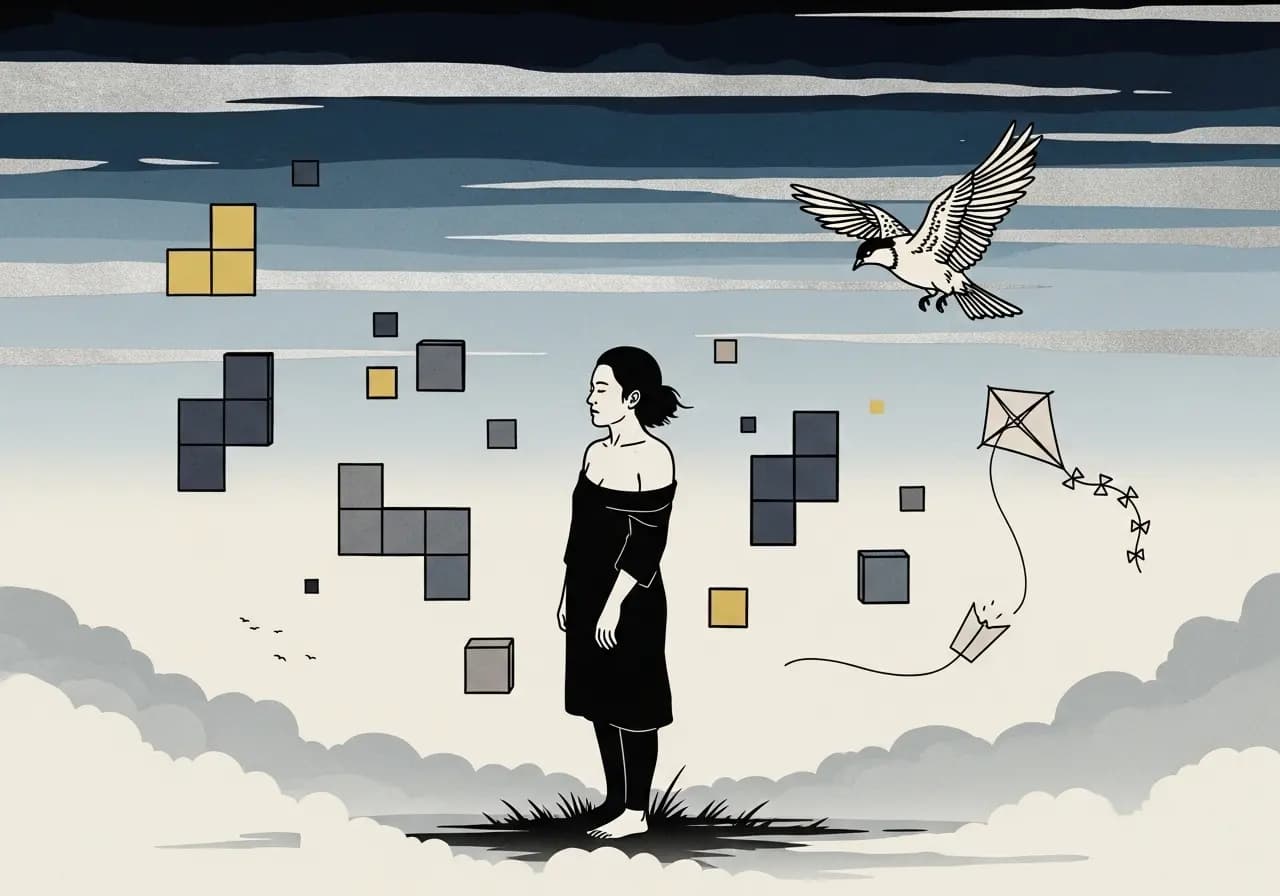
Buddhism as a non-theistic tradition is saying there is no hand to hold. There's nowhere to hide from the rawness that is life. Life—using the analogy of Tetris—is a series of pieces that show up. Some we like, and some we don't. Some are pleasant, some are unpleasant. Some have tremendous joy, and others invoke pain and sadness beyond what words can describe. In the midst of all that, we realize that perhaps there is no hand to hold, and it's just me here figuring this out.
The Kite and the Bird: Reconsidering Analogies
I want to share a correlation I've had with these thoughts of Buddhism as a non-theistic tradition. In the past, I've talked about an analogy comparing ourselves to kites or birds. I first used this analogy when a friend was interviewing me on his podcast. He was asking in the context of religion and how some ideologies provide us with essentially the hand to hold—the thing that gives us hope. It might be following a set of rules or commandments, or something that gives a sense of structure. If you comply with this structure, then there's hope on the other end of it.
He asked me, "What would you say to someone who says, 'Well, I have this ideology that I follow, and it essentially acts as my string. The string holds me up. I'm the kite. When the wind blows, the kite is able to fly safely because it is attached. That attachment to the string represents obedience to commandments, or faith in a specific belief. This acts like the string that holds us in the air.'"
I agreed and said, "Well, that's correct. The mistake would be to assume that we're all kites." I went on to say, "From my perspective, I think there are kites and there are birds, and there's nothing more sad than to see a kite flying so well only to have someone come along and sever that string. What a sad sight. The kite will fall because it can't fly without the string. But it's similarly sad to see a bird tethered with a string. The poor bird may not know that it's capable of flight on its own."
When I first made this correlation, I clearly viewed myself as the bird. I felt that by untethering or cutting that string, I discovered I could fly on my own and that my own wings were essentially the hand to hold. I think Buddhism works that way. But what I didn't like about this comparison is that some people might think there's a connotation that the kite is inferior to the bird or that the bird is somehow better. That was not my intention. My intention was to express that a kite is not a bird and a bird is not a kite—we're not all birds and we're not all kites. There's a level of skillfulness required to know the difference between one and the other.
In this specific analogy, I view myself more as the bird than as the kite. So my thoughts have changed since then. Let me give you two other examples: paragliding versus paramotoring.
When you go paragliding, you just have the paragliding wing over your head—no motor. You have to launch from the top of a hill, a cliff, or somewhere you already start out high. Then you glide out and look for thermal activity to climb back up and continue to stay up high. With paramotoring, it's essentially paragliding, but now you strap a motor to your back, and it changes the dynamic of the experience because now you don't need a hill or mountain. You just take off from wherever you want. You have something to rely on, which in this case is the motor on your back.
In this example, similar to the kite versus bird, I'm talking about paragliding versus paramotoring. But in this analogy, I identify more with the paramotor than with paragliding. The paraglider requires more faith in their own skillset. They have no hand to hold. There's nowhere to hide. You're exposed out in the open. If you don't do this right, you're just going to come down and land. But if you want to keep flying, you've got to hunt and find the thermal activities—the warm air that's rising. You find it, spiral up in it, gain altitude, climb out, and then shoot out of that and find another one. As long as you keep doing that, you get to stay up and keep flying.
I've spent time doing this, and I've had some scary experiences because the air is more rough and violent, and it takes a lot of skill. It can be a little unnerving. Then there's the easier way: strap a motor to your back and go fly when it's smooth and calm. You don't have to hunt for rising air. You don't need rising air. You just turn on your motor and let it push you up as high as you want to go. It doesn't require as much skill in terms of hunting for thermal activity.
Here's where it gets funny: with this analogy, I view myself as the one who does prefer having the hand to hold—the motor to rely on. So I have these two analogies, right? With the kite and bird, I think I'm more of a bird than a kite. I don't like to be tethered. At the same time, if I use this other analogy, someone might say, "Well, the more pure way is to be untethered from the motor and just rely on the winds." I'm saying, "Well, in that case, I actually do prefer the motor. Give me that tether—that something to rely on."
The reason I wanted to bring this up is because I don't want anyone to think the bird is superior to the kite. With the analogy of paragliding and paramotoring, there could be a connotation that "the more pure form, the superior way of doing this, is to not rely on the motor." Now here I am admitting I do prefer the motor. I want the easy way.
Groundlessness and Suffering
The reason I wanted to bring this up is because Buddhism in a lot of ways does fit the description of not having anywhere to hide, not having anything to depend on, not having a hand to hold. That is indeed kind of the Buddhist way. The essence of the First Noble Truth is to understand that there's nothing wrong with suffering, nothing wrong with this unsatisfactoriness. We suffer and think something is wrong because we're suffering, and that's what kicks in the instinct to do something about it.
But Buddhism comes along and says the nature of unsatisfactoriness is that we all experience it. Sometimes, perhaps the reason we experience it is because we're caught up in our views, our stories. The moment we're able to understand that about ourselves—that these are just stories—we can let go and start to experience the cessation of the unsatisfactoriness based on the story itself.
One of the main stories is the story that says, "Hey, you shouldn't be experiencing suffering. If you are, that means something's wrong." This is at the heart of what I was trying to convey in the last podcast episode, especially around the topic of parenting. Parenting is hard. There's no way around the fact that there's going to be unsatisfactoriness with being a parent. But I think that's also true about life. That's exactly what the Buddha was saying: the very fact that we are experiencing life means we will experience unsatisfactoriness because it's hard and difficulties arise. Tetris pieces show up that don't fit and that we don't want in the moment. We realize, "Oh, I don't want that." Or "I want things to be other than how they are." We experience this unsatisfactoriness.
I think this manifests quite commonly in terms of our views, our stories: "Here's what just happened. I don't think this should have happened, and now I'm experiencing that dukkha, that unsatisfactoriness. That's what I feel because things aren't the way I want them to be."
Taking Refuge: A Personal Understanding
So what I want to correlate this with further is that we talk about Buddhism as this non-theistic tradition, meaning there's no hand to hold, nowhere to hide. Yet at the same time, one of the first things you learn about Buddhism when embarking on this path is the concept of taking refuge. The whole thing about taking refuge seems to contradict the notion that there's nowhere to hide, nothing to hold.
On one side of the coin, we seem to be saying, "Yes, Buddhism is saying there's nowhere to hide. There's nothing to hold. There's no firm foundation to stand on." I've talked about groundlessness, about all these ideas, about becoming comfortable with discomfort. Yet at the same time, we're saying, "But you can take refuge, find comfort, or seek a form of safety in what is commonly called the Three Jewels: I take refuge in the Buddha. I take refuge in the Dharma. I take refuge in the Sangha."
Well, I want to share my personal understanding of what it means to take refuge and explain this with the perspective that I also believe there's nothing, nowhere to hide, nothing to hold. The concept of taking refuge, for me—and I actually wrote these down in my journal a year or two or three years ago (I don't remember exactly when)—I wrote these down as kind of my core values inspired by the teaching of taking refuge.
The first one I wrote: "I value the wisdom, knowledge, and experience that I am capable of achieving through my own practice. I recognize that when it comes to understanding my own mind, I am my greatest teacher." To me, this is the essence of what it means to take refuge in the Buddha. That's essentially what the Buddha did. We talk about enlightenment—what does it mean? I've done podcast episodes about this. To me, the core understanding of the Buddha's awakening was his realization that he was it. He was the source of his suffering and the source of his joy. It was all him.
So to me, that's what this first value is about. It's recognizing it's just me. I'm my own teacher. I am my own best friend. I am my own worst enemy. I am the captive one in the jail of my own mind, but I'm also the jailer who holds the key to unlock the prison cell. That to me is a really profound understanding that is empowering, and at the same time confirms to me that there's nowhere to hide because it's just me, and there's no hand to hold because it's just me.
The second one is that "I value all teachings that help me understand the nature of suffering, the impermanence of all things, and the interdependent nature of all things. I recognize that wise teachings can help me live in alignment with my values now." This goes hand-in-hand with the second refuge: I take refuge in the Dharma, which is commonly translated as the teachings. What I enjoy about this one is it reminds me that there are powerful teachings everywhere. A lot of these for me are found in Buddhist teachings and concepts, in Buddhist stories and in these koans that we read. There are so many sources for these, and I find value in them because they help me perceive reality in a more skillful way.
The third one goes hand-in-hand with the teaching: I take refuge in the Sangha, which is the community. This one eluded me for a while. I don't have a local group that I get to practice with. I live in a home with people who are not interested in Buddhism. I live in a community with people who are generally not interested in Buddhism. These concepts, ideas, and topics—I don't really talk about them with many people, even the people closest to me.
So I don't have that traditional sense of community. The way I worded this is: "I value the friendship, guidance, and support of others who are on this path. I recognize that I can offer my friendship, guidance, and support to others." To me, this is where the podcast comes in. It may not be in a one-on-one setting where I have closeness with you as the listener, but in a way, I'm extending my friendship to you by sharing my thoughts. I'm allowing myself to be open and vulnerable—to express my views and my thoughts, some of these being my innermost deep thoughts. I don't know you. I don't know who's listening.
That to me is part of the sense of community. It may feel at times like it's a one-way thing, and I've received emails from podcast listeners who feel like you have a little peek into the window of my mind. You've gotten to know me throughout the years because I share a lot of my story and where I am and what I'm doing. It feels like you have a friend in me, and it may feel like it's a one-way street because it's just you listening to me and I don't have that back. I don't get to hear your story directly. With some of you, I do because you'll email me.
Now, especially with the Patreon community, there's a new venue where we can share in real-time with video messages, emails, and live interaction. It's been a really fun transition from doing this totally alone to now having some people that I get to share this with. But whether you're in that Patreon community or not, if you're just a listener of the podcast, you're in that circle. Even though it may be one-way, as I said, that's okay. It's okay that it's that way. I find value in offering my friendship, guidance, and support to others. That to me is part of my personal values and my personal understanding of taking refuge.
The Beauty of Vulnerability
So it's a fun correlation—these two notions of going through life and understanding that there's nowhere to hide. We often hide behind our stories. I may have a story about myself that I find myself hiding behind. If someone comes along and pokes and prods at that story, it reminds me, "Oh, wow, why does this feel this way?" Because I'm protecting this story. Then I pop out of there and decide, "Okay, all right, I'm not going to hide behind that." That, little by little over the years, has allowed me to be more and more comfortable with just being vulnerable, with just being me, and not hiding behind any stories anymore—not hiding behind any of my views, any ideas that I clung to so tightly.
Recognizing that there's nothing to hold, that as I go through this whole experience (and this is far from over), I have so many stages I anticipate going through. At the same time, with the uncertainty, who knows when this journey ends. But for now, I anticipate there's a lot more ahead. I'm going through it with no hand to hold. It's me.
In a strange yet profound way—going back to the bird, right?—I've realized I don't need a hand to hold because I have my own wings and I am learning to advance with my own footing. It's me figuring this out. There's a sense of faith in my ability to figure things out. I'm not saying that means it's going to be easy or pleasant or enjoyable. I recognize that there are going to be difficult days ahead. I know I'm going to experience days of sorrow, of pain, of—I don't know if discontent is the right word—but certainly sorrow and sadness and heartache because that's the nature of life.
I think the big difference from before is I thought there was hope in the sense that I know I can get over these things. The rainy days—one day the sun will shine. But hopelessness for me doesn't carry a negative connotation. For me, it gets to the heart of what I think Buddhism has done for me: I'm no longer afraid to feel.
I'm not afraid to feel the sadness that's going to hit me when I lose a loved one. I'm not afraid of the anxiety that I might feel if I find myself in a position where I'm struggling to provide for my family. I'm not afraid of the discomfort that I'm going to feel when I'm late to be somewhere and that's when I get a flat tire. I'm not afraid of the frustrations. I'm not afraid of any of the emotions that can arise. I'm not afraid to just feel it all, and that's the difference.
To me, that's in a nutshell what having no hand to hold means—the concept of hopelessness. Actually, I think I like thinking about this more in terms of groundlessness, which is that there's nowhere to stand. There's just experiencing life and whatever life's going to throw our way. I feel like I've become good at feeling. I've shifted away from thinking the whole point was to feel good. I realize now that it's much more skillful to just be good at feeling.
That is a profound shift for me, and I think that's what I'm trying to convey in this podcast episode. Sometimes my thoughts just ramble, and I try to tie it all together and connect the dots. Maybe sometimes I do, maybe sometimes I don't. But again, I think it's cool that I get to just share all this. I don't have a close person that I can call and share all these things with at times, but I get to sit here at my computer and talk into a microphone. I know that when I post this, there will be real people on the other side listening, and these ideas carry weight.
I get real messages from real people who talk about how meaningful these concepts and ideas are and how life-changing they are for you listening. It makes me feel very connected to you, even though I don't know you. It's just a really profound experience. I get a little emotional thinking about that, but it just makes me feel gratitude.
I want to say thank you to all of you who listen, who take the time to listen to these podcast episodes. I'm grateful for the messages that I receive, and I try to respond to all of them. But I apologize that I'm so behind and don't get to them all because the podcast has grown quite a bit. Thank you for being a part of this journey.
Closing
That's all I have that I wanted to share in this specific podcast episode. I want to thank you for listening, and as always, if you want to support the work I'm doing with the podcast, consider becoming a Patreon member and joining the online community where we have live discussions about these koans and podcast episodes. We do live Q&A sessions on Sundays and live community discussions on Sundays. There's even a study group and book club. You can learn more about this by visiting secularbuddhism.com.
If you enjoyed the podcast episode, feel free to share it with others, write a review, or give it a rating on iTunes.
That's all I have for now, but I look forward to recording another podcast episode soon. Before I go, I want to leave you with another Zen koan to think about and work with from now until the next podcast episode.
When the many are reduced to one, to what is the one reduced?
That's all I have. Until next time.
For more about the Secular Buddhism podcast and Noah Rasheta's work, visit SecularBuddhism.com