

Three Approaches to Doubt and Mistrust
Episode 130 of the Secular Buddhism Podcast
Hello and welcome to another episode of the Secular Buddhism Podcast. This is episode number 130. I'm your host, Noah Rasheta, and today I'm going to talk about doubt and mistrust—how essential these things are on the Buddhist path.
As always, keep in mind: you don't need to use what you learn from Buddhism to be a Buddhist. You can use what you learn to be a better whatever you already are.
Quick Announcement: New Patreon Perks
I'm excited to announce that I'll now have two additional perks for podcast supporters on the Patreon community who are looking for more live interactions on a weekly basis. As the community continues to grow, I want to offer value to podcast supporters beyond just listening to the podcast. So I have two new options that I'm going to start doing every week.
The first is using a platform called Crowdcast. I want to offer live Q&A and AMA—ask me anything—sessions. When I first started learning about Buddhism, I really wished I had access to a teacher, a mentor, someone who could help me navigate all the concepts, teachings, and practices. I had a lot of questions, but I had to search for everything on my own. I know that finding a Buddhist center or a teacher simply isn't an option for everyone based on where they live or how much time they have. I wanted to make myself available every Sunday for a live Q&A session where podcast listeners and supporters can ask me anything related to Buddhism, the topics in the podcast, or really anything at all.
So who is this for? Anyone who wants to learn more about Buddhism, Buddhist teachings, concepts, and practices, and who wants to work with a teacher. Starting this week, I'll be offering this every Sunday.
The second component is similar, but using Zoom. As you know, Zoom is big right now, and it allows us to have live group discussions and interactions. The second part of this is about community. Community is an important part of the Buddhist path, and having someone to talk to is extremely valuable. Patreon allows us to communicate, but it's somewhat limited. Nothing compares to real interactions. So the next step is to meet virtually online. Starting this week, I'll be using Zoom to allow podcast supporters to have a greater sense of community—a place where we can get to know each other and have discussions around podcast episodes, break out into smaller groups, and have live discussions around the topics we're learning. We'll also have opportunities to practice meditation and awareness practices. These meetings will follow a structure to maintain orderly discussion.
Who is this for? Anyone who wants to meet and discuss Buddhist concepts, ideas, and topics with real live people in a live setting. This will also be set up every week. If you want to learn more, you can access either one or both simply by becoming a podcast supporter on Patreon. At the lowest tier—essentially the cost of a cheap cup of coffee—it's $3 a month to have community access, and that gives you both options for the live sessions. If that sounds interesting, you can learn more by visiting secularbuddhism.com and clicking the link at the top of the page that says Patreon.
That's all I have about that announcement. Now let's jump into the discussion around the Zen koan that was shared in the last podcast episode.
The Koan: Chao-chou Falls in the Snow
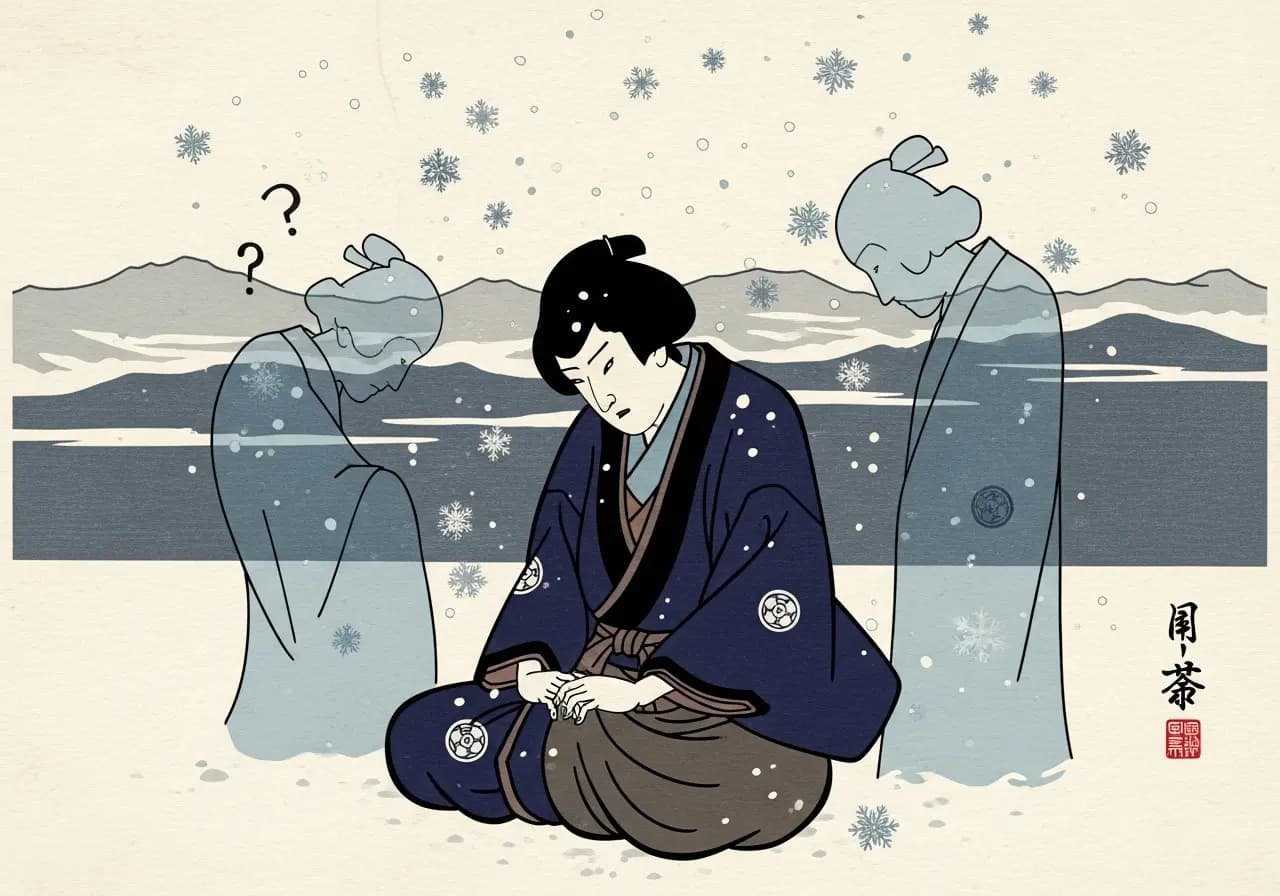
The koan says: "One day Chao-chou fell in the snow and called out, 'Help me up, help me up.' A monk came and lay down beside him. Chao-chou got up and went away."
I want to start by sharing some thoughts that came from the Patreon community, since we discuss the koans and podcast topics there. Ellen says:
"This is what the koan makes me think of. When experiencing difficult emotions like grief or depression, and your loved ones want to help, but there's no way to pull you out of those feelings or make them go away—often the best way to help is just to be with you while you're feeling them. The feelings can run their course with someone you love by your side until you have the strength to get up on your own."
I agree with Ellen's assessment. Often we try to help someone, and our way of helping isn't helpful. Sometimes all we really need is for someone to be with us. Just by being there, like the monk lying down beside Chao-chou, that's all he needed. Chao-chou got up and went away.
Matt offers a different perspective:
"I think it is an example of reactivity. Chao-chou falls and his initial reaction is to panic. He fears he cannot free himself from the situation. The monk comes and lies beside him to show him that the situation is not a crisis. He too is lying in the snow and did so voluntarily. In doing so, one can see that there is no emergency."
That's an interesting take I hadn't considered. With these koans, you're invited to extract meaning, or whatever you're going to get from it for yourself. It's cool that Matt saw this from a different angle—one that I think is accurate in a lot of instances in life. We're in a situation thinking, "How am I going to do this?" But it's helpful to know that somebody else has been in this situation and found a way to cope with it. Then we know we can too.
I've felt that before, and honestly, I think a lot of us are feeling this now with everything we're going through. I was telling my wife the other day how much more difficult it would be to face these uncertainties about jobs and potential financial consequences if I knew this was just happening to me. But somehow, knowing that the whole world is trying to figure out what to do about work and income makes it so much less stressful. We're all trying to figure it out. That's what Matt is talking about, and I like that thought.
Suzanne shares:
"This koan really resonated with me. I was reminded of the key idea in Montessori education: 'Help me to do it on my own.' Chao-chou asks for someone to help him up, which would be quite a passive way of reacting to the present situation—like a child asking their parents to do something for them. Instead, the monk lies down and shows Chao-chou the passivity of his response. Once having realized this, Chao-chou is able to act for himself, get up under his own steam, and walk away. It also reminds me of the raft analogy. The monk and his compassion are the raft which enables Chao-chou to get up and leave behind the monk, which is the raft."
It's fascinating to hear other people's perspectives because we're all in different places in life with different experiences. We each have a unique vantage point. When I read Suzanne's take, I thought about correlations I hadn't made before. What a cool way to see that.
Finally, Nancy says:
"This koan makes me think about when I have a problem or a situation that is troubling me and I turn to a friend or loved one for help. The best help I have received is when that person simply sits with me and listens."
That connects back to what Ellen said—sometimes the best help is simply being with someone and not actually trying to help. I took that lesson from it too.
I think in our own lives, we see this: the best way to help someone is to sit and be with them and not try to help. Often, trying to help makes the problem worse. I've experienced that both as the one receiving help and as the one trying to help, catching myself that my help isn't helping. I assume some of you have too. We can correlate this with teaching people to fish instead of giving them fish. I've connected this with my kids—teaching them how to think rather than what to think.
My mind has gone to a lot of different places with this koan. At the end of the day, I like visualizing Chao-chou falling in the snow calling, "Help me up, help me up," and then the monk lying there next to him and Chao-chou just getting up and walking away. These little stories can always be unpacked to gain lots of perspectives and teachings. There's never a right answer. The point wasn't the answer. The point was: What did it make you think of? And in the process of thinking, maybe you learned something about yourself. That's what's cool about koans.
The Three Stages of Doubt
Now let's move to the topic I want to discuss in today's episode: the concept of the three stages of doubt.
First, let me set this up. Like many of you, I've been seeing all kinds of crazy stuff on Facebook these days—stories, conspiracies, videos. There's a part of us that wonders: Which views are right? How could we possibly know? How can I take what I'm experiencing into my own personal practice? The amount of healthy skepticism and doubt I've applied to my analysis of various news sources, stories, and videos is what inspired this topic.
In Buddhism, the concept of doubt is very important. There's an expression in Zen Buddhism that says: "Big doubt, big enlightenment. Small doubt, small enlightenment. No doubt, no enlightenment."
I really like that because without questioning our views, we can't see new things. We can't experience a new way of seeing things. When I used to teach workshops on the Introduction to Buddhism and Introduction to Mindfulness, I'd often use an analogy about tinted glasses. We're going through life wearing these tinted glasses. If you've ever worn glasses with a tint—red, green, or blue—it affects everything you look at. Everything is tinted by the color of the lenses you're looking through.
If I were born with those glasses and never took them off, only ever seeing life through that tint, I wouldn't even know to mistrust what I'm seeing. I'd think what I'm seeing is reality. This is how things are. Everything has this tint, and I might never know there's anything wrong with it unless I'm willing to at least entertain the idea that maybe the way I see isn't correct.
This is where mistrust and doubt come in.
Invoking Mistrust Through Opposing Views
One way to invoke this sense of mistrust is to consider the views of whatever your opposing political side is. If you're a Democrat, look at the news coming from Republicans. If you're a Republican, look at the news coming from Democrats. You're going to have an almost natural sense of mistrust arise. And this doesn't require being American—Republicans and Democrats exist everywhere. Whatever your views are, look at the opposing party's views and notice what arises in you.
You should experience an instant sense of mistrust. "If so-and-so said it, I don't know about that. If my team said it, okay, I trust that. I'm not even going to question it." This is where we have a neat opportunity. Take that same mistrust and skepticism you so easily direct at the other side and apply it to your own views. That's essentially what we're practicing in Buddhism.
I want to emphasize here: this isn't meant to leave us crippled with indecisiveness or paralyzed with fear, thinking, "Oh, well now I don't know anything." This is meant to liberate us from attachment to our views. We talk about this often in Buddhism—that concepts, beliefs, ideas, whether good or bad, are like chains that bind us. That's not necessarily a problem. We're all bound by our ideas. The thing is, when I'm attached to a view, I'm not completely open to the possibility of changing it.
If we can learn to develop what we call the beginner's mind in Buddhism—the mind of a child that's always curious, always learning, always adapting to whatever's being thrown at it—that's the mind we're after in our practice. And if you think about it, we're always doubting. What are we doubting? We doubt whatever contradicts what we already think we know. Everybody does it. That's why it's so easy to question what somebody says if we don't agree with them. And that's why it's so easy to overlook poor-quality news if it's coming from our team—there's this assumption: "Well, if my team is saying it, I don't even need to question it. It's good."
A Buddhist Way of Doubting
One Buddhist way of doubting is to be a knower who is mistrusting of both directions. I want to talk about this. The three stages of doubt is a neat concept. I first heard about this in the book Mind in Tibetan Buddhism by Lati Rinpochay. I'll post a link in the show notes where you can look it up on Amazon if you're interested. He talks about the concept of the three stages of doubt.
The idea is that you can take a statement of fact—for example, "The universe is infinite." Then you have three ways to approach doubt: one where you tend toward the fact, another where you tend toward the distortion, and a third where you tend equally toward both.
Let me give an example. If we say "the universe is infinite," and I'm leaning toward that fact, I might think, "The universe is probably infinite. I'm leaning toward the fact." If I'm leaning toward the distortion—essentially leaning toward the opposite argument—I might think, "The universe is probably not infinite." And then there's the middle ground. Because we're in Buddhism, there's always a middle ground where you tend toward both extremes equally. Here, you might not be able to make up your mind. You're left wondering: Is the universe infinite or finite? Is it finite or infinite?
That's the third stage.
Why This Matters
Now, why is this helpful? How could this be practical in day-to-day life? In Buddhism, as I mentioned, doubt is beneficial because it's the first step in weakening the possibility of having a wrong view. That's fascinating to me. Let me repeat it: doubt in Buddhism is beneficial because it's the first step in weakening wrong view.
In the Eightfold Path, right view (or skillful view) is what we're after. But how do we know which view is skillful and which is not? We don't. So we have to operate under the assumption that what we think may not be true. It may not be the most skillful way of viewing something. How could we possibly know if we have the wrong view if we're never willing to doubt our view?
So that's the first point: in Buddhism, you're encouraged to carry a healthy amount of skepticism and doubt toward your own views.
This connects with the story of the monk emptying the teacup. If by emptying the teacup you can fill it with new knowledge and new views—but you can't physically fill a teacup that's already full. It can't be done. It's the same with our views. We can't have a new view if we're not first willing to accept that we might have an incorrect view or at least question the view we hold.
So we must have an open mind willing to accept that we may have an incorrect view in order to start the process of arriving at a more correct view—whatever that may be.
The Challenge of Seeing Our Own Tint
If I were to tell you, "Hey, you're seeing things through tinted glasses and that's affecting what you see. The green tint on everything is not an accurate depiction of the world—it's caused by the tint of your glasses," you're left with options. You could believe me and think, "Maybe the way I view things is off." Or you could think I'm absolutely crazy. You might be angry with me because I'm assuming you don't see things correctly.
But that's what we all do. We go around thinking that the way we view things is the right way, but the way you view things? No, that's not right. We think if we can shame you enough about your view, maybe you'll adopt our view. But that absolutely does not work. Anyone who's been on Facebook knows that's just not how it works.
Rather than focusing all our energy on correcting everyone else's way of viewing things, in this practice we're just trying to understand: How do I see things? The example I gave is over-simplified because it's not very easy to identify any tint in your own way of viewing. It's hard enough to identify the tint in my own views, much less confidently point out what tint you have in yours. I'm just trying to figure out my own life here.
I think it starts with recognizing the mere possibility that my view might be wrong. That's where I start. If I want to make change in my world, I've got to start by at least recognizing that maybe the way I'm viewing it is not the most skillful way.
Testing Against Experience
There's a strong emphasis in Buddhism to avoid believing Buddhist teachings. Instead, we're encouraged to evaluate them, understand them, and ultimately test them against our own experience. So how do we avoid getting stuck in doubt and paralyzed with fear?
To me, uncertainty is the important thing. When we're no longer attached to the need to be right or to have certainty in our view, we can move more comfortably between each view we hold. For me, this is the space of "suchness"—what we call suchness in Buddhism. This is the beginner's mind. This is the unknowing mind. There are lots of ways this is talked about in Buddhist literature. Some Buddhist traditions even equate enlightenment itself with this idea of suchness, which to me is tending toward both equally—where you may not be able to make up your mind whether this is this or that is that.
Now pause for a minute and recognize that this probably runs contrary to almost anything you've been taught in our Western society. We do not like to not know things. We're so uncomfortable with uncertainty that we'd rather believe something—even if we're wrong—but at least have the certainty that "no, it's this." Because "I don't know" is not acceptable in our society. We do not like to not know.
Skillful Versus Unskillful
I think it'll be helpful to think about this in terms of skillful versus unskillful. There are some things we will simply never know because they're unknowable. I'm not referring to big existential questions like "Is the universe finite or infinite?" I'm talking about smaller things like: Will my kids turn out the way I hope they will? Will my spouse always love me? Will I remain satisfied in my current job? These are equally troubling questions where we want certainty. We're not okay with "I don't know." We want to know, so we'll stick with either yes or no—at least it's certain.
But with suchness, we allow both perceptions to coexist. One possibility on one end of the spectrum, the other on the other end, and we find comfort in the uncertainty. That's a really fascinating thing to be able to do. There's a lot of skillfulness here, and I want to give some examples of skillful versus unskillful.
I'm not saying we need to be indecisive or wishy-washy about our views. We can absolutely hold onto a view while practicing non-attachment. Let me give you an example.
Let's say you have a spouse and you think they're cheating on you. You believe they are, but really they're not. Think about how unskillful that belief is in your relationship. The only thing giving it credibility is the importance you place on being right. Now, what's that going to do to your relationship? If in reality they're not, but you think they are, that's very unskillful to continue operating under that assumption simply because you believe it.
Now let's flip it. Let's say your spouse really is cheating, but you believe they're not. It's the same dilemma. How unskillful is it to continue operating under those circumstances where the only thing making you behave the way you are is that you can't let go of your belief? There may be all these clear red flags saying they probably are, but you can't see them because you're blinded by your belief.
You can see the dilemma here. It's not about whether they are or aren't. It's about: Am I willing to entertain the opposite of what I believe? Am I willing to at least take my belief and say maybe I'm wrong? And then at that moment, I'm a little bit more free to look at other potential evidence or red flags that would contradict the belief I've already formulated.
The Problem With Fixed Beliefs
Another example I think of often is religion. I've talked about this with my wife where I said: The problem with our beliefs is that once we formulate a belief, you can be presented with evidence that runs contrary to it and you will not see it. You cannot see it.
The example I've used: If I was a devout Christian and I believed that Jesus is coming again—the second coming—what would I do if he appeared with the head of the Jehovah's Witnesses? Would I instantly think, "Oh yep, I guess they were right?" Or would I think, "Nah, there's a conspiracy here. That's not the real Jesus. They're just trying to trick us."
I think that's what most of us would do. Put yourself in this position with whatever your view is. What if the thing you're expecting didn't happen that way? Would you find reasons to explore this, thinking, "Okay, let me look into this?" Or would you think, "No way, no way. That's not what's happening."
I think most of us would say, "Nope, that's not what's happening. This is a conspiracy."
What would the average Christian think if they looked up into the heavens and it wasn't Jesus coming, but Krishna? Do you really think most Christians would say, "Oh, okay, yep. I guess the Hindus were the right ones. Let's all switch." No way. They'd say it's the devil, impersonating and trying to fool us, and so on.
Or if it was Jesus, what would Hindus think? And if it was anything else, what would the atheist think? If Jesus appeared in the sky, would the atheist think, "Oh, I was wrong. Okay, back to Christianity." Or would they most likely think, "Okay, who's pulling the strings here? This is an elaborate prank." Because they've already decided there is no Jesus.
That's what I'm trying to get at. I use that example because I think many of us can understand how strong beliefs are very difficult to look past. That's why I brought it up. You could be a believer and there's nothing that could be presented to make you not believe. And vice versa. You could be a non-believer. What would you present to a non-believer that makes them think, "Oh, okay, now I believe."
I recognize that people shift from one view to another. Believers become non-believers. Non-believers become believers. Believers become believers of other beliefs. This happens all the time. But I don't think it happens willfully, like, "Hey, I just don't want to believe this anymore." I know that because I've gone through it myself. I transitioned from one belief system to non-belief, and it was not intentional. It wasn't like, "Hey, I'm just not going to believe one day." It doesn't work that way. It was a series of events that made me think a certain way, that made me question the way I thought. Before I knew it, I was like, "I don't know what I think." And then I stopped believing.
I think it's odd when people question that and say, "No, you just chose to not believe." I'm like, I couldn't do that. The same way you can't go up to a Christian and say, "Okay, if it's really that simple and it's just about choosing, go ahead and become a Muslim now. Why don't you just switch everything over and believe in Allah." They can't. You can fake it, but it's not natural.
Yet Christians convert to Islam. Members of Islam convert to Christianity. It can happen, but it's not happening because someone just decided. It happens because you go looking. You're open to something. You're curious. You're willing to entertain the possibility that maybe what you believe isn't the most accurate or the most skillful.
The Power of Doubt
This is where the concept of doubt comes in. If you're not willing to doubt your own views, or if you can't doubt your own views, then you can't see anything other than what you're seeing. This is the wonderful thing about doubt: it can propel us in the direction of a more skillful view.
I don't think we have to think of this in terms of true and false, right and wrong. I always emphasize: I like the idea of skillful versus unskillful. When it comes to big things like beliefs, I like what French writer André Gide once wrote: "Believe those who are seeking the truth. Doubt those who find it."
I really like that.
Staying Open and Curious
I want to wrap up my thoughts with that quote in mind. I want to invite you to stay open, stay curious, stay non-attached to the certainty that your views are right. I'm not talking just religious views. I'm talking about all your views—your political views, whether this or that, any view you have. Maybe, just maybe, things aren't what we think they are. Just maybe the view you have isn't the most accurate or the most skillful.
With the three stages of doubt, you can start tending toward both extremes, both ends equally—where you cannot make up your mind and you wonder whether it is or isn't. I think that's a very skillful view to hold.
I'm not saying this because I want everyone out there thinking, "Well, I don't have any opinion about that." I'm not saying that. I have strong opinions about things. I have strong political views on certain things. But I'm not attached to them. I understand why I hold these views because of where I was raised, the societal views I've adopted, all these things that make me have opinions. But that doesn't mean my opinion is right.
So I'm always willing to entertain and explore the view from the other side. I don't care what belief it is that I hold. I'm willing to entertain the view of the other side. Often I will, and I'll think, "Oh, after hearing the argument, yep, nope, I'm still leaning this way." But even then it's not with a death grip. It's more like, "Well, keep presenting. Keep presenting information. Maybe at some point something will click and I'll think, 'Ah, okay, yeah, that does make sense.'" But until then, this is what makes sense to me.
That's how I view all my beliefs, all my views. I hold them very lightly, and that's something I love about Buddhism. It gives me permission to hold my views lightly—even, and especially, my views that come through Buddhism. Because I'm not asked to believe any of this. These are concepts that I get to work with and test, and see how I feel about them, and see if they work for me. And they do. That's why I'm teaching and sharing all these concepts and ideas—because it's been a very liberating way of engaging with reality. A reality I cannot completely understand and cannot completely discern whether one thing is correct or not. But I get to try to understand it a little bit more every day.
That's what I love about science. It's the process of continually uncovering and learning new things, but nothing has to be set in stone.
Closing Thoughts
So I kind of got a little off-topic there, but that's what I wanted to share with you: the concept of the three stages of doubt and how beneficial it might be if we were all willing to at least empty our cup a little. Especially if our intent is to fill our cup with more knowledge—well, then you have to dump out what's in there. You're not going to ever have any change of views if you're not even willing to entertain the possibility that maybe your view isn't the most accurate or the most correct.
That's all I have for this podcast episode. As always, thank you for listening. If you want to support the work I'm doing with the podcast, consider becoming a Patron and joining our online community where we discuss the koans and these podcast episodes—and the live interactions now taking place there every week. To learn more, visit secularbuddhism.com. If you enjoyed this episode, please share it with others, write a review, and give it a rating on iTunes.
Before I go, here is the Zen koan to work with between now and the next podcast episode. This is a classic—one I have to mention if I'm doing all these podcasts:
What is the sound of one hand clapping?
That's your koan. Thank you for listening. Until next time.
For more about the Secular Buddhism Podcast and Noah Rasheta's work, visit SecularBuddhism.com