

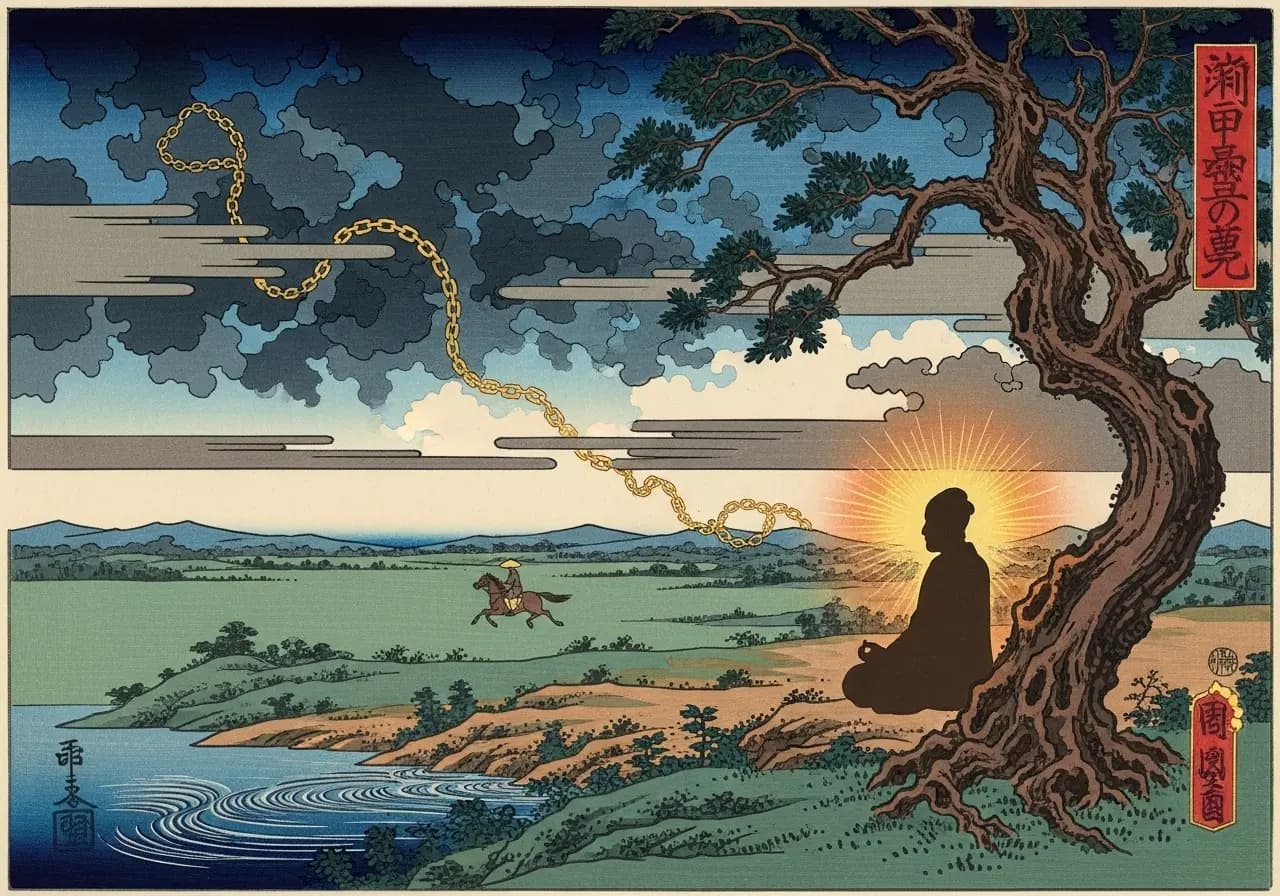
The Path of Liberation
Episode 13 of the Secular Buddhism Podcast
Hello. You're listening to the Secular Buddhism podcast, and this is episode number 13. I'm your host, Noah Rasheta, and today I'm talking about freedom.
Welcome
Welcome to the Secular Buddhism podcast. This podcast is produced every week, where I cover philosophical topics within Buddhism and secular humanism. Remember, episodes one through five serve as a basic introduction to Secular Buddhism and general Buddhist concepts. So if you're new to the podcast, I definitely recommend listening to the first five episodes in order. All episodes after that are meant to be individual topics that can be listened to in any order.
Before starting, I want to share a quote I love by the Dalai Lama. He says, "Do not try to use what you learn from Buddhism to be a Buddhist. Use it to be a better whatever you already are." Please keep this in mind as you listen and learn about the topics and concepts discussed in this episode. If you enjoy the podcast, please feel free to share it, write a review, or give it a rating on iTunes.
Now let's jump into this week's topic.
Freedom Through the Buddhist Lens
I'm really excited to be talking about freedom today—specifically, freedom in the Buddhist understanding, from the Buddhist worldview. Buddhism is often referred to as the Path of Liberation, or the Path of Freedom. But what exactly is this freedom that's being talked about?
Freedom is not an absolute thing. It's a relative thing. Freedom is generally either freedom from something or freedom to do something. In the sense of the Path of Freedom, the freedom we're obtaining is relative to freedom from conceptual constraints and freedom to act or be a certain way.
Let me start with an example. Imagine a prisoner—someone who's been in jail for years—and they're finally going to be set free. Once that person is out of the prison, their freedom is twofold. There's freedom from the constraints of the cell they were in, or the constraints of the prison walls they were behind. And there's freedom to do all the things they couldn't do before—the freedom to be a certain way or to act in a way that wasn't possible while they were imprisoned. This could be as simple as the freedom to go to a store and go shopping. That's a freedom they didn't have before.
Understanding freedom in this way—as both freedom from and freedom to—will help us understand a deeper level of truth. Because we've all heard the expression that "the truth shall set you free," right? But free from what? How does truth actually do that?
Understanding Truth
To understand that, let's talk about truth for a bit. I like to categorize truth into two major categories. This is my own way of thinking about it. For me, there are empirical truths and conceptual truths.
Empirical truths are truths that are true whether or not I believe anything. For example, an empirical truth is that if the temperature drops low enough, water solidifies and turns into ice. That's an empirical truth. It can be observed and replicated. Most, if not all, of our empirical truths come from science and scientific research. Science is always revealing new empirical truths for us. Those are not the kind of truths I'm going to talk about in this podcast. I'm talking about conceptual truths.
Conceptual truths are truths that are true because of our beliefs, not in spite of our beliefs. Another way of saying this: empirical truths are those that would exist whether or not there are humans. If there were no humans on the planet, during the winter months when temperatures cool and water turns to ice, those empirical truths would still be happening, right?
But conceptual truths are true because of humans—because of the beliefs that we have. Let me split this into two other categories: societal truths and personal truths. They're both still conceptual, but it helps to understand the difference.
Societal Truths
An example of a societal truth would be that gold is more valuable than silver. That's a societal truth, and it's conceptual because it's only true because we believe it's true. If there were no humans on the planet, a lump of gold and a lump of silver next to each other in a field would have no inherent value. There's no inherent characteristic that says the gold is worth more than the silver. These things are just things. But we come along and we assign meaning to them. We create stories, and inside our conceptual understanding of the world, we've decided that gold is worth more than silver.
Now, it's not just because someone said so. Supply and demand, scarcity of gold versus silver—all those things went into determining that gold's value is higher than silver. But overall, it's still just a conceptual truth, and yet, it's true. You could argue it's even factual. You could go into a pawn shop with one ounce of gold and one ounce of silver, and you're going to get a lot more for your gold than for your silver. It's a societal truth—conceptual, but true.
Personal Truths
Then you can scale this down from societal truths to personal truths. For example, a personal truth for me would be that eggs taste better when you put hot sauce on them. This may be true for me while it's not true for you. There are countless examples of this. Someone thinking hot dogs are better than hamburgers, or that hamburgers are better with cheese. I keep using food analogies, but it's applicable to so much more than just food. Being a Texan is better than being a Californian—well, of course that's a conceptual truth that you would hold if you believe that Texas is better than California. But if you don't believe that, then it's not a conceptual truth for you.
The Power of Stories
I like to imagine conceptual truths categorized into these societal and personal views, but I recently read a book called Sapiens by Yuval Noah Harari—a brief history of humankind. In this book, there's a compelling argument about our ability as humans to go from early humans as hunters and gatherers to collecting into societies and becoming what we are today. It all hinges on one crucial fact: we have the unique ability to tell and believe stories. Our ability to tell stories and then hold these collective beliefs inside our stories propels humans to where we are now.
With our ability to have collective beliefs, we get the ability to have politics, political systems, and governments. These are all conceptual truths. Same with religion. Same with economics. It's our shared belief that the value of this green piece of paper with a one on it is actually worth something that gives us the ability to interact with each other in commerce. It's a conceptual truth. Is it really worth a dollar? Well, that doesn't mean anything. If there were no humans, that piece of paper is just paper.
This is a fascinating insight—our ability to tell stories and believe them is what got us to where we are today. Along with this comes the ability to be bound by our conceptual truths. There's a saying that good concepts are like a golden chain, and bad concepts are like an iron chain, but they all equally bind you in the end. That's pretty powerful to think about. Everything that we hold as a conceptual truth binds us, and we're bound by it. I don't mean bound in a negative way, but to understand freedom, we need to understand what conceptual truths we're bound to.
Byron Katie has a powerful statement: "A thought is harmless unless we believe it." I think that's really powerful. A thought is harmless unless we believe it. She goes on to say: "It's not our thoughts, but our attachment to our thoughts, that cause us suffering. Attaching to a thought means believing that it's true, without inquiring. A belief is a thought that we've been attaching to, often for years."
When you think about conceptual truths and the beliefs we have through what we consider to be conceptual truths, you start to understand what binds you—what you're bound to. And that's the sense of freedom we're talking about here.
Reality Versus Story
Freedom—whether freedom from or freedom to—has to do with our conceptual understanding of the world being in conflict with the empirical reality of the world. This is to say that there is what is, and then there's the story that we create around what is. As long as we reside inside the realm of the story of reality, we're not dealing with reality itself.
Think about this scenario. You're driving on the road and somebody cuts you off. Immediately, there's what happened. And then there's the story we create about what happened, right? Typically, in a scenario like that, we're thinking, "Okay, this person is a jerk. This person probably does this all the time, takes advantage of people, thinks they can do whatever they want, doesn't obey the rules. Here they are, just cutting me off." There's a whole story attached to the event.
But if you think about it, the suffering you're experiencing during that event has to do with the story around it, not with the event itself, right? You get cut off. That doesn't do anything to you. Nothing actually happened. There's absolutely nothing harmful going on when you get cut off, but the story around it is the dangerous part. Remember: a thought is harmless unless we believe it, right? We believe the story that we've created. This is what I'm talking about when I talk about freedom. It's freedom from habitual reactivity.
Imagine the same scenario again, but with a different story. You're driving. You get cut off by another car. But this time, imagine the story is different. The person in the car ahead is injured. They're trying to get to the hospital as quickly as they can. They couldn't wait for an ambulance, so here they are, speeding on the road. The story changes, but the circumstances have not changed, right? You've just been cut off. That's what is. The story around what is may have changed, and that changes everything.
Now in this scenario, you'd be thinking everybody should get out of the way. You're rooting for this person to get to the hospital as quickly as possible. Yet the reality of what happened is identical to the previous story. The only difference is the story around it is now different. We do this in life all the time. Things are happening, life presents something, and then we make meaning of it. We give it a story. And inside that story is the suffering that we're going to experience.
The Space Between Stimulus and Response
Viktor Frankl was an Austrian neurologist and psychiatrist, and founder of logotherapy. He was a Holocaust survivor who went through some of the most difficult things you could probably imagine going through. Something that he says about freedom is really powerful: "Between stimulus and response, there is a space. In that space, is our power to choose our response. In our response, lies our growth and our freedom."
This is really powerful. I want to talk about this concept—that between stimulus and response, there's a space. Because that's what Buddhism is trying to teach and really get at. We go through life being reactive. Even worse, we're habitually reactive. We tend to just react to things. But between the stimulus and response, there's this space. It's inside this space that we have the power to choose our response.
There's a famous Zen story that illustrates this. There's a man standing on a trail or a path. He can see in the distance that a man is approaching him on a horse, galloping at full speed. He just watches. As the horseman gets closer and closer, finally close enough to talk to, he asks, "Hey, where are you going?" The man on the horse just says, "I don't know, ask the horse," as he gallops by at full speed.
The idea here is that we are like the horse and the rider. We have two systems in the mind. There's our intellectual part of the brain—that's like the rider. Then there's the emotional, reactive side of us—that's like the horse. You can read about this in several books that talk about this concept. The idea is that often times, we go through life like this man on the horse, running at full speed, and we don't know where it's going. Even worse, we think we're in control, but the horse is the one that's deciding where we go and at what speed. This is an example of living in a reactively habitual state. The sense of freedom has to do with that space in between the stimulus and the response—where we actually have the power to choose our response.
Two Zen Stories
There's a Zen story that eludes to this concept. Imagine you're a fisherman out on the river fishing. You decide to lay down in your boat and take a nap or just relax for a minute. While you're lying there, you hear a loud thud on the boat. You sit up and turn around and realize another fisherman's boat has crashed into your boat. There's a hole in your boat. What kind of reaction are you going to have? Typically, you're going to be upset, thinking, "This idiot fisherman crashed his boat into mine."
But then they replay the scenario and ask you to imagine you're the fisherman. You're out on the river and decide to lay down and rest. You hear the thud and sit up. You immediately turn and realize a log has floated down the river and collided with your boat. The scenario and the outcome are the same. Your boat now has a hole in it. The difference is that in one scenario, what you feel can be anger toward the situation. Thinking, "Okay, well that stinks." Because it was just a log, there's not a story behind it. With the person in the other boat, you're creating meaning right away—this person doesn't pay attention, this person is careless. It doesn't matter whether or not the story is true. The point is that inside the story is where we contain the suffering around the event.
What is just what is. Then the story we create around what is determines how we feel about it. When you know that, and when you can understand that that's our natural tendency, then you can start to have this sense of freedom in between the stimulus and the response. This is the space that Viktor Frankl was talking about, and it's inside that space that we can have the power to choose our response. When we can choose our response, we're no longer being reactive.
Reactivity Versus Habitual Reactivity
I want to clarify something here because there's often a misunderstanding. Once I master this, I'll never be reactive—that's not accurate. Reactivity and emotions are a natural part of being human. Let me go back to the example of the man on the horse. Living habitually reactively is when you're running somewhere and you don't know where. You're not in control of that horse. If you tame the horse, you can have a good relationship where you decide where it goes. You're essentially in control of that horse at all times. But if you're out in the field and a snake comes out of the grass, that horse will get spooked. You're going to have a good 10 to 15 seconds of scary, emotional reactivity where you're actually not in control for that brief moment of time. The horse is going to jump, it's going to take however many steps back. It might even buck. Moments like that, you're just hanging on for the ride. But that's not the habitual state you're in.
That's the difference between reactivity and habitual reactivity. What we're trying to be free from is habitual reactivity. I hope you can distinguish the difference there, because it's a very big difference.
We Are Our Own Jailers
Here's something crazy to think about. Going back to the original analogy of freedom—imagine someone who's in prison. That's essentially us. The difference is that we are in our own prison, and we are our own jailers. We're the ones who hold ourselves captive, and we don't even realize it. What we're held captive by is our beliefs—our conceptual truths that we believe in.
Pause at some point and just think about this. Reflect on empirical truth versus conceptual truth. Ask yourself: what conceptual truths do I hold to or believe that cause me suffering? Or cause others suffering? Analyze those. It's a really powerful experience.
Finding Freedom in Nature
There's a place where we can go and experience reality as it is without having any of the habitual truths really affecting us too much. That's in nature. I love experiencing being in nature, and I've thought about this a lot. I think the reason why is because when we're out in nature, we're experiencing reality as it is. There's no pretending. Trees are just trees. Flowers are just flowers. Birds are just birds. Everything is what it is, free to be what it is, doing whatever it does. And we get to be there and experience that.
It's kind of absurd to imagine being in nature and enjoying the scenery while thinking, "If that mountain were ten degrees less steep, then this might be an ideal portrait for me. Or if that tree were five feet in that other direction, now maybe this landscape would look nice." We don't do that in nature because there's no need to. It's one of the places where we can go and experience reality as it is and take it all in without assigning meaning to any of it.
Furthermore, nature does the same back to us. When we're out there, nature allows us to be what we are, to be who we are. You don't hear the birds chirping and then they change their song because you wore a red jacket when you were supposed to wear a yellow jacket out here. There's none of that. You get to experience reality as it is, and reality gets to accept us just as we are. And that's why it feels so good to be there. That's my theory, at least.
All that goes away as soon as we're around people though, right? Because now people have conceptual truths. And inside these conceptual truths, you do have things like, "Why are you wearing that red jacket? I told you to wear your yellow jacket. Or you look better in your yellow jacket. Or why are you even wearing a jacket? It's warm out here. I'm not cold. Why are you wearing—" You know, you get all these crazy things that start to happen where there's no freedom. The sense of freedom—the freedom to be who you are can be diminished when you're around other people. But it's the same thing we do to others.
The ultimate sense of freedom that we can give to someone else is the freedom to allow them to just be who they are. That's also the ultimate sense of freedom that we can extend to ourselves—the freedom to allow ourselves to just be who we are. That's a lot easier said than done. The reason it's hard is because of our conceptual truths. The conceptual truths we believe in bind us, very much like the golden chain or the iron chain—whether they're good or bad.
The Parable of the Horse
I wanted to wrap this up with one more thought. It's my favorite parable, and I know I've talked about this before in another podcast episode. It's the parable of the horse.
The parable goes like this. There's an old man who's out in the field farming, and a horse shows up. His neighbor comes running over and says, "How fortunate for you, you have a horse, and it came out of nowhere." The old man just says, "Who knows what is good and what is bad?" and he goes about doing his thing. He puts the horse in the corral.
Later that night—or in the morning—he comes out and discovers the corral is broken and the horse has disappeared. The neighbor comes running over and says, "How unfortunate. How unfortunate for you. You had a horse and now you don't." The old man simply says, "Who knows what is good and what is bad?" He goes about doing his thing.
Later in the day, the horse comes back with four additional horses. He takes the horses, puts them in the corral, fixes the corral. The neighbor comes running over. "How fortunate for you. Your horse has come back and it's brought additional horses." He just says, "Who knows what is good and what is bad?" He goes about doing his thing.
Then the next day, his son is out working with the horses, trying to tame one so that he can use it in the field. He falls off the horse and breaks his leg. The neighbor comes running over and says, "How unfortunate. Your only son—your only source of help in the field—has broken his leg. So unfortunate." The old man simply replies, "Who knows what is good and what is bad?" and goes about doing his thing.
The next day, the army comes into town and they're conscripting all the youth. They can't take the farmer's son because he has a broken leg, so they leave him. They take everyone else, including the neighbor's son. The neighbor comes running over and says, "How fortunate for you that your son had broken his leg," and then goes on with his normal routine. He pauses and just says, "You know, who knows what is good and what is bad?" and goes back to his house.
The Moral of the Parable
The moral of the story here... I think sometimes there's a misunderstanding with this parable. People think it means that as we go through life we just don't care. We don't care about things. Who knows what is good, who knows what is bad. That's not what we're talking about here. I clarified this in another podcast about acceptance versus resignation. This is not an active resignation to life as it is. This is an active acceptance of life as it is.
The sense of freedom in this parable comes from the old man who's not bound by assigning meaning to things. That's the freedom. The reactivity is there. That part's there. I have no doubt that when his son falls and breaks his leg, this old man is thinking, "Oh no, my poor son, you're in pain. Let me help you." Or when the horse first showed up, it's like, "Woohoo, a horse!" Then it left the next morning. "Oh dang it, the horse is gone. Oh well."
That's the difference—the "oh well." He goes about doing what he needs to do, not attaching to things, and even worse, not making meaning of things. The old man in this parable is not making meaning of things, and that's what the neighbors constantly doing—assigning meaning. "This is fortunate. This is unfortunate." Everything that goes along with making meaning, that is our habitual reactivity.
The sense of freedom comes, again, between the stimulus and the response. There's a space, and in that space is our power to choose our response. This is exemplified in the parable of the old man, where he can choose his response. He doesn't have to be bound by his habitual reactivity and making meaning of things.
The Ultimate Freedom
That's the sense of freedom I wanted to talk about in this podcast episode. I think the ultimate source of freedom that we can extend to someone is the freedom to be who they are. Thich Nhat Hanh says, "We must love others in a way that they feel free." I think that's the sense of freedom he's talking about here. The freedom to love someone without the conceptual constraints that I would put on someone because of my beliefs. "I love you except..." or "I love you but..." or "If you were just this..." or "If you were not that..." Those are the conceptual truths that bind us. Freedom transcends our conceptual truths and allows us to have the freedom to allow ourselves to be the way we are, to allow others to be the way that they are, and to just love in a way that feels free.
That's why I wanted to talk about this topic: freedom.
Closing Remarks
Like with all my podcast episodes, if this is a topic that you've enjoyed, I would love to interact with you on our Facebook study group. If you just search for Secular Buddhism, you can find it there. I'll have a link to it on secularbuddhism.com or on the Secular Buddhism Facebook page, which is easy to find as well. If you enjoyed this podcast, please feel free to share it, give it a rating on iTunes. That really helps. Just feel free to reach out to me. I love talking about this stuff, and I look forward to another topic next week. Thanks.
One More Thing
Before I end the podcast, I want to share something I've been working on. I've been collaborating with a couple of other companies on developing an idea around doing some retreats. I've been really interested for quite some time in putting together either workshops—like part-day or full-day workshops—where we explore topics about mindfulness or meditation and learn as a group in a workshop setting. I'm also interested in doing retreats.
One of the retreats we're discussing is really exciting. It would be a week or even two-week-long retreat going somewhere like Africa, specifically Uganda. The retreat would have two components. In the evenings, we'd be teaching the foundations of mindful living. But during the day, we'd be doing experiential work with humanitarian projects—whether that's working on building schools, digging wells, or interacting with local communities and providing hands-on help to different programs in villages in Uganda.
I'm really interested in gauging what kind of interest there is. If we were able to open this up for 10, 15, or even 20 people, I'd love to gauge your interest. If attending a retreat like that—or even just a shorter workshop—is of interest to you, please visit secularbuddhism.com/retreats. There's a form you can fill out there that will help me gauge what kind of interest there is.
If there's enough interest, this is something I'd like to put together as a retreat where we learn the conceptual understanding of Secular Buddhism taught in courses, but also the experiential, hands-on aspect of it—actually doing humanitarian work in Uganda. This would probably be late January or early February. But go on there and express your interest at secularbuddhism.com/retreats. That will help me gauge what kind of retreats we should put together. I look forward to doing something like that with several of you. Let me know if you have any questions. Thanks again, and until next time.
For more about the Secular Buddhism podcast and Noah Rasheta's work, visit SecularBuddhism.com