

The HALT Method
Episode 129 of the Secular Buddhism Podcast
Hello and welcome to another episode of the Secular Buddhism Podcast. This is episode number 129. I'm your host, Noah Rasheta, and today I'm going to talk about the HALT Method.
Keep in mind: you don't need to use what you learn from Buddhism to be a Buddhist. You can use what you learn to be a better whatever you already are.
A Clarification on "Better"
Before jumping into the koan and the topic for this podcast episode, I wanted to clarify something based on an email I received. I want to thank Garrett for emailing me and asking for better clarification around this idea of becoming a better whatever we already are. There was a question about whether this contradicts what we're practicing in Buddhism when we talk about wanting to be a better whatever we already are as a form of craving. The concern was: if the moment we want life to be other than how it is suffering arises, then how does this work with wanting to be better than we currently are? How do those two ideas work together?
I think it's worth clarifying. For me, when I use this quote and this concept of being a better whatever I already am, you have to remember that in Buddhist thinking, we're already eliminating the duality of good and bad, right and wrong. So I think it's more accurate to say: become a more skillful whatever you already are, rather than a better.
When we say "better," it does make you think good, better, best, right? Or better in terms of good and bad. So I might change the quote, but the idea it conveys is that we can become more skillful at whatever it is we already are. And for me, that gets to the heart of what all these practices really do.
I'm not trying to be other than how I am. In other words, I'm not thinking, "I'm this kind of a dad and I want to be that kind of a dad." I don't view it that way. I view it as: am I being as skillful as I can be as a person, as a dad, as a husband, as a son, in all the different roles that I play in my life?
The quote makes a lot of sense to me with that context of skillfulness in relationship to better. I want to be more skilled at whatever it is I already am, rather than thinking of it in terms of better, which implies I'm not adequate where I am now. That's not the idea at all. It's not saying, "You're not very good at whatever you already are, but you could be better." The idea is: you're fine with whatever you already are, but could you be more skillful at being whatever you already are?
That makes a lot of sense to me. So hopefully that makes sense to you as well. But again, thank you, Garrett, for bringing that up. That's an important distinction to make to understand the spirit of the quote. So thank you.
Reflections on the Koan
Now, jumping into the topic for this podcast episode. In the last podcast, I shared the koan that says, "What is your original face before you were born?" I want to share some of the thoughts that came from the discussion in the Patreon community.
With the Patreon community, we have discussions around the koan and around the topic of the podcast. It's a neat way to share the podcast episode and then get the insights, thoughts, and feedback from other podcast listeners and their thoughts about the koan.
Bob shared a thought that I really liked. He says: "My thought is that any answer I might give would earn me a whack with a big stick from the questioner. Isn't that what always happens when a seeker attempts to unravel these conundrums? Logic is my ladder to climb over the puzzle fence, but once I climb the ladder, the fence is no more."
I enjoy that thought from Bob. In a lot of these koans, there is an answer, and the teacher who asks the question ends up hitting you with a stick. That's common in Zen stories and koans.
Christopher shared something that really resonated with me. He says: "This question makes me think about mannerisms—mannerisms I have, which I've begun to realize I acquired from my parents. Then I see my grandparents, and they too have the same mannerisms. It makes me wonder how far back our habits go. Who was the first one to sit a certain way, to smile a certain grin, to laugh an awkward chuckle? The answer to who the first, the original is unknowable. But we are connected to that person long dead, and these habits are passed on through the generations. So our original face was influenced by the thousands before us."
I really liked this thought from Christopher. To me, the invitation of this koan is to see through the lens of interdependence. The interdependent nature of my face, as he mentions, is absolutely interconnected with the face of my mom and my dad, my grandma and my grandpa, and back generation after generation after generation. It's fun to imagine these mannerisms or ways about us, these quirks or certain interests. Wouldn't it be cool to go back and be able to see that five generations back, there was a person there—a grandma or grandpa—who if you could see them and hear them, you'd be like, "Wow, that's just like me"? I think it would be really cool, and it's bound to happen somewhere down the line because that's how genetics work and that's where a lot of our personality traits and maybe our way of thinking comes from.
But it's a fun thought process, and it reminds me of a quote that I really enjoy from Thích Nhất Hạnh. He says: "If you look deeply into the palm of your hand, you will see your parents and all the generations of your ancestors. All of them are alive in this moment."
That's always been a really fun thought process for me—to look into my hands and see the generations of ancestors before me that I have no idea about. I don't know their stories, and yet here I am. The culmination of all their stories is taking place right now in this present moment. So that's a fun thought.
John shared another perspective: "This question reminds me of how we can't actually see how we appear to others. Yeah, I know about mirrors, but you see yourself in a certain way. Others see you in a different way. When you try to answer this question, you're just creating a new version that doesn't last but a moment anyway. I would imagine the answer would be a blank stare rather than a definitive response. Does it really matter? You should live in the moment you're in, not in the past."
I like John's thoughts on this. It's fascinating to think that in a very real way, we never see ourselves. I mean, we can look down and see our hands, we can see parts of our body, but we never see the complete picture of ourselves except through a reflection. That's the only way to do it. But even a mirror is still just a reflection. So it's kind of crazy to think that you'll never actually see yourself. You just can't.
But I think what's even more fascinating is that this also happens in the way we see ourselves mentally. To conceptualize what I must be like is already influenced by every single thought, idea, opinion, and belief that I have about myself and about the world. It's interesting—this concept of the mirror and that you can never actually see yourself. I think the thought process is similar when it comes to understanding yourself mentally.
Going back to the koan—"What is your original face before you were born?"—I don't know that you can answer that. How can you see it? How can you know? I can come up with a story about what I think my original face was before I was born, but that's just another concept, another idea.
David mentioned the fact that we can look back and recognize our face in old pictures. As I was reading his comments, he mentioned that we're so familiar with our face that we can always look back and see it even across the span of time. That was interesting to me because I realized that I can't recognize my face in some of my old pictures. I mean, I can, but it's strange to look at two humans and know that I'm one of them because they both look exactly like me, but I can only be one of them, and I'm not sure which one I am. That's just a twin thing. But at a certain stage of our lives, we looked identical.
We can still look at some pictures where my mom, my dad, my twin brother, and I will all look at it and we're like, "Hmm, which one is which?" It's kind of trippy to look at a human being and think, "I think that's me, but I'm not positive."
So, in my opinion about this koan, I think the wording is interesting to me. The word "face" specifically—to me, as always, this is an invitation to explore the interdependent and non-permanent nature of the self. But what's fascinating is to explore this line of thought and question not just: "What is your original face before you were born?" but to go the other way in time. What is your original face after you're dead, after you die?
This correlates with the quote from Thích Nhất Hạnh. If I can look at my hands and in my hands I can see all of my ancestors, I can also look at my hands and see all of my descendants. In my case, there are already some—I have three kids. It's fun to be able to see in them the continuation not of my face, but my mom's face, but not my mom's face—my grandma's face, but not my grandma's face—my great-grandma. And it goes on and on, right? Across that span of time going back, but also the span of time going forward. And yet here we are in this precise moment. In this precise moment, I can see just how things are right now. It's a fun thought process.
The koan, for me, is just an invitation to look inward. All of these koans are. And it's a fun thought process. But I do think the koan correlates well with the topic I wanted to talk about in this podcast episode: the HALT Method.
What Is the HALT Method?
Now, some of you may have heard of this or be familiar with it. It seems to be a method that's talked about in the realm of addiction and recovery, but it's also made its way into the realm of parenting techniques. That's where I first heard it through my wife, who has been listening to podcasts and reading books all centered around parenting. She was telling me about this HALT Method.
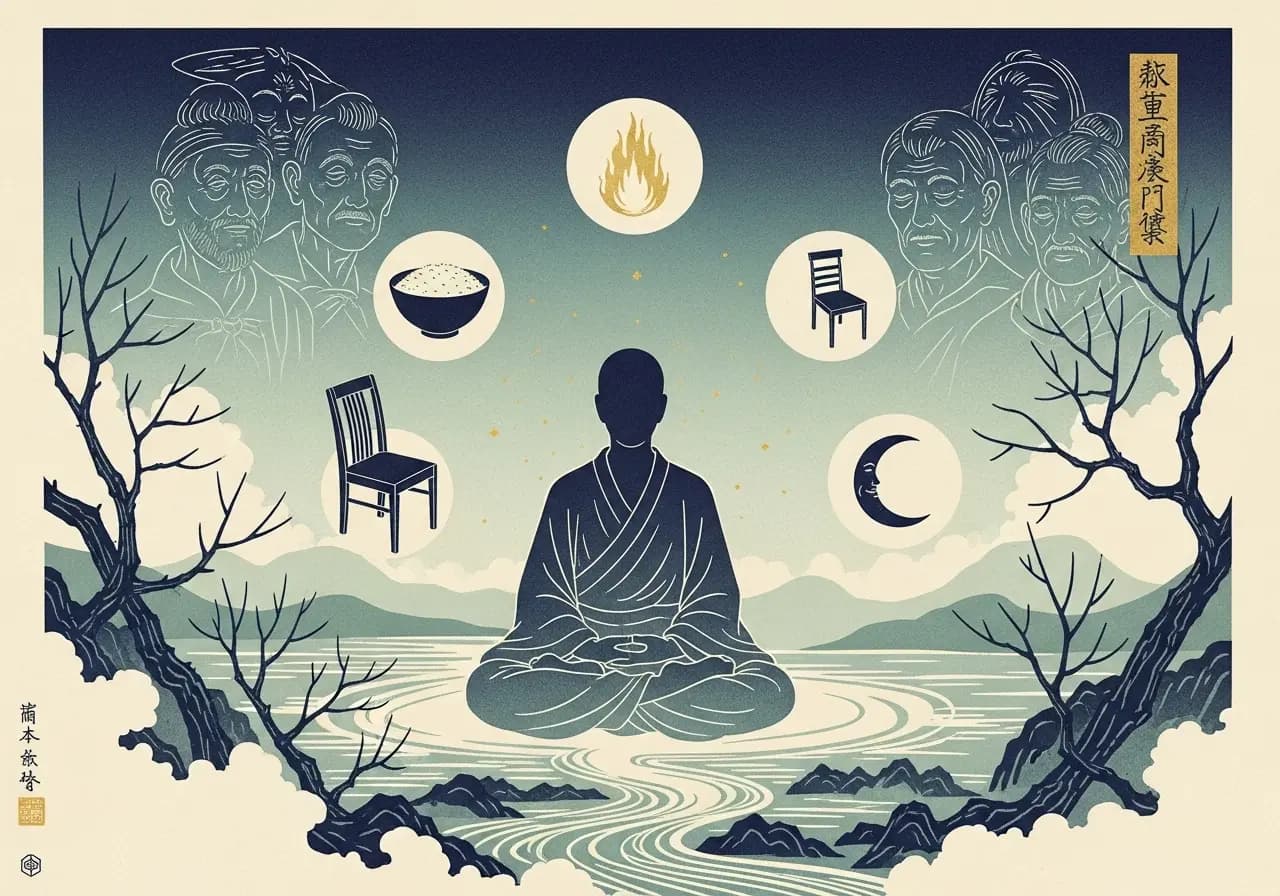
With children, the idea is to help them identify when they're misbehaving or acting out and to recognize if perhaps it's being triggered by HALT. Which stands for:
- H is for hunger
- A is for anger
- L is for loneliness
- T is for tired
In other words: Are you hungry, angry, lonely, or tired? Because if you are, then that's affecting whatever actions you're taking in this moment.
In the addiction and recovery realm, it's similar. They use this technique to pause at the moment of craving. Let's say an alcoholic wants to consume again. They pause and say, "Well, wait a second. Am I under one of these four things?"
I think it correlates really well with Buddhism because in Buddhism we have this concept of pausing—the pause between the stimulus and response. It's in that gap, in that pause, where we're essentially halting. I think it's a cool technique that we can apply to ourselves in the mindfulness tradition where we halt and ask ourselves: wait a second, am I hungry? And not just hungry in the sense that I need food, although that's certainly a big factor. It can be physical or emotional hunger.
Breaking Down Each Letter
Hunger
When we don't fulfill our body's nutritional requirements, we lose the ability to operate at our full potential. You can see this when somebody's stranded on an island and they reach that point of intense hunger—they start making decisions that someone who's not extremely hungry wouldn't be making.
And at a trivial level, think about the Snickers commercial I've mentioned before, which hits this right on the head: you're not you when you're hungry, right? Because in a way, you're not. But hunger can also be emotional—a hunger for affection, a hunger for validation.
The technique is that as you go through the day and you're experiencing a difficult emotion, or you feel like saying something or doing something, if you can catch yourself and think, "I don't know if I should say this"—just pause, halt, and ask yourself: "Am I right now experiencing anything from the acronym HALT? Am I hungry, angry, lonely, or tired?"
Anger
Anger is a healthy, natural, and normal emotion to experience. The reason I think this one is so important is because we need to understand what's causing us to experience the anger. Often, there are other, more complex layers underneath. We may think that we're just angry, but there's probably a deeper reason why. It could be that we're embarrassed, ashamed, or hurting—we're in pain. Those things can be layers that cause us to feel anger.
If we don't pause to recognize what's happening, we may not be skillful with whatever happens next. We can do skillful things when we're experiencing anger, like going for a run or doing something to help get rid of that pent-up energy. That can be a skillful way of processing anger.
Loneliness
You can feel lonely while being surrounded by a lot of people. So this isn't about being alone. It's about not being genuinely connected. I think we see this on social media, right? You can have a lot of interactions, a lot of friends—if we want to call them that—on social media, but it's not meaningful. There's not real, deep meaning, and you can be pretty lonely.
I think there are a lot of lonely people in the world living very lonely lives. They're out there with friends, doing things all the time, and yet they're really lonely. I think there are marriages like this too—lonely marriages where they interact and talk and everything seems fine, but maybe there are certain topics they can't talk about or certain vital connections that just can't be fostered. You get what I'm saying: loneliness doesn't mean you're alone. It means there's not a healthy connection happening with enough people.
Once you feel more secure and connected, that feeling of loneliness goes away.
So taking this to the method: if I pause and ask myself, "Wait, am I experiencing one of these things?" and I realize, "Oh, I'm just really lonely right now because I haven't had meaningful connection with anyone for days," I might recognize that this explains the thought or comment or action I just did or that I'm about to do. Again, it's a useful technique.
Tired
This is the obvious one, right? Being sleepy takes a toll on our mind and body. But just in general, operating at a level where we're constantly exhausted—emotionally or physically—or operating under the conditions of feeling overwhelmed causes us to not be ourselves. This is a critical time for that, especially now. We're all in a new routine, kids are home all day, every day, and it changes the dynamics. We can get overwhelmed and tired.
I just experienced this this week. This whole past week I've been sick with a really sore throat. It reached the point where the pain was so severe that I couldn't eat food. I was only drinking liquids because it just hurt too much to swallow. Yesterday, on Sunday, I was wanting to record the podcast, and I just wasn't feeling it.
I sat down with all my thoughts and I did this method. I sat there and asked myself: "Am I hungry, angry, lonely, tired?" And I was like, "I'm tired. I'm pretty exhausted. I haven't slept well because I keep waking up since I can't swallow, and I'm just feeling overwhelmed with exhaustion."
I thought: "Well, then why would I sit here and record this? I want to be the me that's not the exhausted me. So that me might be the me of tomorrow, but that's not the me of right now." And the me of right now made the decision to not record the podcast. So that's why the podcast came out today instead of yesterday. It was kind of fun to be putting this into practice.
HALT As a Tool
I think this is a really powerful technique. As we go through our day-to-day activities, our goal of looking inward is to understand ourselves. I think this is a fantastic tool that works very well with Buddhist practice. What we're doing is we're pausing and we're halting. Anytime I'm experiencing a difficult emotion, I can halt. Anytime I'm feeling like maybe I'm going to say or do something that I might regret, halt and ask yourself: "Is it because I'm under the influence of one of these four experiences?"
You may find more often than not that you are, and that's why what you're feeling is so intense. The term "hangry," which I think is really funny, is very real. If you're hungry, it can cause you to be angry. Thus the word: hangry. We use that one a lot here in our house.
And we have another one that I like: hotgry. Because that's the big one for me. If it gets too hot, I start to feel like my patience levels drop significantly because I don't enjoy being hot. Some people have different things. For me, that's one of them. If it's hot, I try to be very careful about what I'm going to say or do because I know I'm under the influence of that discomfort.
So that's the acronym. I hope this is something that works well for you as a tool. And remember: all these things, all these concepts, all these ideas, they're just tools, right? This isn't the way. But imagine that what you're building to go through life is a little toolkit. Every time you listen to a podcast or read a book or find a cool quote, all these things are just little tools that you put in your toolbox. Then, here you go—I've got this tool. Under these certain circumstances, I know this is the tool that will help me.
The HALT Method is just another tool that you can put in your toolbox. Hopefully it can help you in your moments where you need to pause and ask yourself: am I experiencing one of these four things—hunger, anger, loneliness, or tired? And see how that works for you.
Closing
So as always, thank you for listening. That's all I have for this podcast episode. If you want to support the work I'm doing with the podcast, consider becoming a patron and joining our online community where we have discussions around these koans and the podcast episodes and more. You can learn more about that by visiting SecularBuddhism.com. And if you enjoy this podcast, feel free to share it with others, write a review, and give it a rating on iTunes.
That's all I have for now, but I look forward to recording another podcast episode soon.
Before I go, here is your Zen koan to work with for this next week:
One day, Chao-chou fell down in the snow and called out, "Help me up, help me up." A monk came and lay down beside him. Chao-chou got up and went away.
Until next time.
For more about the Secular Buddhism Podcast and Noah Rasheta's work, visit SecularBuddhism.com