

No Going Back
Episode 128 of the Secular Buddhism Podcast
Hello and welcome to another episode of the Secular Buddhism Podcast. This is episode number 128. I'm your host, Noah Rasheta, and today I'm going to talk about something I'm calling "No Going Back"—some thoughts about impermanence and how life moves in only one direction.
Keep in mind that you don't need to use what you learn from Buddhism to be a Buddhist. You can use this to learn to be a better version of whatever you already are.
The Koan
The koan I shared in the last podcast episode goes like this:
A monk asked Kegon, "How does an enlightened one return to the ordinary world?"
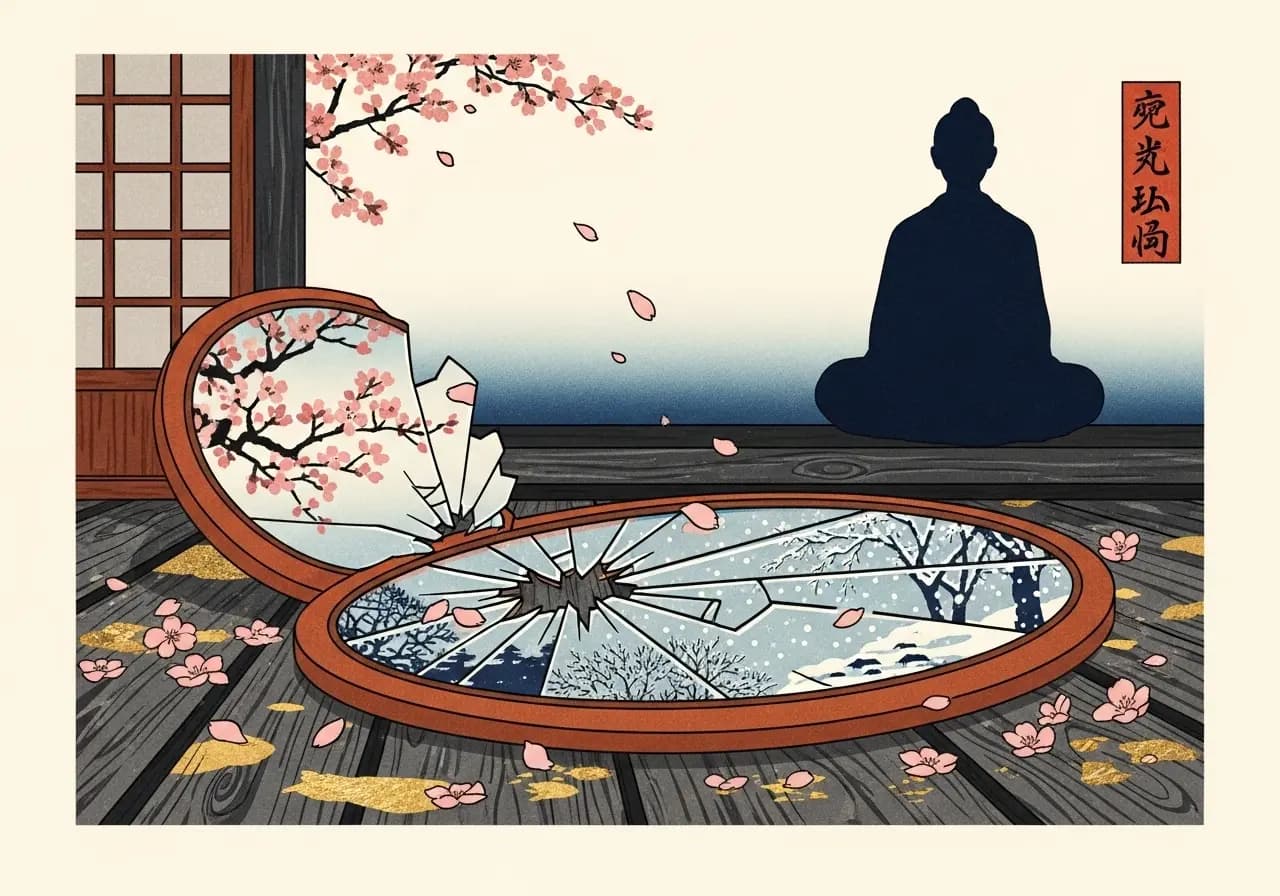
Kegon replied, "A broken mirror never reflects again. Fallen flowers never go back to the old branches."
Let's start by exploring this koan a bit, and like I've done before, I want to share some of the thoughts that come from the Patreon community, where we discuss these koans and explore the ideas and concepts from the podcast together.
What the Community is Saying
David shared this thought: "I really like these koans that you've chosen so far. In my view, enlightenment is an understanding of how the world truly works that one has been able to embody in their daily life. This understanding allows one to see beyond appearances and to act skillfully in consequence. Because an enlightened person cannot simply undo this understanding of the world, Kegon compares it to trying to put back together a broken mirror or fallen flowers."
I really like what David is saying here—this concept that once a person understands something deeply, they cannot simply undo that understanding of the world. And I think there's a lot of truth to that. The moment we understand something and see it in a new way, we can't ever go back to seeing it the old way.
The analogy I've used in the past to describe this involves those optical illusion paintings—the ones that are made up of a series of dots or little patterns. If you stare at them long enough and shift your focus, you can usually see a hidden image inside the image. I remember struggling to see these at first. But then once you see one and figure it out, that's it. You can never not see it again. Your eyes know how to shift and focus, and you never go back to seeing just the dots. Every time you look at it, suddenly that hidden message appears. That's what this reminds me of. The moment somebody sees something through a new lens of understanding, they can never go back to seeing it the way they saw it before.
Talia shared this observation: "I like this one. It makes me think of becoming a mother for the first time. People try to explain it to you and prepare you for how you're going to feel and the emotions that will arise. Those words do help along the path toward parenthood, but they can't do justice to actually living the experience yourself. Until you've experienced that magical time personally, you can never go back to before, when you only had heard about it. Those who are further along the path to enlightenment can teach and share with others and help prepare them. However, once you've reached enlightenment, you can never go back to not knowing what life looks like when you are living mindfully and skillfully."
Talia's comments echo what David was saying—there's a difference between having something explained to you and actually experiencing it. Using motherhood as the example, once you become a mother, you're forever changed. You can never go back to not being a mother because the experience itself has transformed you permanently.
Stanley offered this perspective: "Thank you for the koan. It got me thinking. Everything and every event is impermanent. Once it has changed, you cannot return to its past. It can only exist in the present, only to continue to change and find itself in a new present. I might rephrase Kegon's reply: 'A broken mirror never reflects as it previously did again, and fallen flowers never go back to the old branches.'"
I really like that rephrasing. It's true—the broken mirror may still reflect, but definitely not as it previously did. And again, this echoes that constant change that we can't escape. We can't return to what was.
Then Darlene shared: "For me, it has a double meaning. First, it means that an enlightened one can never see things the same way again after they become enlightened. But secondly, just as flowers both on and off the tree are ordinary, so is being enlightened and unenlightened ordinary. Just because one sees things from a different perspective does not mean they have left the ordinary world."
I really appreciate what Darlene is sharing. To me, this koan contains something important. When the monk asks Kegon, "How does an enlightened one return to the ordinary world?" he's asking a question that would first require us to define what "enlightened" means. What does that even entail? How do we define "ordinary world"?
But here's the thing: Kegon doesn't fall into that trap. He doesn't answer the question directly. Instead, he replies with a very simple observation of the nature of reality itself—a broken mirror never reflects again, fallen flowers never go back to the old branches. He doesn't address anything about enlightened or ordinary. He just teaches a profound truth about how reality actually works.
The Real Teaching
In my opinion, this is infinitely more important than speculating about enlightenment. By never focusing on enlightened or ordinary, Kegon reminds the monk of something essential: there is no going back. Life is always changing, and that's where the title for this podcast episode comes from.
Once you've changed, how can you ever go back to how you were before? The answer is that you don't. Once you've been in love, you can never know what it is to have never been in love. Once you become a parent, you can't go back. Once you lose a loved one—and I have friends who have lost a spouse, a child, or a parent—once you experience that level of heartache, you can adapt to a new normal, but you can never go back to what was.
There's almost a misconception in using the word "normal" the same way the monk uses "ordinary." Is there really such a thing as an ordinary world? Is there such a thing as normal? When you experience any kind of change—even small change—you never go back. There is no going back.
To me, that's the essence of what's being taught in this koan. If I ask a modern version of this question—can someone who survived cancer ever return to the ordinary world?—the answer would be no. If you've had a near-death experience or a second chance at life, you don't go back to the ordinary world the same way. If you've lost a loved one, you don't go back the same way. You adapt to the new normal. And you could apply this to countless other examples.
The point is that there's no going back to the ordinary world because there is no ordinary world to return to.
Life is Always Changing
I think a key Buddhist principle is the recognition that things are always changing. Life is transient. When we feel the desire to return things to normal, we need to remember that normal was always relative. There is no going back.
This is where I think the Tetris analogy fits so well with a worldview that aligns with reality. If I want a worldview that fits with how things actually are, that worldview for me is this: life is a lot like a game of Tetris, where new pieces are constantly showing up. Every time a new piece appears, it changes the game. You never go back to how it was before that piece arrived because in the new present moment of the game, you're dealing with a completely new piece.
We're all experiencing this right now. There's this new piece that suddenly showed up for virtually the whole world—the COVID-19 pandemic—and we're all trying to figure out where it fits in our lives. I think there's a misconception here if we're thinking, "When this is over, we'll just go back to normal." We won't. There is no such thing as normal. This is the new normal. And when this eases off, whatever life looks like then, that's the new normal. It's always changing.
For those of you new to this podcast, I first discussed this concept in episode number five. By the way, episodes one through five serve as a really good foundation for a lot of these ideas. If you've just recently joined and you're catching up on the most recent episodes, I'd recommend pausing and jumping back to episodes one through five before jumping back up to stay current.
The world has changed, and we are changing with it. If we resist the change, we experience the discomfort of change and also the suffering of wanting things to be other than how they are. But if we go with it, if we change with it, we only experience the discomfort of change itself. We avoid that unnecessary self-inflicted suffering—what I call the second arrow.
This concept is really important to me: understanding that there's no going back. As life continues to unfold and each new piece shows up, I can hold the understanding that there's no going back. This allows me to first and foremost accept the new piece. Okay, this is what life has thrown at me. Now how do we pivot? How do we adjust? How do we adapt? Because that's what we're good at. If we want to get through these difficult things, we have to be capable of change.
Change can be uncomfortable, but change is what moves us from where we are toward where we're going. And we're always going somewhere because life is always changing.
Faith in Yourself
A concept I wanted to explore that goes hand in hand with understanding that there's no going back is this: now what? Well, to me, that "now what" is that I need to develop a sense of faith in myself.
Sometimes it seems like we go through life trying to find someone or something we can trust. If so-and-so tells me this is going to be okay, then it will be okay because I trust that person. In that case, I have faith in them, or in something, or in an organization. You can have trust in lots of things. But I want to consider that the trust that matters most is the trust we have in ourselves.
In other words, my ability to adapt, my ability to sit with whatever emotion arises as I encounter these big Tetris pieces that show up in my life, gives me a greater sense of strength. It helps me know that I don't have to be controlled by fear. I can learn to be comfortable with fear and ultimately become more skillful with whatever situation arises.
Now, there can be a misconception here because I'm not trying to say that trusting yourself means everything will work out fine, that you'll figure it all out, that you got this. That's not what I'm saying. What I'm saying is this: have faith in yourself that no matter what life throws at you next, you're going to be able to adapt.
That doesn't mean you're going to like it. It doesn't mean it won't be unpleasant. It doesn't mean you won't experience fear or anxiety. None of that. What it means is I know I can become skillful at pivoting, adjusting, and adapting to whatever life throws my way. Sure, it may be hard. If I encounter very difficult emotions like anger or fear, I'm not afraid to feel those emotions anymore.
And I think there's another big misconception here. It's not that we're trying to change the emotion. We're not trying to ensure that we don't feel pain or fear or anger. What we're trying to do is change the relationship we have with these emotions.
When an emotion arises and I have a good relationship with it, it's okay to experience fear in the face of uncertainty. Maybe you lost your job. Maybe you don't know how you're going to pay rent that's due, or you're behind on rent. It's okay to experience that fear and anxiety. That's natural. So changing the relationship we have with the emotion is much more useful than trying to say, "I need to make sure I don't feel that emotion. I don't want to be scared," and trying to will it away. That's just aversion, which is one of the three poisons.
Instead, approach it with this: "I trust myself to be capable of feeling whatever is going to arise. If I'm going to be scared, I'll be scared, but I'll sit with it and analyze the fear. I might come to find out that it's not fear itself—it's some other emotion underlying the fear. Maybe it's embarrassment about looking like a failure if I can't pay my rent." But that's how this works.
What it means for me is I don't need someone to convince me that things are going to be okay because I trust my own ability to adapt and accept whatever life's going to throw at me. That includes being okay if it's not okay. From time to time, it may not be okay, and it's okay that it's not okay.
Wrapping It Together
When I remind myself regularly that there's no going back, I remember that I'm just playing a game that moves in one direction—forward. Life throws pieces at me, Tetris pieces. These pieces show up, and that's it. The instant a piece shows up, there's absolutely nothing I can do to not have that piece. It's there. I've got the piece. So I'm stuck with it.
The sooner I accept that and recognize this is the piece I have to work with, the sooner I'm working in the space of reality. This is my reality. My new reality is that this piece showed up. So my faith, my trust, my confidence—whatever you want to call it—doesn't rest in anyone else or anything external. It rests in my ability to adapt.
I know I'm going to figure this out. It doesn't mean I'm going to figure it out in a nice, concise, pretty way. I might make it messy for a little while. But I'm going to figure it out. I trust that eventually I will. And that, to me, is a very powerful thing that gives me a great sense of peace with whatever life's going to throw at me.
It's like, "Oh, I'll figure this out. And if I don't, if I mess it up, that's okay, I'll figure that out too. I'll figure out how to handle the fact that I didn't figure it out." And that makes it feel a lot less intimidating.
The Next Koan
So those are the thoughts I wanted to share with this concept of no going back and the concept of having trust in yourself—your ability to adapt.
That's all I have for this podcast episode. As always, I want to thank you for listening. If you want to support the work I'm doing with the podcast, you can consider becoming a patron and joining our online community, where we discuss these koans and podcast episodes. You can learn more by visiting SecularBuddhism.com. If you enjoyed this episode, feel free to share it with others, write a review, or give it a rating on iTunes.
Before I go, I'm going to leave you with an additional Zen koan to work with between now and the next podcast episode:
What is your original face before you were born?
Think about that, and I will share my thoughts on the next podcast episode. Thank you for listening. Until next time.
For more about the Secular Buddhism Podcast and Noah Rasheta's work, visit SecularBuddhism.com