

Becoming Nobody
Episode 127 of the Secular Buddhism Podcast
Hello, and welcome to another episode of the Secular Buddhism podcast. This is episode number 127. I'm your host, Noah Rasheta, and today I'm going to talk about becoming nobody.
Remember: you don't need to use what you learn from Buddhism to be a Buddhist. You can use what you learn to be a better whatever you already are.
Reflections on Last Week's Koan
Before jumping into the topic for this podcast episode, let's talk about the Zen koan I shared in the last episode: "When you can do nothing, what can you do?" I want to share a couple of thoughts from some group members in the Patreon community. As a refresher, the Patreon community is a group of people supporting the podcast where we discuss Zen koans every week, talk about mindfulness concepts and topics, discuss the podcast episodes, and a few other things. I like to share some of the perspectives and ideas that come from the community on the Zen koans, so let me start out with that.
Sean says, "Don't just do something, stand there. If you can do nothing, do nothing." I like the thought that Sean shares—don't just do something, stand there. Standing there is doing something. And if you can't do something, then do nothing. Both are really good thoughts that evoke this question that Thich Nhat Hanh often asks: "Is nothing something?" In this case, and in all cases, nothing is something. We have an idea in our mind of what nothing is, so to do that thing is to do something. That's a fun way to think about and explore this concept.
Joey from the community says, "When we get to a point where we cannot react to the stimuli around us and do nothing, all possible actions are now open to us. The ability to do nothing is not inaction." This shares that same concept—that by doing nothing we actually are doing something, and that the ability to do nothing is not inaction. I think sometimes we have a concept in our mind of what nothing means, and we think of it as inaction. But this is similar to the whole conversation you could have about acceptance versus resignation. We have an idea of what acceptance is, and sometimes that idea is more accurately described as resignation. But acceptance isn't resignation. In this case, doing nothing might not be what you think. Doing nothing may be doing something, and I'll get into that in a minute when I share my thoughts on the koan.
I want to close with thoughts from Theste, also from the community, who says: "The notion of not doing is part of the Chinese influence via Taoism on Buddhism—wu wei. Alan Watts has a whole chapter in one of his books on the topic. He interprets it as not forcing things, or we might say going with the flow or not trying so hard. Jon Kabat-Zinn also has a chapter on not doing in his book, Wherever You Go, There You Are. I love the idea, but it's been an elusive, poorly understood, and inconsistent practice for me—just to be still and not concerned about getting anything done. I think meditation is a form of not doing, just being still for its own sake."
Those are some of the thoughts that were shared in the Patreon community. I really enjoyed the various perspectives and takes around this koan, and there were several more that I didn't have the chance to share. But it's always fascinating to take a koan and to explore it. Of course, the principal perspective is what this means to me, but then it's helpful to get insight from other people who are in different places in life, other ages, live in different communities or societies, and just have different perspectives that can add light to something in a way that maybe I hadn't thought about. So it's always fun to read other perspectives.
The Fledgling Birds: A Teaching Moment
When I think about this koan—when you can do nothing, what can you do—similar to what was shared by some of the group members, I think of the concept of what nothing is. I think nothing is something. It's funny. This week, we've had an experience going on here in our community in Mexico. Now, as a reminder, I live in a pretty tropical place surrounded by rainforest. I don't know exactly what to call it, but it's tropical forest with lots and lots and lots of birds.
In our neighborhood where we have a whole bunch of trees, if you walk out the front door, you'll see a whole section of trees that are full of birds. It happens to be the season right now where a lot of these birds—I don't know what kind they are—where the baby birds are taking their first few steps and trying to learn to fly. Unfortunately, we've had a lot of them come down from the trees too early. Some of them seem to have fallen and they're tiny, nowhere near ready to fly. Some of them have reached that stage where they thought they could fly, but they weren't quite ready. They flew down, kind of flapped, had a very soft landing, and now they're stuck. The neighborhood kids have been seeing these birds and running to take care of them.
I didn't notice it the first few times because there was a bird that seemed sick. The security guard picked it up and took it in a box. Then, a few days later, there was a bird that also seemed sick. The neighborhood kids decided to adopt the bird. They put it in a box and carried it around, and it eventually died. All these birds that were being cared for were dying. It was somewhere at this point that I realized: wait a second, these aren't sick birds. I noticed what was happening in the trees and realized there are a lot of these little birds, and some of them end up flying and a lot of them don't.
One particular bird, just two days ago, landed down in the grassy area right by our house. He was just hanging out down there, and what I presume is the mom would fly down and feed him. They open their beaks and feed regurgitated food. It was fascinating to observe this bird that wasn't quite ready to fly, still being fed down there, then he would flap his wings and try, and try, and try. He wasn't quite ready. It took about a day and a half, and around the middle of the day of the second day that it had been down there, it suddenly flew. It was really cool to watch.
I had this conversation with my kids while this was happening because they wanted to go take the bird and put it in a box like they had done a few days before. We sat and talked about the importance of allowing the bird to run the course of what it needs to do and that we can observe but we cannot do anything. We have to just watch. Throughout the week I had already been thinking about this koan: "When you can do nothing, what can you do?" And here we were. There was nothing we could do. And what could we do? Well, we could do that. We could do nothing. We could allow the bird to run its course.
I felt sad that we had missed the mark, or that the kids had missed the mark, a few days prior with trying really hard to help these little birds. Putting them in the box was a death sentence. The moment the kids were around the bird, the mom couldn't come down to feed them. She wouldn't dare come down because people were around, and the bird died—not because it was sick, but because it couldn't be fed.
The security guard didn't realize that. The maintenance person didn't realize that. And the little kids in the community obviously didn't realize that. It wasn't until I saw—I was sitting out there while the kids were swimming, just observing. What are these birds doing? I saw the whole process taking place, and it connected. I thought, "Oh. Oh, that's what's happening."
So with this specific bird that we decided to name Hopsy—because it was hopping around trying to fly for a day and a half—Hopsy finally took off. It was a really neat opportunity to talk to the kids about this koan: "When you can do nothing, what can you do?" It was when we realized that we should have been doing nothing all along that we saw what was actually supposed to happen, and Hopsy ended up flying. It was a neat experience, but it got me thinking about how often we do this in our day-to-day lives. Not with birds, but with all kinds of circumstances and things where we don't know better and we're thinking, "Here's the thing I'm going to do," and doing something was the wrong answer. Doing nothing would've been the right answer. And in doing nothing, you are doing something. You're allowing it to run its course.
I can't think of any specific instances right now, but I know that has to have happened multiple times in my life where the intervening action probably made the situation worse. Had I done nothing, I would've been doing something probably much more skillful than whatever I was doing by trying to do what I thought was something. I'm sure you can probably think about and recall some kind of instance like that in your own life, or you can observe this in someone else's life. That's a fun way to think of this koan: "When you can do nothing, what can you do?"
The Concept of Becoming Nobody
Now I want to jump into the topic that somewhat correlates with this koan, and that's the topic of becoming nobody. In the podcast community, we have an ongoing book club. The book that we're reading right now is The Magic of Awareness by Anam Chöphel. There's a chapter in this book that talks about the concept of being a nobody, or it warns against the danger of becoming somebody. I wanted to share a little bit about this concept because I'm always interested in trying to explain the same ideas over and over again from different angles, from different perspectives. Because what you may have heard two, three, four, ten times from different angles, suddenly you hear it from this one angle and it clicks. You're like, "Oh, okay. Now it makes sense." And that's why you're kind of never done talking about these things. This is an example of that.
I want to correlate the concept of awakening with the concept of becoming a nobody. This concept was brought up in The Magic of Awareness, and there's a quote I've referenced before by Jetsun Milarepa who said, "Good concepts are like a gold chain. Bad concepts are like an iron chain. They all equally bind you in the end." This idea of concepts, the ideas, beliefs, or opinions that we hold can be very binding. I want to talk about that a little bit because what were we before we became somebody?
The Stories We Tell
Now, I want to talk about stories. We know that we are storytellers. As a society, we tell stories. Our ability to tell and collectively believe stories has catapulted us from caveman to where we are today as a modern society. Our ability to collectively believe the story that this green piece of paper is worth something. Our ability to collectively believe that allows us to have commerce. Our entire financial system works this way. This is why we can use bills of paper to do transactions instead of having to barter one thing for another. We can actually use money. But money, the idea of money, is just an idea. It's a concept. It's a shared story and a shared belief that this paper is actually worth something.
But we have stories about everything. Probably the most important stories for us to want to understand are the ones that we have about ourselves. We have a story about who we are. That somebody is an idea. It's a concept. It's a belief that you have. Maybe it's a shared belief. You've convinced other people to buy into the same story that you believe about who you are. But then there are multiple layers: the somebody that I think I am, the somebody that you think I am, the somebody that I think you think I am, the somebody that I think I should be. It just goes on and on. All these super intricate layers of the story of the somebody.
There's a story that really illustrates the importance of understanding that we have stories about the somebody we think we are. I'm paraphrasing a story I heard in The Magic of Awareness, and it's essentially about a teacher and his student—let's call them two monks. The senior monk, or the teacher, was always telling the student, "Don't become somebody. Never become somebody." And the student said, "Okay, I understand that. I'm going to follow that."
Then one day while traveling on pilgrimage, they stopped by a place and decided to rest. I think in the story it was a palace or something along those lines. They decided to rest, and they fell asleep—one in one room, one in another. They were just there somewhere on the palace grounds.
Suddenly, the king returns and realizes these two wandering monks are sleeping there in one of the rooms or quarters. The king arrives and he's furious. Who are these two people who have the audacity to be on his property? He speaks to the student first, wakes him up. He's like, "Who are you?" The student immediately goes into trying to explain: "Oh, we're just monks, and we're traveling. What we do is this and that." The king is just curious and picks up a rod or a whip and starts beating him as he runs him off his property. The guy is running scared, I presume.
Then the king approaches the teacher and says, "Who are you?" This time, the teacher just looks at him and says, "Hmm," but doesn't answer. Then the king, kind of confused, is insisting, "Who are you? Who are you?" And again, the master says, "Hmm. Hmm." At this point the king is frustrated and just yells, "Ah, this man is a halfwit. Get him out of here." They kind of run him off, but the king doesn't hit him or beat him with the whip.
Later, the teacher and the student meet up, and the teacher says, "I told you: never become somebody. The moment you decided to become a monk, that's why he started beating you. Why would a monk be in a palace?" He said, "I remained a nobody, and nothing happened to me."
That's the gist of the story. I like it as an example of the fact that being a somebody in this case ended up being a painful experience because the somebody did not match what someone else—in this case the king—would have thought is a valid excuse for that somebody to be in his palace. By not becoming somebody, the other one was easily dismissed as a halfwit.
Now, most of us, in an instance where we're suddenly confronted with having to defend who we are or we're asked "Who are you?" we have an idea of who we are. That somebody that we are needs to be defended. And that somebody may not match the somebody somebody else is thinking that we are, and then you end up in a situation where you're experiencing pain. In the story it's a whip or a beating with a cane. But we essentially put ourselves in a position to feel pain or discomfort because of the somebody that we became.
To me, the gist of this story, of this lesson, is that when someone says, "Who are you?" the teacher had no reason to defend who he was. Now, as simple as it sounds to just respond "Hmm," to me that sounds very simple. But we don't do that. We all have a story of who we are, and by golly we have to defend it. This is who I am. This is what I believe. This is my opinion. Whether it's political, religious, I don't care what it is—whatever the view is of the somebody that I think I am, I'm going to take that seriously. And if somebody's going to ask me about it, I'm going to have the tendency to want to really protect the story I have of the somebody that I am. We all kind of have this tendency, and that's what's fascinating about this practice.
The Practice of Becoming Nobody
One unique way to look at all of this is to say, "What about the practice of becoming a nobody? Or becoming nobody in the sense that I have a story that I have about myself?" That's fine. Keep the story. But recognize it's just a story. And then what happens is I'm not so attached to it anymore. I can recognize that the story I have about myself is just that—it's a story. And when the story gets confronted by someone else asking, "Who are you?" I have nothing to defend. Sure, I have a story, but I don't need to defend it. I don't even know if my story's accurate. That's kind of living with the "I don't know" mind, right? That uncertainty. But becoming nobody in this sense allows us, in a very real way, to have freedom to be whoever we are.
I think a lot of times we become somebody, and that causes us to feel pain and suffering because we're always defending the somebody that we think we are. When we have these masks of identity—when the mask of our identity becomes the somebody that we think we are—it's almost like we're the ocean, the ocean wave that thinks it's a wave and doesn't realize that it's just the ocean. To me, that is a very profound insight into the nature of my relationship with reality.
Carl Sagan famously stated that we are all stardust. His statement sums up the fact that, in a literal way, the carbon, nitrogen, and oxygen atoms in our bodies, as well as the atoms of all other heavy elements, were created in previous generations of stars over 4.5 billion years ago. But somehow we don't fully understand the implications of that. Instead we become somebody, rather than remaining nobody—the stardust that we are, that's everything. It's literally everything.
I like to imagine that the moment of the Buddha's enlightenment perhaps was nothing more than the Buddha realizing that he was nobody. He let go of the idea of being somebody. We're always talking about peeling away the layers, right? The concepts, the conceptual understandings that we have of reality. Stripping away the mental conditioning, the ideas and beliefs that we have about who we are and about reality in the same way that you can take an onion and peel away layer after layer. Stripping away the mental conditioning, and if you go through it far enough, layer after layer, you realize that there's nothing there. The onion was the layers. And in that same way, the onion is nothing, and we are nobody. What we are are all the layers that make us who we are.
Now, realizing that we are nobody is perhaps the most beautiful truth we'll ever understand. Somehow, in that new perspective, we can be liberated from the chain of being somebody—the golden chain or the iron chain, as that quote implied. The good or the bad concepts, but equally binding concepts that we have of who we are.
One of my favorite quotes of all time, which I've shared before, is the Picasso quote that goes like this: "My mother said to me, 'If you are a soldier, you will become a general. If you are a monk, you will become the pope.' Instead, I became a painter and became Picasso." To me, that is a really powerful quote that ties very well into this concept of becoming nobody. Picasso was free to develop into himself—the nobody that we all now have made into a somebody.
Now, when I say Picasso, I have an idea of what that means. I've made him a somebody. But he was essentially nobody. He wasn't trying to be anybody else. He was trying to be himself. Now, can you see the irony in this way of thinking? We're always aspiring to be somebody—the somebody that I think I should be, the somebody that I think my parents think I should be, or that my spouse thinks I should be, or that I think my kids think I should be, or that my siblings think, or that my society, or that my religion, or that my you name it, right? There's always the somebody. This is a very liberating switch from that way of thinking.
The alternative goes to saying, "No, my practice is becoming nobody. I'm not trying to acquire something new. I'm trying to strip things away—layers of beliefs, layers of concepts, layers of ideas and opinions—to return to that unconditioned state, the state of being nobody." To me, that is a really fun way to think about this idea of enlightenment.
Now, I think—and this is my opinion, of course—that when the Buddha had that moment where he realized he was nobody, I think anybody could have approached him and tried to call him out on whatever he was doing and be like, "Oh, you think you're just this enlightened person because you sat here and meditated?" He probably just laughed. He literally had nothing to defend. There was no somebody in his mind of who he thought he was, and he would be free. You can see this in some people.
It's very liberating to not have the story of somebody that I need to defend about myself. And if you're going to question me about anything and say, "Oh, you're this," or "You're that," or if that conflicts with the story I have about the somebody I think I am, then yes, we're going to have a difficult time, and I'm going to have to defend. But if I don't have that story about me, I've literally become a nobody—like the guru or the teacher in that story. If you say, "Who are you?" I can say, "Hmm," because I don't know. I don't have an answer to that.
And then next thing you'd say is, "Oh, who's this halfwit?" Well, that doesn't bother me. I'm a halfwit to you. Okay. That's who I am to you. And then you allow yourself to be whoever the somebody is that you think I am. That's enough. I'm cool with that. I don't have a somebody that I need to be.
I really like that. I think it's just a really fascinating concept to play with in your mind, especially in our day and age where we have very, very strong inclinations to want to be somebody in all kinds of different facets of life. The somebody that you are at work. We have an idea of what it means to be successful. That's a somebody—a successful somebody. An unsuccessful somebody is still a somebody. A winner's a somebody. A loser's a somebody. Someone who's right, someone who's wrong, someone who's righteous, someone who's evil—all of these are somebodies. And then in the middle of all that, there's the nobody that's not bound to any of those things.
The Monk Hozo's Realization
There's a story about a monk named Hozo who wanted to become enlightened. He wanted to be like the Buddha. So he approached the Buddha and implored him to teach him how to become enlightened. The teacher replied and said, "When you want to become an enlightened one, the teachings of the Buddha or any other teachings are not necessary. You must look within and listen to yourself." This story comes from one of the Zen traditions. I really like it because, to me, this goes hand in hand with the Picasso quote.
Picasso's success, whether it was accidental or not, was that he became himself. The Buddha's success, similarly, was that he was striving after something and realized he was the source of it. He just had to look inward. I think for us it's the same. We always make this mistake of looking out there: "Oh, I want to be like so and so. Oh, I want to be like Picasso. Oh, I want to be like the Buddha. I want to whatever."
But as this little story implies, when you want to become an enlightened one, when you want to be like these people that you look up to—these somebodies in your life—that's the time to look within and listen to yourself. And perhaps the very first step to becoming what you thought you wanted all along was to quit wanting to be somebody and to start striving to be nobody. That's just a fun way to think about it.
Now, there is a word of caution here. We're really good at playing the game of cat and mouse. Alan Watts calls this the game of cat and mouse in our mind. It's like, "Oh, okay. Now I want to be somebody," or, "Now I want to be nobody, and I'm going to turn the nobody into the somebody that I want to be." And here I am, caught once again in my own game. So we want to be careful of that too. You can't just pretend, "Oh, here I am. I'm being a nobody. Look at me, because now the somebody that I am is the nobody that I want you to think that I am." That's the somebody that I am.
And I see this all the time in meditative circles where it's like, "If I want to be really mindful and peaceful, I got to make sure you know how enlightened I am. I got to make sure you can see how peaceful I am." You can catch yourself in this game. And if you catch yourself, that's it. The game is over. You can't trick yourself.
So we're always looking inward, and we're trying to catch that part of us. Why do I want to be a somebody? Why do I want to be a nobody? Why can't I just be content being exactly who I am right here, right now in this specific stage of life? To me, that is enlightenment: not wanting anything to be any different than how it is. So that's something to keep in mind as you explore all of these concepts.
But imagine how different life would be if all of our views, opinions, and beliefs were flexible enough to adapt, to take in new evidence and new information and say, "Oh, okay. Here we go," and we pivot. Why do we hold on so strongly to our ideas, especially the idea we have about who we are? The somebody that we think we are, or the somebody that we think we should be, the somebody that we think others think we should be. We get really, really caught with these ideas. They're like traps, and you get caught up in these spider webs almost and you just feel stuck.
To break free from that web, to break free from those chains—whether they're gold chains or rusty iron chains, they're still chains. To me, that's what this is all about: breaking free from all the concepts and ideas that we have about who we are. That's the somebody.
Personal Encounters with Being Nobody
So I just wanted to share a couple of things and correlate them with the overall topic of becoming nobody. I think it's a practice, and it's something I strive to understand in myself all the time. Who is the somebody that I think I am? Or the one that I think I should be? Or the one that I'm trying to avoid being? Or all these complex layers of the relationship I have with being somebody? And then how do I practice being nobody?
Many of you know that when I was younger, when I was nineteen and twenty, I lived overseas in Ecuador serving as a missionary. At the time, I was out there knocking on doors and preaching Mormonism. I had this experience early on in my mission where we were walking down the street and there was a group of younger people sitting on the sidewalk drinking. They started blurting things at us. I was with my companion—missionaries are usually out there two at a time, so this is the person you're assigned to for however many months.
My companion and I, we call them companions. We're walking along the street when this group of hoodlums stood up and started swearing at us. Then one of them picked up one of the glass bottles—because they were drinking—and threw it at us. I was so deeply offended. I thought, "Why would you do that? You don't know who I am. I'm not your enemy." And I just took it really, really personally.
In the days after that experience, I had a really fascinating shift in my mindset when I suddenly realized they didn't throw that at me. They don't know me. They don't know anything at all about me. In fact, if they did know me, they probably wouldn't have thrown that. We'd probably get along pretty well because I'm a nice person and I've never really had a problem with having enemies or anything like that. So that's part of why I was so upset and offended—that somebody would throw a bottle at me, wanting to hurt me.
But I realized they were throwing it at something, at the somebody that they thought I am. And the somebody that I thought I was got offended by that. Here I was. The reality was they were throwing it at something that I represented. At the time in Ecuador, there was a lot of animosity against the United States because of their own political and economic problems that they were experiencing in Ecuador back at the turn of the century. It was the year 2000, and there was just a lot of animosity. They were throwing the bottle at the somebody that they thought I was.
Luckily, I made that connection early on, and it changed my experience for the rest of my mission. I allowed myself to not take it personally. The rest of my mission, it wasn't about me. It wasn't me there. I was representing something bigger than me. At the time, that was meaningful to me. I was representing the church that I believed in, the ideology that I believed in at the time, and I was a part of something bigger than me. That was my first time ever encountering this experience of being a nobody and feeling liberated from the idea I had about me.
Now, ironically, it happened many years later in a similar context when I stopped believing in Mormonism and I had to kind of remove myself from the day-to-day experience of being a Mormon, stop going to church, and living in a community that was very religious. With Mormonism, I was encountering the same experience. Suddenly, people seemed a little standoffish with me or perhaps a little concerned, like, "Oh no. You're going down this path of unrighteousness," or "You're going astray." I mean, nobody ever implied that I was evil, but they kind of got scared of you.
Suddenly, you're this black sheep or poisonous in a way. And that was that same feeling I had where I thought you might as well be throwing bottles at me and saying, "Get away. We don't want you here," because they were now uncomfortable with me. Why? At first, I took it personally, right? But then I realized this is no different. I have become a somebody to them. And in their mind, that somebody is not the kind of person I should be, not the kind of person they would choose to be. And that somebody created problems. And I, for a moment, allowed myself to keep thinking, "Oh, no. No. I need to prove to you I'm this other somebody. The somebody that I have in my mind is very different than the somebody that you guys have in your mind," and I wanted to somehow reconcile the two. It was impossible. It cannot be done.
I couldn't change the somebody they have in their mind. But I could change the somebody I had in my mind. And I became nobody. In a very real way—this wasn't overnight. This took months and years. This is actually a lot of what led me to Buddhism. It was the suffering I was experiencing by suddenly becoming the somebody that I knew other people didn't approve of. And here in the process of stripping away the idea I had of the somebody that I was, I ended up becoming nobody. And suddenly, in a lot of ways, I was like the guy in the story. When people would ask me, "So do you... are you still Mormon? Hmm. Do you still believe in this? Hmm." I didn't have an answer. I'd become a nobody.
And that's kind of where I find myself now. I no longer feel the strong sense of defending or protecting the somebody that I think I need to be protecting. If somebody's going to come to me and say, "Hey, just so you know, you're a naive, fooled person. The devil has fooled you," and tell me that whole story, I have no problem with it. I know that's just the somebody that they have in their mind. And I don't need to defend it or push myself away from that definition of the somebody they have. I can't do that anyway. I'm perfectly content now with just saying, "Hmm, okay," and moving on.
And that, like I said, was definitely not easy. It took a lot of work. But it had nothing to do with them. All along, it had everything to do with the somebody in my mind that I was, that I was trying to prevent myself from being seen as this somebody, and trying to prop myself up as this other somebody. It was all in the somebody. But the moment I understood the concept of the nobody, I felt free. I was totally liberated. And now I'm not nearly as sensitive or concerned about what somebody thinks of me, or how they think I am, or how wrong I am, or how misguided I am, or whatever they want to call it. It doesn't bother me.
And in the same way, if somebody does the opposite and they're like, "Oh, man, you're so wise," or "Oh, you have a podcast, and you've done this and that," that's also just the somebody that you think I am. I'm much more of a fool than anyone thinks. I'm not wise. And if someone does it backwards—"You're such a fool"—okay. I'm not really a fool. But that's what you think I am. I'm nothing. I'm nobody.
So I just wanted to share those two things and correlate them with the overall topic of becoming nobody. I think it's a practice, and it's something I strive to understand in myself all the time. At the end of the day, this is stepping into the uncertainty of it all. I don't know who I am, but I know how I feel right now. So the nobody that I am right here right now, that's all I've got to work with. And that's the topic I wanted to explore.
Closing
That's all I have for this podcast episode. As always, thank you for listening. If you want to support the work I'm doing with the podcast, consider becoming a patron and joining the online community where we discuss these koans, podcast episodes, and have a study group and other things. You can learn more about the online community by visiting secularbuddhism.com. If you enjoyed the podcast episode, feel free to share it with others, write a review, or give it a rating in your podcast app. All of those things help.
Now, I must mention this is a pretty cool milestone. This week—I don't know exactly when it's going to happen, but it's only days away—the podcast will now have six million downloads. It seems like yesterday I was saying that we were at two million downloads, and it's just been growing so much month after month, year after year. It's really fun and really exciting, and I'm very grateful for this journey and the fun times I've had doing all of this and exploring and talking about all these concepts. I just want to say thank you to all of you who listen to this and who have been a part of this journey with me.
Now, before I let you go, I do want to share a koan for you to think about between now and the next podcast episode:
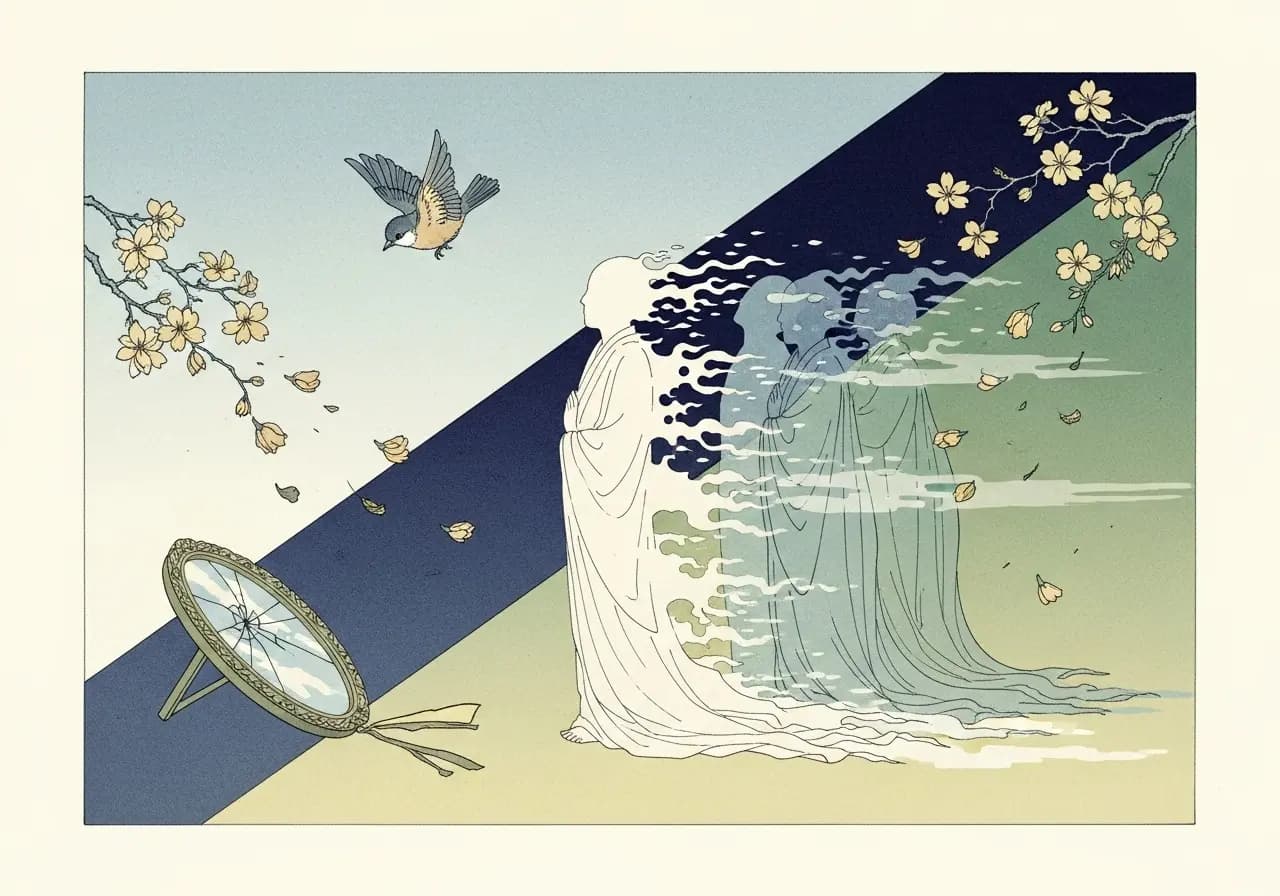
"A monk asked Kegon, 'How does an enlightened one return to the ordinary world?' Kegon replied, 'A broken mirror never reflects again. Fallen flowers never go back to the old branches.'"
That's the koan. I look forward to recording another episode soon. Until next time.
For more about the Secular Buddhism podcast and Noah Rasheta's work, visit SecularBuddhism.com