

Finding Peace Amidst Chaos
Episode 126 of the Secular Buddhism Podcast
Hello, and welcome to another episode of the Secular Buddhism podcast. This is episode number 126. I'm your host, Noah Rasheta, and today I'm going to talk about finding peace in the midst of chaos.
As always, keep in mind: you don't need to use what you learn from Buddhism to be a Buddhist. You can use this to learn to be a better whatever you already are.
A Classic Zen Koan
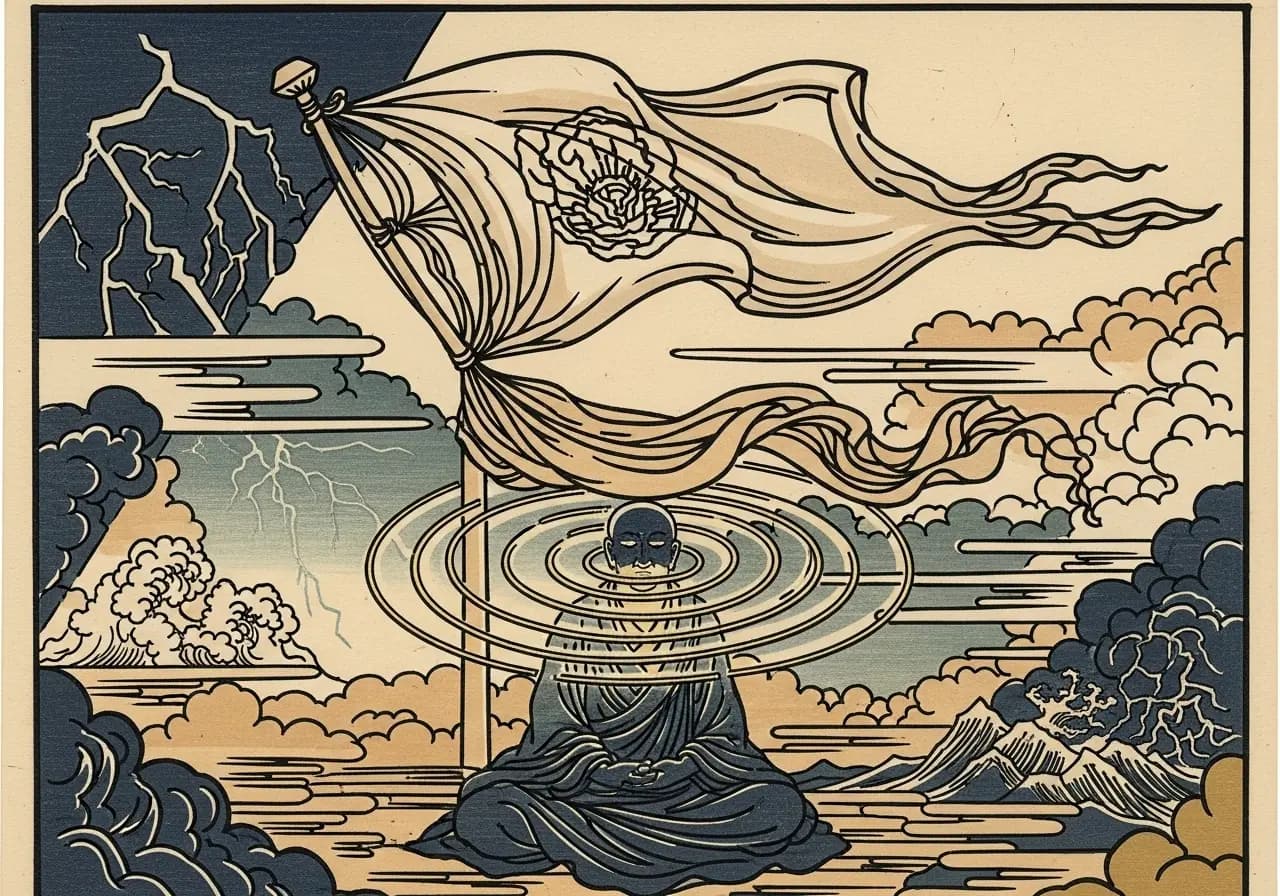
So let's jump right into the Zen koan I shared at the end of the last podcast episode. Two monks were arguing about the temple flag waving in the wind. One said, "The flag moves." The other said, "The wind moves." They argued back and forth, but could not agree.
Hui-neng, the Sixth Patriarch, stepped in and said: "Gentlemen, it is not the flag that moves, it is not the wind that moves, it is your mind that moves." The two monks were struck with awe.
I think this koan is very appropriate to the topic of our discussion today, and quite honestly, to the observations we make on almost any argument you see on social media or in person. You just picture these two people standing there arguing about whether it's the wind that moves or the flag that moves—and we see that in almost any conversation. Two completely different perspectives, both trying to get the other one to see the way they perceive it.
I shared this on the Patreon group and got some thoughtful responses that I wanted to share with you.
Community Reflections on the Koan
Sitae's perspective:
"Okay, so my initial reaction was to argue with the monks by thinking the flag and the wind both move. Why did I rush to impart my own judgment? Hui-neng reminded me why. My mind moved."
I really like that. Like Sitae, it's very common for us to approach this and immediately have our answer. We say, "The flag and the wind are both moving, of course. That's how I perceive it." But that's the reminder—right then, in that moment, what happened? It was my mind that moved. I think there's real wisdom in recognizing that automatic reaction.
Stefan's interpretation:
"Both monks are seeing the same thing and perceiving it completely differently. Neither is wrong or right. Hui-neng noted that since what they were seeing was the exact same thing, the only difference was in their perception, and therefore their moving mind was the only variable in this situation."
Yes, echoing what Sitae said, I think that's a really neat way to look at this. The variable, as Stefan says, is the moving mind. And isn't that true in almost anything?
This is what's at the heart of the teaching of the six blind men describing the elephant. You have the same thing, and everybody's perceiving it completely differently. That's the situation we're faced with in almost every disagreement or conversation. There's no way for us to make everyone perceive something the same way. It just can't happen.
We all know this from any news article, any conversation on social media, anything really. You're going to have two people approach something entirely differently. Sure, sometimes you get someone who views it the same way you do, but we've all encountered somebody who sees something very differently from how we view it. That's what was taking place with these two monks, and that's what this koan is teaching.
David's perspective:
"It seems that this koan touches perception and interdependence. There is an external world out there and we can only perceive through our senses and ultimately our mind. So both monks perceive the same objective reality differently, but in the end, it is just the way their mind interprets it, and this is also related to interdependence. The flag and the wind are both needed to generate the experience the monks are observing, and so is the mind that observes the phenomenon."
I like what David is expressing there with the concept of interdependence in this koan. Without the wind, you don't have the flag moving. Without the flag, you don't have wind responding to it. And that's how all things are. Seeing the interdependent nature of things in this koan is a really cool way to interpret it.
Darlene's insight:
"What a fascinating koan. My interpretation is that the flag and the wind are concepts which only exist in our minds. We habitually perceive reality filtered through language, our narratives about the world, and our nervous systems, and mistake these perceptions for unfiltered reality. Therefore, the movement is a product of our minds."
Yes, I think that's a common concept found in Buddhist teachings: that the external world we see exists in our minds. The way I see what's out there has everything to do with what's happening in here. We tend to think that what's happening in here is happening because of what's happening out there. Sure, that's true to a certain degree, but if you're going to recognize that, you've got to recognize the reverse as well—that what's happening out there is interpreted the way we perceive it because of what's happening in here.
This points me toward Alan Watts' concept of the "do-happening." I think I've mentioned it before. It's like this constant interplay between the doing and the happening. Things are happening, which causes doing, and because things are being done, that causes things to be happening. Everything's just that balance of the do-happening. That's what Darlene is kind of explaining here—where the way the mind perceives affects what we perceive, and what we're perceiving makes the mind perceive it in a certain way. They play on each other, constantly happening that way.
Finding Peace Amidst Chaos
Now I want to share some of my thoughts around this same teaching and correlate it with the topic of this episode: finding peace amidst chaos.
I think this is good timing. As I mentioned in the last podcast episode, for the most part, the whole world is experiencing a very similar experience right now. This is quite unique—at least in modern times—that we're all sharing a very similar experience that's unfolding similarly for people all over the world.
The intensity and scale are different based on where you are, but it seems like there's no part of the world now that's untouched by the coronavirus and the spread of COVID-19. Earlier this week, I was asked to share some of my thoughts regarding how we can find peace amidst chaos, considering that we're all in this chaotic time. I wanted to share some audio of my response to that question because I think it fits in well with the koan and with the concept of the moving mind.
How to Find Peace in the Midst of Chaos
I want to share some thoughts regarding the idea of finding peace in the midst of chaos, in the midst of the situation that we're going through with the coronavirus.
The thoughts I want to share pertain to the idea of wanting to find peace in the midst of chaos. I think the very fact that we're looking for peace in the midst of chaos sets us up with a mindset of trying to avoid discomfort. And here's the thing: oftentimes, our discomfort arises because we're trying to not experience any discomfort.
The truth is that at times, life is uncomfortable. As we're all experiencing now, sometimes it's very uncomfortable. The fear that arises out of uncertainty is real. The discomfort that arises from the break in our ordinary routine—it's real—because we're creatures of habit. We're social creatures, so when we can't socialize the way we're used to, that creates anxiety. And wanting to not feel that discomfort only aggravates the discomfort.
So the thought I wanted to share around finding peace in the midst of chaos would be to perhaps look inward and reflect on where that need for peace comes from in the first place. Why am I not resilient to the discomforts that arise in life? In other words, can I become more comfortable with discomfort? I think that's a good place to start.
We Can't Control What's Happening
Here's the reality: we can't control what's happening outside of ourselves. The coronavirus is a perfect example. Causes and conditions gave way for this cascade of domino effects that started happening, which put us suddenly where we are. We cannot control that.
Now, there are things we can do to mitigate the potential ramifications of all this—for example, social distancing—but if we get to the heart of what many of us are after, which is "How can I find peace in the midst of all this?"—I think it's okay to admit that perhaps we don't find peace in the midst of it.
Here's something I've come to understand: we always have just a little bit of peace and a little bit of chaos. Things come together and things fall apart. That's the nature of life. Things are always switching between that fine line of being chaotic and peaceful, and then peaceful, and then chaotic again, and then peaceful. That's the nature of things.
Welcome the Discomfort Rather Than Push It Away
Sometimes we have the tendency to think positively or try to push away the fears, anxiety, and uncertainty. We try to force ourselves to not dwell on the difficulties we're experiencing. But I don't think that's helpful.
Rather than pushing away the discomfort, we allow the discomfort to be there. We welcome it with open arms. We acknowledge: "Yes, things are scary. I don't know where all of this ends. I've never dealt with a situation like this, and that's scary."
But here's the key: at that moment, we can also open up our awareness to everything else that's going on by simply asking ourselves, "What am I not noticing?"
It's a very simple question. What am I not noticing right now? Maybe I'm not noticing that I don't have a toothache. Or that right now I have a roof over my head. Or that it's not raining on me while I'm outside. There are many things we can bring into our sphere of awareness without negating the difficulties we're also experiencing in our sphere of awareness.
So we can say: "Yes, while I am anxious and nervous and understandably fearful of how things are, I'm also noticing that I don't have a toothache, that I have my health for now, that I have a roof over my head, and I'm still spending time with the people that I love. I still have them."
What We're Really Doing Is Increasing Awareness
What we do when we start doing that is we're increasing our awareness. That's kind of what mindfulness practice is. It's asking ourselves, "What am I not noticing?" And by paying attention to the things we're not noticing, we'll notice that there are a lot of things happening and arising simultaneously with the discomfort, fear, and anxiety. There are also feelings of joy, of gratitude, of safety. These things can exist simultaneously with the others.
And I think sometimes we get caught up in thinking that it's one or the other. If I have peace, then I don't have chaos. But the truth is we can have peace in the midst of chaos. We can have bravery in the midst of fear. We can have doubts about uncertainty in the midst of gratitude for some things that feel certain. These things are not mutually exclusive.
That's ultimately how we start to find peace in the midst of the chaos we're experiencing. That's also how we handle the anxiety we may be feeling. We don't handle anxiety by trying to get it to go away. We handle it by recognizing it's okay to feel anxious. There's a reason why we're feeling anxious. But then we ask: what else? What am I not noticing?
In that analysis, we may notice other things that minimize the anxiety. Suddenly it gives way to something like gratitude or contentment or joy. Increasing our sphere of awareness is a powerful practice during difficult times. It allows us to see more, to not allow ourselves to zero in on the one thing that's giving us so much fear or anxiety.
Open Up Your Perspective
Just open up your perspective and ask yourself: what am I not seeing? In that analysis, we're not pretending like the scary stuff isn't here. We're allowing that to stay there, but we're trying to see more. That's what I would recommend as a practice during this time.
Hopefully, by asking yourself "What am I not noticing?", you'll start to notice things you hadn't noticed before that may be there in the midst of the scary. And don't try to push the scary away. This is new for all of us. Everything we're going through right now is new for all of us. So give yourself a little bit of patience and allow yourself to embrace all the emotions that arise, all the fears.
Then open up your eyes to see more and allow more of it in. If there's anxiety, that's fine, but there's also gratitude. Look for that. What are you grateful for? In the midst of that, we increase our awareness.
Closing
So good luck to all of you with everything you're going through. I hope you can use this time to learn a little bit more about yourself and to see things you hadn't noticed before.
About the Podcast
That's all I have for this podcast episode. Thank you for listening. If you want to support the work I'm doing with the podcast, consider becoming a patron and joining our online community where we discuss the koans, podcast episodes, and more. You can learn more about the online community by visiting SecularBuddhism.com.
If you enjoyed this podcast episode, please share it with others, write a review, and give it a rating in iTunes.
I look forward to recording another podcast episode soon.
This Week's Koan
Before I go, here's the Zen koan to work with this week:
When you can do nothing, what can you do?
For more about the Secular Buddhism podcast and Noah Rasheta's work, visit SecularBuddhism.com