

Keep Calm and Carry On Skillfully
Episode 125 of the Secular Buddhism Podcast
Hello and welcome to another episode of the Secular Buddhism Podcast. This is episode number 125. I'm your host Noah Rasheta. Today I'm going to talk about skillful action in times of uncertainty and stress.
Keep in mind you don't need to use what you learn from Buddhism to be a Buddhist. You can use it to learn to be a better whatever you already are.
Revisiting the Koan: "There Is Nothing I Dislike"
Before jumping into the podcast topic for today, I want to discuss and share some thoughts around the Zen koan that I shared in the last podcast episode. This is the koan that goes like this:
Ling Yue said, "There is nothing I dislike."
I mentioned in the previous podcast episode that this is one of those lifetime koans. You could really work with this for the rest of your life, constantly analyzing and asking yourself: How is that possible to reach a state where there's nothing that I dislike?
I like this koan a lot and I like to revisit it and think about it often. I want to share some of my thoughts around it, but first I want to share some of the thoughts that were shared in our discussion group. On the Patreon community for the podcast, we have discussions around podcast episodes, around Zen koans, and many other things. These are some of the thoughts that came out of the discussion around this specific koan.
Thoughts from the Community
Christina said: "There are parts of me, ego states, that dislike things and suffer from these emotions. But I can choose to access other parts and ego states that will help me find inner peace about these things through mindfulness and meditation. Through choosing, I can think and act more skillfully despite disliking the person or situation."
She goes on to say: "It's also fun to think there's nothing I like. You can play with this and ask yourself: Aren't there also times when I don't even like the things and people I almost always like? Who am I in those moments?"
I really like what Christina shares here. I like that she's showing the other side of the same coin. If I'm going to say there's nothing I dislike, the similar analysis would work to say there's nothing I like. And I think that's accurate when we really start to break this down. That's another fun way to work with it. When you find yourself with a person or a situation that you really do like, ask yourself: Do I really like this? What part of me likes this person? In the same way that we do with things that we dislike.
Bob shares a slightly different thought: "This koan amuses me since my current focus seems to be observing how often 'I' arises within me. This koan reminds me that disliking is not possible when there is no I."
I think that's one of the powerful parts of this koan for me: the recognition of who the "I" is in the statement "There's nothing I dislike." When I understand or have a more skillful context around this "I" that supposedly goes around liking and disliking things, then yes, I suddenly discover there is no I to be disliking anything. In that sense, "there is nothing I dislike" is accurate because there is no I. I like that interpretation.
Mirella shares this: "The koan made me think about equanimity and non-attachment. There's nothing I dislike when I observe without getting attached. It is an invitation to look inward and investigate why I am disliking something or someone. I usually find that the reason I dislike something or someone is because of cravings, aversions, or fear. And I love the idea of using the koan as a reminder to look deeply into the causes of my dislikes and work with my cravings and aversions."
Yes, I really like what Mirella is bringing up here. This is always an invitation to look inward and to find the reason why we dislike something or someone rather than focusing on the dislike or even the like as if it was this thing that has nothing to do with me. I think that's where we get stuck sometimes. We treat dislike as if there's something we don't like, and it has everything to do with the thing we don't like and doesn't have much to do with us. But in reality, if there's something I dislike, it's me that's doing the disliking. So it's about looking in and finding: What part of me doesn't like what I'm experiencing or this person that I'm with?
My Thoughts on the Koan
For me, my thoughts regarding this koan really involve investigating the "I" in terms of impermanence and interdependence. It's this notion that when I can see through the illusion of there being a permanent or independent me that exists going around this world liking things or disliking things, something shifts.
When I start to see myself in the context of being impermanent and interdependent, the impermanent me is the me who one day likes this and another day doesn't. The interdependent me is the me who under this set of circumstances likes this, and under this other set of circumstances doesn't like it. When I recognize that, it gives me a big sense of freedom because I can recognize that I may dislike something now, but in another place or another time I might like it. And also, from another vantage point, you may like this and I may not like this. And if I were you, I would like and dislike all the same things that you like and dislike.
I think sometimes that's hard for us to really understand because we really do have this tendency of thinking that the way we experience life is the most accurate way. And to a certain degree it is. It's not that it's the most accurate; it's that it's the only one that makes sense, because we've only ever experienced life from one vantage point—the one we're in right now in this present moment. And it's really hard to put myself in someone else's shoes.
Maybe to some degree, if I could say, "Well, I've been there before, so I can see why you view this that way or why you like this or dislike that, because I've been where you are"—that's a little bit easier. But that's still an incomplete picture because I've never been where you are right now. Where you are right now is there, and where I am right now is here, and those are not the same place. They can never be the same place. I can only ever be where I am here and now. Therefore, my perspective and my interpretation of reality is unique. It's mine. It's the only one that I'm capable of experiencing.
And to me that's really helpful to know because I can take your interpretation of reality. When you give me a description of your likes and dislikes, I can at least understand: Well, for you, that must make perfect sense, because my picture of reality makes perfect sense to me. And I think there's wisdom to be had in simply recognizing and acknowledging that if I were you, in your place and time with every single set of circumstances and causes and conditions that have allowed you to be who you are right here, right now, I would probably be doing and saying and thinking the exact things that you say and think and do. I would be believing the exact things that you believe or disbelieving the same things that you disbelieve.
For me, that's really powerful to remind myself of that. I cannot help but to experience life the way I'm experiencing it.
This has been a really helpful perspective any time I encounter some kind of clash in terms of views. Someone will approach me like, "I just don't understand how you could not believe what I believe." And they may not say it like that, but that's the implication. And I sense compassion when I hear that because it's like: Well, of course you can't. You can't possibly fathom why I wouldn't believe what you believe because you don't know what it is to be me, to think like me, to see the world the way that I see it, to have experienced the things that I've experienced.
And the same thing is true backwards. It may be really difficult for me to grasp how you see the world through that lens. Or how you could believe this? Or how you could believe that? But holding in the back of my mind the very same thing: Well, I can't make sense of that, but because I'm not in that specific place and space and time.
But I can at least acknowledge that if I were, I would see it exactly the same way that person views it. And that helps me to not feel a sense of judgment or indignation like, "How dare you see life from a perspective that's not mine?" And it's just crazy because, well, you can't. I can't see it from your perspective. You can't see it from mine. And I can't even change you. I cannot put you in my shoes.
Now, sure, we may end up having shared views at some point, but it won't be because they were forced. Any time you try to force a perspective on someone else, it usually doesn't work. They're just going to entrench in their view because their view will always be the only one that makes sense to them.
Now, if you want to expand that view, you have to be willing to, first of all, acknowledge that there is more to be known and be willing to think of other perspectives, read books, talk to people, and try to understand: Why do you see the world the way that you see it?
To me, this koan gets to the heart of that. "There is nothing I dislike." I like to think of that for myself. And when I apply that expression to someone else—when I'm with someone who says, "I like this" or "I dislike that"—I can agree with that and be like, "I get that you like this," or "I get that you dislike that." It may not make sense to me, but if anything, if I have any sense of skillful action here, it would be to help me understand why. And maybe, just maybe, with a little bit of skillful communication and time and patience on the part of both people doing the communicating, you may understand a little bit more about why someone views something one way or likes something or dislikes something.
And I think in our current environment, that might be a really skillful thing to do.
Now, again, I can't change someone else's views, and that shouldn't be my goal. But I feel like there's almost a sense of responsibility on my part to at least want to understand someone's views. And this can get really uncomfortable really fast. So this is something that you would practice, and don't get into topics that you're going to be really emotional about because that's not going to be skillful. It's like putting yourself through torture.
But if you've reached a point where you can be more non-attached to your views and to your beliefs and to your ideas and opinions, then it can be a really skillful thing to develop the ability to have discussions with people about their views and their opinions and their ideas—especially the ones that don't match with our own. It's like: "Huh, you see this this way. That's very foreign to me. I'd love to know why you see it that way." And maybe it just arrives at: "Okay, well, I guess we'll have to agree to disagree, but at least I have a little bit more understanding now about how you view things or why you view things."
Working with Liking and Disliking
Those are some of the ideas that come to mind when I think of this koan: "There's nothing I dislike." And as I go through my day-to-day life and I encounter situations or people or anything where that feeling of liking or disliking arises, I like to remind myself of this koan. I'll look at whatever that circumstance or person is and think, okay: Who is the interdependent, impermanent me that's doing the disliking?
And then for me, there's a second component to this because the word "dislike"—well, what does that even mean? What does it mean to like something or to dislike something? I like to think about that in the context of something I call "tone." It's like a sense of pleasure or a sense of displeasure. The reason you like something is because it doesn't produce a sense of discomfort or pain; it's doing the opposite.
Any time you identify something that you like or dislike, there's an opportunity to really practice. Because liking and disliking is kind of the core of what we call the three poisons in Buddhism, right? There's the aversion to the things that we dislike, and then there's the craving for the things that we like. And those can both be poisonous. And then there's the third one, which is ignorance, right?
So the moment I can identify, "Oh, here's something I really like," I want to understand: Why do I like this? I may find it's not skillful. I may learn something about myself by pausing and asking myself that. And same with the things that I dislike. If the moment there's something I dislike, I pause and ask, "Why do I really dislike this? Is it really me that dislikes this, or is it something else?" Like I mentioned in the last podcast episode: Is it me that doesn't like a food, or is it my taste buds? If I understand that it's my taste buds, well, that changes the relationship I have with the disliking.
And that same way of thinking, I think, extends to anything that you like or dislike.
So again, the whole goal for me with this koan is to learn a little bit more about myself. So keep that in mind.
Keep Calm and Carry On Skillfully
Now the next thing I wanted to discuss was the concept of "Keep Calm and Carry On Skillfully."
At the time I recorded this episode, the Coronavirus was affecting day-to-day life for much of the world. It was growing, and it was fascinating to watch and to see unfold. And I thought it would be appropriate to share some thoughts around mindfulness and what Buddhist teachings might convey to us during a time like this.
I want to start off by sharing a quote from Pema Chödrön. This is one of my favorite quotes where she says: "The most difficult times for many of us are the ones we give ourselves."
This quote from Pema is one I really like to think about often because it's true. If you look at this in your own individual day-to-day life and actions and pay attention, you'll see how many of the difficulties that you experience have to do with difficulties that you've given yourself. And as a society, I see this especially in times of crisis like what was happening with the Coronavirus.
You can see how we create so many of our problems. For example, the fear of uncertainty, the fear of the unknown, and honestly, the fear of death—these can cause us to be very unskillful with our actions. Out of a sense of panic, we may go buy all the toilet paper, for example, and then we complicate things for ourselves and for everyone else. And because we live in a world that is interdependent, everything that we do affects everything else.
The bad news with this is that we ourselves are the problem.
But the good news is that we are also the solution.
So I wanted to bring up this context of keeping calm and carrying on skillfully. I think if we all strive to be a little more skillful in our actions, if we try to refrain from giving ourselves and others any unnecessary difficulties, now is the time to practice something like that.
I think now is a good time to remember the British advice and attitude during World War Two: keep calm and carry on. But I like adding the word "skillfully" at the end of that because there are people who are carrying on. There are the hustlers who go and buy up all the toilet paper so that they can try to turn around and sell it for more money. And not only is that not skillful, it's not beneficial, it's not helpful. You could argue it's not a skillful livelihood, and the truth is that it ends up hurting other people. There are people who actually need supplies, and they go to the store and they can't find them because somebody unskillfully hoarded them.
Now, at the same time, it would be unskillful to not stock up on some supplies. But there's a fine line between: Do I need enough supplies to get me by for a few weeks while everything's kind of shutting down? Yeah, that seems pretty skillful. Do I need enough supplies to carry me through the next year? Well, no. Right now that's not very skillful because you're going to disrupt the supply chain. If demand goes up and we run out of supply, it starts to disrupt things. It only complicates things and makes things more difficult for everyone else.
And again, with acting skillfully right now in regards to traveling or the attitude of just kind of ignoring the dangers or the possibility of spreading disease or virus—these are all things that we need to consider.
Understanding Flattening the Curve
Now, I know as this was all initially unfolding, I was really tempted to just treat this like: Look, let's just carry on and keep going about our day-to-day lives. And I read an article about flattening the curve.
So if you visualize this on a graph, there's an exponential curve that happens when a virus starts to spread. The more that infected people interact with other people, the growth of that curve is really exponential. It spikes and then, as fast as it came, it'll start to go away. But here's the problem: Our current system isn't capable of handling a lot of sick people at the same time.
So the idea of flattening the curve means we spread that out so that the disease or virus spreads slower. Let's just say you have the same amount of people over the course of the next year who are going to get it—it's the same amount. But in one scenario, they all got it in one month, and in the other scenario, it was spread out over, let's say, six months or whatever.
If you visualize that on a chart, what you would see is this: The hospital can handle, using random numbers as an example, 20 people per month over the course of five or six months. But in one month, they're now handling 100 or 200 people in that month. That's the difference.
I hadn't really thought about it that way, but when I visualized that, I felt a sense of responsibility to do my part to help flatten that curve.
A Personal Decision
And that understanding entailed not traveling. I had a trip planned in May to go to France. It was kind of a work trip with the paragliding company that I'm a brand ambassador for. I was going to go do a paragliding trip in France, and I'd been looking forward to this. This was something I was going to go do with my brother.
And it got canceled because of all of this. And of course I was disappointed. And then I realized how irresponsible it would have been for the organizers to leave it planned. Here you'd have people from all over the world congregating, which does exactly the unintentional thing that happens when you do that. We're all risking spreading this from one country to another and from one community to another.
But it got me thinking: Okay, maybe I haven't been skillful in my understanding of how viruses work. So I started reading about it. When I encountered this concept of the curve and flattening the curve, I was like: "Oh, okay, well, now this all makes sense to me. And now I'm totally on board with the idea of separation and isolating myself for a time and all of these concepts that are starting to emerge."
So for me, this concept of "Keep Calm and Carry On" fits really well with my practice.
A Forced Retreat
It's kind of funny in a way to think that people will go out of their way to isolate themselves from everyone else, to spend some time alone, and even pay to do that. And they'll call that a retreat. "I'm going to go on a spiritual retreat, and I'm going to pay to isolate myself so that I can..." for whatever reason you're going.
And here, I guess one way to view this is: now it's kind of a forced retreat.
Now I get that there are differences. I'm home now with my kids whose school is now canceled for a month. And so the dynamic of staying home on retreat alone is very different than we're all kind of stuck at home now. My wife and I both still have to work. We also have to entertain the kids. They'll probably have schoolwork that they're trying to do. So there's going to be a lot to juggle. So in one way it's not really a retreat.
But if a retreat isn't focused around everyday life and challenges, then I think there's no point to the retreat in the first place.
So in a way, here we are on retreat, immersed in some of the more uncomfortable aspects of day-to-day life. And there's going to be plenty of practicing mindfulness in the next month for us, and I'm sure for a lot of you listening, wherever you are and whatever circumstances you're in.
The whole world right now is kind of in some ways being put on retreat. And I hope that we could spend this time to get to know ourselves, to look in, to get to understand ourselves a little bit more and to practice how we handle our aversion to the things that we dislike or chasing after the things that we like.
I guess what I'm trying to get at is this: This is a great time to practice. And I think it's really, in a way, kind of cool that we can take advantage of almost any scenario, any situation, and turn it into an opportunity to practice.
And that in itself is a form of practice. Because if you have the mindset of "I'm only practicing when all the circumstances are adequate and just the way that I want them to be, then I'll sit in practice"—well, that kind of defeats the whole point.
The point of practicing, the reason that people even want to practice mindfulness, is so that when they are in a circumstance that is uncomfortable, they're more comfortable with the discomfort. Well, here we are. This is a really uncomfortable situation that's happening all over the world, and there's going to be a lot of opportunities for you to be thinking about "there is nothing I dislike" and applying that to everything that you dislike that's happening in the world right now. Practice with it. Get to know yourself. Look inward. Practice this concept of looking in the mirror and looking in.
Closing Thoughts
Those are some of the thoughts that I wanted to share about this.
Don't go out and buy all the toilet paper. That's totally unnecessary. It's not cool. There are parts of the world where there are no problems with that. Fortunately, here in Mexico, there is no sense of panic whatsoever. All the stores are completely normal, and walking around, everything seems like there's nothing going on. Hopefully, that's not something that will end up backfiring in the next few weeks. I'm guessing some of that panic that spread in the U.S. wasn't like that three or four weeks ago, and now it is. Europe wasn't like that five or six weeks ago, and now it is. So we'll see how things go. But for now, things are good here, and all of us have this opportunity for practicing retreat time.
And I wanted to just share these thoughts with you kind of as a unique episode where I'm not going into the normal topics like before. This is one where I just wanted to discuss the Coronavirus situation.
For those of you who listen to this who are on the Patreon community, this is a great place and time to interact with each other and spend time on there. I will be on there engaging with you regularly and practicing together: What are the things we like or dislike? What kind of tools do we have access to? I will be uploading some guided meditations and things of that nature.
For now, that's all I have for this podcast episode. As always, thank you for listening. If you want to support the work I'm doing with the podcast, consider becoming a patron and joining our Patreon community where we discuss the koans in the podcast episodes and many other things. You can learn more about that by visiting SecularBuddhism.com.
As always, if you've enjoyed this podcast episode, please share it with others and write a review or give it a rating on iTunes.
That's all I have for now, but I look forward to recording another podcast episode soon.
The Closing Koan
But before I go, here is your Zen koan to work with between now and the next podcast episode.
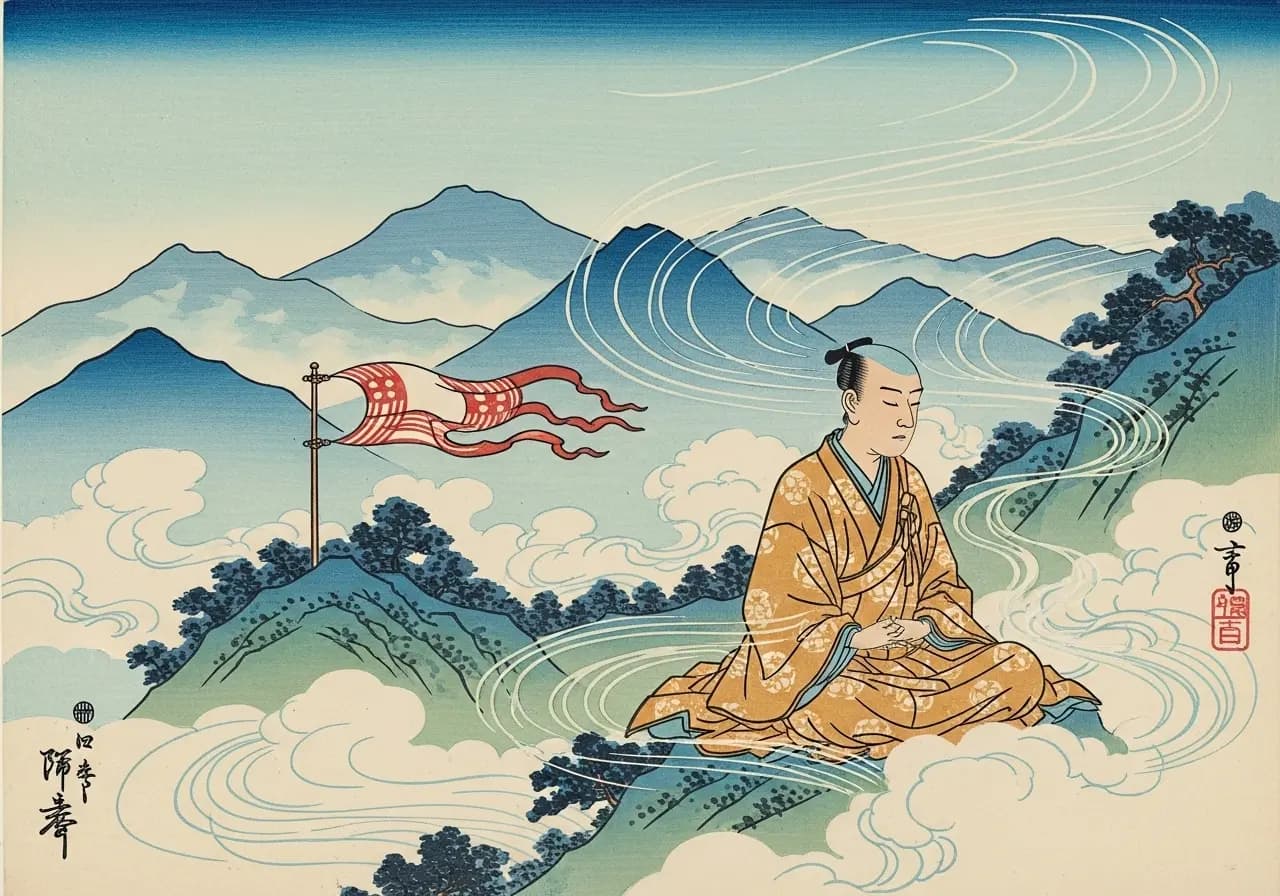
Two monks were arguing about the temple flag waving in the wind. One said, "The flag moves." The other said, "The wind moves." They argued back and forth but could not agree.
Hui-neng, the sixth patriarch, said: "Gentlemen, it is not the flag that moves. It is not the wind that moves. It is your mind that moves."
The two monks were struck with awe.
That's all I have for this podcast episode. Thank you for listening. Until next time.
For more about the Secular Buddhism podcast and Noah Rasheta's work, visit SecularBuddhism.com