

Dealing With People You Dislike
Episode 124 of the Secular Buddhism Podcast
Hello, and welcome to another episode of the Secular Buddhism Podcast. This is episode number 124. I'm your host, Noah Rasheta, and today I'm going to talk about dealing with people that you don't like. As always, keep in mind—you don't need to use what you learn from Buddhism to be a Buddhist. You can use it to learn to be a better whatever you already are.
The Origin of This Episode
This podcast episode comes from a request in an email I received. Someone asked if I'd be willing to do an episode discussing the idea of how we deal with people that we don't like. I thought that would be a good idea, especially during this time when the way social media works, we're all dealing with people that we don't like—or perhaps it's not people that we don't like, but ideas that we don't like. It seems to be a prevalent thing.
I'm trying to shift the concepts of the podcast toward something more practical: "How does all this apply in everyday, day-to-day scenarios?" So this is my approach to this specific topic. How do these concepts and ideas that we learn about in Buddhism apply to everyday scenarios like dealing with people that we don't like? I thought that would be a fun way to start off this episode.
Revisiting the Zen Koan
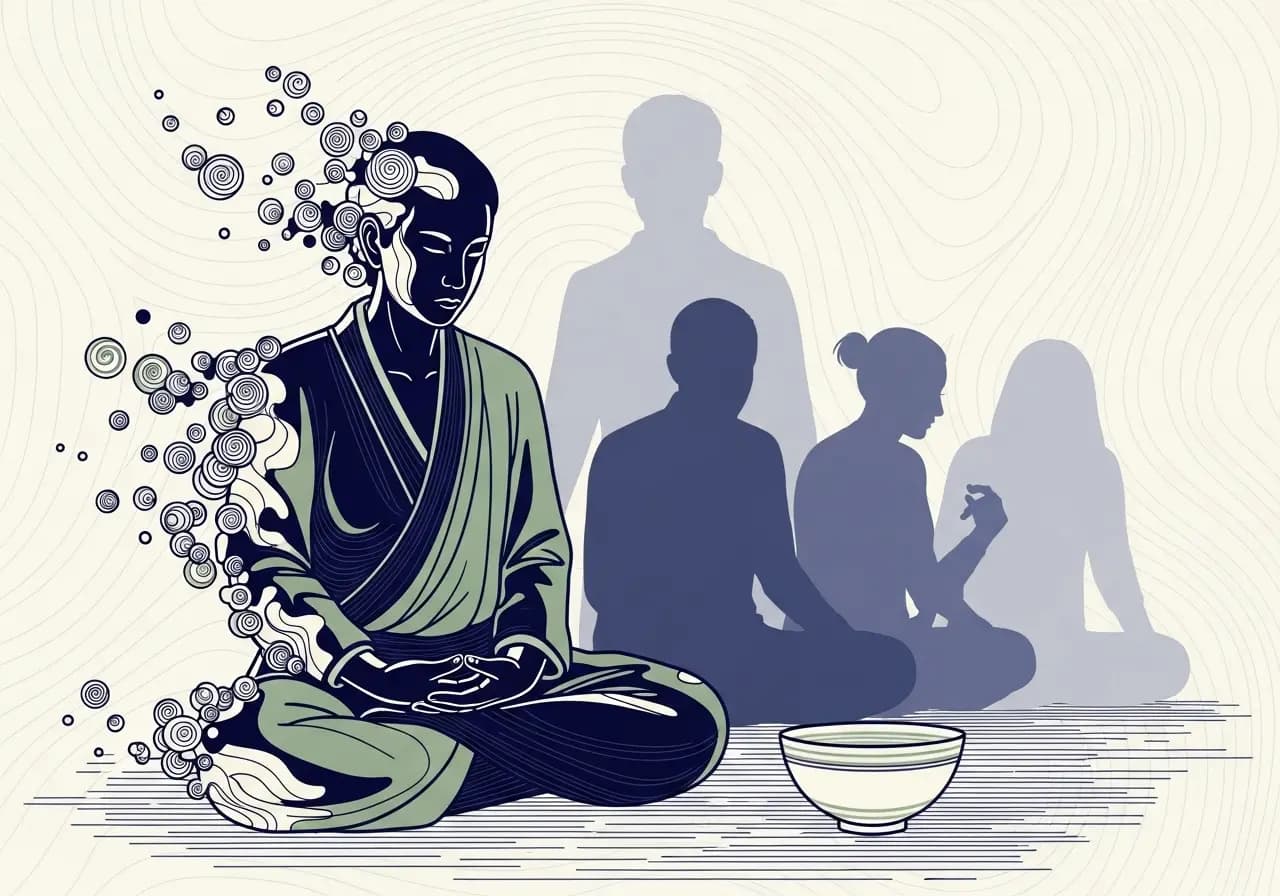
Before I dive into the main topic, I want to go back to the Zen koan that I left in the last podcast episode. A monk asked Zhao Zhou to teach him, and Zhao Zhou asked, "Have you eaten your meal?" The monk replied, "Yes, I have." Zhao Zhou said, "Then go wash your bowl." At that moment, the monk was enlightened.
This koan does a really good job of presenting the simple and profound way that Zen Buddhism tries to simplify the whole point of what we're practicing and what we're doing.
Reflections From the Community
I want to share a couple of thoughts from people in the Patreon community who discussed this koan. The first comes from Nancy, who said: "My understanding is that enlightenment only happens when we are fully aware in the present moment, no matter what we are doing—even washing a dish."
I like that thought. The idea is that enlightenment happens in the present moment, and no matter what we're doing—even washing a dish—that's where it's accessible. This definitely points to something true: it doesn't matter what you're doing. You could be walking the dog, stuck at a traffic light, or in the middle of an argument with someone you dislike. These are the moments where you could notice something you hadn't noticed before, and that moment of awareness can have a component of what you could call enlightenment. That's what this koan is trying to point at.
Michael shared another thought that I really appreciated. He said: "The bowl has served its purpose for the monk who used it for his lunch, but now the dirty bowl is of no use to the next hungry person that comes along. By washing the bowl after he has finished using it for his own purpose, he then gives someone else the opportunity to make use of the bowl to nourish themselves. The monk could contemplate that someone before him had washed the bowl, which allowed him to enjoy its use."
I like how Michael extrapolated the nature of interdependence from this. If the bowl was there for me to use it, someone must have cleaned it before me. And if I'm cleaning it now, this will allow another monk at some point to also enjoy its use. That's a beautiful line of thinking.
I want to remind you that with all of these koans, the purpose is to get us to look inward. It's what you get out of the koan that really matters, not about discovering the right answer. It's fun to see what other people extract from these koans.
David shared this perspective: "This koan reminds me of something that ancient Greek philosophers such as Epictetus used to say to those who wanted to learn from them. Rather than reading many books and learning quotes, the students should practice making good choices in their everyday lives. So when the monk asked Zhao Zhou about teaching him, he replied with the same kind of idea. Instead of reading more books or listening to Buddhist teachers about how to achieve enlightenment, go wash your bowl, as you should, and practice living mindfully."
I really enjoyed this interpretation because I highly agree with it. You can read and listen, and you can devour the theory behind living more mindfully or all of these topics and concepts in Buddhism. But nothing will substitute for the experiential understanding you'll gain when you're just out doing whatever it is you're doing. I can't overemphasize that—whatever you're doing, even washing a dish, gets to the heart of what this koan is talking about.
Brayden offered another thought: "For me, this koan makes me think of the way I go about enlightenment. I've delved wholeheartedly into enlightenment and forgotten about the world around me and the responsibilities I have outside the desire for enlightenment. The pursuit of that desire has gotten in the way of my other responsibilities, and I've neglected tasks and people in my life. This koan is a reminder to me to follow through with the things outside my journey, and that can help in setting up an environment that promotes enlightenment as I focus my whole attention on studying and learning."
I really agree with what Brayden is emphasizing. The koan is an invitation to remember to go back to washing the dishes rather than getting lost in the pursuit of enlightenment. And the irony of this koan—especially this one—is that the moment the monk hears this, he is enlightened. It says, "At that moment, the monk was enlightened." When he realizes he just has to go wash his bowl.
To me, that's incredibly profound. We can get caught up in this pursuit of becoming enlightened, thinking, "I'm going to go become enlightened, so I don't have time to wash the dishes. I've got to go sit on my meditation cushion and hit my one-hour or two-hour meditation goal for the day." And in the process of pursuing this conceptual idea of enlightenment, we're missing the whole point. It was in the washing of the dish that you could have found it. That's right at the heart of what Zen is constantly trying to do—push us back to the everyday nature of this stuff.
The Heart of the Koan
My thoughts on this koan: it's an invitation to go back to the simple, experiential nature of life. It's important to emphasize that enlightenment is a concept—an idea. We gain this idea from books, people, teachers, and all kinds of places. But once an idea gets planted in your head that there's this thing called enlightenment and here's how you go obtain it, we get caught up in that. What we're trying to get back to in many ways with this practice is the present moment and living a life that's a little bit more skillful and less reactive.
And since you just finished eating, perhaps the most skillful thing to do next is to wash the bowl. That's it. That's how simple it is. But to understand that and do it—because it's non-reactive, like "I am washing the bowl because I understand that it makes sense at this moment in time to now wash the bowl"—that's enlightenment. There's nothing big, great, and vast beyond that. That awareness that the skillful thing to do is wash the bowl—that's the magic of awareness.
Applying This to Dealing With People We Dislike
Now I want to apply this discussion to the topic I wanted to share today: the answer to the email asking, "How do we deal with people that we don't like?"
With the concept of dealing with people you don't like, just like with koans, what we're trying to learn is to look inward. Rather than thinking, "Okay, here's so-and-so. I don't like so-and-so. How do I deal with them?" let's look inward for a moment and ask, "What is this really pointing to? What is it that I dislike? Where does the disliking come from?"
Understanding What We Dislike
I've been practicing this a little bit with my kids. For example, my son Riko is a picky eater and has a lot of foods that he doesn't like. Anytime he says, "Oh, I don't like this or that," I try to remind him and say, "Wait, is it you that doesn't like it, or is it your taste buds that don't like the food?"
That simple question helps him understand it's not him that dislikes the food. It's how he is—his taste buds—that prevents him from liking the food, and he can't help that. All of us have this. Just think of something you don't like to eat and ask yourself that same question: "Is it you that doesn't like it or is it your taste buds?"
I did the 23andMe genetic test, which gives you not just your ancestry and genetic information, but also your health traits and genetic health reports. Something that stood out to me was that there's a variation on one of the genes you can have that determines whether you're likely to enjoy bitter tastes. They use it as a marker to determine if you like Brussels sprouts or not.
It's fascinating to think that it's just a matter of DNA that could determine if somebody likes Brussels sprouts versus someone who doesn't. This goes right back to the heart of what I'm discussing here. Is it really me that likes Brussels sprouts, or is it my genetic makeup that allows me to taste and enjoy that flavor when someone else will taste it and all they get is a bitter flavor they can't tolerate? So they think, "I don't like Brussels sprouts," while I'm thinking, "I do like Brussels sprouts." And it's neither one of us. It's the genetic marker in our DNA that allows us to experience the world and Brussels sprouts the way we're experiencing them.
I think that's a really profound understanding you can take not just into how you taste food, but into the very question of dealing with people that you don't like.
The Lifetime Koan
This alludes to one of the most profound koans I've encountered—what I would call a lifetime koan. These are koans you work with in an ongoing manner, day after day. These are the powerful words: "There is nothing I dislike." That's it. That's the koan.
When I first heard this koan, I thought, "Wow, there's nothing that I dislike. How on earth do you ever arrive at that?"
Now, take that sentiment and apply it to dealing with people you dislike. The implication is that if there's nothing I dislike, then there are also no people that I dislike. You might pause and think, "Okay, now that's just impossible. How on earth would you ever reach that?"
Well, it's quite simple if you apply the same line of thinking I mentioned with Riko: "Wait a second. Is it you that doesn't like the food, or is it your taste buds?"
When it comes to people, it's a little bit harder to take that step back, but we can do it and say, "Wait a second. Is it me that doesn't like so-and-so, or is it the ideas that I hold that clash with the ideas that they hold? And that friction is uncomfortable, and that discomfort makes it so that I don't want to be around that person?"
There you go. That's a more realistic picture. But that doesn't mean I dislike so-and-so. I barely know myself. How do I know everything there is to know about so-and-so to decide I dislike them?
So I think that allows us to take a step back and realize, "Okay, well, so-and-so might espouse certain views, beliefs, or ideas that are uncomfortable for me to be around because they clash with mine." But take another step back and think, "I am not my ideas. I am not my beliefs. I am not my views, and neither is so-and-so. So there's nothing—there's no fundamental, permanent, independent part of me that dislikes the permanent, independent part of so-and-so, because both of those are an illusion."
The Paradox of "I"
I'm not trying to minimize the unpleasantness we may deal with from people we really don't like to be around. You may not like being around someone because they say really mean things, or they take advantage of you, or maybe they're abusive. I'm not trying to minimize that in any way. All I'm trying to emphasize here is the nature of interdependence and the nature of impermanence applied directly to the concept of not liking things.
With this specific koan—"There is nothing I dislike"—for me, the secret of understanding that entire phrase is the word "I." He says, "There is nothing I dislike." Because there is no "I" the way I think I exist, right? There's an interdependent and impermanent part of me, but that implies that there may be a version of me that does like so-and-so.
Maybe if I'm in a good mood, or I just got an offer for a new position at work, or I just ate a good meal so I'm not hungry, or I was raised in conditions where I don't have to worry about certain circumstances or factors in my life—just change the variables a bit, and suddenly I would like this person. That's a really profound understanding that helps me recognize it's not me that dislikes anyone. It's not me that dislikes anything.
To me, that's a really profound koan to work with, and like I said, you work with this every day. Every day you can analyze the things that you don't like and then ask, "Well, is it really me that doesn't like it?" Break that down, get into the causes and conditions, and see the interdependent, impermanent nature of things. Suddenly the way you view that changes, and what changes is the relationship you have with the feelings you're experiencing while you're going through whatever circumstances you're in.
The Long Answer to the Short Question
So that would be a kind of roundabout way—long story short—to answer the email I received that says, "How do we deal with people that we don't like?"
Sure, on the surface I could give tips like, "One obvious thing is to try not to be around people that you don't like." But it's not that simple, right? The people you don't like might be people in your family. It might be your in-laws, cousins, your crazy aunt or uncle. It can get muddy to the point where you can't just avoid these people. You can't ignore them and not have them be a part of your life. It may be your neighbor, and you can't just move away. It may not be so simple.
So in these complex situations where you're dealing with people you dislike, my invitation is always to stop looking at the people and start looking inward at you. "What is it I dislike about this person?" What you'll learn about yourself in that process is what really matters. You can gain a lot of insight and wisdom about yourself. Remember, the whole thing we're trying to accomplish here is to step away from the more reactive life—where you just go from one chain of reactivity to another—and break that chain. Live a more skillful life where you are more deliberate and skillful with each action.
So the moment I encounter someone I dislike, that's an invitation to me to go inward. To ask, "Huh, why do I dislike this person? What part of me dislikes the part of them? Where exactly does that happen? Is it that I dislike their look? Is it that I dislike their words? Is it that I dislike their ideas, their views, their beliefs? What is it that I dislike?"
And I go inward and try to understand that about me. When I can identify what the thing is, then I have to identify exactly, "What part of me doesn't like that? Is it my thoughts? Is it my ideas? Is it my beliefs?" Then I do the same thing inward that I was doing to pinpoint what I dislike about them.
That deconstruction—that separation into layers, into causes and conditions—essentially what I'm doing is trying to look through the lens of impermanence and interdependence. That changes the dynamic, and then suddenly I realize, "Okay, I realize I don't dislike this person. Sure, my views don't match their views, but that's different. I can still like them in spite of their views, and in spite of my views. Where on earth did I get my views anyway?" I got them from the same place they probably got theirs—all these causes and conditions that I almost can't help. I can't help that I read a book that made me think this way, or I was raised in a household that made me think that way, and I'm the result at this specific moment in time of all these past causes and conditions that make me the way I am. But so is that person I dislike. So at what point in that chain do I say, "Oh, that's what I dislike," right?
The Parable of the Stick
This is like that story of the stick—it's a koan as well. A father is pointing out to his son, "What is it that you dislike?" as he's poking him with a stick. The son gets mad and asks, "Are you mad at the stick, or are you mad at my hand, or are you mad at my arm? Are you mad at my mind for this idea, or mad at my dad who taught me this lesson?" Right? It's like, at what point do you say, "Oh, that's the thing I'm mad at?"
When we're dealing with people we dislike, you can do the same thing. Do you really dislike them, or do you dislike their parents who raised them that way? Or the society or neighborhood they grew up in that made them think this way? Or is it that you dislike their religion that taught them to think what they think? At what point do you say, "That's the thing I dislike?" And you might say, "I dislike all of it," but that's still helpful. It's more nuanced than just pinning it on this one person.
Because who is the person to be disliked and who is the person that does the disliking? Neither one of those are really there the way we think they're there.
Looking for What You're Not Seeing
That's how I tackle this concept of dealing with people I don't like. I invoke the wise words of Linji, who said, "There is nothing I dislike." And I take that to heart in my own life. I really do. I try to remind myself that in a very real way, there is nothing I dislike. There isn't.
Another way to encounter this is to ask, "What am I not seeing?" When we talk about the concept of awareness—the magic of awareness, so to speak—for me, that's an invitation to say, "There's something here that I'm not seeing."
And if I dislike someone, that could very well be that there's something in them I'm just not seeing. It doesn't require any change on their part. What it requires is more attention or more focus on my part to ask, "What am I not seeing?" Sometimes that mental exploration allows me to start changing the feeling or the attitude I have toward another person, because I start to see something in them that I didn't see before.
And that's work that's done on my part. That's not work that needs to be done on their part. I think sometimes we get mixed up there. We're thinking, "Well, I will like them more when they stop doing this or when they start doing that," and we put it on them to change.
The truth is, it's on me. If I want to like someone, all I have to do is look harder. The more I understand someone, the more natural it is to like that person. And this isn't forced. I'm not saying all this because you should like everyone. You don't have to like anybody.
The Choice to Change
If you're uncomfortable with how you're dealing with people you dislike, then yes, listen to all of this. But if you don't care and you're fine with disliking people, then fine. Keep disliking people. This is like the hamster in the wheel that's just running. If you're that hamster running in the wheel and you're comfortable with that, fine. But when that hamster gets tired and asks, "Why am I in here running, spinning on this wheel?" Well, maybe let's look into that. Maybe it's wise now, at this point in your life, to hop off the wheel.
That's what I want to emphasize in this lesson. I'm not saying these things with the idea that "Hey, you need to go out there and start working to like the people you dislike." I'm not saying that. You don't have to do that. But if it's bothering you enough that you're saying, "I don't like how I deal with the people that I dislike," well then sure. Listen to all of this, and maybe spend the time to look inward and see what you can learn about yourself. Ask yourself exactly: what part of you is it that dislikes, and what part of them is it that you actually dislike?
It's the same way that with Riko—when you ask, "Is it your taste buds that dislike the food?"—because that's very different than saying, "I dislike the food." I think that's a skillful way to start: with introspective questioning of, "How do I deal with someone that I don't like?"
The Daily Practice
So that's it. That's my invitation. Rather than sharing a new koan at the end, I'd like to leave you with the koan that Linji said: "There is nothing I dislike."
I'd like to leave that with you as an exercise between now and the next podcast episode—and beyond that, really. Make this a daily one. One of those daily koans where every now and then you remind yourself, "There is nothing I dislike," and analyze: how does it feel to even say that? "Are there things I dislike?" Yeah, yeah, there are. "Okay, well what are those things? And what part of you dislikes them?"
Really work with it through the lens of interdependence and impermanence. What you should start to see, if you really look through those two lenses—especially in the context of what that implies about you—is something shift. Revisit this question: "There is nothing I dislike." And when that rings true to you, it's going to be a really powerful experience to understand that, just as Linji said, "There is, indeed, nothing I dislike."
That's what I want to leave with you. That's all I have for this podcast episode today. As always, thank you for listening.
If you want to support the work I'm doing with the podcast, consider becoming a Patron and joining our online community where we discuss these koans and the podcast episodes. I'm getting ready to add a lot more weekly content there—taking these concepts into everyday life and situations. You can learn more about that by visiting SecularBuddhism.com.
If you've enjoyed this podcast episode, please share it with others, write a review, and give it a rating on your podcast platform. That's all I have for now, but I look forward to recording another podcast episode soon. Thank you for taking the time to listen, and until next time.
For more about the Secular Buddhism Podcast and Noah Rasheta's work, visit SecularBuddhism.com