

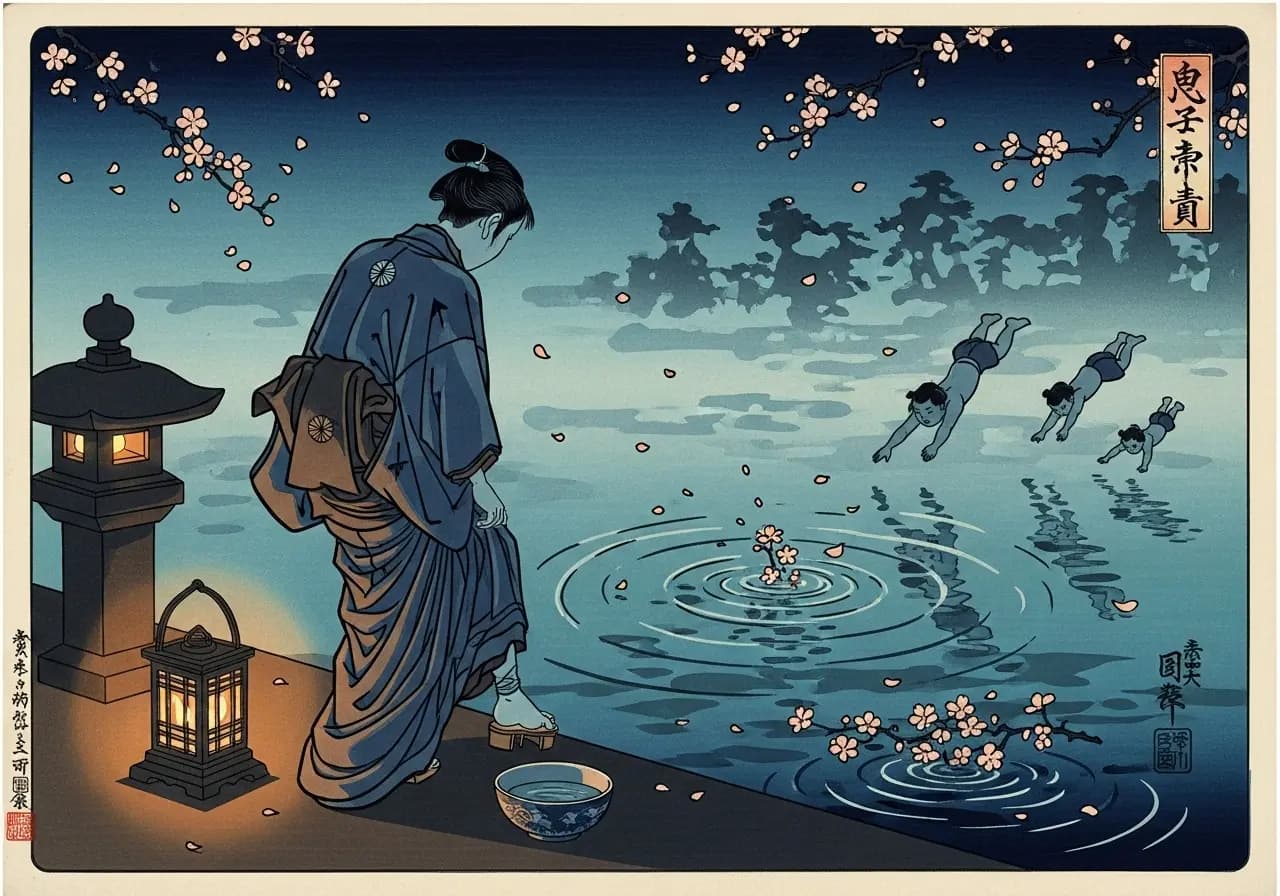
The Art of Diving In
Episode 123 of the Secular Buddhism Podcast
Hello and welcome to another episode of the Secular Buddhism podcast. This is episode number 123. I'm your host, Noah Rasheta, and today I'm going to talk about the art of diving in.
Keep in mind, you don't need to use what you learn from Buddhism to be a Buddhist. You can use it to learn to be a better whatever you already are.
Announcements
I have a couple of announcements before I jump into the podcast topic for the day.
First, I have a new microphone, and I'm really excited about it because the audio quality should be significantly better than it has been in the past. This will also allow me to record faster because previously I would have to spend a lot of time after recording to clean up the audio and get rid of the echo and other issues. I'm hoping this will save me time and make it easier to record podcast episodes more frequently. So if you have any feedback or comments about the audio, let me know.
The second announcement is about the mindful trekking expedition to Nepal. As some of you know, I did this last year with a group of 20 individuals. We met up in Kathmandu and then did a 12-day trekking mindfulness retreat. It was a really fun, cool experience, and I'm doing that again.
This will take place November 6th through the 20th, and information can be found on mindfultrekking.com. If this is something you're interested in doing, take a look at that website where you can see the details, dates, costs, and the full itinerary. I know this isn't for everyone, but if you're in a position and place in life where you can afford the time and costs to do something like this, it really is a fun, unique experience. I would recommend checking it out because last time the available spaces filled up pretty quickly. This will likely be the only time I mention it on the podcast, so check out mindfultrekking.com if you're interested in learning more.
The Kōan: The Blind Man and the Lantern
Now let's jump into the Zen kōan that I shared from the last podcast episode:
In early times in Japan, bamboo and paper lanterns were used with candles inside. A blind man visiting a friend one night was offered a lantern to carry home with him. "I do not need a lantern," he said, "darkness or light is all the same to me." "I know you do not need a lantern to find your way," his friend replied, "But if you don't have one, someone else may run into you. So you must take it." The blind man started off with the lantern and before he had walked very far, someone ran squarely into him. "Look out where you are going," he exclaimed to the stranger. "Can't you see this lantern?" "Your candle has burned out, brother," replied the stranger.
This is an interesting one. I want to share a couple of comments from the Patreon group. A couple of individuals had some comments regarding this specific kōan, and I thought it would be fun to share these.
Shane's Interpretation
Shane said: "The blind man reminds me of times in my life when I thought I had finally figured things out. He didn't need the lantern because he had life figured out. He reluctantly takes on this additional tool, the lantern, and sets out on his way thinking all his bases are covered. Sometimes we can learn things and take on a self-righteous attitude. I wonder if this was his view? He eventually learns that he did not know all he thought he knew. 'Your candle has burned out, brother' really resonated with me. Thinking we know it all and have control is really exhausting. Maybe the reason the blind man was so grumpy with the one who ran into him was because he was burned out."
I like the thoughts Shane extracted from that. Let me share some thoughts from another group member.
Emery's Interpretation
Emery said: "When I heard the kōan, the first thing I asked myself was why the stranger ran into the blind man. Was it because the lamp was not lit anymore, or was it maybe because the blind man was not as careful as he normally was when he did not have a lamp? If so, was the underlying reason actually that someone else had convinced the blind man to do things differently than he normally would?
Maybe this kōan is about the concept of dependent origination. The incident reminds the blind man that whatever he does has consequences. Things might not always turn out the way we want them or expect them to, but at the end of the day, we have to realize that things arise interdependently based on an never-ending chain of causes."
I enjoy the thoughts shared by both Shane and Emery. I want to remind you as you listen to explanations—anybody's explanations—that the invitation of the kōan is to learn to understand a little bit more about yourself. When I listen to a kōan, I'm thinking: What can I learn about myself? What does my interpretation of the kōan tell me about me?
So keep that in mind. We're not trying to listen to other people's explanations with the intent of analyzing whether they're right or wrong. That's not the point. We can extract useful perspectives when someone else tells us their interpretation. It's like, "That's interesting. I didn't think about that." But don't approach it from the perspective of, "I think you're right, or your answer is more correct than mine." That's not the right way to approach these, in my opinion.
My Interpretation of the Kōan
So in the spirit of that, to me, what this kōan is about is the concept that we're damned if we do and damned if we don't. To me, this is just how life works.
Here's the thing: the blind man takes the lantern because it's going to help so others can see him and maybe not run into him. But he does take it, and then something else can go wrong. The lantern can go out and someone still runs into him. Or it could have been that he was holding a lantern and the other person was also holding a lantern and they were both blind. There are so many ways this could have unfolded.
To me, it's a reminder that no matter what you do, things can happen.
I can check the tire pressure of my cars before every trip I take. I can do everything I think I need to do to prevent certain things from happening, and those things can still happen. That's what the kōan is trying to teach. It reminds me of the parable of the horse and the whole idea of "who knows what is good and what is bad?" It equally reminds me of the analogy that life is a lot like a Tetris game—we never know what shape is going to show up next.
At the end of the day, we do our best to anticipate what we think is best, and then we do it, and we're like the blind man who still ends up with someone running into us. That's just the nature of life. There's no way to avoid the inevitable bumps that life has in store for us.
This kōan is a reminder that I can do everything in my power to avoid those bumps, and the bumps may still happen. I know that I can work very hard every day of my life and still end up in a position where I'm struggling financially. Or I can follow all the advice from the best relationship books, and I could still end up in a situation where my relationship is struggling. Or I can read all the proper parenting books with all the best parenting advice and still end up really struggling in my parenting.
And that's the thing: we can cross all the T's and dot all the I's, and still be surprised by the outcome.
To me, this is the absurdity of the human condition. It's both painfully heartbreaking and, at the same time, an incredible experience. And at the same time, it's very laughable. It's all of that.
It's like we're trying to avoid getting wet in the rain. But once we do, we're like, "Okay, well now that I'm wet, now I can dance in the rain." To me, that's what this kōan is an invitation to look at—that damned-if-I-do, damned-if-I-don't reality.
So the question is: Am I going to take that lantern and light it? Yeah, I guess I will, knowing that it might prevent someone from running into me, but it doesn't mean it's going to guarantee that no one runs into me.
The Story Versus Reality
I think life works one way, and the idea I have about how life should work is another way. As long as I remember that, when I have that thought of "well, I think this is how it should be," I don't have to be so attached to it. Because I can remember: well, that's just my idea. It doesn't mean that it's correct, and I cannot see the big picture. Because like the blind person, we're all blind to the big picture. We don't know what shape is going to show up next.
So we try our best with the understanding that it's still damned if we do, damned if we don't, but I'm still going to try. That's how I see it.
I think we can start to really live life more fully when we understand this—that we're damned if we do, damned if we don't. Because once we're more comfortable with the discomforts that are inevitable in life, I think we can start to dance in the rain rather than just working so hard to avoid getting wet. We can feel that, okay, life is painful, but pain isn't bad. It's just unpleasant.
And we get a little bit more unattached to that idea that I have to avoid pain at all costs.
The Art of Diving In
So that's what the kōan means to me, and I think it fits pretty well with the topic I wanted to discuss today, which is the art of diving in.
This occurred to me last week when my four-year-old daughter was learning to dive. We have a swimming pool, and where we live in Mexico, we have year-round swimming. It's nice and warm. So she's out there swimming, and she sees the bigger kids diving in. She wants to learn to dive.
She says, "Daddy, teach me how to dive."
And I was like, "Well, you just kind of dive in. Your arms go up, you put them together, you point forward, and you just jump in." I helped her do it a couple of times, and she was ready to just go for it.
The moment she did it, she jumped and did the classic belly flop that someone does when they don't know how to dive. All the kids laughed and made that classic "ooh" sound. But it didn't hurt her. She got out and said, "Did I do it? Did I do it?"
I said, "Well, you kind of did it. You did a belly flop."
She got up and did it again. And again. Then the other kids started jumping in to do intentional belly flops because suddenly the belly flops were cool, and everyone thought that was funny.
This had me thinking that this is kind of like life, right? The art of diving in. With my daughter wanting to learn to dive, it can be a painful process. But if you want to learn to do it, there's no other way than to just dive in—to just start doing it.
When you start doing it, you start realizing: that hurt. Let me change this up a bit. That hurt less. Let me try again. And eventually, suddenly you've got it.
And this has me thinking: aren't all things like this?
How We Approach Life
I think we go through life kind of like kids standing at the edge of the pool, thinking: I kind of want to learn to do that, but I'm not going to do it until I know that I can do it. Then I'll do it.
I think there's a disconnect in that way of thinking. We have how things are, and then the story we have of how we think things should be. And it fits into this perfectly.
I think we do this with a lot of things. I see this often with marriages and relationships in general. It's like: I want to dive in, but I just want to end up with someone when it's the right relationship, and it will always be nice and peachy—no fights, no unpleasant experiences. We're just going to love each other, and that's it.
But nobody wants to just dive in to a relationship and encounter all the messy, uncomfortable parts of a relationship—the learning to live with another human being who doesn't think the same way you do, who may not believe the same things you believe. We don't want that. We just want it to be pleasant.
The Analogy of the Cold Pool
In the same way, I've done this at my own pool. The kids are like, "Let's go swim," and I'm like, "Well, let me feel the water first." I feel the water, and I'm like, "It's a little too cold. I don't want to jump in unless it's going to be nice and pleasant."
But they just jump in. And I thought: Do you seriously not feel the cold?
Then I realized it's not that they don't feel the cold. They do. They'll even say, "It's cold," and then they'll just swim around until they warm up. But the point is: what they wanted was to jump in, and what I wanted was to have a pleasant swim. So the jumping in was not something I was looking forward to. My end goal was pleasant temperature water, while their end goal was to jump into the water.
And that's had me thinking: How often do we do this in life with so many other things?
The art of diving in is learning to recognize what Buddhism teaches—that the path itself is the goal. People want to learn to meditate, for example, because their end goal is they want more peace in life. It's like, "Well, I'm not going to sit and meditate unless I know that I can get a more peaceful life out of all of this."
This is trying to flip that on its head and say: No. A guarantee of a more peaceful life? You may not get that. But what you will get out of this is you'll learn to sit and meditate.
So if we change the mentality and think, "Well, what I want is to learn to sit and meditate," then that's going to be pleasant regardless of what happens after. In the same way, if my goal is to jump into the pool, well, now the jumping in is the fun part. Whether it's hot or cold, once I hit the water, that's secondary.
Diving Into Life Itself
I love thinking about this in terms of life in general. Here we are, alive. You just came into existence out of no fault of your own, right? You just are, and I'm here experiencing life.
But sometimes I have that attitude of: well, there's life, but this isn't the life I want. I want the water to be more pleasant. I want it to be warm. So while I'm here existing, it's an unpleasant existence because it's not the existence I want.
This is trying to flip that mentality and say: well, if I understand that the point is that there is no point, or I can make whatever point I want, then the existing alone is enough.
It's like: here I am. And this is that mindset I've talked about before that turns us into thinking, "I get to experience this. I get to experience this unpleasant moment." Or when I'm angry, "I get to experience anger." Or if I got so angry that I threw something, "I get to experience anger to the point where I lost control."
Little by little, you start developing a greater understanding of yourself and what makes you do things, say certain things, and act certain ways. And the point of all of it is the experience, the observation of the experience.
And this is where the irony comes in. The outcome is a kind of mellowing out, because you become more comfortable with the discomfort, and suddenly the experience of having the experience—that is the treasure.
It's All the Same Teaching
There are so many ways to talk about all of these concepts, and I feel sometimes like that's what I do. I just talk about similar things over and over. But I think that's important because sometimes we have to hear it this way, and then that way, and then this other way. And then it's like, "Okay, I think I'm understanding it."
That's what I've noticed for myself in my life as I go through experiencing all of it. It's like: the point of the experience is all of it. I'm experiencing all of it. I'm no longer chasing after only the pleasant moments. I'm no longer running away from the unpleasant moments, because we still have them all.
I'm surprised sometimes when people talk to me and ask: "So do you only experience pleasant things now that you practice mindfulness so much? Or that you've had X amount of years meditating?"
I always say: No. My favorite part of practicing mindfulness is the ability it's given me to just jump in and enjoy the fact of being alive. No specific goals or outcomes. It's just taking it all in and enjoying the experience, even the unpleasant ones.
And the truth is, there are a lot of unpleasant ones.
Real-Life Messiness
Going back to my daughter for a moment—she's gone through this phase of unlearning her potty training. I don't know what it is, but it's a frustrating experience. When I'm alone with her and having to deal with the fact that she's pooped her pants again, and I'm scrubbing that out, that is not a pleasant experience. It's not an experience where you sit there and say, "This is so Zen-like." It's not like that.
But here's the catch, and this is what I was explaining to my wife. We were talking about this. I said: "The difference is, if she loses her temper and says, 'I can't believe here I am scrubbing poop out of these pants again,' she's really mad at herself. And then afterwards, she's really mad at herself for having gotten so mad."
"For me," I said, "if I'm encountering that unpleasant moment and I'm like, 'Seriously, G.G? Again? Come on. What is it going to take?'—I say whatever I said, and I'm scrubbing the poop out because that's not fun. In that moment, it's highly unpleasant, and I'm feeling strong, unpleasant emotions."
"As soon as that's over, it's over. I can literally in five seconds be done with it and look back and have compassion for the me of five seconds ago, because that me was having to scrub poop. Of course, that me was angry. This me is not. This me five seconds later is happy again, thinking: I got to scrub poop."
It might be harder to say "I get to" in the moment, but I can say I got to. And that's the difference. It's allowing yourself to feel the emotions as they unfold and recognizing: this is all part of the package. Nobody said that existence is a pleasant thing, but existence is a unique thing.
I can hold space in that moment to recognize: this is not fun. And at the same time recognize: but it's more fun than not existing. At least I'm here.
The Uniqueness of Every Moment
Because being here and having the ability to experience things as they unfold—to me—it's very unique. I've talked about this from past episodes: what makes that moment magical is the recognition that that moment is unique in space and in time, no matter how unpleasant it is.
Even if it means I'm standing at the sink scrubbing out poop, and I'm not enjoying it, that's still a unique moment. Granted, it's much easier to recognize that as soon as you're done with that process. In the moment, it can still be hard.
But that's the difference. You can be in that moment and then let it ring for a long time after, making many more unpleasant moments after the pleasant one you were in. Or you can just experience the pleasant moment or the unpleasant moment while it's unpleasant, and then be done with it, and still have a sense of—I don't know what the word is. I don't know how to describe it very well.
It's like a sense of satisfaction for having experienced something so unpleasant. I don't know if that's the right way to word it, but I hope you understand what I'm trying to get at. The art of diving in, to me, is that you're jumping into life with all of it.
Sometimes you jump in the water and that means now you're dealing with cold water that you weren't really expecting. Diving in could mean: You know what, I'm going to jump into this relationship, and I don't know what it will be. It may be filled with many days of unpleasant fighting with my partner, but that's part of the relationship. Or parenting. I'm going to jump into this and recognize that there will be days when you're standing at the sink scrubbing poop out of pants. That's part of the parenting experience.
And with everything. I want this new job. Well, there are days I'm going to wake up and wish it wasn't Monday so I wouldn't have to go to work. That's fine.
Knowing When to Make a Change
Now, if it's unpleasant long enough and there's something you can do about it, then I hope you'll be skillful enough to recognize: maybe it's time to do something different.
Because this is something else that gets brought up a lot. This idea that: well, if I practice mindfulness too long, am I just going to become content and no longer have the desire to change things? Am I just going to put up with whatever life is throwing at me?
And I would argue adamantly that the answer is no. You're not putting up with anything. The more you practice this, the more skillful you become at recognizing: what am I putting up with, and what am I skillfully handling? Those are not the same things.
And we shouldn't ever just be putting up with something. In fact, if you are, I would invite you to pause and really start thinking and considering: what am I putting up with in life? Because I don't need to be putting up with anything. I can actually dive in and experience life to the fullest.
Because experiencing life to the fullest entails both the pleasant and the unpleasant. If you've just been putting up with something—a relationship, a job, whatever it is—you're not diving in. You're allowing yourself to stay in a stagnant, uncomfortable situation, perhaps because you fear a more uncomfortable scenario that could be even worse than this one.
So the art of diving in is saying: this is where I am, this is what I'm experiencing. How can I really pay attention and observe it and be with whatever it is I'm experiencing? And then, of course, the most important part of all of it is: how do I skillfully act with whatever comes next?
Because that's something you have to keep in the back of your mind with all of this—nothing is stagnant. Everything is changing. The moment I think, "Okay, well this is what it is, I can get used to that," it all changes. I'm dealing with the new Tetris piece that showed up.
Gratitude for the Present
So keep that in mind with the art of diving in. For me, again, I feel grateful that I have encountered these concepts at an age and stage of life where there's so much diving in to do. I can only imagine looking back at some stages thinking, "I wish I would have appreciated that stage more, because during that stage, I just thought it was hell."
But I'm not feeling that. I might feel it for a fraction of a second during the moment when I'm scrubbing poop for the nth time. Right? But I get to look back on it rather quickly and say: one day I won't get to do that. I'll be dealing with something else.
And again, I'm not trying to emphasize that what we need to do is put ourselves where we can appreciate everything and say, "This was pleasant." That's not at all what I'm saying. What I'm saying is the opposite.
This will not always be pleasant, and that's okay. Because there's never been a problem with things that are unpleasant. The problem has been that we've been thinking we're supposed to arrive at a place where things finally become pleasant. That's the problem. And the truth is, they're not.
Sometimes life is pleasant. Sometimes life is not pleasant. Sometimes jumping into the pool is pleasant because the water's nice. Sometimes jumping into the pool is not pleasant because the water is too cold or too hot or too murky or too whatever.
But the art of diving in is about diving in, not about what the pool is like. At least that's what my kids have taught me in the last few weeks. They just want to jump in. They just want to learn to dive.
And I'm trying to extract from their experiences something I can relate to in my own life, as far as mindfulness practice and what Buddhism teaches me.
Closing
So that's the topic I had for today. That's what I wanted to share with you. Again, I hope that makes sense.
I know all of you who listen to this are going through different things and different experiences. You're in different circumstances, different ages, different cultural norms—we're all in different places. And that's what's important: to recognize that all of this is relevant to anyone in whatever situation you're going through.
That's all I have for this podcast episode today. As always, thank you for listening. If you want to support the work I'm doing with the podcast, consider becoming a Patreon member and joining our online community, where we discuss these podcast episodes and other things. You can learn more about that by visiting secularbuddhism.com.
If you enjoyed this podcast episode, feel free to share it with others, write a review, or give it a rating on iTunes. And that's all I have for now. I look forward to recording another podcast episode soon.
But before I go, I'm going to leave you with another Zen kōan to work with for this week.
The Kōan: The Enlightened Meal
A monk asked Zhao Zhou to teach him. Zhao Zhou asked, "Have you eaten your meal?" The monk replied, "Yes, I have." "Then go wash your bowl," said Zhao Zhou. At that moment, the monk was enlightened.
That's all I have for this podcast episode. Until next time.
For more about the Secular Buddhism podcast and Noah Rasheta's work, visit SecularBuddhism.com