

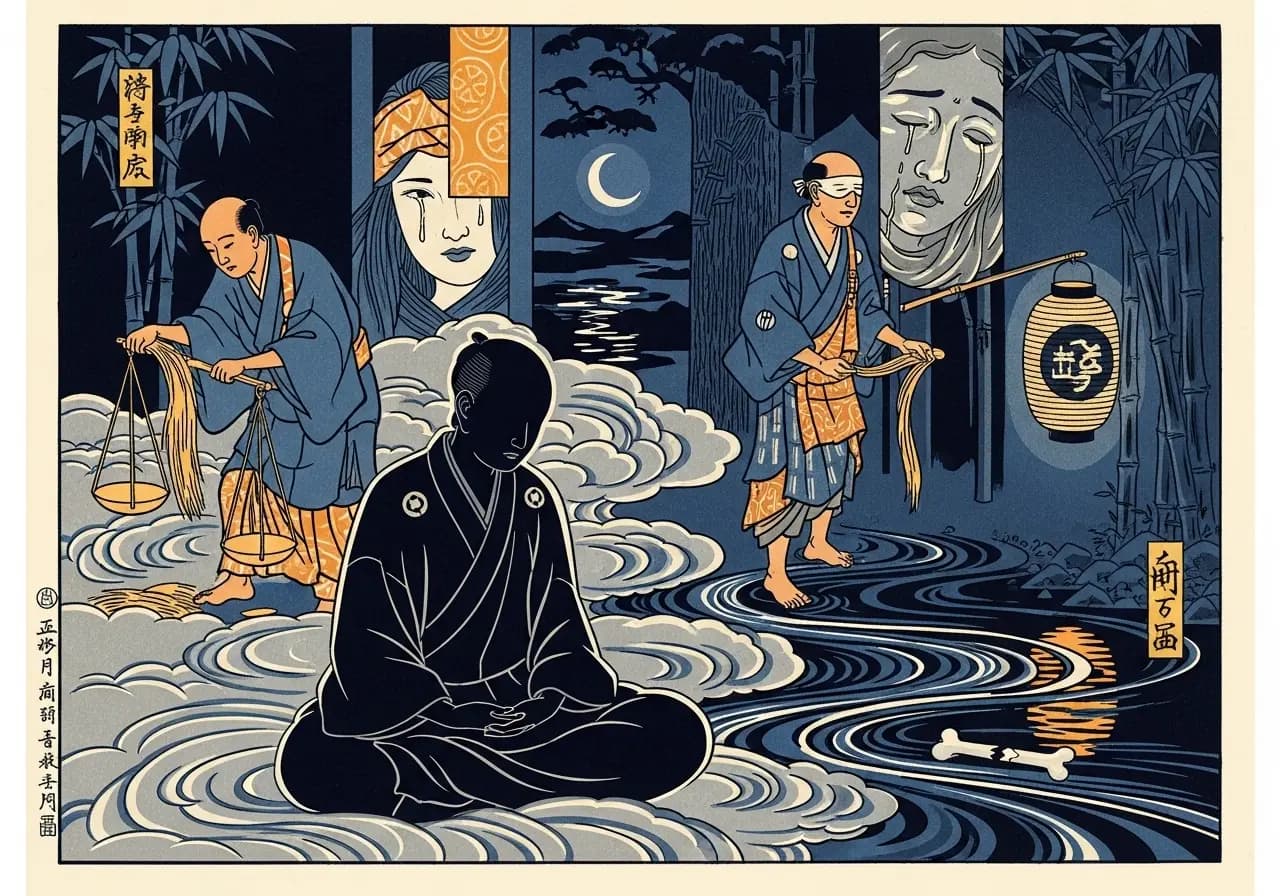
The Problem with Suffering
Episode 122 of the Secular Buddhism Podcast
Hello and welcome to another episode of the Secular Buddhism Podcast. This is episode number 122. I'm your host, Noah Rasheta, and today I'm going to talk about the problem with suffering.
Keep in mind: you don't need to use what you learn from Buddhism to be a Buddhist. You can use this to learn to be a better whatever you already are. So let's get started.
The Gateless Gate Koan
I want to start with a discussion around the koan that I shared in the last podcast episode. This is where a monk asked Tozan when he was weighing some flax, "What is Buddha?" Tozan said, "This flax weighs three pounds."
Now, this is a koan that I really enjoy because, as I've mentioned before, the whole point of these koans seems to be—at least for me—that they're trying to get us out of conceptual thinking and back into the experiential, into the present moment. And that's exactly what this koan does.
You're in the middle of weighing some flax, and someone says, "What is Buddha?" That's a concept. It's an idea. But you know what's real? This flax weighs three pounds. That's exactly what the monk was teaching in this koan, and I think it's a really fun, simple, and profound lesson. The questions that we ask sometimes—sometimes the question itself is the problem.
There's another koan that goes: What is the color of wind? To me, it's like, well, you could wrestle with that question all day long, but if you fail to understand that the problem with that question is the question itself, if you fail to recognize that it's an absurd question—then you're missing the point. We do this all the time. We have questions, and they entertain the thoughts in our minds and distract us from the experiential. But this koan is an invitation to bring us back to reality. In this specific case, reality is that this flax weighs three pounds.
I like this because it reminds me to stay mindful of the questions I'm entertaining.
The Focus on Questions
I think I've mentioned this in a previous podcast episode, but one of the things that really drew my attention to Buddhism in the first place was the focus on questions rather than the focus on answers. I feel like a lot of ideologies focus so much on giving you the answers—answers to big existential questions like: What happens when we die? Why are we here? Where did we come from?
You're not going to find those answers in a tradition like Buddhism. Buddhism is much more focused on the question itself. In fact, it would prioritize the question. If you were to ask, "Well, what happens when I die?" they would say it's more important to know: Why am I asking that question? Why does that question matter so much to me? That to me is a really fascinating way of thinking—where you prioritize the question rather than focus on giving the right answer.
I think a lot of times these koans are trying to do exactly that. Here you have a direct question: What is Buddha? And the answer that's given has nothing to do with the question because it's reminding you that the question was misguided in the first place. In real life, in that moment, one thing that's true—or at least that mattered in that moment—is that the flax weighs three pounds. I love that shift.
In my own life, I often find myself in the position of the monk that's asking questions like: What is Buddha? What is enlightenment? What is suffering? Can we eliminate suffering? These are big questions. I'm not trying to say we should dismiss all questions. I love the idea of thinking deeply, and I'm glad that people have questions because those big questions lead to ideologies, philosophies, religions, and they give us something to work with and something to think about.
I'm not trying to minimize or dismiss questions. I'm trying to emphasize that in this particular case, these koans are helping us understand the importance of the experiential and the present moment versus the conceptual that's taking place somewhere that's not here and now. When you're asked, "What is Buddha?" versus the simple truth that "the flax weighs three pounds"—there's a real difference.
The koan tells us that the monk asked Tozan when he was weighing some flax. So here Tozan is doing something, and he's been interrupted with a question that has nothing to do with what he's doing. He's saying the answer, this flax weighs three pounds, because that's more important. And I just love that way of thinking.
The Real Problem: Our Words
This leads into the topic I wanted to discuss in today's podcast episode: the problem with suffering.
It all started with a question someone was asking me: "Would an unenlightened person still suffer or mourn over the loss of a loved one? Or over the pain of a broken bone?"
In a way, it made me think of that koan because I'd been thinking about it all week when that question came in. And I almost thought, well, there's no appropriate answer to the question because to me, that question is flawed. It's not the right question. The real question would pertain to whatever it is we're actually doing in that moment.
I started thinking about it later and realized something: the problem might not be with suffering itself. The problem might be with the word "suffering."
In Buddhism, we're always talking about suffering. We discuss it in the context of three different types: the suffering of suffering (which is essentially pain, like a broken bone), the suffering of loss (when we lose a loved one or a job, or feel nostalgic for the past), and all-pervasive suffering.
But what if what we really have is just an error in word choice? What if the problem with suffering is the word itself?
The Translation Problem
Here's the thing: in the original teachings, what's being talked about as suffering doesn't necessarily mean suffering. The actual word is dukkha. But you can't take an idea from one language and explain it in another language without translating the word. So right there, from the very start, you have your first problem: which word do we choose?
Unfortunately, the word that's been most commonly used is "suffering." And that's created a lot of confusion.
The problem with concepts, ideas, and words is that they're all just stories. They're inherited from our society, our culture, our religion, our families. And especially words—the words themselves carry meaning. Suffering is a word, and we've inherited that meaning. Somebody at some point described what suffering is to you. But imagine: how would someone describe suffering to you without using any words? How would you convey that to another person to help them understand what it is to suffer?
We really can't do that. You could feel it and then recognize, "Oh, this is that feeling they're talking about." But we're stuck with the meaning that society has given us for what that word means. That's the problem we run into with every word—whether it's "enlightenment" or "suffering."
A Better Translation: Unsatisfactoriness
What we really want to get at when we use the word dukkha is something else entirely. Scholars have since talked about using a different word, like "unsatisfactoriness." That's a word that lately I've been using more in my own mind, and I like it. The idea of unsatisfactoriness sits better with me.
But the same problem comes up with enlightenment, right? The idea of enlightenment is a story. Thinking you are enlightened is just a story. And thinking that you're not enlightened is also just a story.
I love the koan that I've talked about before—the gateless gate—where Manjushri is being asked to enter this gate, and he sees no need to enter the gate because he doesn't see himself as being outside. That to me is a really profound understanding of the concept of enlightenment. How can you enter a space that you're not outside of? It's impossible. How can I enter a room if I'm already in that room? That is the teaching in this koan, and think of the implications when you apply it to something like the concept of enlightenment itself.
So going back to the original question someone was asking me: "Would an enlightened person still suffer or mourn?" Well, we have to stop there. What is an enlightened person to you? Because we may not be seeing that the same way. I don't think there's such a thing as "an enlightened person." I think the whole concept of enlightenment is just a concept. And I think a lot of people get hung up on concepts and ideas like that.
The problem with suffering is the word itself. What if we got rid of that concept and thought about what we're really dealing with: unsatisfactoriness in life?
Understanding the Four Noble Truths Differently
I ran into this challenge when I was writing my book, No-Nonsense Buddhism for Beginners, where I was discussing the Four Noble Truths and the concept of suffering. We talk about how there is suffering in life, and then later you're talking about a way to end suffering. But these concepts are really difficult to use if you're limited by your understanding of the word "suffering."
What I was trying to help my publisher understand is that when I'm referring to "suffering" in the Buddhist sense, I'm referring to all-pervasive suffering. If somebody in Western society thinks of the word "suffering" and then you talk about the idea of eliminating it, you're running into a lot of problems. First, you have to unpack what suffering actually means from the Buddhist perspective rather than what it means in the average Western way of thinking.
But I couldn't get around that. I couldn't interject other words because the publisher said, "The most common way that Buddhists talk about dukkha is suffering, so you're just going to use the word suffering." My hands were tied, and so I explained the concept using only the words I was allowed to use.
So again: the problem with suffering is the word itself.
Pain Is Different from Unsatisfactoriness
Here's what I've come to understand: I feel a sense of discomfort or unsatisfactoriness at times in my life, and that's separate from what I feel when I'm feeling suffering. So I want to be clear: there's no problem with experiencing suffering or pain. I experience both at times in life, and that's okay. That's not the problem.
The only problem with suffering is when we think we shouldn't experience it. Or, even worse, when we think there's some magical way to eventually avoid or eliminate suffering altogether. That's a problematic thought. That's a problematic concept, belief, or idea to hold—unless you start unpacking what suffering actually means.
There's just not a way to eliminate suffering in the general sense that we think of suffering. But unsatisfactoriness? That's different. That's something we can work with.
Be Good at Feeling
I think we should quit striving to only feel good in our lives. Instead, we should strive to be good at feeling—at feeling whatever it is that we're feeling.
Instances of unsatisfactoriness are a great invitation to pause in that moment and really pay attention to what we're feeling. Here's something that's interesting to me about this problem with the word suffering: In the story of the Buddha, when he attained enlightenment, he came to understand that he was the source of all his dukkha, all of his unsatisfactoriness.
What does that tell me? When I'm experiencing any form of unsatisfactoriness in my life, I can look inward. I can explore and ask: "What does this say about me? If I'm the source of what I'm feeling, then where did this start? Why am I feeling what I'm feeling? What stories do I have in my mind that affect my experiencing this specific emotion?"
But I don't think suffering fits in that whole description because we know in the story of the Buddha that not long before he passed away, he had eaten something that caused him a lot of pain. He was experiencing stomach cramps. So here you have an example of someone who was in pain.
It's odd, thousands of years later, that somebody would have this concept in their mind of enlightenment and ask, "Well, could an enlightened person feel pain?" Of course they could. Here we have the story of the Buddha where he ate something, his stomach was causing him a lot of pain, and he was probably holding his stomach the way any of us would. And it wouldn't have occurred to someone back then to say, "Hey, wait a second—aren't you enlightened? Why is that hurting?"
Back then, they would have thought enlightenment and suffering weren't correlated that way. You wouldn't assume that an enlightened person doesn't experience suffering. But ironically, in our day and age, that's exactly the word used to correlate with enlightenment—thinking that somebody who's learned to transcend suffering is someone who's enlightened. That's very problematic to me because we're messing with words, and the words are the problem.
The Beauty of Loss
Unsatisfactoriness is a whole different thing. I can be experiencing pain, and it can be an unsatisfactory experience. But I could also be feeling pain or loss with a sense of acceptance. I'm not talking about liking it. I'm talking about something deeper.
When I think about the suffering I'm going to experience at the loss of a loved one—at the thought of my children dying, or at the thought of my parents passing away—I experience a sense of loss and discomfort around the pain I'm going to inevitably feel when that moment finally comes. But what I don't feel is an aversion to that pain.
I'm not going out of my way to mask those feelings of discomfort. When the time comes, I'm going to allow myself to feel, in the broadest sense and the widest range, every single emotion that will flood into my mind and into my heart when I'm going through that difficult stage. That's the difference.
There may have been a time when I would do everything possible to avoid that discomfort. But now I'm not afraid of it. I don't have an aversion to it. To me, that is what Buddhism as a practice is trying to get us to do: to be really good at feeling, not just to be feeling good.
In that sense, the unsatisfactoriness associated with the pain of losing a loved one—that's what transforms. There's no longer that sting of resistance. In fact, I will probably feel quite alive in that moment of intense emotion because those are the moments where you cherish life. When you're looking at the face of death, or confronted with the concept of death because a loved one has just passed away—man, those are the moments we feel most alive.
Our priorities get totally shifted and rearranged. Things that mattered suddenly don't matter. It's a beautiful time to just feel, to experience it all. In that moment, I don't think there's that sense of unsatisfactoriness. And that's what I wanted to get at with the problem of suffering: it's the word suffering itself.
The ELSA Acronym
When you take the Four Noble Truths and apply them with the definition of "unsatisfactoriness" in mind, it all makes so much more sense to me.
There's an acronym I use: ELSA. Let me break it down:
E is Embracing. This thing happens, and I just embrace it. I acknowledge: Oh, this is what I'm feeling. That's E.
L is Letting Go. Letting go of the habitual reactivity or instinctive reactivity. When something happens and boom, I start spiraling—I feel this, so I'm going to do that, I'm going to do that, I'm going to say this. That chain reaction—I'm breaking it by just letting it be, observing it.
S is Seeing. Seeing the stopping of the reactivity. It's recognizing: Wow, that felt really unpleasant, which made me feel this way, which made me start to say this. And then I was able to pause. I see in that moment the stopping of the reactivity, the stopping of the spiral. Rather than spiraling down, I just stopped, and I'm letting myself feel everything I'm feeling.
A is Act Skillfully. This is the most powerful part of the entire process. I may have acted unskillfully three or four steps into this spiral. But by the time I reach this fourth step, my action is going to be more skillful than it would have been had I not been practicing this way of life, this way of trying to be mindful.
I hope that makes sense to you. That's definitely how I see it, and that's how I experience it working in my own day-to-day life. I experience moments of unsatisfactoriness all the time. It's inevitable—as a parent, as a spouse, as an employee, as a person who drives in traffic, as a person who navigates Facebook. There's just no way around it.
But unsatisfactoriness is different from suffering. Saying, "Oh, I shouldn't feel suffering"—that's different. When I'm feeling a sense of unsatisfactoriness, I can pause and ask: "Huh, why does this bother me so much?"
Take Facebook as an example. Somebody posts something, and you feel this in your stomach. You can pause and ask: "Why does that bother me so much?" That mental exploration can lead to an understanding of the causes and conditions that led to the unsatisfactoriness. It can lead to the pausing of reactivity. Suddenly you catch yourself not needing to reply or comment on that post. And then you act more skillfully.
Suddenly, there you did it. You applied the ELSA acronym in your day-to-day life. And it was never about suffering—it was about unsatisfactoriness.
The Computer Analogy
While we're on this topic, I was talking to my son Riko. My wife just bought a laptop to run the software for one of her dance competitions. It's a gaming laptop, and my son, who loves computers and gaming, saw it and asked, "Why can't I use that one instead of the normal computer we use?"
That got us talking about computers. I said to Riko, "Isn't it interesting to know that that computer and the other one—because that one's a PC and the one we normally use is a Mac—isn't it interesting that the hardware, the components that make a computer a computer, are essentially the same? But the software makes these two entirely different systems. They work differently. The PC can't help but be a PC because of the software that makes its operating system. And the Mac can't help but be a Mac because of its software."
I told Riko, "We're like that. We're like those computers. We inherit a software that's installed in us little by little from the moment we're born. That's the language you speak. That's your operating system. The ideas and beliefs you have—that's part of your operating system. The societal norms and views, from simple things like a green light means go and a red light means stop—those concepts, those ideas—that's part of the software."
At the end of the day, you have these little computers running around that think what really makes them themselves is all this software. They fail to recognize: no, you're not your software. You're the hardware too—your genetics, your DNA, all the materials that make you you. Those interact and contribute along with the software. But in essence, what I'm getting at is: I'm hydrogen and oxygen and all these other materials that make me me. But my software that's programmed in me—I can't help that. That's just what it is.
It's changed and evolved over time, sure. But I can't just reboot and install new software and suddenly I don't know how to speak English, or I only understand Chinese culture. It doesn't work that way. I could learn and adapt to another culture, but I can't stop being what I already am.
Talking to Riko about that really helped me feel like that's hitting home on some of these concepts we explore in Buddhism. We're just programmed. The idea of stories—especially the idea of eliminating suffering—that's just a story. If you believe it, you're going to continue to experience suffering on one level because it's inevitable. And on a deeper level, because you're experiencing something you don't want to experience, something you don't think you should be experiencing, and that just aggravates it.
Why not just stay on the first level? When you experience suffering, you just experience it. Like any emotion, when I'm feeling it, I'm just feeling it. I'm allowing myself to feel that. That's what I wanted to get at with this concept and idea of the problem with suffering.
The Full Range of Feeling
I want to be clear: I don't particularly like to suffer. It's unpleasant. I'm not trying to say, "Hey, what you should do in all of those practices is learn to accept suffering and go suffer." No. What I'm saying is that in those instances of unsatisfactoriness, in those unpleasant feelings, there's beauty.
Those are moments that can be a beautiful reminder of how alive we are and how unique it is that we can feel something so intensely and be aware of the fact that we're feeling something so intensely.
My goal with all of this is to be really good at feeling—at experiencing every range of emotion that will arise at every stage of life. I don't want to just feel good. Sure, that's a pleasant thing. Sure, it's nice to feel good. But I want to enjoy the full range of emotions as they arise. The emotions that arise when I lose loved ones. The happy moments in life when I get something new, or I get to go flying, or I get to see my kids succeed at something.
It's the full range. Not just the difficult and uncomfortable stuff. But to fully feel the pleasant and the comfortable stuff too—the moments of happiness and joy along with the moments of sadness or sorrow. That's what I wanted to get at with the problem of suffering.
Closing
That's all I have for this podcast episode. As always, thank you for listening. If you want to support the work I'm doing with the podcast, consider becoming a patron and joining the online community where we discuss these koans, the podcast episodes, and more. You can learn more about that by visiting SecularBuddhism.com.
If you enjoyed the podcast episode, give it a rating on iTunes, and share it with others. But that's all I have for now, and I look forward to recording another podcast episode soon.
But before I go, here's your Zen koan to work with between now and the next podcast episode:
In early times in Japan, bamboo and paper lanterns were used with candles inside. A blind man visiting a friend one night was offered a lantern to carry home with him.
"I do not need a lantern," he said. "Darkness or light—it's all the same to me."
"I know you don't need a lantern to find your way," his friend replied, "but if you don't have one, someone else may run into you. So you must take it."
The blind man started off with a lantern, and before he had walked very far, someone ran squarely into him.
"Look out where you're going," he exclaimed to the stranger. "Can't you see this lantern?"
"Your candle has burned out, brother," replied the stranger.
That's all I have for this podcast episode. Until next time.