

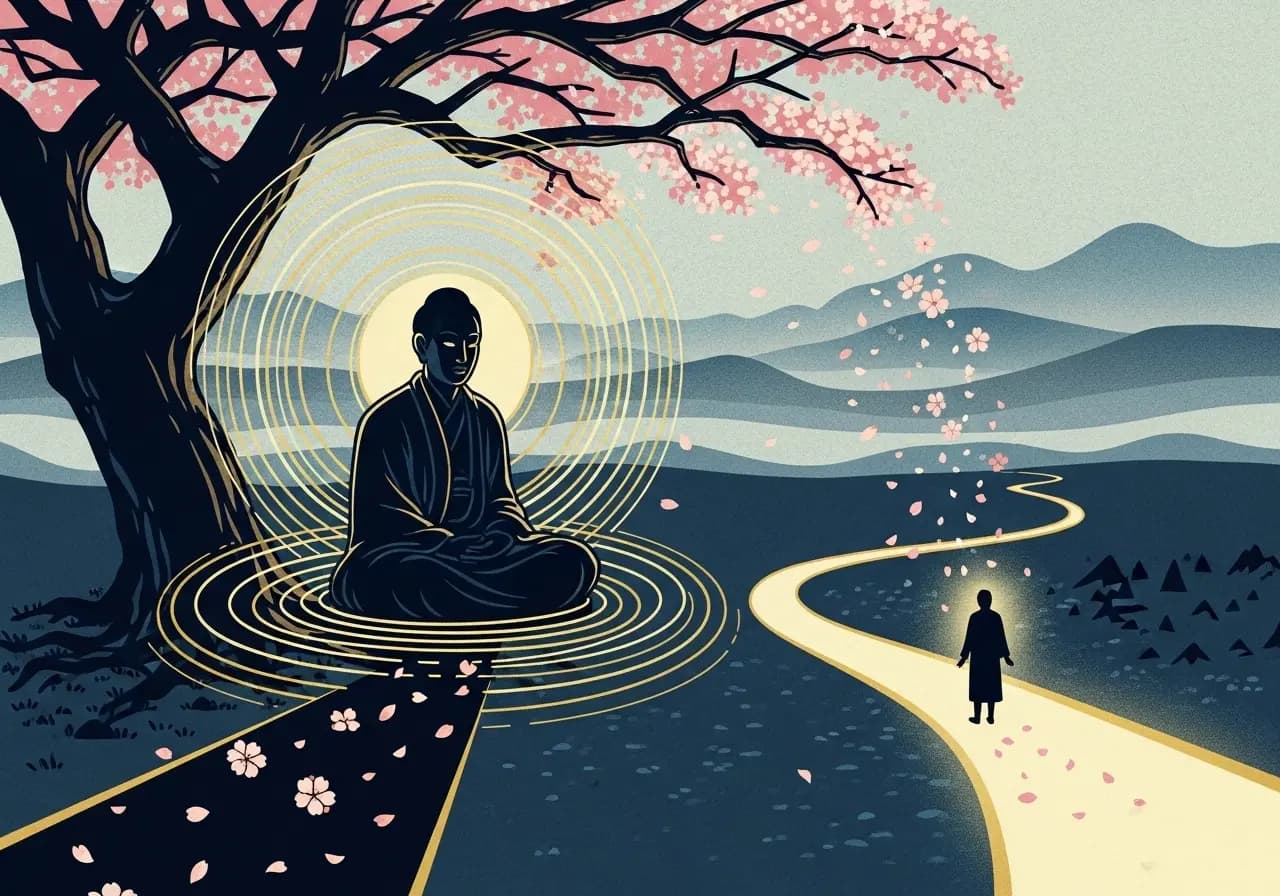
Unconditional Joy
Episode 120 of the Secular Buddhism Podcast
Hello and welcome to another episode of the Secular Buddhism podcast. This is episode number 120. I'm your host, Noah Rasheta, and today I'm going to talk about unconditional joy.
As always, keep in mind: you don't need to use what you learn from Buddhism to be a Buddhist. You can use it to learn to be a better whatever you already are.
A Few Updates
Before jumping into the topic for this week, I want to talk about the Zen koan from the last episode, which actually ties in perfectly to what I've selected to discuss today. But first, I want to acknowledge that I've been a little MIA the last couple of weeks, as you may have noticed. I haven't had the chance to upload a new podcast episode, and I've been tied up with several things.
I knew January was going to be a very busy month for me because I'm training a class of new powered paragliding students in a new location. I've been out in a remote place, staying in a cabin, and I thought I'd have the chance to record out there. But every night, unfortunately, there were parties or loud things going on around me that made it too difficult to record. So I haven't had the chance. I had every intention of sticking with my weekly uploads, but it just hasn't been possible.
Then there was a week where I was battling a mysterious allergic reaction that sprung out of nowhere. I spent days whittling down the list of possible culprits—thinking it was nuts, various foods, all sorts of things. I think I finally have it solved. It was the shampoo I was using.
But long story short, all these things delayed my chances to record, and I finally have the opportunity today. To find a quiet place to record, I'm sitting in my car. So I'm excited to finally be able to talk about the topic I had picked many weeks ago.
Just as a heads up, if several weeks go by in the future and you don't hear from me, know that I'm probably out somewhere working on something and trying to get a recording done. No, it doesn't mean the podcast is ending. It doesn't mean anything's changed. It just means every now and then I get tied up with things and fall behind. I don't program these episodes ahead of time—they're not recorded and scheduled to come out later. I record them usually the day of, the morning of, and an hour or two later I'll polish and clean it in editing software, then upload it right then.
So when I'm out of town, like I was in Nepal last November, I just don't get the chance. And when I'm in town but very busy with something, I also fall behind. I really appreciate people who reached out with concern, asking where I've been and whether I'm okay. That's good to know. Honestly, if something ever happened to me, I think podcast listeners might be some of the first to notice. They'd say, "Where is he?" So please do go looking for me if you haven't heard from me after a while.
The Blind Man and Bankei
Okay, so the Zen koan that I shared in the last podcast episode was called "The Voice of Happiness." It goes like this:
After Bankei had passed away, a blind man who lived near the master's temple told a friend, "Since I am blind, I cannot watch a person's face, so I must judge his character by the sound of his voice. Ordinarily, when I hear someone congratulate another upon his happiness or success, I also hear a secret tone of envy. When condolences are expressed for the misfortune of another, I hear pleasure and satisfaction, as if the one condoling was really glad there was something left to gain in his own world. In all my experience, however, Bankei's voice was always sincere. Whenever he expressed happiness, I heard nothing but happiness. And whenever he expressed sorrow, sorrow was all I heard."
I enjoy this koan because I've always liked the concept of rejoicing with those who rejoice and mourning or weeping with those who weep. After I posted this in our Patreon group, I got some wonderful thoughts and ideas coming from other podcast listeners and supporters. I wanted to share a few of them because I appreciate these different perspectives on analyzing these teachings.
Thoughts from the Community
One member, Emray, said: "Everything we do and say also reveals something about ourselves. Bankei might have said the same things other people have said, but unlike other people, he truly meant what he said. Therefore, his words and true intentions were well aligned. For some reason, this also reminded me of the Four Sides Model of Communication by Schulz von Thun. He's a communication expert, and according to his model, whatever we say also reveals something about ourselves."
This is a fascinating observation because it speaks to what I really appreciate about the introspective nature of Buddhist practice. When you listen to a koan or study a Buddhist teaching, the invitation is always to look inward, right?
So I'd echo what Emray was sharing: what does this reveal about myself? Rather than just analyzing whether Bankei was authentic, I'm looking at my own authenticity.
Ryan in our group also shared this thought: "After listening to this koan, it made me think that Bankei understood the interdependent nature of the universe. A misfortune for his neighbor was a misfortune for him. Likewise, a success for someone else was a success for him. Bankei seemed to not let his ego create a false mask of authenticity."
I really like that line of thought. The interdependent nature of things. It seems inevitable that someone who has a deep understanding of the interdependent nature of things would naturally feel inclined to rejoice when someone's rejoicing, to feel sorrow for someone who's feeling sorrow, and to have a sense of harmony with regards to thoughts, words, and actions.
What I mean is: I'm thinking this, I'm saying this, and those two things are aligned, and I'm doing this. When what I'm thinking, what I'm saying, and what I'm doing are all on the same page, then there's authenticity there. Sometimes what we're thinking and what we're saying don't match. Or sometimes they match, but what we're doing doesn't match. I really like the introspective work of trying to analyze whether all three of those are aligned when I'm saying something.
Then Stephan from our group said: "I find it poetic that the blind man can actually see people for who they are better than those with sight. Add to that he describes his situation as a disability because he says, 'Since I am blind, I cannot see a person's face,' when in fact it is a gift. His humility allowed an open mind to those with whom he interacted. By seeing people better than those with sight can, he could better grasp that Bankei was in fact a genuinely good soul, one without judgment or preconceived notions. Even Bankei himself may not have recognized this while he was alive. One can appreciate that his honesty and wise speech was better for the world even if others did not see it. The blind man saw it."
I really like those words by Stephan. I also find it poetic that oftentimes the blind person can see in a way that the person with sight cannot. I think that's applicable in many other areas too. We have people who may struggle with something that someone else doesn't struggle with, but that struggle allows them to be stronger in another area that other person is not as strong in. The blind man in this case refined his ability to detect authenticity and genuine tone when listening to people.
The Deeper Invitation
Now, I should mention here that as far as my own thoughts go, I don't know for certain how we can trust the blind man's assessment of who's authentic or not. But that doesn't concern me because, for me, the koan is all about introspection. It's about looking inward. Rather than approaching this koan and thinking, "Well, how do we know that the blind man was accurate in his assessment?" or "How heartbroken would the blind man be if he found out Bankei actually wasn't very authentic—that he was thinking something different than what he was saying?"—that's not the point being made.
Sure, that could be the case. But to me, this goes back to the heart of the practice, which is: what does this say about me? What insight can I gain from this? For me, this is an invitation to look inward.
It seems that the blind person was able to detect sincerity in Bankei's voice. But for me, the real challenge is to get to know the sincerity of my own voice. Are my thoughts, my words, and my actions all on the same page? And how often are they on the same page? How often are they not?
I like that the koan refers to happiness and sorrow because those are two very powerful emotions that we all deal with regularly. We're all chasing after more happiness, and we're all running away from sorrow. That's at the heart of what Buddhism is dealing with—the desire for things that we think will make us happy, the aversion toward things that we think will bring sorrow. These fall under what we call the poisons.
And this isn't just about ourselves. I think we're always juggling our happiness with the happiness of those around us and our sorrow with the sorrow of those around us, because we're social creatures. We don't exist in a vacuum.
Even people who seem to make a point of not caring what others think—I always find it interesting that the person who doesn't care about someone else's opinion cares very much about making sure you know that they don't care. To me, that's like saying, "Well, then you do care, because you care enough to make sure we know that you don't care," which is itself a form of caring.
And so what? We all do care about what others think. We're hardwired for that. We're social creatures. It's not like a badge of honor to say, "I actually don't care what others think of me." Why not just say, "Yeah, I'm hardwired to care. I try to not let it matter too much, but deep down I'm fighting millions of years of evolution and instinct. I may have convinced myself that I don't care, but if I really didn't, why would I care so much about making sure you know that I don't care?"
When Joy Becomes Conditional
Going back to this concept of rejoicing with those who rejoice and weeping with those who weep—this verse comes from the Bible, but the overall sentiment falls very much in line with today's topic of unconditional joy.
I like to think back to instances in my own life where I felt I was pretty good at painting the picture of experiencing joy with people who were experiencing joy. Rejoicing with those who rejoice. But when I'm being honest with myself, I think what I was really doing was rejoicing with those who I felt deserved the joy I was sharing with them. In other words, I was really good at pretending to rejoice with others, but the ones I truly rejoiced with were the ones I felt deserved it. It was conditioned joy, not unconditional joy.
That gets to the heart of what I want to talk about in this episode.
My Own Journey with This
If I backtrack a little, for those who know something about my story and what we could call my faith transition—my journey from one belief system to no belief system, then gravitating toward Buddhism, a secular form of Buddhism—that whole journey has made it so that some of my close inner social circles are concerned about my lack of belief in my prior faith tradition.
When I went through the process of becoming a Buddhist minister, the induction ceremony was a pivotal moment. In some of my social circles, it felt almost like a disapproval—like this is your way of now formally saying you're definitely not one of us anymore. That's the vibe I was getting.
And I started noticing things I hadn't really paid attention to before. When I posted a picture from my induction ceremony, I noticed that the core circle of people who typically interact with my social media posts were absent or silent. They didn't like the picture. They certainly didn't comment. And I felt like it was a way of communicating: "We do not endorse this path that you're on."
I remember that was one of the first times it struck me—this notion of not being capable of rejoicing with the joy I was experiencing that day because it wasn't approved. "I don't approve of what you're rejoicing about. Therefore, I will not share in that joy with you. I will not rejoice with you." And that stuck with me for a long time. I'm sure all of you have experienced something like that to some degree, and I'm sure we've all done something like that too.
That stood with me for a few years, and then I started noticing little trends. Anytime I would post anything about Buddhism, mindfulness, or my book on Buddhist topics, I noticed that a certain group of people who regularly interact with me on social media were silent and absent from the conversation and engagement around those topics.
And then I started detecting in other conversations comments about other people where it was like, "Oh, I won't like their picture when they're posting this because I don't want them to think I approve of that specific action." That's when I connected the dots and realized: my joy is somehow threatening to them, and they cannot share in my joy because they don't approve of it.
I felt a little bit of a sting at first, like, "Oh, well, that's unfortunate." But then what started to happen was I began to ask myself: why is that painful? Why do I feel the need for them to rejoice with me? And the truth is, I don't. But what it helped me start to see—and this is the powerful part of the whole thing—was it made me question: when do I do that? Do I do that to people too?
And I started to notice that I do. I didn't notice that I did until I noticed others doing it to me. And I thought: how interesting. What scenarios do I do that to people?
The Baptism Realization
I noticed that typically it happens with social media posts about things from my former religion. For example, in my former faith, kids get baptized when they turn eight. And when I see friends posting pictures of their child getting baptized with comments like, "Oh, I'm so proud of so-and-so because they chose to take this important step," I found myself experiencing a strong sense of disapproval. I thought, "I don't think you should be allowing that to happen. I disapprove of a child at that age making a decision that important."
And I found myself doing exactly what I was noticing people were doing to me. I don't want to rejoice with you because the joy you're experiencing at your child's baptism—I feel it's not deserved because I disapprove of it.
That really helped me start to see it differently. It was a powerful realization. I don't feel this disapproval about other things. I have a cousin of a different faith, and when she posted a picture of her baby being baptized, that didn't offend me. But obviously, the one coming most recently from my former tradition is a little more sensitive to me.
And it was really fascinating to sit with that whole experience. I started to notice something specific: the joy that some of my friends are experiencing and posting in pictures, talking about this important event that just took place in their life—I am the one who's deprived of feeling that joy because I'm not sharing it with them.
And I thought, "That's the very thing that I wanted from people. I wanted them to rejoice with me, to celebrate the fact that I just took this decision that I felt was important and meaningful for me. And when I noticed people close to me did not want to celebrate with me, I thought, 'How sad. You're the one missing out on that joy simply because you don't think I should be doing what I'm doing.'"
Yet here I was doing the very same thing, thinking, "Oh, I don't find joy in what you just did because I don't think you should be doing what you're doing."
That was a really enlightening thought experiment, and it became the topic of much of my meditation for weeks, maybe months. I would sit with it and think: why? Why do I not find joy in that? And that allowed me to change the relationship I had with the emotion I was experiencing when I would see these pictures of people baptizing their eight-year-olds.
In my case, part of that sensitivity is because I'm still involved in that circle. I have children who are that age. A few years ago, I went through the experience of watching my son go through it, and I didn't get to participate in any way because I'm not allowed to as a nonbeliever. And I'm getting ready to go through it again next year with my seven-year-old who's turning eight. So it's a topic of sensitivity for me. I didn't realize how sensitive I was until I started going through this whole process of experiencing it backwards, and now it's made me more aware of it moving forward.
I thought: I want to share that joy.
An Important Clarification
I should mention here that I'm not sharing this in the sense of saying I should be feeling joy with people who are experiencing joy. I'm not saying that. I want to be clear about this with everything related to Buddhism. It's not a commandment—like, you should be joyful, you should experience joy with others. It's not that at all.
It's the understanding that joy could be shared. But if it's not being shared, why is that? What conditions have I placed on joy that prevent me from experiencing such a natural emotion? Working with my own mental conditioning has helped me uncover a greater sense of that unconditional joy that I think is there naturally. So it's been a really powerful process for me—going through my own mental processes as I go through events in life.
The Nature of Unconditional Joy
So the idea of unconditional joy: normally, we think of joy as a reaction. Something happens, and it causes the emotion of joy to suddenly arise. That's natural. But I think that type of joy is conditioned joy. This thing happens, I think this is what I wanted to have happen, and therefore I feel joy.
Unconditional joy is a concept in Buddhism that's always there. It's covered or hidden, similar to the concept of enlightenment, right? It's always there. Unconditional joy is just covered or hidden, and we can uncover it through practicing awareness and through feeling gratitude.
One of the exercises that has been really helpful for me—and I've talked about this before—is the question: what did it take for this moment to arise? When I think about that, it immediately invokes two things: a sense of the interdependent nature of things. This is because that is—well, what is that? And that is because of what other thing?
When I do that in my mind, it prompts me, and it starts to uncover a form of joy that was there all along but I was unaware of it. Finding unconditional joy seems to be rare, perhaps unnatural for most people. But it can become natural if it's practiced the same way gratitude can be practiced. It can become your new habitual way of being because you're always thinking: what did it take for this moment to arise?
For me, this is all about introspection. When I see a picture now of somebody at their child's baptism and they say this is joyful—they're very joyful for what just took place—I analyze how I feel about it. And if I think, "Well, I'm not feeling very happy for them," I ask myself: why? Why am I not happy?
And here's the crucial part—I think this is what really shifts things—I ask: what all did it take for this moment of happiness in their life to arise for them?
The moment I start doing that, there's a shift. I start thinking about the years of ideas shared from generation to generation, the beliefs handed down, the personal struggles people have gone through and endured. Their beliefs have helped prop them up through difficulties. It becomes this giant spider web of interdependent causes and conditions, many of which I can empathize with and identify with. And that changes the moment.
I think: for this moment in time, for all the causes and conditions that allowed this moment to be what it is and the joy that they're feeling—I feel joyful about things too. And that's what connects me to the moment.
I know what it is to feel joy about things that are meaningful to me. It may not be the same things, but I know what it's like to go through a course—for example, a two-year course—that led to one singular moment that I'm celebrating as my meaningful moment. I know what that feels like.
And here this family is going through it for an entirely different set of purposes and beliefs. But I know what that feels like to feel that joy. And that allowed me to start connecting with these posts in a much more authentic way. I do feel a sense of joy because it's the joy I'm concerned about now, not so much the causes and conditions that led to it. Well, maybe it is the causes and conditions of the joy, but not so much the singular event itself.
Practicing the Exercise
So that's been a fun thing for me. I can almost feel my smile starting to develop when I look through one of those posts or pictures that previously I would've been like, "Eh." And now I look at it and think: what did it take for this moment to arise for them?
That five, ten, fifteen seconds it takes to entertain that thought and that question, I start to smile and think, "Ah, good for them. I'm glad they're experiencing that." And then I remember what I've mentioned in past episodes—what I call Pamela's formula—that says: I feel strongly about things too. They feel strongly about whatever they're going through, and I feel strongly about things too.
That's been powerful for me.
The Result
At the end of all this, I recognized something: there is a sense of joy that can be shared when you see someone else experiencing joy. And when I'm not experiencing it, that's my own mental block. My own mental conditioning is preventing me from accessing something that's natural and that's already there.
It's been fun to notice that it really has made a difference. I'm starting to find a much greater sense of unconditional joy that arises more often than it used to. It didn't change overnight, but I've worked on this for a long time, and it's been a slow, fun shift that's happened for me.
I think it can become natural if practiced. So again, introspection is the key here. And I like the idea that unconditional joy is an invitation to look inward and start to understand more about myself—what concepts, ideas, or beliefs are covering up my ability to access that unconditional joy that I can feel and share with someone else who is experiencing joy.
The Flip Side: Sorrow
And the flip side of this is applicable to sorrow as well, right? When someone's experiencing sorrow and you're like, "Oh yeah, I feel sorry too," but inside you're really thinking, "No, actually I don't, because you had it coming or something like that." That's a moment of introspection where you can just say: I wonder why I feel that way?
Again, this is not to say I shouldn't feel this, and then I'm going to be mad at myself for feeling it. It's not that at all. It's just a moment to be very honest with yourself and say, "Oh, I actually don't feel that. Why don't I feel that? I wonder why. What did it take for this moment to arise? What kind of mental conditioning is preventing me from feeling that sorrow that you're feeling for what you're going through?"
That introspection can lead to something that can unlock or access that natural sense of sympathy, compassion, or whatever you want to call it. That arises and that you haven't been experiencing. Because again, if you're experiencing joy and I'm not experiencing the joy with you, I'm the one who's missing out.
It doesn't affect you in any way. Well, maybe it will if you're like, "Huh, why is he not happy about me being happy about this?" Then that could affect you, and then that's your own introspection. But on the first pass at all that, I'm the one who's missing out on the joy. So I'm the one who can be introspective and say: why am I not experiencing that joy?
Closing
So that's the topic. That's all I have for this podcast. As always, thank you for listening. If you want to support the work I'm doing with the podcast, consider becoming a patron and joining our online community, where we discuss koans, podcast episodes, and more. You can learn more about the online community by visiting SecularBuddhism.com.
If you enjoyed this podcast episode, feel free to share it with others, write a review, or give it a rating in iTunes.
But before I go, here is the Zen koan I want to share with you for this week:
This Week's Koan: Announcement
Tanzan wrote sixty postcards on the last day of his life and asked an attendant to mail them. Then he passed away. The cards read: "I am departing from this world. This is my last announcement. Tanzan." And then the date: July 27, 1892.
That's all I have for this podcast episode. Thank you for listening. Until next time.
For more about the Secular Buddhism podcast and Noah Rasheta's work, visit SecularBuddhism.com