

Endings and Beginnings
Episode 119 of the Secular Buddhism Podcast
Hello. You are listening to the Secular Buddhism Podcast, and this is episode number 119. I'm your host, Noah Rasheta, and today I'm going to talk about endings and beginnings. Keep in mind, you don't need to use what you learn from Buddhism to be a Buddhist. You can use this to learn to be a better whatever you already are.
The Kōan: No Water, No Moon
Let's start by talking about the Zen kōan I shared in the last podcast episode. This is the kōan called "No Water, No Moon." As a reminder, here's how the kōan goes:
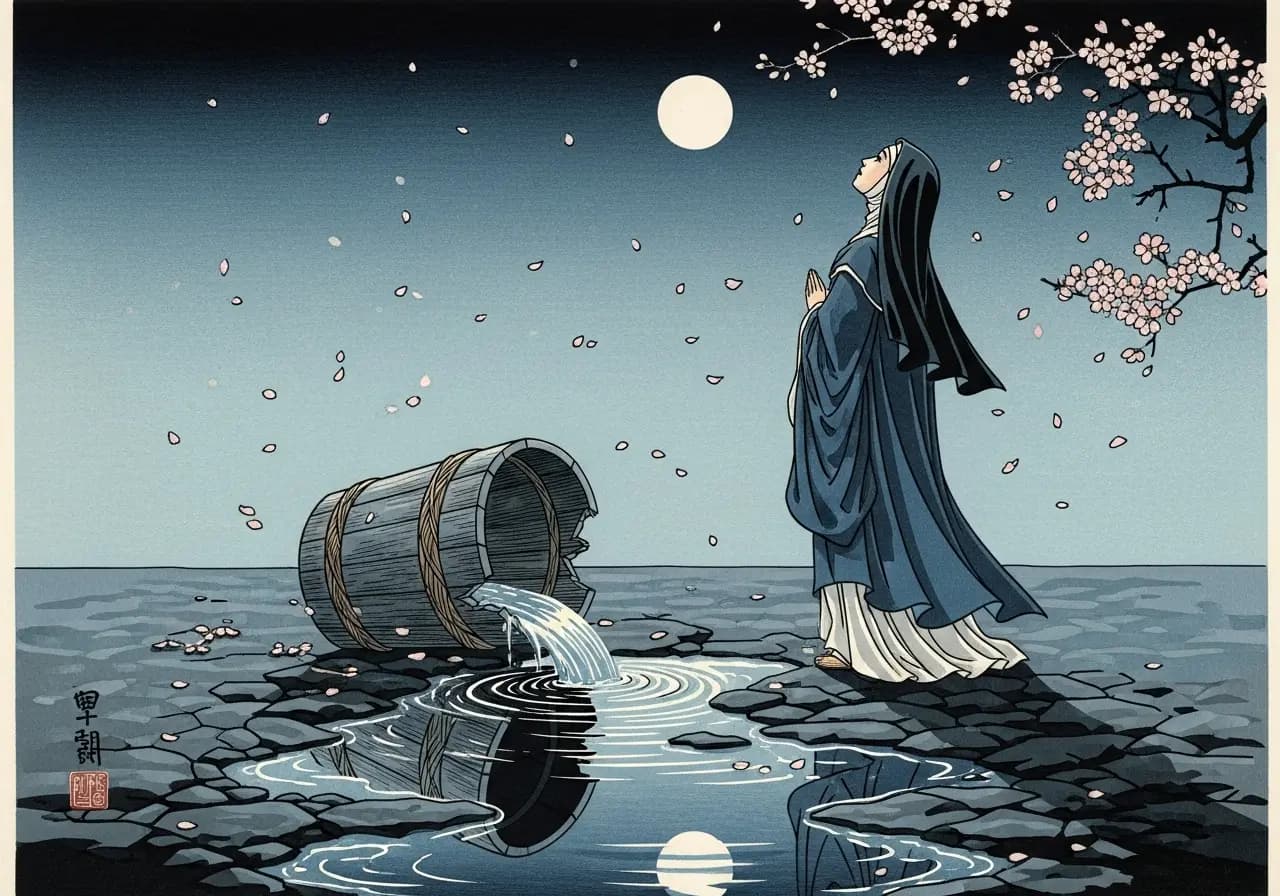
When the nun Chiyono studied Zen under Bukko of Engaku, she was unable to attain the fruits of meditation for a long time. At last, one moonlit night, she was carrying water in an old pail bound with bamboo. The bamboo broke and the bottom fell out of the pail, and at that moment, Chiyono was set free. In commemoration, she wrote a poem:
In this way and that, I tried to save the old pail. Since the bamboo strip was weakening and about to break, until at last the bottom fell out. No more water in the pail, no more moon in the water.
It's a fun kōan to visualize—imagining what this experience was like for Chiyono, the nun. Bodhidharma, who is the first patriarch of Zen and is considered the founder of Zen in China, is purported to have said that "Zen is a special teaching outside of the scriptures, beyond words, beyond letters, pointing to the mind, seeing directly into one's true nature." To me, this kōan—like all the other kōans—seems to be an invitation to look at something beyond words, beyond the letters you would find in teachings. It's trying to get us to learn something about ourselves.
My initial attraction to Buddhism fell along these lines: it was a transition from looking outside of ourselves for something to looking inside. And if you'll recall, I think I've mentioned it in a podcast episode before, but up until I encountered Buddhism as an ideology or as a way of thinking, it seemed like most of the major ideologies had answers to life's big questions.
It's like, do you want to know who you are, why you're here, what happens when you die? Big, big questions. All you have to do is entertain the answers they have to those questions and then decide if that makes sense to you or not. What I loved about Buddhism is that it didn't have answers to those questions. In fact, it turned the tables and essentially asked me back: "Who wants to know? Or why do you want to know?" That was a radical shift. Rather than having the answer, it was presenting me with another question: "Well, why do I feel the need to know these things?" Because that answer might be more important or more skillful to know than the answer I thought I wanted—which is, "What happens when I die?"
Well, why do you feel the need to know? Once I could answer that—why do I feel the need to know?—I might realize that the answer to the original question is irrelevant or no longer necessary. That way of thinking was fascinating to me. I think that's what we encounter with these kōans and with this quote from Bodhidharma where he's saying that Zen is something that's outside of and beyond words and letters, and it's pointing to the mind. That's what this kōan is trying to get from us.
How Kōans Work
Keep in mind that these kōans are going to be interpreted differently by different people based on who you are, what you've gone through in your life, what you may be going through now, what beliefs you may or may not have, and so many other variables. And that's part of what makes these kōans so fun to work with: knowing that the kōan is for you, and what you extract out of it—what it means to you—is totally unique.
So keep that in mind when I share my thoughts or other people's thoughts or commentaries on a kōan. It doesn't have to make any sense to you. You might say, "No, that's not at all what I got out of this." And you would be correct. Your way of making sense of this is the only one that matters because this is for you. It's an invitation to look inward. And just as Bodhidharma said, "This goes beyond words and letters. This goes to the nature of one's own true mind, which is yours. Only you can look into your own mind."
The Pail as a Reflection of Conditioned Mind
Okay, so having said that, I think for me, in some ways, the concept of the pail is a reminder of my conditioned mind—always reflecting. So there you have the pail, and it's full of water doing what a pail does, right? The pail was meant to hold water, and as it holds water, it reflects the moon. And that's what happened on that specific evening—it was reflecting the moon. When I see the moon, I'm seeing the mental reflection I have of the moon, just like I do when I see people. Just as the pail reflects the moon, when I look at another person, I'm actually seeing the reflection that my mind has made of that person. In other words, I'm seeing how I see that person more than actually seeing that person. And that might sound a little strange or weird, but I'll give you an example.
There's a funny meme I saw on the internet about a rhino painting a landscape. In all of the various renditions—the mountains, the trees, different landscapes—they all have one prominent peak right in the middle, which is the rhino's horn. So if you visualize this, imagine a rhino looking off into the landscape and whatever landscape they're painting, there's a horn in the middle of it. Well, obviously we see this and we say that's the rhino's own horn. But the rhino doesn't see it that way. That horn is literally in every landscape everywhere it looks. There it is.
To me, that's what I'm trying to get at with this concept of reflection. It's that when I see reality, I'm trying to discern what part of the picture of reality is my own horn. What part of the picture is not really the picture? It's me. It's how I'm seeing. And when I understand that, it makes me start to wonder: can I even get rid of the horn? The horns that paint my picture of reality? Can we get rid of those?
Just like water—there will always be in the water the reflection of whatever is there. Whatever is there, it can be anything, but the reflection will always mimic what's really there. I think it's similar with my conditioned thoughts. The conditioned mind that I have causes me to see the world a certain way, and it doesn't matter what I'm seeing out in the world or in reality, my mind is going to somewhat be a reflection of that.
So it makes me wonder: well, can I get rid of the conditioned thoughts I have? Well, just like the rhino can't really eliminate the horn from his view, I'm not sure that we can entirely rid ourselves of our conditioned mind because that's the nature of what a mind is, right? A mind holds thoughts, thoughts are conditioned. How do you escape that?
Well, in the case of the pail, you don't—until the pail broke. To me, that's one of the important parts of the story. Chiyono is trying to figure out what the fruits of her meditative practice should be, and then her moment of realization happens when there's no pail holding water, there's no reflection of the moon in the water. It's something that may seem so simple: there's no water, there's no moon. It's like, well, when I'm trying to experience—let's just call it enlightenment—when there's no me, there's no enlightenment, because enlightenment is a concept. It's an idea. That's one way I like to think about this.
Other Perspectives on the Kōan
I want to share a couple of thoughts from people who commented in our Patreon community because I think they're valuable.
One comes from Bernadette, who says: "So many of the kōans seem to be about our perception of reality versus what reality actually is, and only when the nun's perception is broken is she truly free to see and accept things as they are." I love that image. I can just imagine Chiyono looking down into that pail, seeing the moon on the water. The moment the pail breaks and the water's gone, she can't see the reflection there anymore. She probably looked up and looked at the moon and was like, "Oh, there it is. There's the actual moon—not the reflection." To me, that's what Bernadette is pointing out: the difference between our perception of reality—the reflection—and what reality actually is. To be free to see things as they are, it required the pail to break. I like that.
David shared his thoughts: "The nun is attached to the pail, which is preventing her from looking up to the moon. She has to look down, not to spill the water, and can only see the moon in reflection. She is so attached to it that she refuses to accept its impermanent nature, fixing it as long as she can. As the pail breaks down and she stops clinging to it and accepts its impermanent nature, she can see things as they truly are. In this case, looking up to the moon rather than its reflection."
That's a similar thought to what Bernadette was sharing, but he mentions the idea of attachment to the pail, which is a fun thing to visualize. I hadn't thought about that, but to effectively carry that pail and not spill it—especially if the water was close to the top—yes, you would be looking down at the pail, right? Like when I carry a cup or something full of liquid that's full, I'm definitely looking at it when I carry it to make sure I'm not spilling it. And I can see that in this description David is sharing. And to have that spill on you, then you don't get the reflection anymore. You just get the real thing.
And then Nancy shared this: "To me this kōan is a reminder of how we experience our world is often influenced by what we carry in our mind—our bucket in the form of past experiences and beliefs. Once we are aware of this and can empty the bucket, we find space for a clear view of the experience."
Those are all fun takes on this kōan. What matters is what you get from the story—what it means for you. And those are the thoughts we wanted to share on that one.
Endings and Beginnings: The Topic
Now, jumping into the topic of this podcast episode—endings and beginnings. I thought it would be appropriate as we're approaching the end of another year and the beginning of a new year. This will likely be the last podcast episode of the year, and the next episode will be a whole new year. So I thought it would be fun to talk about the concept of endings and beginnings from a Buddhist perspective.
Buddhist teachings help us to see that endings and beginnings are the key to understanding that all things exist in an interdependent cause-and-effect type relationship. The end of one moment gives rise to the beginning of another moment, and the rise of a moment will inevitably lead to the ending of that moment. And as we approach the end of the year, we can't have the start of the new year without the ending of the old year. So it seems to be with all things in life.
Comfort and Discomfort in Change
Seeing endings and beginnings can be the source of great comfort during difficult times. The expression "this too shall pass" comes to mind here. When we're going through difficult things and we have that thought—"well, this won't always be like this"—that can be the source of great comfort. But it can also be the source of great discomfort. Because if the moment we're experiencing is pleasant, we don't want it to end. If it's unpleasant, we do want it to end. So if it's a pleasant moment, the thought of it ending ends up bringing discomfort. And if we're having an unpleasant moment, the thought of it ending could bring comfort.
It's funny how that works. But if we learn to use that discomfort skillfully, perhaps it will allow us to make the best time that we have with the current moment before that moment passes.
Less Afraid of Pain
For me, learning to see endings and beginnings has actually made me less afraid of pain. And I want to talk a little bit about what that means.
When I'm talking about seeing endings, if I only see endings, I'm missing half of the picture, right? Because endings and beginnings, you can't have one without the other. But we often seem to fixate on endings. I see the fact that I'm eventually going to move away from where I live. I'm in Mexico right now for another six months, and I'm already starting to have this mental picture of what it'll be like to leave this place and move back. This one year of adventure down here, having my kids learn Spanish, that's almost done. We're just over the halfway mark now, and I'm starting to see the eventual ending.
And we do this with other things. I see the eventual ending of the various phases that I'm in, in my life. I have young kids right now; they won't always be young. One day I won't have little kids in my house. I'll have teenagers. One day I won't have teenagers; I'll have grown-ups that won't even live with us anymore. Right now I have my parents that I can talk to. One day I won't have my parents that I can talk to. One day my hobby that I love so much won't be a hobby that I'll get to practice. I may have a back injury or just be growing older. Maybe the inevitable change will steer me out of that hobby and into something else.
Those are the endings that I see and that I anticipate. Some of which are very uncomfortable to think about because they're going to be painful. And then, of course, there's the eventual loss of my own life and the lives of all those that I know and love.
The truth is, I used to be really scared of the pain involved with these inevitable losses. But through practicing mindfulness and through studying Buddhist teachings, what I've come to understand is that the fear of the pain is what has been lost. That's what has gone away. It's interesting.
We all somehow seem to grasp this notion that life gives us very painful and uncomfortable experiences at times, especially when we're talking about loss, and we don't want to feel that pain. And I don't think any of us are sitting around thinking, "Oh, maybe there's this magic thing I can do that will prevent all bad things from happening. I'll never have to experience the loss of a loved one." We don't think that. But we do somehow think, "Well, maybe there's this magic thing that if I can do it, then it won't hurt so bad." That to me is where the disconnect is.
Because it doesn't matter how much you meditate or practice or whatever it is that you do, or how much faith you have—it's going to hurt when you lose the people that you love. And to me, the heart of the practice is to no longer be afraid of that pain. That's what I've noticed in my own practice. As I see and anticipate endings, I'm not afraid of the pain. It's going to hurt, and I know it's going to hurt. I'm not afraid of the pain that I'm going to experience when I undergo change, whether it be intense pain or minor pain, deep pain or shallow pain.
Fighting What We Fear
Most of us tend to think that in order to be at peace, we have to suppress or push away the things that trouble us. And I think this is why we don't like to see—or much less think about—endings. But this is what the story of the Buddha teaches us: fighting the things that we fear or chasing the things that we crave won't bring about the lasting peace that we're after.
That's what the Buddha learned. The Buddha tried to starve and eliminate a part of his humanity—the part that was afraid. But in the end, that resistance was only another source of his suffering.
And that's what I see in this kōan that I shared in the last podcast episode with Chiyono, the nun. She said, "In this way and that, I tried to save the old pail." And I see that in myself and in others. If I think we can see ourselves in this story, here we are trying in this way and in that to save the old whatever—the pail can be symbolic of so many things. But inevitably, with time, the bottom of the pail falls out, and we're left with both the frustration of losing the water in the pail that we were so carefully carrying, and also with the potential situation of being awakened and free in that moment. Just like Chiyono was—to the fact that no more water in the pail, no more moon in the water, right? It's a fun thing to realize. And that to me is the practice of seeing endings, but also seeing beginnings.
So rather than thinking, "Oh, let's just turn a blind eye to these endings. Just don't think about when your parents are going to die or don't think about if you could lose your job," rather than approaching it that way, just recognize: "Well yeah, these things are going to happen. I'm not going to turn a blind eye to it. I'm not going to pretend like it's not going to happen. But I'm going to become less afraid of the pain I'm going to experience when it does happen."
And as in the story of the Buddha, it turns out that the trick all along was to turn inward toward the pain and the discomfort and to become comfortable with it and to become less afraid of the pain that often accompanies endings. And I think that, to me, is the greatest part of the whole Buddhist story: he realized he was the source of his own suffering. What a cool thing for us to realize in ourselves as well.
Seeing Beginnings
And this is where I want to talk about the other side of that coin. If we're seeing endings, what does it mean to start seeing beginnings?
There was a time in my life when I really cherished my youth—living at home with my twin brother and doing all these fun, adventurous things we did as kids with my parents facilitating and taking us and showing us the world. But that phase had to end for a new phase to begin: the phase of no longer living at home with my twin brother by my side and no longer with my parents at home.
But that stage brought the beginning of adulthood and the start of my own family. I would have never imagined back then, when I was a youth, what it would be like to be a dad and to have my own kids. And had someone been able to tell me, "Well yeah, this is you're going to start an incredible phase," I would have been a lot less afraid of the pain I was going to feel of no longer living with my parents and with my brother. Because now I get to experience a different environment.
And it's not to compare and say, "This one's better than that one" or "That one was better than this one." That's not what I'm saying. All I'm saying is I didn't realize how cool this would be, but I wouldn't have had this had I not lost that.
I think that we see this a lot with careers, right? The end of one career—in my case for sure—the end of one career led to the start of a new career that I never would have imagined was going to be as fun as it is. Because I thought that one was fun. And I can put myself in that same situation now and think, "Wow, I hope what I'm doing now never changes." But there might be some new beginning out there—a different way of a career that I can't even imagine now—that one would be even better than this one. I don't know. And that's what I hold on to: that the mind that doesn't know, right? I don't know. It could be worse too, but it could be a lot better.
I think about that a lot—trying to see the endings, but also trying to see the beginnings.
Seasons of Life
There was a stage in my life where family life felt like it couldn't be any better. On Sundays, my grandma would come over to our house and we'd play cards. I was like, "That's the way family dynamic should be." But with the loss of my grandma and time, we gained grandkids. My brother was the first one to have kids, and suddenly there's a new dynamic. There are little kids running around, but grandma's not there anymore. And it's like, "Well, that's just a new dynamic." This is the new dynamic. Now all the grandparents are gone, and there are a whole bunch of grandkids. And these grandkids are going to keep growing. Then that stage just goes on and on, right?
One day it'll be my parents and their generation. They will be gone, and my kids' grandparents will all be gone. I'll be the grandparent, and my kids will have their kids. And that's what we do. We see endings, and we see beginnings. It takes the ending for the beginning to happen, and if there's a beginning, there's going to be an ending. And what we can do with all that, knowing that change is inevitable, is become less afraid of the pain.
It's fun, and at times it's a bit nerve-wracking to think about all the upcoming beginnings, and we don't even know what's in store, right? It's like the Tetris game—the unknown Tetris pieces. Some will be pleasant, some will be unpleasant, but that's the point of the game. We're just going to see how it all goes while the game is still going on.
A Common Misconception
I think one of the misconceptions I encounter from time to time with people who are trying to get into mindfulness practices is that they talk about practice as if there's the assumption that if we practice hard enough, we can figure out how to make it so that life won't hurt anymore. And the truth is, it's going to hurt from time to time. That's the nature of life, right? The first noble truth talks about how in life difficulties arise. But perhaps we don't have to be afraid of the pain anymore. To me, that's the key. That's the difference.
In that moment, we experience a bit of freedom—a little bit of liberation from the fear that we've been living with, because we're not afraid of the pain. And that's my wish. That's my hope for myself, for my family, and for you as we close this year and we get ready to start a new one.
A New Year's Intention
May we come to see that change is inevitable, that all beginnings have endings, and that all endings lead to new beginnings. In this new year and with each new day, may we each start to see the interdependent nature of reality—the interdependent nature of ourselves with everything around us. And may we each work diligently to be skillful with how we contribute to the infinite causes and conditions that are giving way right now in the present moment to untold beginnings that are in store in the future and that are still yet to be.
And with that, I want to wish you all a happy New Year and to thank you, as always, for being a part of this journey with me.
Closing
That's all I have for this podcast episode, and I want to thank you for listening. As always, if you want to support the work I'm doing with the podcast, consider becoming a Patreon and joining the online community where we discuss these podcast episodes and more. You can learn more about that by visiting SecularBuddhism.com.
If you enjoyed this podcast episode, feel free to share it with others, write a review, and give it a rating in iTunes. That's all I have for now, but I look forward to recording another podcast episode soon.
The Next Kōan: The Voice of Happiness
Before I go, here's the Zen kōan you can work with from now until the next podcast episode. This one is called "The Voice of Happiness":
After Bankei had passed away, a blind man, who lived near the master's temple, told a friend, "Since I am blind, I cannot watch a person's face, so I must judge his character by the sound of his voice. Ordinarily, when I hear someone congratulate another upon his happiness or success, I also hear a secret tone of envy. When condolence is expressed for the misfortune of another, I hear pleasure and satisfaction, as if the one condoling was really glad there was something left to gain in his own world. In all my experience, however, Bankei's voice was always sincere. Whenever he expressed happiness, I heard nothing but happiness, and whenever he expressed sorrow, sorrow was all I heard."
Until next time.
For more about the Secular Buddhism Podcast and Noah Rasheta's work, visit SecularBuddhism.com