

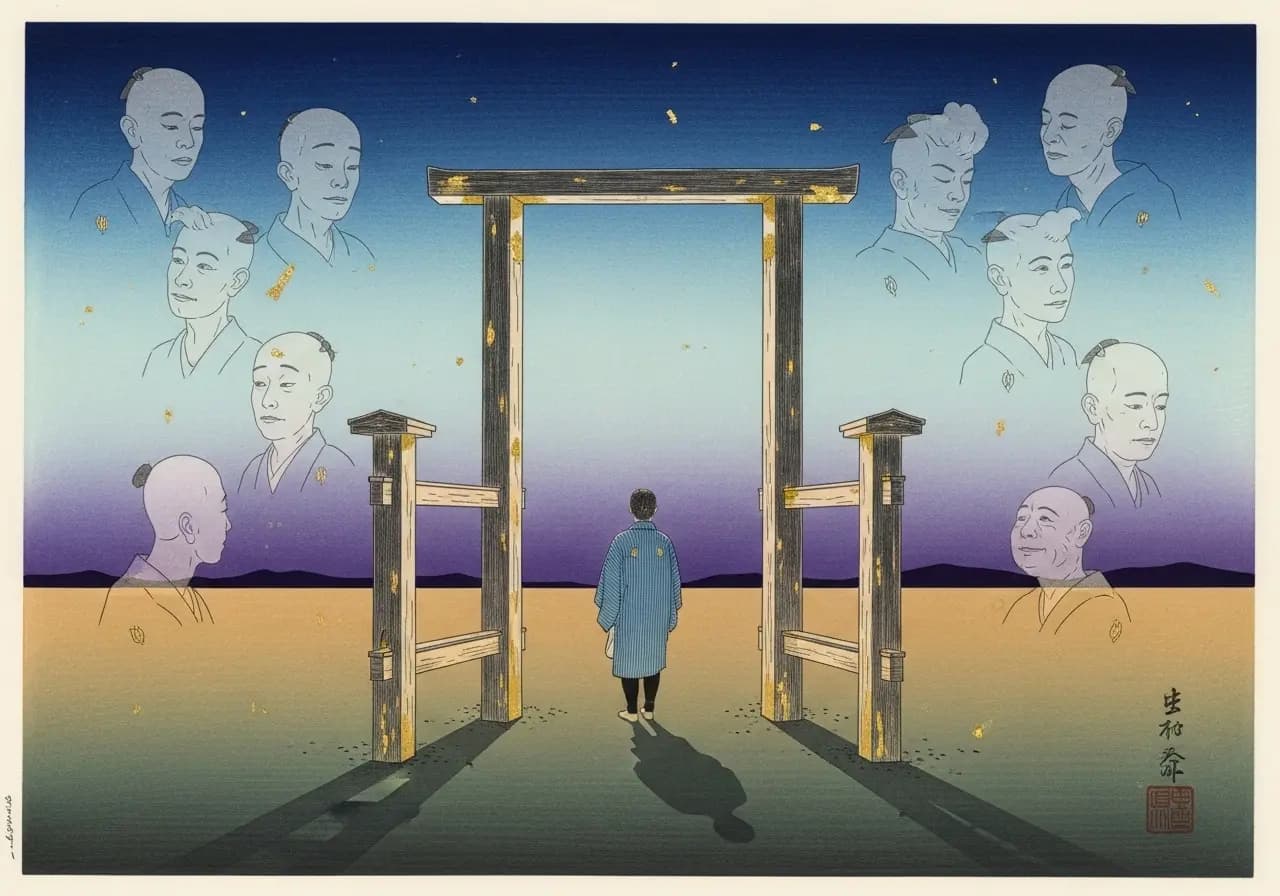
People Who Don't Exist
Episode 116 of the Secular Buddhism Podcast
Hello and welcome to another episode of the Secular Buddhism podcast. This is episode number 116. I'm your host, Noah Rasheta, and today I'm going to talk about the people who don't exist.
The Opening Teaching
Keep in mind you don't need to use what you learned from Buddhism to be a Buddhist. You can use what you learn to be a better whatever you already are.
Before jumping into the topic, I want to talk about the Zen koan that I left you in the last podcast episode. This is the koan of the Gateless Gate.
One day, as Manjusri stood outside the gate, the Buddha called to him, "Manjusri, Manjusri. Why do you not enter?" Manjusri replied, "I do not see myself as outside. Why enter?"
I've talked about this concept of the Gateless Gate before in previous episodes, but I recently just got back from Nepal. I had an excellent time there, and during one of the days we were trekking out in the middle of a field, there was a gate. I looked at it and jokingly called it the Gateless Gate.
The gate looked like it had been built without a fence. Maybe at some point the fence would be installed, or it could have been the frame for what was going to become a swing set or something. But the gate was there—it looked like a gate without a door. The frame of a gate, I should say. A doorframe with no door and nothing else around it. No fence, no wall. It was just a random entrance in the middle of the field. If you were to walk through it, you'd be in the same field you were before walking through it. I called it the Gateless Gate.
And this is exactly the mental picture you should conjure in your mind when thinking about the concept of the Gateless Gate.
The Invitation of Enlightenment
In this koan, you have the Buddha himself calling out to Manjusri, "Hey, why don't you enter?" To me, this invokes the invitation of Buddhism saying, "Hey. Why don't you become enlightened?" And someone wise, looking at that, says, "Well, I don't see myself as unenlightened. Why do I need to be enlightened?" And that's exactly the point this is trying to hit home.
We see separation where there is no separation. We see ourselves as not being enlightened because we have a concept of what enlightenment is. This concept came up during the trek in Nepal. Someone asked whether people in our day and time can also be enlightened. And I would say emphatically yes.
But there's a catch. What do you think enlightenment means? Because if it's something that's just a concept or an idea, then I think we've missed the point.
It's like talking about something experiential, like love. You could talk about the theory of love—what it means to feel love. But you wouldn't really know what love is until you feel it. I could try to explain it to someone who hasn't felt it, but there's just no way to convey it intellectually. It has to be experiential. You could say, "How do you feel about your mom?" or "What about your pet dog?" or "Your cat?" These things might help someone remember the feeling, and they'd think, "Oh yeah, I know that feeling."
I think it's similar with enlightenment. There's a Zen expression that says, "Before enlightenment, chop wood, carry water. After enlightenment, chop wood, carry water."
I love that expression because it really hits home with the idea of the Gateless Gate. It's like, wait, you thought that walking through something was going to change things? No, you're in the same field. This is a gate with no door. There's no difference walking through it. You're in the exact same place you've always been because there is no other side.
That's what Manjusri is expressing in this koan. "I do not see myself as outside." This is only a problem for people who do see themselves as outside. They're going to try unsuccessfully every possible method to get inside. But when they realize there is no inside, they realize there was no problem to start with.
Manjusri realizes this from the beginning. He doesn't see himself as outside. So for him, there is no gate to enter. And I think this is the profound understanding of enlightenment in Buddhism. The more you study it, the more you realize that seeking after it is unnecessary. It's not something other than what we're already experiencing.
If your life consists of chopping wood and carrying water, well, after enlightenment, that's still your life. Chopping wood, carrying water. To me, that's a really profound understanding.
The Nepal Trek and a Profound Realization
So the topic I picked for this podcast episode is: the people who don't exist. Who are the people who don't exist?
This thought came to mind as we were in Nepal. Quick recap: there were twenty of us who did a mindful trekking retreat in Nepal. It was a really cool, really fun experience, and I'm so glad we did it. I'm definitely going to do it again in November of 2020. I'll post all the details and announcements for that later.
We covered roughly seventy miles of distance trekking over the course of about eleven or twelve days. We had a few days at the front and end where we weren't trekking, but we were in Kathmandu and Pokhara. We did a lot of stairs. At the end, we calculated it was the equivalent of climbing the Empire State Building nine times—just over nine times taking the steps up. Our legs were very sore by the end.
I was very pleased it was a challenge. It wasn't a walk in the park, but it was doable, and everybody completed it. We had a gentleman who turned seventy-two on our trek, and we had a really wonderful birthday celebration for him. Our youngest was about twenty-five, so that was the age range. We had a really good time.
Every evening we would sit down and have group discussions—kind of like Dharma talks. We'd talk about a specific concept, and toward the end, we were developing a really nice sense of camaraderie in the group. I found this quite fascinating because the group was very diverse. Fifty percent were from outside the US, and fifty percent were from within the US but different states. We had a wide range of people on different ends of the political spectrum. A diverse crowd that got along really, really well because we were all there with the purpose of trying to be more mindful.
The Realization: We Talk to People Who Don't Exist
But during one of these evening discussions, it occurred to me that here we were, twenty of us sitting around this table, all talking in a way to people who don't exist.
Think about it. Everyone there has an idea of who I am based on their understanding, their mental image, the narrative they've created of who they think I am. And that's probably not accurate when I compare it to who I think I am, or to who I think other people think I am—my parents, my siblings, my spouse, my kids. They all have different versions of me in their minds. And I likewise have a version of who these nineteen other people are, based only on the experience I've had with them for the past five, six, or seven days at that point.
And yet that's enough for me to create a mental picture. Here's who I think this person is. Here's who I think that other person is.
It occurred to me then that in a very real way, the vast majority of our interactions with other people are interactions with people who don't exist. They only exist that way in our minds.
This was a profound thought for me because there's no line where it's like, "Well, okay, these strangers I don't know very well—sure, they don't exist in my mind the way I think they do. But what about people close to me? I definitely know them." The answer is still the same. No, we don't.
Which Version Is Which?
When I think about this in terms of myself, which version of me is me? Or which version of you is you? We understand that there are a whole lot of different versions of us. The me that's me when I'm sick versus when I'm tired versus when I'm hungry versus when I really have to use the restroom. There are all these different versions of us.
On this trek, we had the same thing. Someone got sick a couple days in, and now we're trekking with someone who's fighting a cold. We developed a sense of relationship and friendship with that person in that context, and I couldn't help but think, "What would this person be like if they weren't sick?" It would be like dealing with a different person. And I think that's applicable to all the rest of us in the group.
But you can take that same way of thinking and apply it to all our closest circles. I think in closer circles, this is probably even more common and yet harder to see.
I have a picture in my mind of who my parents are and how they are. And yet they have a picture in their minds of each other that's probably different than the one I have of them. Probably different than the one my siblings have of them, or that their neighbors have, or that they have of themselves.
Likewise, my parents have an image of me based on how I was when I lived with them in high school, based on how I was as a kid growing up. And that me is not the same me that lives where I live now, that has a family and my own kids. Sure, there are glimpses that help them construct the overall picture and narrative of who I am. But that picture is probably slightly different than the picture my twin brother has of me. Or than the picture my wife has, or that my son has.
Suddenly I realize there are all these different portraits out there that represent me. And then there's the portrait I have of myself that represents me. Those are all probably... some are good approximations to the truth. But which of those is truly one hundred percent accurate? I would argue that none of them are.
That to me is pretty fascinating.
We Are Painters of Portraits
I see people based on how I see, not based on who they are. And that's a limitation we all have. We see the world the way we see things. When I see someone, they may not even know who they are, but my picture—the narrative I've created for them—it's real to me. And that paints a picture that's not the same thing as reality.
I like to imagine this as if we're all artists, all painters. Like a painter who does a portrait, the portrait is never the real thing. It could be a lovely portrait, but it could be inaccurate.
Now if a painter does a really good job, you can see the portrait and the real person side by side and say, "Yeah, okay, I can see that's a portrait of this person." But some people aren't very good at painting. They may have a portrait that you would look at next to the real person and say, "I don't know who that is." And they'd say, "It's this person right here," and you'd be like, "What? I don't see it at all."
We do that in our minds all the time. We're creating portraits for people.
I would suspect that, like with actual painting and our talents and abilities, we probably have some people who are a little bit more skilled at creating an internal image of who they think someone is. But most of us probably aren't very good at it. And yet we think ours is accurate. We think our portrayal of a person, our story, our picture or painting of whoever it is, is accurate. And it may very well not be.
I would dare to say that's probably more applicable with people very close to us. The portrait you have of your sibling, of your spouse, of your parent, of a cousin, of your child. These are people who don't exist.
So what do we do with that?
The Freedom to Change
Well, this makes me think of a quote by Thich Nhat Hahn. He says, "We should love people in a way that they feel free. That the person that we love feels free."
What does it mean to feel free? In this context, I think that's really powerful. It's saying perhaps we must see others in a way that they are free—free to change, free to be whoever they are in that moment, not compared to who we think they should be or who we knew them to be five minutes ago or who they were a year ago.
It's kind of like what Alan Watts talks about with the concept of the "do-happening." And I really like applying that to this way of thinking. We have people, including ourselves, and we're all caught up in the do-happening. There's something that's being done to us, which causes a happening. There's the doing and there's the happening, and the happening influences the doing and the doing influences the happening. That's how we are.
As I go through life, I'm interacting with life in a certain way that's forging and shaping me into who I am. But I can't separate myself from that. Life is happening to me, which is creating me. And the way I interact with life is affecting life. That's the do-happening.
So when I keep that in mind and think about other people, I remember another quote from Alan Watts: "I'm under no obligation to be the same person I was five minutes ago."
Now, what if I extend this to other people? What if I look at someone and extend that sense of freedom? What if I love someone in a way that they are free and under no obligation to be who they were five minutes ago? Or under no obligation to be who I think they are?
We're constantly comparing people and their actions, words, and thoughts to this mental portrait we have of them. It's like we're holding up two things side by side. Here's my portrait of you. And here's who you are. And I keep comparing them. When I think, "Wait a second, this doesn't match," I trust my portrait more because that's what I know best. That's where I feel super competent—in my own thoughts and feelings.
And how inaccurate is that?
This exercise says, "Wait, let's compare the two," and then, "I'm a little surprised. My portrait may not be so accurate." I don't have to trust that my portrait is infallible. The portrait I've made of you is just that—it's a portrait. But it's not the real thing.
And I think there's a tremendous sense of freedom we give others when we start to look at people through this lens: you don't exist the way I thought you did.
Well, what does that leave me with? It leaves me with the ability to be completely open and free to interact with you. To allow you to surprise me. Because I may be right or I may be wrong in my mental portrait of you.
Beginner's Mind with the People We Know
Imagine if we could extend this, especially to the people closest to us. This reminds me of the concept of Zen mind—beginner's mind. Where you try to see things as if they were new, as if you were seeing them for the very first time, every time. The way a child sees the world.
That to me is what this whole concept and topic of the people who don't exist is about. It's allowing myself to see people fresh, as if for the first time.
Now, I want to be clear here: this is not an invitation to overlook people who cause you harm or people who take advantage of you. I think this requires an exercise in skillful means with how you approach this practice. But what I'm trying to get at is this: imagine how liberating it would be for us and for the people we interact with if we view them through this lens. If we recognize that there's who they are, and then there's the portrait we've created of who they are, and those two things will never ever be one hundred percent accurate. They can't.
And the portrait they have of themselves and who they are? That one can't be accurate either. So much less is the one I have of this person versus who they actually are.
Just simply recognizing that gives me enough freedom to allow myself to interact with this person with a more open approach. I'm allowing you to be under no obligation to be the person you were five minutes ago.
How liberating would that feel?
If people interacted with us in that way, I think we would sense it. We would feel a sense of freedom and liberation to allow ourselves to change. The one thing that's happening and is inevitable is that we're constantly changing. And if people gave us that freedom to change, imagine what would happen if we did the same thing back. If we started interacting with people with that same context, giving them a little bit of freedom and a little bit of flexibility.
And all it takes is simply recognizing: there's reality, and then there's the painting I have of reality. When it comes to people, it's no different than me recognizing that I'm a fairly poor artist who keeps creating portraits of people. And then I think my portrait is more accurate than who they actually are. That to me is highly unskillful.
Now all I have to do is recognize that's what I'm doing. Now I can stack my portrait next to the person and say, "Okay, I'm not sure I trust my portrait anymore."
Sure, it's what we do, right? It gives us the ability to interact with people, to make assessments, which are very important parts of being social creatures as humans. But it doesn't mean they're accurate. By reminding ourselves of that, just because I have a picture of you that seems real to me doesn't mean it's one hundred percent accurate.
That alone gives me just enough flexibility to take my portrait and hold it there, recognizing that I may be wrong in how I painted it. This may not be accurate. I may be fifty percent, seventy percent, ninety percent accurate. I may be ten percent accurate. I don't know.
And I think just recognizing that I'm not one hundred percent accurate—that's the goal. Because we're not. And I think we go through life thinking we are one hundred percent accurate in the portrayal we have of people and in these portraits we make of them.
Closing Thoughts
So that's the topic I wanted to talk about. It's something that came up in Nepal, and I think it's a really fun way to interact with people. Recognizing that the people who don't exist—it's just a fun mental picture.
That's all I have for this podcast episode, but thank you for listening and being a part of this journey with me. If you want to support the work I'm doing with the podcast, consider becoming a patron and joining the online community where we discuss koans, podcast episodes, and more. There's even a weekly study group. You can learn more about that online community by visiting SecularBuddhism.com.
As always, if you enjoyed this podcast episode, feel free to share it with others. Write a review, give it a rating on iTunes. That's all I have for now, but I look forward to recording another podcast episode soon.
Your Zen Koan
Before I go, here is your Zen koan to work with this week.
Dizang asked Xiushan, "Where do you come from?"
Xiushan said, "From the South."
Dizang said, "How has Buddhism in the South these days?"
Xiushan said, "There is extensive discussion."
Dizang said, "How can that compare to me here planting the fields and making rice to eat?"
Xiushan said, "What can you do about the world?"
Dizang said, "What do you call the world?"
That is the Zen koan. I'll discuss that in the next podcast episode. Thank you for listening. Until next time.
For more about the Secular Buddhism podcast and Noah Rasheta's work, visit SecularBuddhism.com