

Unhooking Habitual Patterns
Episode 115 of the Secular Buddhism Podcast
Hello and welcome to another episode of the Secular Buddhism podcast. This is episode number 115. I'm your host, Noah Rasheta, and today I'm going to talk about unhooking habitual patterns.
Keep in mind: you don't need to use what you learn from Buddhism to be a Buddhist. You can use this stuff to learn to be a better whatever you already are.
So let's get started with last week's Zen koan: "Bells and Robes."
The Koan: Bells and Robes
Zen master Yunmen said, "The world is vast and wide. Why do you put on your robes at the sound of a bell?"
This one is a fun one. I tried to imagine the world that Yunmen lived in. As a monk, probably talking to another monk, the world of the monk would have consisted of waking up every day to the sound of a bell. When the bell rings, you put on your robes, and that's just the start of your routine.
It would be no different than in our day and age. It's like your alarm clock goes off and you get out of bed. It would be like someone saying, "Why do you get out of bed when your alarm clock goes off?" Or, "Why do you look at your phone when the phone chimes?" Or it could be any event where you have a stimulus and a response. This happens and then you do that. Why?
To me, the key here is that he's asking why. Why do you put on your robes at the sound of a bell? He's not saying it's wrong to put on your robes. He's not saying it's wrong for there to be a sound of a bell. This is an invitation to understand: why do we do the things that we do?
For me, this is about habitual reactivity. Just like in Yunmen's world where the bell rings and monks put their robes on, in our day and age, it's so many things, right? For me it's about having a deliberate action with how I live my life. We can be reactive and habitual, or we can be more deliberate and know why we do the things that we do.
The truth is, a lot of times we don't know why we do the things that we do because there's a lot about us that is habitual. We're very habitually reactive creatures. We can be reactive and habitual, or we can become more deliberate. So again, for me, this is about skillful action versus unskillful reactivity.
To me, this koan is an invitation to continually understand my actions. It's a constant invitation to ask myself, "Do you know why you do what you do?" Because the moment that I am caught up in something habitual that I just do it because it's what I do, that may not be the most skillful thing.
Again, it's not about saying that's wrong. Habit and routine certainly have their place in our lives, and it can be a very useful thing. But can it be unskillful to get caught up in habits where we no longer know why we do the things that we do? To just habitually do them? To me, that's what this is pointing at. It's saying we can live a more skillful life when not only do we have routine, but we know why we have the routine that we have. Not only do I have habitual tendencies, but I understand where my habitual tendencies come from and why I have them. That's always going to be more skillful than not knowing. So for me, that's an invitation.
Unhooking Habitual Patterns
I think to go into this a little bit more, the topic for today's podcast—unhooking from habitual patterns—goes into this even more. I thought just a simple explanation of this one specific koan doesn't do it justice. So I want to address this a little bit more.
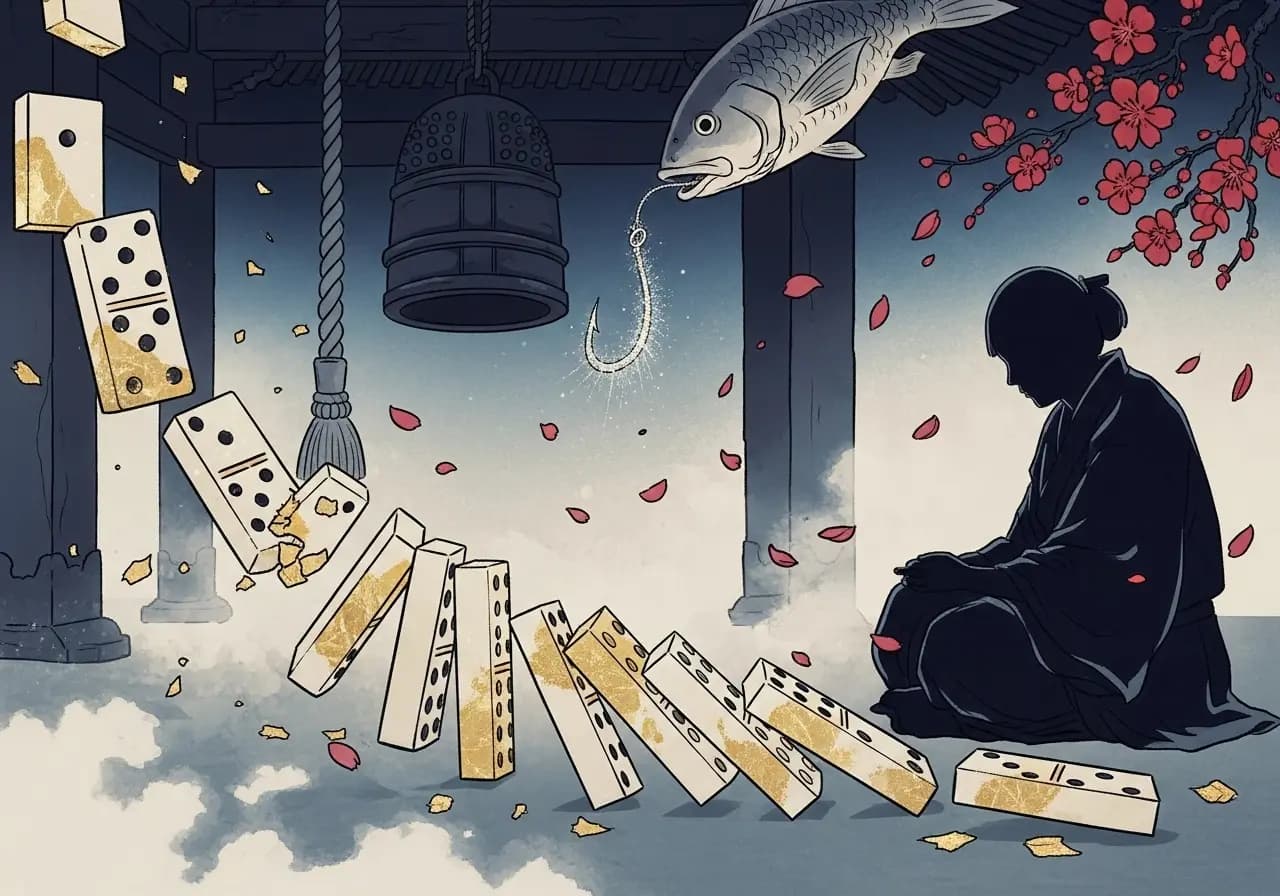
Let me start off by painting a picture in your mind. I'd like to use the analogy of a fish.
The Fish and the Hook
A fish is swimming along and it sees something floating in the water. It bites it. It bites the bait, and suddenly it's hooked. Now from the moment that the fish takes that bite and it's hooked, you have a whole series of actions that unfold. The entire sequence of events that follow all started with one decision: "Oh, look at this shiny thing. I'm going to bite it."
Luckily in many cases, the fish that struggles once it's hooked—it has a few seconds to a few minutes, or maybe many minutes if you're looking at the big fish in the ocean—eventually gets unhooked and thrown back into the water. Then it goes about its normal routine. I can only imagine the fish is like, "Wow, what was that?" But then, before it thinks about it, it sees another shiny thing. Maybe it'll try again.
Here's the trick: the reason this works for the fish is because most of the time they see something shiny or curious and they bite it, it pays off. It's like, "Oh, well that was good. That was yummy." It goes on doing this, and every now and then it bites something that gets it hooked.
I like to use that visual as an example of how I think about myself going through life. This to me is one way to look at the entire Buddhist concept and approach of attachment. What it's saying is we are attached to certain circumstances that are based on the actions we took prior to arriving at those circumstances.
So in this sense, we can think of attachment as something that hooks us. What are the things that hook us? Well, I think in our quest to understand ourselves and to become better whatever we already are, it's extremely beneficial to be capable of recognizing our attachments and knowing what are these things that hook us.
The Dominoes
So I like to think of habitual patterns as I would think of a stack of dominoes that are falling. Here's another mental picture for you. When you see dominoes falling—I'm sure you've all seen these—what makes the domino fall is the previous domino falling and hitting it. Then there's this moment where one domino is falling, it hits the next one, and on and on and on.
So in this sense, my current thoughts, my words, and my actions are all like dominoes in a long series of stacked dominoes. This visual helps me be better at asking: what was the domino piece that made this current thought or this current word I'm speaking or this current action I'm taking initiate? Where did this come from? Why am I saying this?
Because things are interdependent, I can always count on the fact that this is because that is. So if I pause to analyze this—whatever this is, whether it could be a thought, a word, or an action—I can gain some insight by looking into what was the "that" that led to the "this." That sounds funny to say, but that's how it works.
Life is like a large series of dominoes falling, and it's all happening really fast, right? We barely focus on the fact that there's just all this movement and motion happening in life. The falling dominoes look like a really fast series of one big fluid motion. But if you were able to slow it down long enough, you would see that what's really happening is there's a brief moment from the time a domino gets hit until it's almost suspended in the air, slowly leaning towards the next domino, and then it hits that one. Then that one also has this ever-so-slight gap of time before it hits the next one.
That's what we're trying to become better at: working with the space we have in the gap between one domino hitting the next domino. So that's why I like this visual example of the dominoes.
With this perspective, we can start to recognize that there is something behind every thought, word, or action that arises. Understanding the chain of reaction that gives rise to whatever the present action is—that's the key to seeing what motivates our habitual patterns and understanding how it is that we get hooked.
Two Levels of Reaction
Now I think it can be helpful to think of this chain of reaction at least at two different levels. At one level, we have the reaction that's taking place to pain that surfaces within us. The pain that surfaces within us is one level, and at another level we have the escaping of that pain within us.
For example, the moment someone says something that you don't like, there's a reaction. The reaction causes certain feelings or emotions to surface or certain thoughts to arise. That's all happening at this one level of the chain of reaction that we can call the level of thoughts.
Then with the feeling or emotion, when that feeling or emotion that arises within us at the thought of what we were just called or told becomes uncomfortable enough for us, it causes the next level, right? The pain they're dealing with at that level of discomfort escapes us and causes the next level of the chain of reaction, which is often where we act or say something in response to what we were feeling or thinking about what had been said.
It's not as simple as saying this is just a chain of reaction. It's more like it's a web of reactions. At any given moment, we all find ourselves somewhere deep within a very complex web of reactivity—from emotions or from actions that we started or actions that have started long before we came into existence. It could be actions from our family or ancestors. It could be actions from our culture or society, and on and on and on.
If you think about it, we ourselves are the result of actions. We suddenly wake up in this life alive, and we're already caught in that web of reactivity. This happens, and here I am.
I don't like to think of this web of reactivity as the problem per se. The problem isn't that, "Oh no, there's this web of reactivity." I like to think of it in the context that in my tiny portion of this web, I can become more skillful at understanding my own role within this large web of reactivity that I can call life.
Can I understand the level of hooking that happens internally with my thoughts and the hooking that happens with my words and my actions? How well can I cope with the discomfort and the pain that surfaces within me? And what does my discomfort and pain give rise to on that next level, right?
So that's kind of how I try to visualize this.
Pema Chödrön on the Urge
Pema Chödrön talks about this whole concept in the context of the urge. She says, "It is the urge to smoke that cigarette, to overeat, to have another drink, to indulge our addiction, whatever it is. Sometimes this urge is so strong that we're willing to die getting the short-term symptomatic relief. The momentum behind the urge is so strong that we never pull out of the habitual pattern of turning to poison for comfort."
It doesn't necessarily have to involve a substance. It can be saying mean things or approaching everything with a critical mind. This is the addictive nature of getting hooked that I think to some degree we all know so well.
In our effort to escape the discomfort and the pain, we get hooked into mindless practices like eating the entire bag of candy, or smoking an entire pack of cigarettes, or binge drinking, or whatever it is. It could be binge-watching shows on Netflix.
Pema goes on to say, "At the subtlest level, we feel a tightening, a tensing, a sense of closing down. Then we feel a sense of withdrawing, not wanting to be where we are. That's the hooked quality. That tight feeling has the power to hook us into self-denigration, blame, anger, jealousy, and other emotions which lead to words and actions that end up poisoning us."
I think that's a very powerful thing to understand about ourselves: this concept of habitual reactivity and habitual patterns.
Beyond Destructive Behaviors
Now, the mindless practices don't have to be things that we typically associate with destructive behaviors. In the examples that we give, we're always thinking of these destructive behaviors, but you can also mindlessly get into the habit of meditating as a form of escapism or abandoning, where you sit and meditate and you abandon the world or your family for hours at a time. Or it could be reading books, or it could be gardening, it could be going to church—it could be so many other seemingly good things. But we get hooked by anything when we're battling the urge to escape our pain and discomfort.
I think it all starts with the underlying insecurity that we all experience due to the fact that we are living in a world that is always changing. We get caught in wanting things to be a certain way and for it to always be that way. Which is funny—we get caught in our desire for some sort of certainty and permanence.
I see this happening all the time with people who are getting into practicing meditation. It can happen that they start practicing meditation and they have a nice or pleasant experience with meditation. Then they measure all future meditation sessions based on that one experience, and then they get really disappointed if they can't repeat that initial experience again. This is kind of that same thing that's happening.
Unhooking: The Practice
Unhooking is about bringing ourselves back to the ever-changing present moment. It's about accepting whatever comes at us and becoming unattached to the stories that we have about how things should be.
It's like we experience an itch, and then we observe that because I feel an itch, the urge to scratch the itch arises. And then what happens if I don't scratch the itch? If I just sit with the urge? It can be a fascinating observation, and you can do this in meditation.
Anytime you sit there and meditate, almost just by thinking, "What if my nose itches?" That's enough to start thinking, "Oh, I better scratch it." And there you go, and you scratch your nose. But what would happen if you felt the urge, if you experienced the itch, but then you observed the urge to scratch and then you don't do it? What would happen? That can be a really fascinating observation and a fascinating practice.
So we all experience this process of getting hooked into the chain of reactivity. Many of us spend a lot of time, effort, and even money trying to avoid the discomfort that arises at that first level where pain or discomfort first arises in our thoughts. We all experience the itch and the subsequent urge to scratch the itch.
So the question becomes: how do we overcome that urge? How do we overcome our attachments?
Understanding, Not Eliminating
I want to highlight something here that's very important. I want to be clear that the point of this practice is not about eliminating the urge. It's about understanding the urge.
I mean, you can sit there in meditation and you're not going to reach this point where you suddenly never feel the urge to itch. The urge is a natural response. It's kind of like in the koan of the bell—the point of the koan to me is not about eliminating that bell or eliminating the routine that you have after the bell. It's about understanding the relationship between putting the robes on and hearing the bell ring. It's about understanding the relationship between the stimulus and the response.
If you don't understand that relationship and why it's taking place, then you're doing this mindlessly. But if you do understand that there's a relationship, and when this happens, I do this, and I know why I do it, then that's fine. That can be a very skillful thing if you know why you do it.
The Practice: Recognizing the Gap
So back to this concept of unhooking habitual patterns. For me, the practice starts with having a deep understanding of yourself, and it requires a lot of listening to yourself and a lot of introspection.
If we go back to the visual of the falling dominoes, I think the key to the practice is to be able to pause just long enough to start to see the gap of time between the start of the falling domino and the moment it strikes the next domino to continue in that chain.
What happens in that gap of time? If we can increase the amount of time in the gap, we start to have more power over what happens next. Am I going to let the domino fall this way or fall that way? Is it going to strike this domino over here or is it going to strike that domino over there?
Before you know it, it's like you can catch yourself feeling the intense anger inside of you and observing that anger. Then realizing that the anger didn't burst out into words or actions. It could be that you see and feel the urge to reach for that next candy or that next cigarette or the next drink or whatever it is. But before you know it, you've changed the relationship you have with the way that you experience life.
The urge can arise, but it doesn't have to lead to the action that usually takes place to satisfy the urge. To me, that's the key in all of this.
The First Step: Recognition
The process for practicing all of this starts with first recognizing it. What are my habitual patterns? Again, like in the koan that I shared: when the bell rings, I put on my robes. So that's the initial observation. That's a habitual pattern. So I want to understand: why do I do it? That's the invitation of that koan, right? He says, "Why? Why do you do it?"
Meditation is a great place to start this practice. We sit there and we observe our breathing. We learn to open and relax to the experience as it unfolds. I'm breathing in, and then I'm breathing out, and then I'm breathing in, right? I'm noticing whatever arises in this process.
So meditation teaches us to experience the discomfort and the urges that arise and to not interrupt that experience. We don't have to chase after our thoughts. We're not trying to control our thoughts or control anything. We're just practicing the art of observing.
We become good at sitting with the urge to scratch the itch, and that's it. That's the key. That's the secret. The secret was never to get rid of the urge. The secret was that we can learn to observe that there's the urge to scratch the itch and that's it. It's just an urge.
This is how we learn to alter the chain reaction of habitual patterns that will otherwise control how we live our lives. This is the start of how we change the patterns that keep us hooked to those rocks. Like I mentioned in the last podcast episode, the rocks that often cause us more discomfort than they do comfort.
A Gradual Process
Keep in mind, this isn't an overnight fix. Our observations don't always get it right. You'll make assumptions about why you experienced this urge or what this urge says, and you may get it wrong. There are many complex layers to our habitual reactivity, but we're basically headed in the right direction when we learn to focus inward and we start to pay attention to the places deep within us that are currently not very well understood—the places where these urges arise from.
I think those places are the key to a journey towards greater inner peace and greater contentment.
The Invitation
So the invitation of this topic and the invitation of the Zen koan that was shared, for me, all comes back to this introspective questioning of why.
Again, in the koan, he says, "The world is vast and wide." To me what he's saying is there are a lot of reasons for why things are the way that they are. Why is it that when this happens you do that? That to me is, in a nutshell, what he's saying in this Zen koan, and that's a very profound invitation to be introspective of my actions in my own life.
There's all these different ways that things can be. Life, or the world, is vast and wide, like he says. So when this happens, why do you do that? Insert whatever the "this" and the "that" into that equation and analyze it and see what happens for you.
Closing Notes
Okay, that's all I have for this podcast episode. So thank you for listening and for being a part of this journey with me.
If you'll recall in past episodes I've mentioned an upcoming mindfulness trekking retreat in Nepal. Well, that trip is finally here. It's this week that I'm headed out to Nepal with twenty podcast listeners who are joining me on a fifteen-day trekking expedition and mindfulness retreat.
So that means it's going to be a few weeks before, likely, I get to upload a new podcast episode. I'm looking into the option of maybe trying to prerecord one and have it upload, but I don't know exactly how that would work. So just keep in mind, it may be a few weeks before you hear another podcast episode. I apologize for that gap. I've been on such a good roll doing this weekly for what—three, almost four weeks in a row now. So I apologize for that delay, but stay tuned for a new episode when I get back from the trip.
If you want to support the work I'm doing with the podcast, consider becoming a patron and joining our online community where we discuss these weekly Zen koans and the weekly podcast episodes and more. There's even a study group there if you're interested in really diving deep into Buddhism. You can learn more about the online community by visiting secularbuddhism.com.
As always, if you enjoyed this podcast episode, please share it with others, write a review, or give it a rating in iTunes. That's all I have for now, and I look forward to recording another podcast episode soon.
The Next Koan
But before I go, here is a new Zen koan for you to think about while you wait for the next podcast episode.
Manjushri Enters the Gate
One day, Manjushri stood outside the gate. The Buddha called to him, "Manjushri, Manjushri. Why do you not enter?"
Manjushri replied, "I do not see myself as outside. Why enter?"
That is the Zen koan. Give that one some thought, and until next time.
For more about the Secular Buddhism podcast and Noah Rasheta's work, visit SecularBuddhism.com