

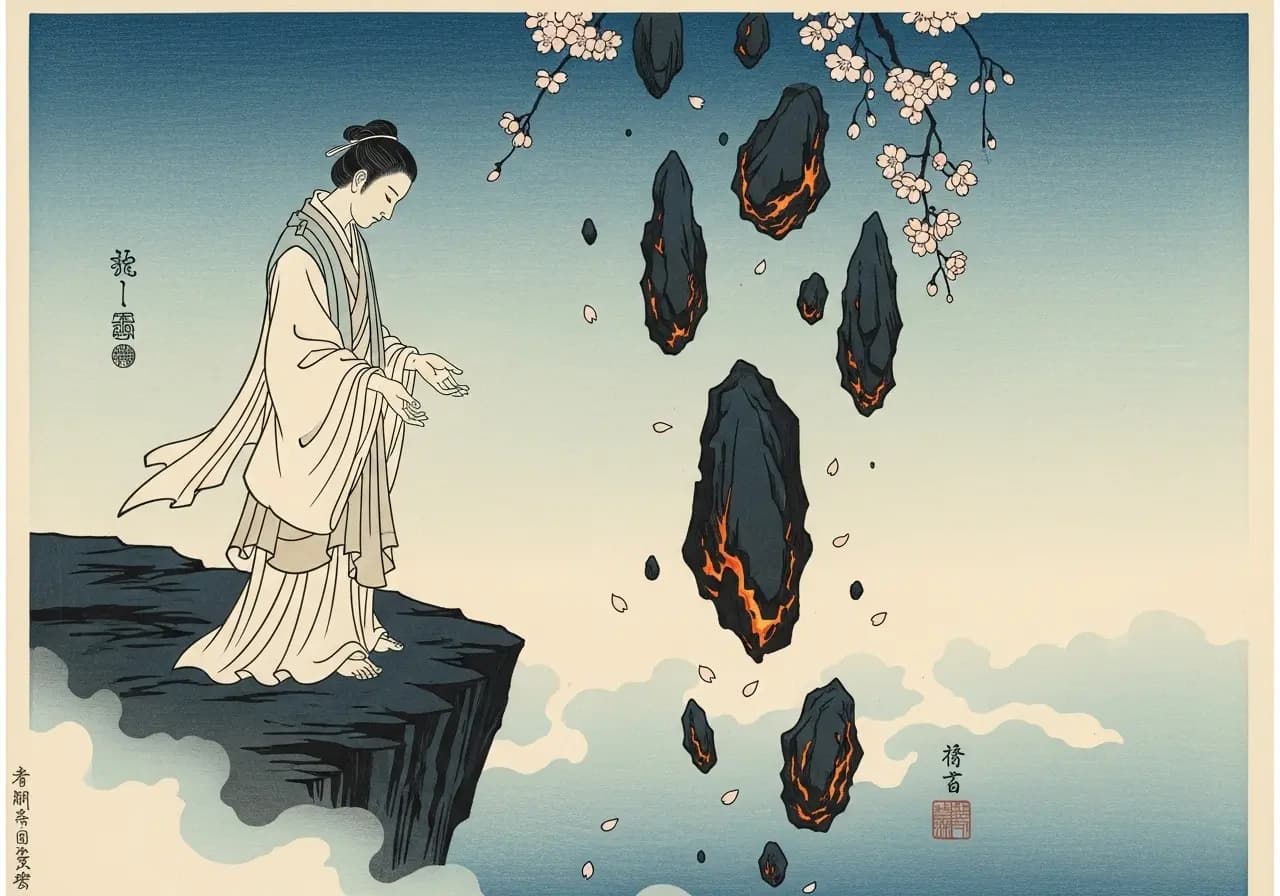
Beware of Flying Rocks
Episode 114 of the Secular Buddhism Podcast
Hello and welcome to another episode of the Secular Buddhism Podcast. This is episode number 114. I'm your host, Noah Rasheta. Today I'm going to talk about falling rocks. And remember: you don't need to use what you learn from Buddhism to be a Buddhist. You can use this to learn to be a better version of whatever you already are.
A Note on Language and Skillful Means
Before we jump in, I want to give you a quick reminder about language. It's common when learning about Buddhism to hear words like "skillful" and "unskillful" being used when referring to aspects of the Buddhist path. This comes from a Sanskrit expression that's central to Buddhist teaching: "skillful in means."
Skillful means is a concept that emphasizes that a Buddhist practitioner may use their own methods or techniques on the path to enlightenment depending on their specific circumstances. The Buddha was known for adapting his teachings to the specific person or audience he was addressing, taking into account the listener's particular needs and skill level. In this way, we can adapt Buddhist practices to conform to our own individual needs and circumstances. This is what we call skillful means.
Now, considering this idea of skillful means, I want to circle back to last week's podcast episode, where I spoke about right speech, one of the spokes on the Eightfold Path. I want to remind you that the tools I shared about the iMessage formula are just meant to help you be more skillful with your communication. Communication formatted in the iMessage structure doesn't, in and of itself, constitute right speech. It's just a tool, and any tool can be misused or abused. If someone were to take advantage of the iMessage format to try to manipulate their listener into acting a certain way, then that is certainly not right speech.
So keep this idea of skillful means in mind anytime you're learning about Buddhist concepts, ideas, or teachings—and especially keep this in mind when I'm sharing something on this podcast. Nothing I share is meant to be authoritative in the sense of being a final word: "This is the way." It's only meant to be shared as another way of thinking about things. This is a way, not the way.
Right speech is a very broad topic that could be explored for hours and probably deserves an entire book. What I shared in one short podcast episode last week isn't meant to be a definitive understanding of what right speech is. The goal of what I was trying to share is simply this: here's a tool. It may work for you and your circumstances. It may not. The whole point of exploring it isn't about deciding how someone else should or shouldn't speak. This is meant to be introspective. It was presented so that one could look inward and ask, "Am I being as skillful as I can be in the way that I communicate with others?" Make this very much about you and how you communicate, not about saying, "That's not the right way," if others are using it or not.
There's simply so much complexity to this one topic, and I want to be careful. It's not right speech to think, "Oh, well, I speak in these new iMessage formulas where I feel this when you do that, therefore can you please..." Boom. Now I'm using right speech. It's not that. It's meant to be one more tool in your toolkit to understand yourself more deeply. You can ask yourself: Am I speaking skillfully? Do I understand what I'm really trying to communicate, and why I'm communicating it, and to whom, and when, and how? All of those things, combined with many other factors I wasn't able to mention in that episode, will help you determine if you're being as skillful as you can be in your communication with others.
I wanted to clarify that because I acknowledge that this—and any other topic—could be easily hijacked. Someone could misuse this tool or this concept, and then claim that's right speech. And you would be absolutely correct. That would not be right speech.
So as Forrest Gump would say, "I think that's all I have to say about that."
The Zen Koan: No Cold and Heat
Now let's talk about the Zen koan I shared in last week's episode: "No Cold and Heat."
As a reminder, here's how it goes:
A monk asked Tozan, "How can we escape the cold and heat?"
Tozan replied, "Why not go where there is no cold and heat?"
"Is there such a place?" the monk asked.
Tozan commented, "When cold, be thoroughly cold. When hot, be hot through and through."
For me, this koan is really about the poisons of desire and aversion. If you'll recall the concept of the three poisons in Buddhism, two of those are desire and aversion. And it's important to note that there's nothing wrong with being cold. There's nothing wrong with not liking being cold. But the moment I feel aversion to the cold—the moment I resist it—I'm adding a new layer of suffering. I'm cold and I'm upset that I'm cold. Or I'm cold and I'm feeling that I shouldn't be cold. It's like the second arrow. It's like you're adding more arrows than necessary.
It's okay to just be cold. It's okay to just be hot. But it's that desire—that desiring for things to be other than how they are—that adds a new layer of suffering on top of whatever discomfort you're already experiencing from simply being cold or hot.
I think this has to do with the relationship I have with the feeling. And I see this every year because I live in a place where we have all four seasons. As soon as summer comes around, everyone's excited that it's summer. But give it a month or so, and then people are complaining about how hot it is. Or it goes the other way—by the end of summer, people are like, "Oh, I can't wait for that first snowfall." As soon as it snows, they're posting pictures. Give them a few weeks and they're talking about how they can't stand the winter, how miserable it feels to be cold. They can't wait for summer or spring. I see that all the time. And I often feel it myself.
We're always wanting things to be other than how they are. And I think that's what this koan is inviting us to do—why not just be with whatever it is that you're experiencing right now? For me, this koan is an invitation to be with what's actually there.
And I think that's especially relevant when I apply this to emotional states, not just physical sensations like heat or cold. The koan could just as easily say: a monk asked, "How can we escape happiness and sorrow?" And the reply would be, "When happy, be thoroughly happy. And when sad, be sad through and through." Whatever I'm experiencing, I try to allow myself to fully experience it.
Working with the Koan
I found myself thinking about this koan all week. One of the things I like about this format of sharing koans is that you get to sit with them, to think about them over several days. And this week, I found myself experiencing several moments of discontent and suffering over small things because I had several obstacles come up.
One of the big things I've been working on since I got here is trying to get my voter's registration card. I lived in Guadalajara before, in the state of Jalisco, and now I live in a different state of Mexico, Quintana Roo. I wanted to get a local registration card because you get discounts at the big theme parks. So I've been working on this for five months now, and it's been obstacle after obstacle after obstacle.
The first problem was realizing that the name on my Mexican nationality is missing my second last name. Here in Mexico, we have two last names—your paternal and maternal last name. On my official paperwork, I only have one. So that was problematic because my Mexican passport has two, and my voter's registration from Jalisco has two. When I tried to switch to this state, they ran into this issue where they said, "The supporting documentation you have for your Mexican citizenship only has one last name. The quick solution is to get an actual Mexican birth certificate."
So I submitted everything for that, and it was a long process. I had to order the long format from Texas, where I was born. That was a two-month process. Then it arrived and I realized it needs an apostille—that's "apostillado" in Spanish—certification for international purposes. That took time and money. Then when it arrived, it had to be translated by a certified translator. More time. More money.
Then I turned it all in and found out that the last name on my birth certificate from my mom is wrong. She has her first name and middle name reversed. On all her official paperwork, she's Maria Teresa, but on my birth certificate, she's Teresa Maria. I went to pick everything up on Friday—five months in the works—and finally I was going to get my birth certificate sorted. Except I couldn't pick it up because they detected this error. Now they're saying I have to change my last name, and the state of Texas told me that's a three- to four-month process.
I was immediately feeling a lot of discontent and frustration because I was so close to finally having this resolved.
Sitting with Difficult Feelings
This was one of those moments where I was feeling really hot, and I didn't want to feel what I was feeling. So I sat with myself and asked, "Why is this bothering me so much?" And I allowed myself to really feel it.
After a few hours of sitting with this frustration, I realized something. The irony of the entire thing is that the only reason I'm trying to get my voter's registration is to go get a discount at theme parks. The amount of money I've paid and the entire process to get this new voter's registration is already more than I would have paid if I'd just gone to the park and paid full price ten times over. And it's almost comical.
Once again, Pema Chödrön's quote popped into my head: "The most difficult times for many of us are the ones we give ourselves." And that allowed me to break out of that funk and realize, okay, I just need to sit here and be with what I'm experiencing—frustration at a never-ending road of obstacles. I don't know what's going to happen next. I think I'm going to continue trying because at this point I just want the ID. I want to have my voter's registration for the state where I actually live now. But I may give it up. They told me they'd let me know on Monday what the next steps need to be.
But what I noticed this week while keeping in mind this koan about hot and cold was that I was experiencing a strong emotion. And one of the reasons the emotion felt so intense was because I was thinking I shouldn't feel this way.
It's like: "Oh, I'm frustrated."
"Well, you shouldn't be frustrated."
"Well, why not? I can be frustrated."
And allowing myself to be frustrated actually allowed the frustration to pass way faster than if I'd spent days sitting there thinking, "I am such an ungrateful person for allowing myself to get frustrated over something so insignificant and meaningless in the big picture."
Yeah, as insignificant as it is in the big picture, it still feels frustrating. And why not just allow myself to feel frustrated for a moment? By allowing myself to fully feel it and sit with it, it passed much quicker. And I only know that because, as I've mentioned many times before, I've experienced this with much stronger emotions—like hatred—and let that fester for years rather than just allowing myself to acknowledge that what I'm feeling is hatred. And then it finally went away.
Falling Rocks: The Main Topic
So jumping into the main topic for this week: "Beware of falling rocks." What do I mean by that?
I've used this analogy before. I believe I shared it in an episode on groundlessness. But I want to emphasize this and go a little deeper today. So I'm going to repeat the story.
Imagine that you're standing at the edge of a bottomless cliff. Suddenly, the rock you're holding onto as you look over the edge gives way, and you find yourself falling while grasping that rock. At first, this is scary because you've fallen off a cliff, right? But with enough time, you relax and you remember: this is a bottomless cliff. There's nothing to stop your fall.
In that moment, you realize you're still hanging on tightly to that rock. And the rock does nothing for you except possibly provide some comfort. So you decide to let it go. When you do, you realize you're still falling. The rock's still falling there next to you. Nothing has changed. And yet, you become a little bit more comfortable with the discomfort of not having a rock to hold onto for comfort during your fall.
In Buddhism, this idea is called groundlessness—which I talked about in an earlier episode. But I think in life, we tend to rely on these rocks, these things to hold onto or stand on, and they act as our foundation for comfort. These rocks can be people, relationships, ideas, beliefs. They can be the amount of money we have in the bank. They can be our jobs and our titles. There are countless possibilities.
But the concept of groundlessness implies that as long as there's a rock, there will also be fear and discomfort around losing that rock. So we grip these rocks tighter and tighter, often failing to realize that our tight grip is actually causing more discomfort than the comfort the rock provides us by just being there. The idea instead is to ease the grip and learn to let go of the rock.
Now, letting go might be a big, radical thing. But it could just be a matter of, for now: what if I loosen my grip on the rock? See what happens.
To experience groundlessness is to have that proverbial rug pulled out from under us. Our new foundation becomes the foundation of having no foundation. We become more comfortable with the discomfort of having no ground to stand on, having no rock to hang onto. And ironically, the end result is we have more peace and more comfort. We become comfortable with the fact that we're falling, and that's it. No rock is going to change that fact.
And add to that: there's no fear. Because there's no fear of losing the rock if you're not holding a rock in the first place. There's no fear of having that rug pulled out from under you if you don't have a rug there to begin with.
Understanding Our Rocks
Let me talk about these rocks. I like to think about the things I'm not willing to let go of. What am I gripping onto so tightly? This has evolved quite a bit for me over the last few years because I've spent a lot of time thinking about these rocks. But you can do this yourself.
Ask: "What does this rock do for me?"
I like to picture Gollum in Lord of the Rings, holding onto his precious and not realizing the unspeakable pain and suffering he's experiencing because of his attachment to this ring, his object, his precious. He can't see it in the moment. But as the audience, we can see it, and it's like, "Come on, let go of that thing."
Well, that's all of us. We're all going through life in this free fall. And the journey of life is that free fall. We don't know when we hit bottom. We don't even know if we hit bottom. And we're hanging onto all these rocks. I like the expression: "Beware of those falling rocks." Because there they are, falling at the same rate we're falling. If I look this way, there's a rock. Oh, there's another rock. Over time, I've clung onto some of them. One, I put in my pocket. Another one, I strapped to my back. Another one, I tied around my foot.
But then there are some that you're physically gripping so tightly that your hands are bleeding and you have blisters. You don't realize that the discomfort of gripping the rock outweighs the comfort of gripping it.
And that's when it becomes a really powerful thing to sit and see that, to notice it in ourselves, and say, "Hmm, maybe this tight grip is what's causing me discomfort, right?" There's already a baseline of discomfort—we're falling. We're all experiencing that. We're alive. We don't know how or when this journey ends, but we know it's coming, just like that fall. You're falling and falling and falling, and we all know that eventually it stops, or at least that's what it seems like. So we can pause and ask: "Well, why am I hanging onto this so tight?"
Why Care About the Rocks?
Now, if you ask, "Well, why do we care about these rocks? Why not just fall while holding them?" You can. You absolutely can.
If I explore, "Why do I even need to be careful about the rocks I'm holding?" For me, it goes back to the matter of skillful means. Is there anything inherently wrong with gripping a rock really tightly? No, not at all. But what if the rock is causing you more discomfort than comfort? Oh, well, now we've got something to talk about.
Because we're trying to live a life of minimal suffering, or ideally, the elimination of suffering, right? That's what we talk about in Buddhism. What if the cause of the suffering is that we're so desperately clinging to this thing? What if we're so desperate not to feel discomfort that we hang tight to this rock? And yet, that's the very thing that's causing you discomfort—a form of discomfort you hadn't even thought about. You could let go of that level of discomfort and then sit with just the original discomfort: "Oh no, I'm falling." And that one would be enough. That one's manageable if you could just sit with it long enough.
That, to me, is where this becomes a powerful way to engage with this concept: what if the rock is causing you more discomfort than comfort?
I want to highlight something important here: it's not the rock that's the problem. Whatever that rock is—the belief, the idea, the opinion, the relationship, the person, whatever—that's not the problem. It's the attachment to that thing. Because remember, you can let go of it and there it is. It's still there next to you. But the death grip is what was causing so much discomfort, not the thing itself.
What to Do About the Rocks?
So what do we do about these rocks? What we can do is learn a lot by paying attention. That involves becoming familiar with the rocks you're holding. Notice them. Look around and notice: what are the rocks that others are holding? This is especially relevant among people close to you—family and friends, loved ones. These rocks are precious items to us and to them.
You can look around and see: "Oh, uncle so-and-so, I see that's why he's gripping that rock so tightly." Or, "Oh, here's my friend," or "Here's the person at the store," or "The neighbor next door," or "Here's my family member." Look at anyone, really, and you can start to see through this lens: we're all just scared of falling. And here we are falling, so we're gripping things and holding on tightly to them.
When I start to see that in myself and in others, it gives me a great sense of compassion. I recognize that their relationship, their belief, their political views, their comforting opinions, their wealth, their prestigious accomplishments—all of these are their rocks. It could be as simple as the amount of likes they're trying to get on their social media posts, or whatever it is. It's just a rock that provides comfort during the fall.
For me, this helps me pause from time to time. Not just to look at my own rocks—which ones am I gripping so tightly today?—but also to look at others and ask with compassion: "Do these rocks provide more comfort than discomfort?"
Letting Go of Important Rocks
I've had to let go of some very important and meaningful rocks in my life. Rocks that, at times, I would have said you'd have to pry from my cold, dead hands. And yet, because of circumstances or insights, at one point I realized that hanging onto this was more uncomfortable than just free-falling. So I let go of it.
I've only been able to do that by realizing, again, that the pain of the grip was more than the comfort of holding the rock. And even then, it wasn't easy to let go because it's scary. What am I going to do without my rock? Here I am falling. I don't want to just fall alone.
But luckily, I found that I'm still here, just falling. And so is the rock. The rock that I finally let go of—it's right there next to me. It's still falling there next to me. But the difference is my fingers aren't bloody. They're not bruised or blistered because of the grip I had on that rock. And that rock is still there.
Changing Your Relationship with the Rock
I want to emphasize that this isn't necessarily about letting go of the rock and saying, "I have to let go of it." This is about changing the relationship you have with that rock. What if it was a matter of letting go of the rock for a minute, spinning it around, and realizing, "Oh, I can hold it now, and I've developed a more skillful way of holding this rock. Now it doesn't cause me and others so much pain or discomfort because I switched around the grip I had on it." That's a valid way to look at this too. You don't have to let it go.
Now, I do think in Buddhism, it's more about: "Well, if you rearranged your grip and found that beneficial, imagine if you didn't even have to have a grip on it. What if you didn't have to have the rock at all?" I think that's a valid position as well. That's one I like to explore. But I'm saying this because it doesn't just mean you have to let go of the rock. It could be a matter of, "I'm going to see if there's a more skillful way of holding onto this rock." That's also a valid step in the right direction.
How to Work with Rocks
How do we start to work with these rocks? Again, I don't think it's about just throwing the rock away. It could be a matter of learning to loosen the grip and seeing what that does. Do your hands and arms feel better because you loosened your grip? Maybe that's all it took—a loosening of the grip. It could be an entire letting go as well. But it's something to start looking at and exploring.
We're all falling, right? And the rocks are all here. We can be aware of the falling rocks—which ones are worth hanging onto? Is this a really sharp rock with pointy edges? The tighter you squeeze onto it, the more it cuts into you. Some rocks are hard. Some are sharp. Some are smooth. Some are easy to hold onto. Some of them you can hold really tight and it doesn't really do anything other than make your muscles sore from squeezing so hard.
But there may be some that are still warm, like lava, and they're a little bit painful to the touch. If you're hugging it and holding it tight, you may be experiencing a lot of discomfort because of the nature of the rock itself, not just because of the tight grip you have on it. But you have to be skillful to be able to look at your rocks, put them there in front of you, and say, "Is this one a good one? Is this a hot one? Is this a sharp one? Is this a pokey one?" And understand your rocks. "Oh, well, this one is... why am I using that one? Why am I hanging onto that one so tight? That's a pokey one, right?" It takes skillful means to understand our rocks.
But all of that starts with the process of being able to acknowledge: here I am falling, and here are all these rocks. What are these rocks doing for me? The ones that seem to provide me a lot of comfort—well, do they really? Maybe they do. Or maybe I realize, "You know what, as much comfort as I thought this rock was providing, it's actually providing me more discomfort because I'm still gripping so tightly to it." That's part of the introspective quest you have to discover for yourself by looking at your rocks.
What are your rocks?
Compassion for Others' Rocks
And then allow other people to have that same sense with their rocks. It's not fair for you to go around pointing at someone else and saying, "Hey, you need to let go of that rock." What are they going to do? They're going to hold onto it tighter. "Oh, you want me to let go of this? Yeah, right," and now they're gripping it even more tightly. That's what happens, right? So we don't need to go around telling people to let go of their rocks.
Again, as with all the things I share on this podcast, this is an invitation for you to look at your rocks only. Sure, I think it can be beneficial to look at someone else's and think, "Ah, I see what's going on there. You're holding onto that thing so tight that your hands are bleeding. But you don't see that. But I do. So now I'm going to be a little bit more compassionate with how much that rock means to you." I think we can do that.
Closing
So those are the things to think about. That's all I have for this podcast episode. As always, thank you for listening and for being a part of the journey with me.
If you want to support the work I'm doing with the podcast, consider becoming a patron and joining our online community where we discuss these topics, the koans, and podcast episodes. I do Q&A sessions and there's even a weekly study group. You can learn more by visiting SecularBuddhism.com.
If you enjoyed this episode, please feel free to share it with others, write a review, or give it a rating on iTunes.
Before I go, I'm going to leave you with your Zen koan to work with this week. The title is "Bells and Robes."
Here's how it goes:
Zen Master Unmon said, "The world is vast and wide. Why do you put on your robes at the sound of the bell?"
Give that some thought for the week. I'll share my thoughts on it in next week's episode. Thank you for listening. Until next time.
For more about the Secular Buddhism Podcast and Noah Rasheta's work, visit SecularBuddhism.com