

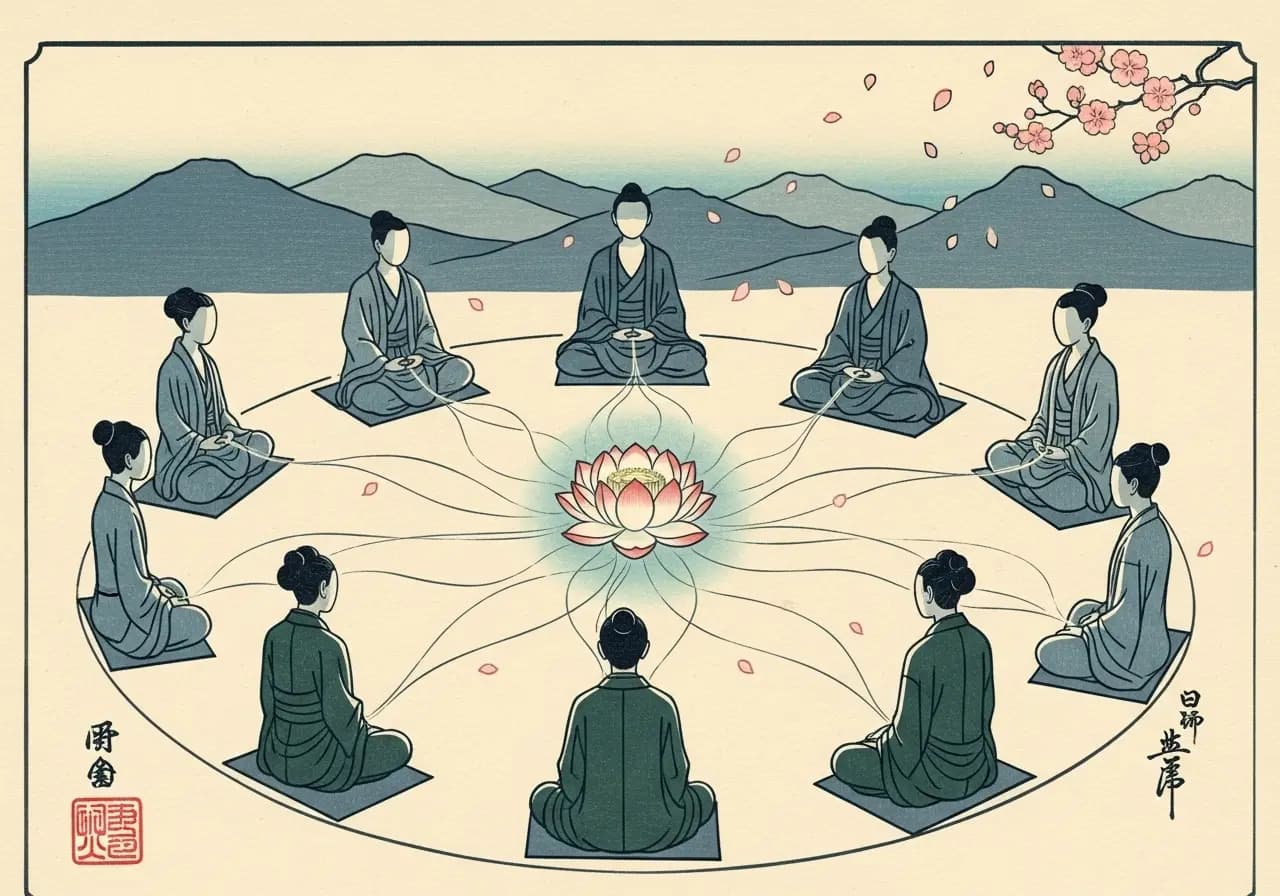
The Importance of Community
Episode 112 of the Secular Buddhism Podcast
Hello and welcome to another episode of the Secular Buddhism podcast. This is episode number 112. I'm your host, Noah Rasheta. Today I'm going to talk about the importance of community. As always, keep in mind you don't need to use what you learn from Buddhism to be a Buddhist. You can use it to learn to be a better whatever you already are.
The Nothing Exists Kōan
Let's start with a discussion about the Zen kōan I shared in the last podcast episode. This kōan is titled "Nothing Exists."
"Yamaoka Tesshū, as a young student of Zen, visited one master after another. He called upon Dokuon of Shikoku desiring to show his attainment. He said, 'The mind, Buddha and sentient beings, after all, do not exist. The true nature of phenomena is emptiness. There is no realization, no delusion, no sage, no mediocrity. There is no giving and nothing to be received.' Dokuon, who was smoking quietly, said nothing. Suddenly he whacked Yamaoka with his bamboo pipe. This made the youth quite angry. 'If nothing exists,' inquired Dokuon, 'where did this anger come from?'"
This is a fun kōan to visualize. Here comes this student, really trying to show off to this new Zen master, demonstrating how smart he is and how much he understands the concept of emptiness. So he lays it all out, gives him the complete answer, and the master hits him—smacks him with a bamboo pipe. Then the master notices the anger that arises and asks him: well then, where did that anger come from?
For me, this kōan is a reminder of the importance of understanding that "nothing exists" within the context of interdependence and constant change. I think it's a common mistake in the early stages of studying Buddhist teachings. The misunderstanding is that "nothing exists" means everything's just an illusion—I don't exist, this doesn't exist. That's one interpretation, and this Zen master immediately points out by making him feel anger and then asking: what's that? Where does that come from?
I like to correlate the view of "nothing exists" with the concept of no-self. When these teachings refer to concepts like no-self or no existence, it's only in the context of an independent self—there is no permanent self. In other words, there is no me that exists without all the things that are not me.
I use the example of the flower that Thich Nhat Hạnh talks about. If you've seen a flower and all you saw was the flower, then you haven't really seen the flower. That is at the heart of understanding "nothing exists." It means nothing exists in and of itself without all of its causes and conditions that allow that thing to exist. That's very different than just saying "nothing exists."
This is especially relevant when we start talking about the view we have of ourselves. It's not that we don't exist—it's that we might not be what we think we are. We're not the solid self that exists from moment to moment without changing. The reality is we're constantly changing. The me of now is not the same me of a week ago or a year ago. And that continues into the future.
But also in terms of interdependence: the me that is me is not me without all these other things that are not me. The food that I ate today is now part of me. It's in my muscles. The air that I breathe is now in my bloodstream. Oxygen is being carried to the muscles that support me right now as I'm talking.
There are all these elements of me that are not me. So the illusion isn't that I don't exist—it's that there's not a me that exists the way I might tend to think I exist, as an independent, permanent self. To me, that's at the heart of this kōan. That's how I understand it. It may mean something different to you, but it's a fun one to work with. It asks: well, where did this anger come from if anger isn't real? If I'm not real, then what is this experience I'm having of being here and existing? Hopefully that makes sense.
Understanding the Three Jewels
Now let me get into the topic I want to discuss today: community. But to understand the importance of community, you need to remember one of the core Buddhist teachings found in all schools of Buddhism—the teaching of taking refuge in the Three Jewels.
Buddhist practitioners take refuge in three different things: the example to follow, the teachings to follow, and the community to practice with. These are typically expressed as the Buddha, the Dharma, and the Sangha. Most schools of Buddhism have a formal ceremony where one essentially becomes a Buddhist or enters the path by reciting: "I take refuge in the Buddha. I take refuge in the Dharma. I take refuge in the Sangha."
I spoke a little bit about this back in episode 41, "Life on the Buddhist Path," but I want to elaborate on it a bit more here.
What Taking Refuge Means
In a literal sense, taking refuge means finding shelter or protection from danger. The ceremony one takes to enter the path or become a Buddhist is called taking refuge. It's like taking refuge under a bridge in a hailstorm or in a basement during a tornado. It's finding a safe place.
Everyone takes refuge in something. If you want to know what you take refuge in, just ask yourself: where do I look for happiness? Where do I seek safety and comfort? Often it's in relationships. It could be in certain locations like a church building. It could be certain activities like being busy at work. But it can also be other things—like manufacturing the image we put out on social media, working on our social status, or the amount of money we have in the bank.
The Buddhist invitation to take refuge in the Buddha, Dharma, and Sangha comes from the recognition that one of the biggest dangers we face is being controlled by our own habitual reactivity and our unskillful thoughts. By seeking a safe place in these three resources, we minimize or perhaps even eliminate the suffering we cause to ourselves and others by being habitually reactive.
I like to think of the process of taking refuge similar to making a New Year's resolution, where we set an intention to be better than we've been in the past.
A Point of Clarification
Here's something important to understand: this expression—taking refuge in the Buddha, the Dharma, and the Sangha—is very ordinary in nature. It's not like we're summoning anything supernatural or spiritual. The power of the simple vow comes from our own sincerity and commitment to what we're saying. In the same way that the power of a New Year's resolution doesn't come from the expression itself but from the action we take following the expression. Let's look at what each of these expressions of refuge actually means.
I Take Refuge in the Buddha
When I say "I take refuge in the Buddha," it's like saying "I take refuge in the example." To seek shelter in the Buddha means to recognize that the Buddha was capable of attaining enlightenment, and therefore so am I.
It's worth noting here that the Buddha is a good example because he wasn't a God. He was just a human like us. His example shows that we too, as ordinary humans, can follow the path to enlightenment that he took. Taking refuge in the Buddha is simply an invitation to see ourselves in him and to strive to attain liberation from our own habitual reactivity and the poisons of greed, hatred, and ignorance in our own minds.
In a broad sense, taking refuge in an example also applies to any example—any teacher, any person who inspires us to follow the path towards liberation.
I Take Refuge in the Dharma
The second one: "I take refuge in the Dharma." To me, this is like saying "I take refuge in the teachings." To seek safety in Buddhist teachings is to recognize that they can give us a new perspective and a profound understanding of ourselves and the nature of reality. It goes beyond just trusting or accepting the teachings. It's about trusting that our practice of the teachings will indeed create a more peaceful and harmonious way of living.
The teachings are found everywhere. You can find them in books, lecture series, and podcasts. They're in local meditation groups and Buddhist temples. And they're even in ordinary everyday life. Most of the things we'd look at and think are ordinary can be profound teachings. Looking at the clouds and seeing the nature of impermanence, or studying a flower and seeing the interdependent nature of the flower with the bees and the sun and the rain.
I think taking refuge in the Dharma is a way of making an earnest intent to learn, to study, to read, and to try to see things differently.
I Take Refuge in the Sangha
And then there's the final expression: "I take refuge in the Sangha." To me, this is like saying "I take refuge in the community." To seek refuge in the Buddhist community is to recognize that by practicing with others, we can find and offer support.
The importance of practicing with others cannot be overestimated. A good friend helps us to see the unskillful actions that we may not see in ourselves. Opening ourselves up to others and allowing them to support us, while we simultaneously support them, is a critical step in overcoming an ego-centered life. When we take refuge in the community, we also become the refuge in the community for others.
Many consider this final form of refuge to be the most important of the three because you can find the example and the teachings within the community.
What Taking Refuge Provides
Taking refuge doesn't protect us from the problems that arise in the world. It doesn't shield us from the inevitable difficulties that arise in life. But it does provide us with the skill set and the tools to relate to life and the difficulties that arise in a new way, and to change the relationship we have with those difficulties. That's what protects us from the anguish and despair.
My Journey with Community
From day one with this podcast, my primary goal has been to share the stories of the Buddha and other great teachers that serve as an example, and to share the teachings that come from the Buddha as a form of inspiring each of us to become a better whatever we already are. That fulfills two of those pledges—taking refuge in the Buddha and in the Dharma, the teachings.
The one elusive part of this teaching—also known as the Three Jewels—has been the third jewel, the third element. I've been trying to practice with communities on my own, visiting different ones and seeing where I fit in with a sense of community. I found a few from time to time. There's one about an hour away from where I live in Utah, but that's a long way to go, and I didn't go very often. I don't have one where I live now.
I've tried a couple of online versions and had some small groups. The closest and most successful thing was leading study groups in the past with the Secular Buddhism teachers course I did. These were six-month programs with around ten people, and we were interacting with each other every week. They were incredibly fulfilling. We developed a strong sense of friendship in the group. They were really great.
The only problem is you're limited in how many people can be in a group. If you're doing one group of ten people for six months, that's a lot of people who don't get to participate in something like that. So I've been thinking about ways to work with all of this on a larger scale, to develop a sense of community.
Why Community Matters
We're hardwired to be social creatures. The truth is, we do better when we're together with the right people. When I say "I take refuge in the community," it's not about expressing devotion. It's about practice. Without having some sort of community, without being supported by a group of friends who are motivated by the same objectives and the same style of practice, it's honestly more difficult to progress on the path.
I recognize that community can be anyone. It can be your friends, your family. At times, my community is my spouse and the things that we talk about. It doesn't have to be practitioners. My wife doesn't practice Buddhism. But it really is helpful to have a group of people who understand the same concepts and ideas that I do, who understand the world the way that I do. That has been invaluable to me—to have friends online that I can communicate with who are putting into practice these very same things I'm trying to do.
In that sense, community is where we practice. The community also offers multiple perspectives. Being able to present a teaching or a concept and then getting the perspective of people in different situations in life—a single parent, a widower, a parent, a child. There are so many different circumstances people can be in, and when we're sharing in a community where there are people in different circumstances, we get different angles.
It's almost like the parable of the blind men describing the elephant. If I'm standing at the front of the elephant and all I can feel is the trunk, it's great to know I can listen to someone standing at the other end describing what the tail is like. It gives me a more accurate picture of what I'm dealing with.
The Challenge with Online Communities
The podcast has grown and continues to grow. It's about to surpass five million downloads worldwide, and we have active listeners now in over fifty countries. I feel like the time has come to offer some kind of perk to the people who are supporting the podcast.
After much thought and trying many different approaches, I've decided it's time to introduce a new way of having a sense of community for podcast listeners. This stems from the fact that the podcast has had supporters for some time—people who are supporting the work I do—but there were no perks for supporting. I didn't like that because it made it feel like what they were supporting was the time I put into making the podcast. But I don't want that to be supported because I do it because I enjoy it. Whether or not I ever collect anything in terms of a donation, I don't like that feeling. The truth is, I do the podcast because I like it, and if I didn't have anyone ever paying, I'd still be doing it. Even if it was costing me money out of my own pocket to continue, I would do it. That's how I started.
But what I've found over time to be time-consuming is interacting with podcast listeners—answering emails with questions or wanting clarification, or when I attempt online communities. I've tried a couple with Facebook Groups. And Facebook Groups are really hard to manage.
First, they grow really fast. The first Secular Buddhism group I created grew to over five thousand people. It was difficult to manage because the vast majority of people joining had nothing to do with the podcast. They were just interested in Secular Buddhism as a general topic. So it started feeling like just a crazy place, with all these people proposing their understanding of this and that. If you've been on Facebook long enough, you know it's not conducive to skillful communication. Then you've got trolls and things that are just unpleasant.
So I made a separate group called the Secular Buddhism Podcast Community, and that was better. But it was also very difficult for me to interact with the group because of the way Facebook works. If somebody posted something, it might be that I never saw it and never commented. If someone tagged me, then maybe I did, but it just felt like a very ineffective way to engage with podcast supporters. And of course, a lot of people don't even like being on Facebook. This was a platform exclusive to people who were on Facebook. If you weren't on Facebook, you had no community to speak of.
Introducing Patreon Community
I've decided to move away from Facebook entirely and I'm excited to announce that I'm launching my own online community using Patreon as the platform.
I want to address why I selected Patreon. It's because of the way the platform works and the structure it provides. I set it at a low price—three dollars a month. I selected that price because I want people to join this community intentionally. I thought about making it even lower, maybe a dollar a month, but my fear is that if you join something just to donate a dollar a month without engaging with it, it's really easy to forget you're even doing it. I don't want someone being dinged a dollar a month and forgetting they're doing it. This doesn't need to be a donation-based thing. I don't want to be compensated for the time I put into the podcast. But I do want to be compensated for the time I put into interacting with you on a weekly basis, answering questions, and doing the things that actually take up my time during the week.
If three dollars sounds like too much, consider this: the average cost per fuel per mile in the US is about twenty cents per mile. If you were to drive to a local meditation group that's two miles away and you go once per week, that's about eighty cents for your round trip. If you do that four times in a month, you're spending three dollars twenty cents just to drive to your local meditation group. I spend forty-five minutes to go to one, so I'm spending considerably more.
Also, the average American spends three dollars a day on coffee. So this is equivalent to one day of coffee for your monthly interaction with the group.
What the Patreon Community Offers
The podcast itself isn't going to change. The content will continue to be published just as it always has. If you're just a listener of the podcast, nothing changes. You won't notice anything, and you don't lose out on anything.
But if you're someone who supports the podcast, there's now an additional perk. There's the ability to join the online community and interact with me and with other podcast listeners, to post questions, and to do all the things that are beneficial to the community. Patrons will have access to:
- Posts with comments and interactions with me
- Weekly discussions centered around podcast episodes
- Live Q&A videos and "ask me anything" posts
- Access to news about the podcast
- Possibly helping me pick what topics to discuss in future episodes
- Access to a weekly study group—a book club where you can get into studying these concepts more in depth with a small group of people all reading the same thing and discussing it like you would at a book club
I'm very excited about these offerings with the launch of this new membership-based community on Patreon.
Is This for You?
If you're looking for a place to build a sense of community with me and with other podcast listeners, this is a new place where you can visit. If you think this is right for you and you join, I look forward to working with you, interacting with you, and spending time with you in this new online community. And if you don't—then don't. This isn't something to feel pressured about. This is just the podcast, and the podcast isn't going to change. If the podcast does everything you need, then keep listening to the podcast. That won't change. But if you do want to engage further, this is that new thing.
You can find all the information by visiting SecularBuddhism.com. At the top in the navigation, you'll see "Support the Podcast." When you click on that, it gives you the option to make a one-time donation if you want, but it also gives you the option to become a monthly contributing member by joining the Patreon community. That's where the link is. That's where you'll see how it works, what you can do, and some of the posts that are on there, because this is live now and it's all functioning.
Closing Kōan
Before I end this podcast, I want to look at another Zen kōan for this week. Here it is—"The Short Staff":
"Shuzan held out his short staff and said, 'If you call this a short staff, you oppose its reality. If you do not call it a short staff, you ignore the fact. Now, what do you wish to call this?'"
I love that one. Think about it and we'll talk about it next week.
That's all I have for this podcast episode. Thank you for listening and being a part of this journey with me. If you enjoyed this podcast episode, please share it with others, write a review, or give it a rating on iTunes. And of course, if you would like to support the work I'm doing with the podcast, consider joining the Secular Buddhism Podcast Community on Patreon. You can learn more by clicking SecularBuddhism.com and clicking on the "Support the Podcast" button.
I look forward to recording another podcast episode soon. Until next time.
For more about the Secular Buddhism podcast and Noah Rasheta's work, visit SecularBuddhism.com