

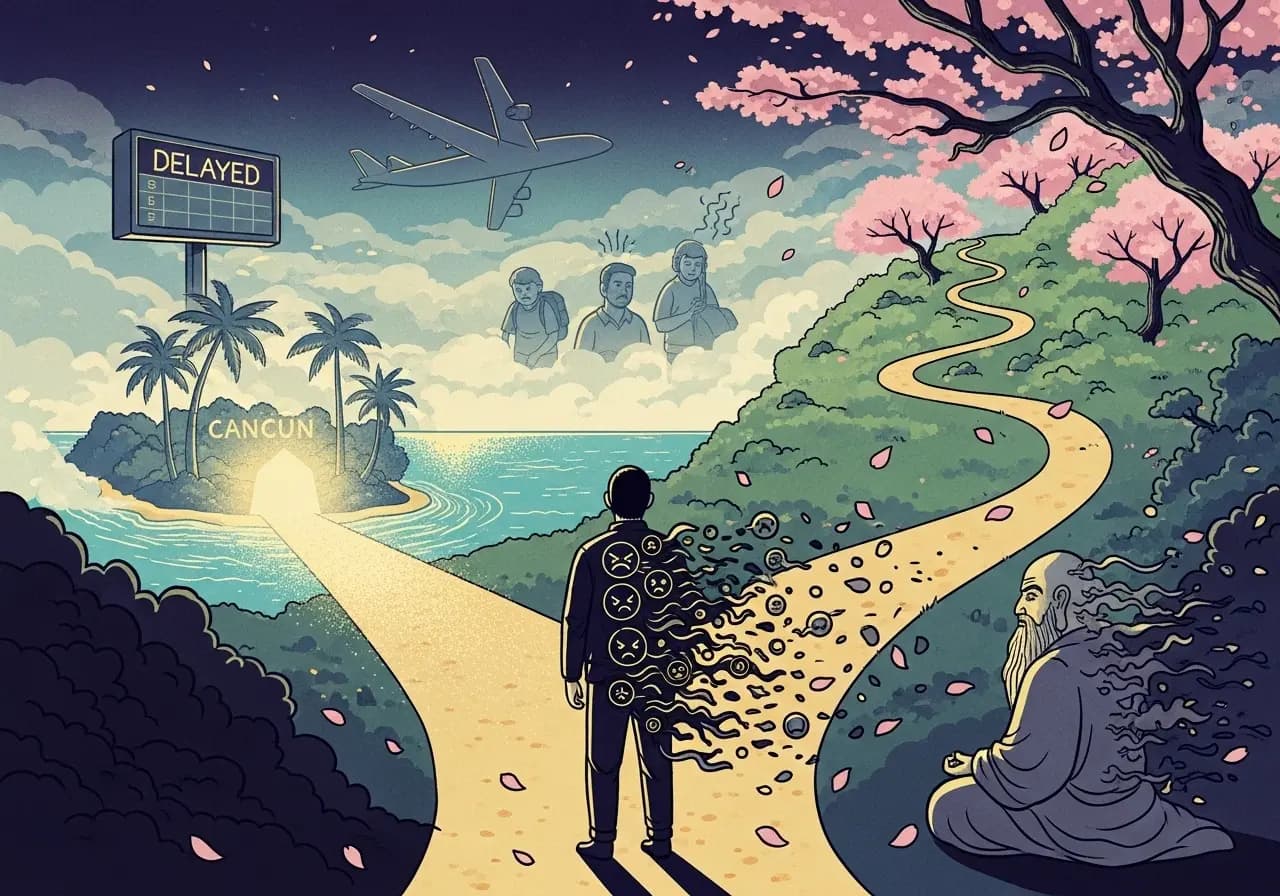
Unhappily Headed Towards Happiness
Episode 110 of the Secular Buddhism Podcast
Hello, and welcome to another episode of the Secular Buddhism podcast. This is episode number 110. I'm your host, Noah Rasheta. And today I'm talking about being unhappily headed towards happiness.
Keep in mind: you don't need to use what you learn from Buddhism to be a Buddhist. You can use it to learn to be a better whatever you already are.
The Zen Koan: Bodhidharma's Beard
Last week, I talked about a Zen koan called "Bodhidharma's Beard." As a reminder, Bodhidharma is the founder of Zen. He's the person who took Buddhist teachings from India and introduced them to China, and he was known for having a large beard. The riddle, or koan, goes like this: when Wakuan saw a picture of bearded Bodhidharma, he exclaimed, "Why hasn't that fellow a beard?"
At first, this seems absurd. Any normal person would think, "What are you talking about? You're looking at a picture of a guy with a beard—a guy known for having a beard. Everyone knows about the beard. And here you're saying why doesn't he have a beard."
To ask this question is confusing, to say the least. The practitioner can meditate on that question all day long and puzzle over it. How do you even answer that? Why doesn't he have a beard when it's so obvious that he does?
If you try to answer the question by saying, "But he does have a beard," you'll be told to go back and look again, to keep meditating. And if you're lucky, with time, the realization will come that the master was right all along: Bodhidharma doesn't have a beard.
So who is Bodhidharma, and what does he actually possess? Like the previous koan that questioned who really has the temper—is it yours, or is it just an experience arising?—we can ask: Is the beard really his, or does it belong to his body? Is Bodhidharma a body, or is he a name? Is he a concept?
Upon pondering these things and contemplating this new perspective on what Bodhidharma actually is, perhaps you'll go back to that Zen master and agree. You'll say, "You're right. Bodhidharma doesn't have a beard. Now let's get on with life." And that is the key to a lot of these Zen teachings. It's okay. So what? Now let's get back to life. Let's get back to the basics. Zen is kind of famous for that.
The Airport Experience
I wanted to talk about a couple of things that have happened over the past few weeks. I've been traveling. I went to my cousin's wedding in Texas. And on my flight back home to Cancun, I noticed a few things that gave me an idea for this podcast.
The title—"Unhappily Headed Towards Happiness"—comes from an experience I had while waiting for the flight from Dallas back to Cancun. And as you can imagine, Cancun is a destination that most people are really excited to head to. It's known as a popular tourist spot, a vacation destination, but it also has a party crowd that comes here to celebrate.
As we're waiting for the flight in Dallas, we received notification that it was delayed. Then an hour or two later, we got word it was delayed again. And it kept getting delayed. By the third delay, we were several hours behind the scheduled departure time, and people were upset.
There was one woman specifically who was very vocal about her frustration. What I found interesting is how she kept talking about needing to get to Cancun. She had people waiting for her. They were supposed to go out and party. She had even started drinking early in the process, before boarding the plane, which only made her experience of these delayed emotions even more unpleasant.
But I had this thought: here we have someone who is eager to head to a place that she thinks is going to fix everything. There's probably a reason why she was headed there, a reason she was so excited to get there. But whatever she was hoping this trip would do for her, she was already bringing with her the unhappiness of the moment. When things aren't going right and you're unhappy, it doesn't matter where you are. If you're in paradise or not, you're going to bring this unhappiness with you.
That reminded me of the Zen koan about the gates of heaven and hell. We learned that the gates of heaven and hell are right here. We're the ones who open them and close them based on the experiences we're going through and how we experience those things.
The Seeds of Unhappiness
This got me thinking about different areas in my own life where I've experienced this sensation of being unhappily headed towards happiness, not realizing that I'm carrying with me all the seeds of unhappiness. Getting there isn't going to fix the problem because I'm only going to arrive and realize there is no "there" there.
I think I see this a lot in people I know who are unhappily headed towards what they believe will be eternal happiness. What happens when we die? We go to this place where we're going to be eternally happy. I know a lot of people who believe that, and it seems like they're very unhappily headed towards this eternal happiness without realizing that they're not happy right now. I've experienced that myself.
Could Wanting to Be Happy Make Us Unhappy?
So what I wanted to explore is this idea: could it be that wanting to be happy is what makes us unhappy?
My experience with this is limited to a couple of very specific experiences that I've worked with in my own life. One of them was going through a faith transition. When I started to evaluate the views and beliefs I had, it was a very difficult experience. I felt like I was perceiving the judgment of others, so my struggle came from not wanting to be judged.
When you leave an ideology that's rooted in the belief of being the only correct path, and you leave that path, people who are still on that path are going to look at you and think, "What on earth are you doing? Why would you leave the one true path?" And that's what I was experiencing. Maybe it wasn't actual judgment, but I perceived it as judgment. What it was, really, was people thinking, "What the heck are you doing? What are you thinking?"
What I started to notice is that in the people I know—family members specifically—this was harder for me. The problem wasn't that I was being judged. As it turns out, being judged wasn't the problem. The problem was that I didn't want to be judged.
So I had two things going on. One was perhaps being judged by people, but the other was my aversion to being judged by people. It was the aversion to the judgment that was actually causing all of the discomfort and unhappiness in me.
The Shift
Once I understood that—that it was my aversion to judgment that was the real problem, not the judgment itself—I was able to start sitting with that and working on my part of it. Why do I feel aversion to judgment? Instead of trying to avoid judgment, which is what I did for quite some time, trying to talk to people and explain myself, trying to find a way to make the people I cared about understand me so that I would feel validated on my path—I started asking a different question.
I started to realize early on that you just can't make people understand a path they're not on. There's no way they're going to understand my path because they're not on that path. In fact, the path they're on prevents them from having any way of validating my path. Of course they're going to think I'm on the wrong path because they believe that theirs is the only right path. There's no way around that.
I couldn't fix what I thought was the problem, which was feeling like they were judging me for being on this path. But what I could fix was the aversion I felt towards being judged. That's where I started to invest my time and energy. Why does it bother me that others might be judging me?
The more I became comfortable with that process, the more peace I started to feel again. And that was kind of the irony. I don't know if any of the perceived judgment that people have of me ever actually changed. I think that people who judge me still judge me. But what did change was my aversion to it. That went away, and that changed everything.
Applying This to the Airport
Taking this line of thinking back to that passenger on the airplane—it's not that we want these ideas, concepts, or teachings to transform our lives so that we're no longer angry or upset when our flight gets delayed. This woman was visibly upset and angry about not being able to get on the plane. In fact, when they finally called us to board, she went right to the front of the line. When they were saying families with kids could board first, she jumped in front of them and said, "I'm going to get on. I've been waiting for hours," totally unaware that all of us had been waiting for hours. It seems odd these days that they put up with that kind of behavior, but they did.
But here's what I'm trying to get at: it's not about not being upset when the flight gets delayed. It's not that. It's that when the flight gets delayed and we experience the unpleasant emotions that arise because of it—and all of us there were feeling that "Oh man, seriously, another delay?"—that's fine. The shift is that we don't feel aversion to the emotions that arise. We're okay with the emotions that are there. If we're upset, we can just be upset. We don't have to be upset and also be upset about being upset.
To me, that is the magic in all of this: becoming comfortable with the discomfort.
The Practice: Questioning Your Identities
I think the koan of Bodhidharma's Beard helps us do that because it helps us look at this angry person, ready to get on the plane, and maybe pause for a moment and pull out this Bodhidharma koan. We look at this person and ask an absurd question: "Why is this person so content?"
It's an invitation to ask: Who actually possesses the unpleasant attitude that I'm experiencing here? Is it the person being unpleasant, or is it the person watching this unfold? Is it me? Is it unpleasant because I don't like how they're acting, or is it unpleasant because of the action itself?
If I wanted them to act that way, then it wouldn't be an unpleasant experience for me to watch this unfold. I'd be clapping and thinking, "Oh, this is so entertaining." That's the kind of exercise I worked with throughout that whole experience—entertaining this Bodhidharma and the beard thing.
So in that moment, you can ask: Is it the causes and conditions that gave rise to this person acting this way? Is that what possesses the beard, or is it Bodhidharma himself who possesses the beard? It's an invitation. It's a mental exercise meant to invite us to think about things from a different perspective.
Your Challenge for the Week
If I were to offer a challenge for the week, I think it would be this: look at yourself through the same lens as someone looking at a picture or painting of bearded Bodhidharma and asking why this fellow has no beard.
For me, what it might be is this: What is something that I really identify with? As I mentioned before, the irony with Bodhidharma is that he was known for his beard. So what are you known for? If I'm known for doing a certain thing—like I'm a paragliding pilot, I like to fly—I could ask myself, "Why doesn't Noah like to fly?" And that would be an invitation to explore something.
What are you talking about? I love to fly. But who is it that loves to fly? Who is Noah? What part of me is it that loves to fly? Is it my brain? Is it in my hands? Is it my feet because they don't have to touch the ground? Is it my eyes perceiving what I see when I'm up high? What exactly is it?
Again, it's an invitation to find "me" in all of this and discover there is no "me" there.
When we do this with ourselves, if you're known for driving a nice car, ask yourself, "Why don't I have a nice car?" Or if you identify with a certain trait or characteristic that you have, question it. And do this with others too. You can really experience some neat emotions and insights when you flip this onto other people.
The person who's known for being angry or upset all the time—say, "Why is this person not angry?" You get the drift. You get the idea of what I'm inviting you to do here. I think that's the invitation of the koan: take something that seems so obvious on the surface and flip it on its head by asking an absurd question like "Why does Bodhidharma have no beard?"
Practice this and see what it does to your sense of attachment to the concepts and ideas you have about yourself and about others. That would be my invitation to you for the week.
Back to the Story
When we finally landed, it's funny now that I think about it. You know how the instant the plane lands, it takes a while to taxi, and it's not until the plane does that little ding sound—indicating we've arrived at the gate—that you can stand up? Well, the instant our wheels touched down, she stood up and started yelling, "Open that door!" Everyone on the plane at that point was just kind of laughing because it was quite entertaining and absurd. But she was very eagerly waiting to get to her happy place, whatever was waiting for her in Cancun.
I hope she found the joy and contentment she was looking for when she finally arrived.
The Real Miracle: A Koan to Contemplate
I'm going to leave you with another Zen koan to think about throughout the week. This is called "The Real Miracle."
A Shinshu priest, who believed in salvation through the repetition of the name of the Buddha of Love, was preaching at Ryumon temple when he heard about Bankei's large following. Jealous of Bankei's audience and wanting to debate with him, the priest appeared while Bankei was in the midst of a talk. But the fellow made such a disturbance that Bankei stopped his discourse and asked about the noise.
"The founder of our sect," boasted the priest, "had such miraculous powers that he held a brush in his hand on one bank of the river, and his attendant held up a paper on the other bank. The teacher wrote the holy name of Amida through the air. Can you do such a wonderful thing?"
Bankei replied lightly, "Perhaps your fox can perform that trick, but that is not the manner of Zen. My miracle is that when I feel hungry, I eat. When I feel thirsty, I drink."
I really like that one. I'll talk about that more next week.
That's all I have for this podcast episode. Thank you for listening. Thank you for being a part of this journey with me. If you've enjoyed this episode, feel free to share it with others, write a review, or give it a rating on your favorite podcast platform.
If you would like to make a donation to support the work I'm doing with this podcast, you can visit SecularBuddhism.com.
That's all for now, but I look forward to recording another episode soon. Have a great week. Until next time.