

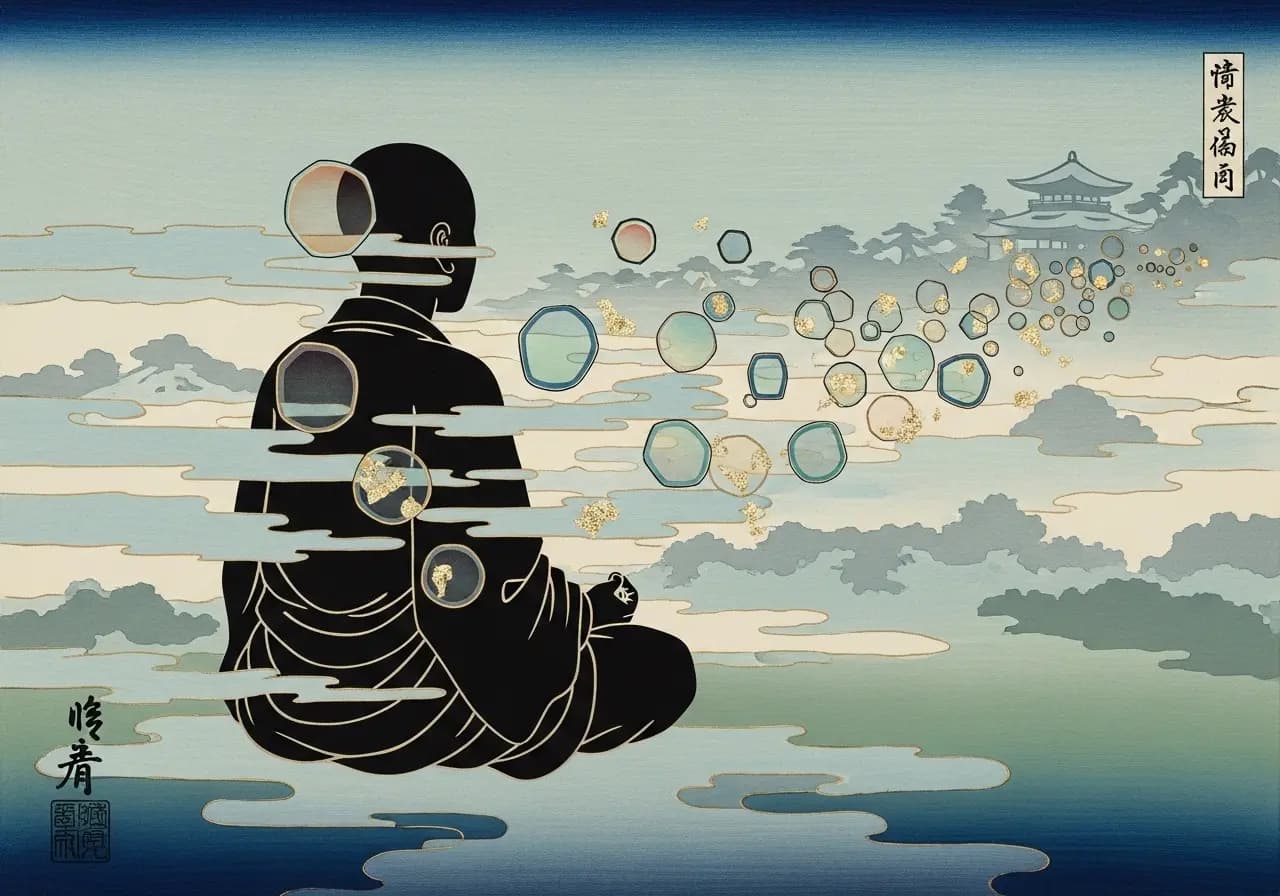
Finding Your True Self
Episode 109 of the Secular Buddhism Podcast
Hello, and welcome to another episode of the Secular Buddhism podcast. This is episode number 109. I'm your host, Noah Rasheta. Today, I'm talking about finding one's true self.
Keep in mind that you don't need to use what you learn from Buddhism to be a Buddhist. You can use what you learn to be a better whatever you already are.
So let's start with last week's Zen koan.
Time to Die
This one is called "Time to Die."
Ikkyū was a Zen master who was very clever, even as a boy. His teacher had a precious teacup—a rare antique. Ikkyū happened to break this cup and was greatly perplexed. Hearing the footsteps of his teacher, he held the pieces of the cup behind him. When the master appeared, Ikkyū asked, "Why do people have to die?"
"This is natural," explained the teacher. "Everything has to die and has just so long to live."
Ikkyū, producing the shattered cup, added, "It was time for your cup to die."
Now, this one makes me laugh as I try to picture it. To me, this reminds me of when you do something wrong and you're trying to figure out a clever way to get out of it. That's what I see in this koan. For me, it's about cleverness, about being skillful in that moment—you could say skillful action—and of course, the obvious reminder that all things end.
But when we talk about koans, there isn't an answer, right? It's just a story. And to me, this story reminds me of a couple of things. It's an invitation to act skillfully. So that's all I'm going to say about that one.
A Disclaimer About Koans
I want to continue talking about more koans, but I need to share a disclaimer. These are my opinions. That's all they are—opinions and ideas that I'm sharing, but they make sense to me. They may not make sense to you. You may come to other conclusions, and that's perfectly okay.
In fact, with koans, the moment you start to explain it and think to yourself, "Well, I think the teacher is saying..." stop. Stop yourself right there. Interrupt your train of thought and say, "Okay, I already got it wrong," because that's how these riddles are supposed to work.
So with that out of the way, here are some of my thoughts on the idea of finding one's true self.
Conceptual Fog and Colored Lenses
There's this notion of conceptual fog. What is that? Well, we all know what fog is. If you've ever been in fog, you know that your view of things is severely limited. This is where the expression comes from about fogginess—whether that be fogginess in what you see or what you're thinking. It's like you're not seeing clearly. But then you break through and suddenly you see something. You get a glimpse of how things really are.
When we're talking about Buddhism, we're often talking about this conceptual fog—this way of perceiving that is limited. What is it that limits us from seeing things as they are? Our concepts and our ideas. That's the conceptual fog.
Another analogy that I use is talking about colored lenses. If you have colored lenses over your eyes, the way that you see and perceive reality is tainted. It's tinted, specifically. I see something because of the way my eyes look through those lenses.
So our practice in Buddhism is to remove as much as possible the lenses that distort our ability to see. At the same time, we're understanding that we can't completely remove them all because our nature is to have lenses. We're limited by how we see, and how we see is always going to be tainted with the conceptual fog of beliefs and ideas and opinions.
So what we're trying to do is change our relationship with the way we see things, even though the way we see things may never change. That's kind of the catch-22 in all of this.
The Koan of Mu
Let's jump into another famous riddle—a koan called "Mu."
This one is about Joshu, a famous Chinese Zen master who lived in a province from which he took his name. One day, a troubled monk approached him seeking guidance. A dog walked by, and the monk asked Joshu, "Has that dog Buddha nature or not?"
The monk had barely completed his question when Joshu shouted, "Mu!" Mu is often translated as meaning "no."
Let me give you a little background to explain why this is a riddle in the first place. This Zen master and the monk were from China, where Mahayana Buddhism is the predominant school of Buddhism. In Mahayana Buddhism, we learn about the concept of Buddha nature—the fundamental nature of all beings, not just human beings.
So for this monk to ask, "Does a dog have Buddha nature?" the answer should be quite obvious. A dog is a being, and all beings have Buddha nature. But Joshu shocks everyone with his answer: "Mu"—or "no." Not only does he give the answer that wasn't quite obvious, but he gives the unexpected answer and shouts it.
The obvious and expected answer would have been yes. However, the Zen master says no. So what's going on?
For me, the question about whether a dog has Buddha nature is fundamentally about the nature of existence. The monk is asking from a one-sided perception of existence—the perspective that would have been expected and would have had one correct answer to the question. The Zen master answers with "Mu" somewhat as a hammer to break open that conceptual fog in the monk's ordinary way of thinking.
Understanding Mu
Remember, practicing with a koan consists mainly of taking away what you are sure about, especially what you're sure about yourself. It's trying to pull the rug out from under your feet. It's trying to break the firm foundation on which you stand when it comes to what you know and what you believe about yourself.
Understanding this, it's interesting—and seems quite obvious—that the answer to the question could be no. Or the answer could be yes. I think understanding or resolving Mu—or "no"—is considered to be the beginning of a lifelong practice of seeing things differently. When we understand the implications of Mu, it changes the way we perceive everything.
Keep in mind that Buddhism has many other teachings, many other ideas and practices that also work toward accomplishing this very same thing. But I think this particular practice of Mu and working with koans tends to be a very effective way.
So what we're trying to do with this riddle is open up a crack in the conceptual fog and see something there behind it—especially something about yourself. So think about that: Does a dog have Buddha nature? Mu.
The Koan of Temper
Now let's look at another koan. This one is about temper.
A Zen student came to Bankei, another famous Zen master, and complained, "Master, I have an ungovernable temper. How can I cure it?"
The master said, "Well, you have something very strange. Let me see what you have."
The monk said, "Well, now I can't show it to you."
"When can you show it to me?" asked Bankei.
"It arises unexpectedly," replied the student.
"Then," concluded Bankei, "it must not be your own true nature. If it were, you could show it to me at any time. Think that over."
I like that he ends with "Think that over."
Here, I'm exploring this idea that we are not our temper. What other things that we mistakenly think we possess might also turn out to not be us? The Japanese Zen master Dōgen says, "The purpose of Zen is to find one's true self. The way to this goal is to forget the self."
I think the start of this process of forgetting begins with the practice of Mu, where we stop trying to grasp everything intellectually and instead we get absorbed into the practice of being, of experiencing. Of course, we're talking about Buddhism, so there's this whole middle way form of thinking—where the middle way between trying to grasp things intellectually and trying to just go with the flow. There's a middle way there. You need to find out what your middle way is.
What Is Your True Nature?
But let's keep digging at the exploration of finding our own true nature. What does that even mean?
In Buddhism, it's common to convey ideas of what something is by specifically pointing out what it's not. So I know I'm not my temper. We've explored this idea. I know I'm not my thoughts. I know I'm not my opinions. I know I'm not my beliefs. I'm not my memories. And that list goes on and on and on. So what are we left with at the end of that path?
I think it's interesting that we as people have these ideas of who or what we are. The word "person" actually comes from the word "persona," which is defined as the aspect of someone's character that is presented to or perceived by others. Another definition is a role or character adopted by an author or an actor.
I'd like to add my own definition here, combining those two with a flavor of Buddhism: a role or character adopted by a being that gets presented to or perceived by others. In that sense, I like to ask myself, "Well, then what is my true nature?"
Perhaps my nature is to adopt an image—a collection of ideas and beliefs I have about myself—and then I strive to present those to others. That gets complicated because I'm also of the nature to create roles or characters for others, interpreting what I perceive them to have for me. So we're stuck in this situation where there's me, there's who I think I am. Those are already two different things. There's who you think I am. That's a third one. There's who I think you think I am. That's a fourth one. And that goes on and on and on, right? All these roles that we're juggling, that we're trying to put out there and interpret about who we think we are.
The Complexity of Finding the True Self
And then of course, there's the problem of time and impermanence. I want to find my true self. Okay, well which one? The one of right now or the one of five minutes ago? Or is it the true self of tomorrow or the one five years from now?
Then add the complications of interdependence. Which true self am I looking for—the one that's me when I'm hungry or when I'm scared? That's a different version of me than when I'm happy and content. So which one is the true self?
Perhaps what I'll find in my quest to find my true self is that there is no true self. There is only the me that I am in the present moment, influenced by countless moments in time that have led to this precise moment, and by countless variables and factors outside of myself that make me how I am in this moment.
I really like the thought of that. It allows me to have the freedom to explore who I am right now—the me of this specific moment.
And maybe I'm just an actor in this cosmic movie of life, and I happen to be so good at acting that I believe that I'm really the part that I'm playing. Could that be my true self? That's a thought I like. I like exploring that one.
Playing Our Parts Skillfully
I must say there's nothing wrong with having a persona. There's nothing wrong with playing a part. I think it's inevitable for us to play these parts because that's what we do. We're human beings, and that's our human nature.
And if I were to wake up and realize, "Oh, I've been playing a part," and now I want to stop playing the part, I'm going to be playing the part of someone who stopped playing the part. There's no way to escape the part-playing that we do.
So for me, it all goes back to this wonderful Buddhist term: skillful means. If I understand my true self—or at least, if I understand how I'm playing this character—how can I go about being a more skillful version of myself? What parts of my character are no longer skillful and can be modified or adjusted to be better for myself and for those around me? And how can I change the relationship I have with the character that I'm playing?
So I guess I'm going to say think that over for a bit. And again, these are just my thoughts. They may be complete nonsense, but I'm happy to share this nonsense with you.
A Final Koan: Bodhidharma's Beard
Speaking of nonsense, I'm going to end this podcast episode with another Zen koan—a riddle. This one is called "Bodhidharma's Beard."
A bit of background for you: Bodhidharma is the founder of Zen, and he was known for having a large beard. That's important to know.
Here's the riddle: Wakuan saw a picture of bearded Bodhidharma and exclaimed, "Why hasn't this fellow a beard?"
That's the koan. Sit with that one. Explore that. See if you can answer that.
Closing
That's all I have for the podcast episode this week, but thank you for listening and being a part of this journey with me.
If you enjoyed the podcast episode, please share it with others. Write a review. Give it a rating on iTunes. If you'd like to make a donation to support the work I'm doing with the podcast, please visit secularbuddhism.com and click the donate button.
That's all I have for now, but I look forward to recording another podcast episode soon.
Till next time.
For more about the Secular Buddhism podcast and Noah Rasheta's work, visit SecularBuddhism.com