

The Five Remembrances: Important Things to Think About Often
Episode 108 of the Secular Buddhism Podcast
Hello, and welcome to another episode of the Secular Buddhism Podcast. This is episode number 108. I'm your host, Noah Rasheta, and today I'm going to talk about a Buddhist teaching called the Five Remembrances.
As always, keep in mind: you don't need to use what you learn from Buddhism to be a Buddhist. You can use what you learn to be a better whatever you already are.
The Source: The Upajjhatthana Sutta
The Five Remembrances come from a discourse, or a teaching, attributed to the Buddha called the Upajjhatthana Sutta. If you want to read the original discourse yourself, it's the 57th discourse in the fifth book of the Pali Canon's Anguttara Nikaya. The discourse's abbreviated designation is AN 5.57, or AN V, like the Roman numeral five, point 57, in case you want to look it up and read it for yourself.
This Sutta is often referred to as Subjects for Contemplation. The discourse advises that these Five Remembrances are to be reflected upon often and by all. They're often called the Five Remembrances—I think that's the most common name—but also the Supreme Contemplation, or the Five Recollections, and a few other variations. I'm going to refer to them as important things to think about often.
Why These Remembrances Matter
The Buddha told his followers that reflecting on these five important things often will assist with loosening the grip of attachment. So let me share the Five Remembrances with you.
The First: "I am subject to aging. There is no way to avoid aging."
The Second: "I am subject to ill health. There is no way to avoid illness."
The Third: "I am subject to death. There is no way to avoid death."
The Fourth: "Everyone and everything that I love will change, and I will be separated from them."
The Fifth: "My only true possessions are my actions, and I cannot escape their consequences."
The First Three Remembrances: Aging, Illness, and Death
The first three remembrances are essentially about sickness, old age, and death. If you recall from earlier teachings, these are some of the key realizations that led Siddhartha, the Prince, on his path to eventually becoming who we now know as the Buddha.
This is what started him on his journey to awakening. It was the realization that he was of the nature of growing old, of getting sick, and ultimately of dying. And that was difficult for him. He really wanted to know, "Well, then what's the point of all of this?" That's what started him on his journey.
So later in life, after his moment of awareness and after he began teaching the dharma, he mentions these five things in this discourse. Three of them are things that he was very concerned with at one point in his own life. These first three remembrances are meant to be humbling, or to be sobering. They're not meant to be depressing. I don't think any of these remembrances are. What they do is they help us overcome a sense of pride and a sense of conceit. It's like being splashed in the face with cold water, or slapped in the face with a healthy dose of reality.
Waking Up to Reality
When I visualize this, I imagine somebody who's been drinking. Maybe they're drunk, stumbling around, not quite with it. They're in a delusional state. And then comes this slap of reality, this cold water in the face. It's like, "Wake up. You've been off in la-la land and here, this is reality."
I think we live in a culture that seems to be delusional about these three things. If you look at all our marketing for products and services, there's just this general sense of: "Buy this and you'll look young. Do that, and you'll stay healthy." There's this sense of, "Death? Yeah, that's there, but not you. At least, not anytime soon." Don't we all kind of feel that?
We put these things on a shelf and we pretend they're not happening, at least not to us and not anytime soon. We think if we buy this thing or have that thing, we can minimize it. "Yeah, I'm going to beat aging, I'm going to beat ill health." These three remembrances are meant to bring us back in line with reality.
I like to frame this teaching, and all Buddhist teachings, within the context of living skillfully and living unskillfully. To me, these are reminders to stay healthy and to enjoy my health while I have it, because I know that it's just a matter of time and eventually my health will deteriorate. I'll start to get wrinkles. My ability to do certain tasks will fade. That's just the nature of being alive. I am subject to aging. I am subject to ill health. And I am subject to death. There's no way to avoid these three things.
The Fourth Remembrance: Impermanence and Attachment
Now let's talk about the fourth remembrance. This one helps us deal more skillfully with our attachment and our desires. The remembrance is: "Everyone and everything that I love will change, and I will be separated from them."
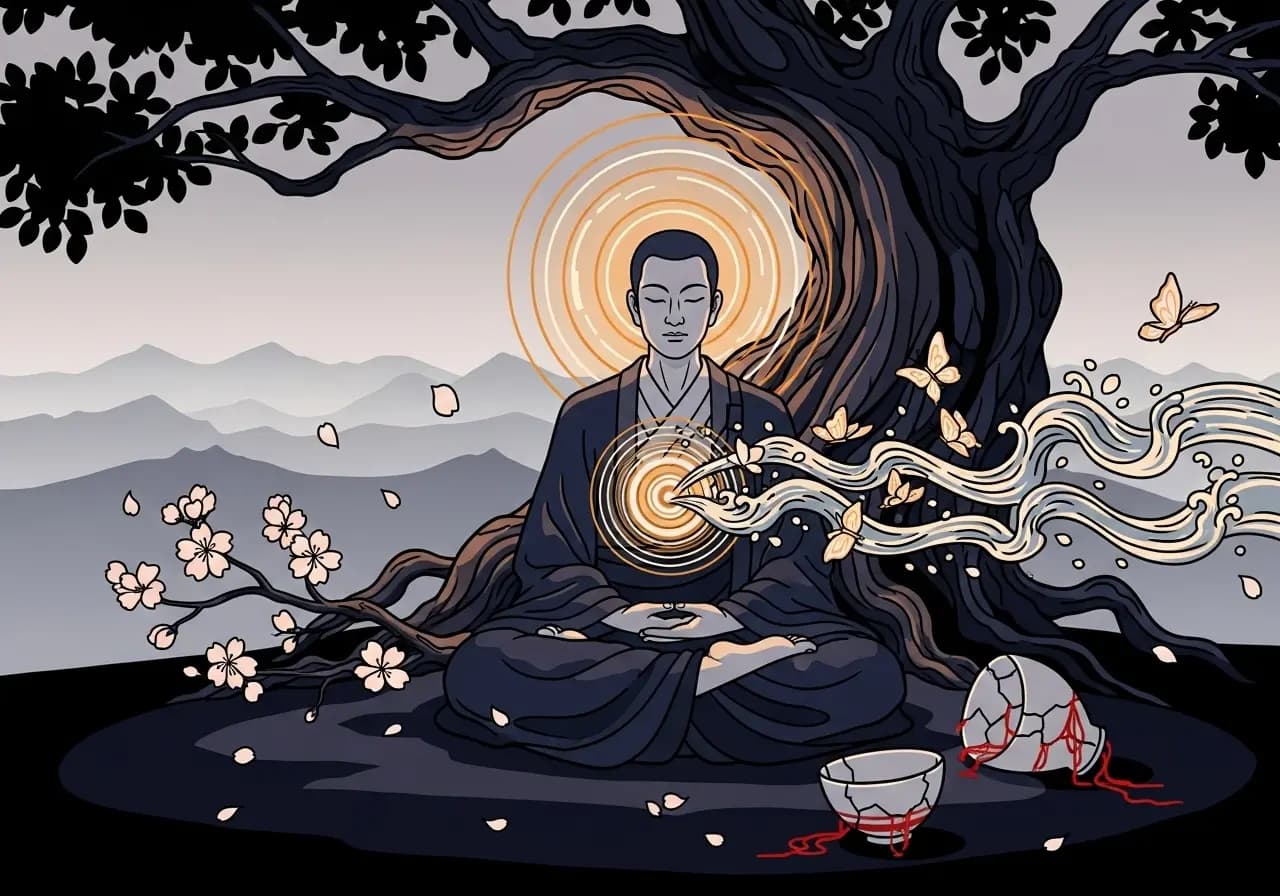
There's a beautiful teaching here by Ajahn Chah. He motioned to a glass at his side and asked, "Do you see this glass?" He said, "I love this glass. It holds the water admirably. When the sun shines on it, it reflects the light beautifully. When I tap it, it has a lovely ring. Yet for me, this glass is already broken. When the wind knocks it over, or my elbow knocks it off the shelf and it falls to the ground and shatters, I say, 'Of course.' But when I understand that this glass is already broken, every minute with it is precious."
To me, that embodies the essence of this fourth remembrance: remembering and recognizing that all things will change. When we understand that everyone and everything is impermanent, perhaps our moments with everyone and everything will also be more precious.
Clearing Up Misconceptions About Non-Attachment
A quick word on attachment. This gets brought up fairly regularly with regards to relationships, goals, or things of that nature, and people are always asking, "Wait, so should I not be attached to my relationships? Should I not have goals?" I want to emphasize here that to practice non-attachment does not mean we can't love and appreciate people and things. It doesn't mean that we don't have goals and desires.
It means we don't cling to these things. We don't make the mistake of thinking these things are the key to our happiness. But in fact, to me, I think a constant reminder of impermanence actually makes us more aware of the preciousness of people and of the world around us.
The more I remember this important thing—that everyone and everything that I love will change, and I will be separated from them—actually makes me feel closer to those things. It helps me to love my children more because they won't always be children. To cherish the moments I have with my parents now, because I won't always have them. To cherish the moments that I get to do the things that I love, like paramotoring and paragliding, because I won't always be able to do that. It makes all of those moments a bit more precious by continually remembering that these moments are impermanent.
The Fifth Remembrance: Actions and Karma
The fifth remembrance is about our actions. It says: "My only true possessions are my actions, and I cannot escape their consequences."
For me, this is the important reminder of karma. You'll recall that the word karma means action. My actions are inseparable from my life, so much so that my life right now is the result of my actions and choices. Sure, there are also factored in the actions and choices of others, because of the nature of interdependence. But this specific reminder is about the interdependence of my life as it is and as it will be, with my actions, my deeds.
This is a reminder for me to take ownership of my own actions, which I believe is an important step on the Buddhist path. When we talk about actions, it's so easy to have this delusional thought that what I do doesn't affect anyone else. The nature of interdependence is the opposite. Everything that I do affects everything else, and everything else affects everything that I do. There's this very intricate form of interdependence happening.
By seeing this, by remembering this, it helps me to want to be highly motivated to be skillful with all of my actions, my thoughts, my words, and my deeds, because I know that I do not exist in a vacuum. I'm not here in the world separate from the world. I recognize that everything that I do affects everything else.
The Deeper Transformation: Looking Inward
You may ask, "Well, how long should we think about these things?" The answer would be: until our mind shifts, until we realize how unskillful it's been for us to be looking out there instead of looking in here, inside of our own mind.
I think a lot of us spend our lives looking out at the world, chasing after happiness, chasing after thoughts and things. We're distracted by all kinds of things, and rarely do we look into the mind that is the ultimate source of these things.
Again, it's like the quote that I revisit often: what we are seeking is who is seeking. In other words, if you're listening to this podcast right now and you're in search of something, you're a seeker. What would happen if you shifted the focus of your search? Instead of finding whatever it is you think you're looking for, try to find the one that is searching for that thing. Look inside, and search there.
The Gift of These Remembrances
The Five Remembrances remind us of the preciousness of this human life, the one we're living now. They remind us that we are going to die. They remind us that our actions follow us everywhere, and that the search for things out there in the world is ultimately a waste of time that only perpetuates our suffering.
So I would like to invite you to memorize these things. Put them on a post-it note. Put it on the bathroom mirror, put it somewhere where you're going to think about them often, and they will reframe your life. They will help you to focus your mind on what really matters, and they'll serve as a guide to advise you in everything you do when you remember these things often.
The Wonder of Our Delusion
Speaking on the topic of death, in the Hindu epic the Mahabharata, a sage is asked, "Of all the things in life, what is the most amazing?" And you know what he answered? He said that a man seeing others die all around him never thinks he will die.
I think that's fascinating. I had the same sentiment about age. What's so amazing? It's amazing that we can be around so many people who are growing old and think that we're not going to grow old. Or to be around so much ill health and think that we'll always be healthy. And then, of course, ultimately, to be around so many impermanent things and think we are permanent. To see and experience interdependence in everything we observe in the cosmos, in nature, and everything, and to think that we are somehow not interdependent. Those are fascinating things.
The Buddha said, "Of all footprints, that of the elephant is the deepest and most supreme," and went on to say, "Of all contemplations, that of impermanence is the deepest and most supreme." So hopefully by remembering these five things, we can remember the nature of impermanence.
Transforming Fear Through Awareness
Now, how does remembering this, how does thinking about these things often actually transform our suffering? One way is that by thinking about these things, we learn to recognize our fears, and we acknowledge them. I think this is important because we all live with fears. In our society in general, there's a tremendous amount of fear about aging. There's fear about not being healthy. And of course there's the ever-present fear of dying.
We need to understand our fears and accept them before they can be transformed. The more we ignore our fears, or the more we fight our fears, the stronger they become. When we contemplate the Five Remembrances, when we learn to think about these important things often, we're learning to invite our fears to come out of that dark closet and into the light to be examined, to be seen, and ultimately to be understood.
When we shine that light of awareness and mindfulness on them, that in turn eases the fear we have of these things, until the relationship we have with the fear is totally transformed. It's like eventually this fear monster that's been hiding in the closet comes out, and under that light of mindfulness reveals itself to be something different than what we thought it was. It may turn out to not even be a monster at all.
A Practice for the Week
I hope you'll think about the Five Remembrances often. I hope you'll try to think about these things every day for a week. Give it a try and see if you notice anything different.
The Five Remembrances are: "I am subject to aging. There is no way to avoid aging. I am subject to ill health. There is no way to avoid illness. I am subject to death. There is no way to avoid death. Everyone and everything that I love will change, and I will be separated from them. And my only true possessions are my actions, and I cannot escape their consequences."
This Week's Zen Koan
Before I end this podcast episode, I want to share something new. A podcast listener reached out with a fun idea. He said, "You've been sharing these Zen koans and they're great, but it would be pretty cool if you shared the koan first, and then let us sit with it for a week, and then share your thoughts about it in the following episode."
I thought that was a great idea, so I'm going to do that. I have a list of about twelve different koans that I've been wanting to share. What I'm going to do is for the next little while: I'll end each podcast episode with a Zen koan for the week, with no explanation. I'll let you think about it. And then next week I'll start the podcast episode by sharing my thoughts about the koan I shared from the previous week.
So here's this week's koan, called "Time to Die."
Ikkyu, the Zen master, was very clever, even as a boy. His teacher had a precious teacup, a rare antique. Ikkyu happened to break this cup and was greatly perplexed. Hearing the approaching footsteps of his teacher, he held the pieces of the broken cup behind him. When the master appeared, Ikkyu asked, "Why do people have to die?" "This is natural," explained the teacher. "Everything has to die, and has just so long to live." Ikkyu, producing the pieces of the shattered cup, added, "It was time for your cup to die."
So there is the Zen koan for the week. The invitation is to think that over, along with the Five Remembrances. I'll share my thoughts about this koan in the next episode.
Closing
That's all I have for this podcast episode. Thank you for listening. Thank you for being a part of this journey with me. If you enjoyed the podcast episode, feel free to share it with others, write a review, or give it a rating in iTunes.
And as always, if you'd like to make a donation to support the work I'm doing with the podcast, you can visit SecularBuddhism.com and click on the donate button.
I look forward to recording another podcast episode soon. Thank you, and until next time.