

Learning to Be Silent
Episode 107 of the Secular Buddhism Podcast
Hello, and welcome to another episode of the Secular Buddhism podcast. This is episode number 107. I'm your host, Noah Rasheta, and today I'm going to share a few Zen koans and talk about what they mean for me. As always, keep in mind—you don't need to use what you learn from Buddhism to be a Buddhist. You can use it to help you be a better whatever you already are.
An Unexpected Expert
Earlier this week, I had an experience with one of our neighbors. We live in Mexico now, and we live in a gated community. Inside our little complex of homes, there are about 30 homes here. We're lucky that there are a lot of kids. They ride their bikes, and it's been great for us to have our kids outside playing, making friends, and learning Spanish through playing and interacting with the other kids.
Well, one of the kids was riding by on his bicycle, and his handlebars were loose. So I asked him if he wanted me to adjust and tighten them, and he said, "Yes, I would love that." He came over, and there in our little garage area, I took out my tools. I have a lot of tools that I brought down with me that I use specifically for maintaining my paramotor. I took out some of the tools from this little bag and adjusted his handlebars. He said, "Thank you very much."
Then over the course of the next 10 to 15 minutes, he kept coming back and asking me to adjust the pegs, tighten the chain, adjust the brakes, tweak little things on his bike. I kept adjusting everything for him. I adjusted the height of the seat.
When all of this was done and his bike was just the way he wanted it, he said, "Thank you so much. I've never met someone who is such an expert mechanic." I laughed and said, "Oh, I'm not an expert mechanic, but I can fix bikes." That was the end of that. He left, riding off on his bike, and I started thinking about how funny it was that he would consider me an expert mechanic.
One of the things I've always been known for in my circle of friends is the opposite—not being mechanically inclined. I've had to get help from people to do anything mechanical. Now, if it's on a computer, yeah, I'm the one they go to. IT and tech stuff—that's something I'm good at. But when it's mechanical or general repairs around the house, that's never been me.
That's changed a lot since I got into paramotoring because I've become more mechanically inclined to maintain and tinker with the motor I use to fly. That's why I even have the tools to help Misael with his bicycle. But what I found funny about that whole interaction was this: the rest of his life, he'll have this memory of a neighbor—this American guy who was an expert mechanic who fixed his bike. There's a new image in this kid's head of someone who, in a lot of ways, isn't really like that at all. It's not an accurate image.
How We Create Inaccurate Pictures
That made me think of interactions I've had throughout my life and youth with people—sometimes just a one-time interaction or limited interactions with someone. And boom. I established in that moment an image of who that person was, what they were known for, what they were good at, or maybe what they weren't good at. And that's it. That becomes the accurate picture in my head of that person.
Then I started thinking, "How many of those pictures were entirely off the mark?" I'm thinking not just about the inaccurate images of someone being better at something than they actually are, but also the reverse. Maybe one or two limited interactions, and I thought, "Oh, that's a really mean person," or "That guy is awful," or rude, or whatever it is. Had I had more interactions, I'm sure I would have realized how off my assessment was of that person.
I'm sure this happens to all of us all the time—whether it's images or assessments we're making of other people, of situations in life, or the reverse: images and assessments that other people are making of us. I imagine how many people out there have such an erroneous mental picture of who I am because they've formed it based on limited interactions.
The Podcast Persona
The podcast is a good example, right? Anyone who has interactions with me through the podcast only knows that side of me. They haven't seen me in other aspects of my life or how I am in those contexts. I thought about this when we did our second trip to Uganda. One of the participants mentioned, once we were there in person, how different it was to see me in person and to hear my sense of humor. I have a very dry sense of humor—that's the word, I think. But I definitely have a sense of humor. I'm always witty about things. That's a side of me that doesn't come out a lot in the podcast because it doesn't lend itself to the format. But interacting in person, it was like, "Wow! I didn't know this about you. It's funny to see this side of you."
That's how we all are, right? We all have certain sides to ourselves that we present in different contexts—how we are at school, how we are at work. Someone who only knows you at work and then later sees you at the park, or in a family setting, gets a different picture. There's the you that you are when things are going well, and the you that you are when you're scared and panicked.
I experienced that for the first time with a cousin. I know my cousins really well. We grew up together. This particular cousin is terrified of, well, everything. But we were out riding the banana—you know, that float they pull you behind on a boat when you go to the beach. It was her and her husband, then my twin brother and I, and probably a few more people. I can't remember who else was there.
We were riding the banana, and they ride those in a way where at some point they try to make you flip. That's exactly what happened out in the ocean. We rocked the banana, and it tipped to the side. Then we were in the water. And man, there was this other side of her that I had never seen before—and I essentially grew up with her. Here we are as adults, and she was just screaming. All of it was driven by fear. In her moment of fear, she was just screaming at us, screaming at her husband, "This is all your fault." It was very interesting. It was comical, actually. We were laughing while trying not to laugh because we could tell she was deathly afraid a shark was going to come get her.
But what I'm getting at is this: the person she was under extreme fear is absolutely not the person she is when she's not in fear. I don't think it's fair to paint one picture of someone and say, "Oh, that's who they are." I want to ask instead: "That's who they are in what context?"
The First Koan: Joshu's Zen
So with that as the background of my experience this week—someone calling me an expert mechanic, which I found kind of comical—I wanted to share a few Zen koans. The first one I want to share is called Joshu's Zen. Here's how it goes:
Joshu began the study of Zen when he was 60 years old and continued until he was 80, when he realized Zen. He taught from the age of 80 until he was 120. A student once asked him, "If I haven't anything in my mind, what shall I do?" Joshu replied, "Throw it out." But if I haven't anything, how can I throw it out?" continued the questioner. "Well," said Joshu, "then carry it out."
That's it. That's the end of that koan. I enjoy this one because it alludes to what we talk about with the koan of emptying your tea cup—the idea of getting rid of the concepts, beliefs, and ideas in our mind that may be blinding us or preventing us from seeing reality a little bit more clearly.
What I like about Joshu's response is interesting. He's saying, "Throw it out," and someone is saying, "Well, if there's nothing there in the first place, how do I throw it out?" He says, "Oh, well, in that case, carry it out." To me, there are two important messages here. One: throwing something out is a bit more aggressive than kindly carrying it out. To me, that's an invitation saying, "Well, if I can't get rid of a concept that's in my mind, how can I carry it out rather than aggressively throw it out?" Sometimes that may mean studying the topic more, reading more, understanding it more. Then my view starts to shift because I carry it out by opening up in a kinder way than being aggressive.
But the other way I interpret this koan is that Joshu doesn't give up the central message of getting rid of it. To me, that's important to understand. The person who's saying, "Well, if I don't have anything in my mind, what shall I do?"—what Joshu is trying to tell them is that you do have something in your mind. If "I don't have anything in my mind" is your statement, well, that's something in your mind. So again, it's the same answer in different words, a way of telling this questioner: you do have something in your mind. As long as you're asking that question, you have that idea in your mind.
It's like what Thich Nhat Hanh talks about with the concept of nothingness, right? "I have nothing in my mind." Well, he would say, "Is nothing something?" And if we analyze that, we understand that yes, nothing is something. To have the idea in my head of what nothing is, is something. And that is the something that you can throw out, or you can carry it out.
So for me, this koan is a constant invitation to carry out whatever thought I have in my head, whatever idea or belief I have in my mind—even if that is the idea of nothingness. I think that's a really important one when we're talking about Buddhist concepts because there are big concepts in Buddhism like emptiness or nothingness. The moment I have an idea of what nothingness is, I've just given it another idea. So I'm constantly battling with the emptying of the mind versus the thought of emptying the mind, because those are different things. And the thought of emptying the mind is still a thought, so there we are, stuck in this situation that's kind of a spiral.
You might be listening thinking, "Oh, well then what's the point?" And the answer is, well, the same thing as Joshu said: throw it out. And if you really honestly think, "Well, but there's nothing to throw out," then take the second answer. Then carry it out. I'll leave you with that. That's the end of that koan. It's a fun one to work with.
I thought this related in some ways to what I was sharing this week with the interaction I had with our neighbor Misael, who thought I was a mechanical expert. For me, throwing things out when I'm thinking of it in that context means imagining: what are the views or beliefs that I have of everyone around me? Perhaps more importantly, the ones that are closer to me—not just the neighbor that I occasionally interact with, since I definitely don't know anything about that person based on a couple of interactions. But we do this with our closest people, right? Our spouse, our kids, our parents, our siblings. We have this idea: "Oh, this is how they are." And Joshu would say, "Throw it out. And if you can't throw it out, carry it out." To me, that's an invitation to stay open, to not get caught up in attaching to the story I have of who this person is, how this situation is, or how life is.
The Second Koan: The Gates of Paradise
I'm going to move on to the next koan. This one is called The Gates of Paradise. I know I've talked about this one in previous podcasts before, but it's been a while, so I'm going to share it again.
A soldier named Nobushige came to Hakuin and asked, "Is there really a paradise and a hell?" "Who are you?" inquired Hakuin. "I'm a samurai," the warrior replied. "You a soldier?" exclaimed Hakuin. "What kind of ruler would have you as his guard? Your face looks like that of a beggar." Nobushige became so angry that he began to draw his sword, but Hakuin continued. "Ooh, so you have a sword. Your weapon is probably much too dull to cut off my head." As Nobushige drew his sword, Hakuin remarked, "Here, open the gates of hell." At these words, the samurai perceived the master's discipline, sheathed his sword, and bowed. "Here, open the gates of paradise," said Hakuin.
This is a koan that I've always enjoyed because it gets at the heart of one of those Buddhist concepts that I think really speaks to me and really gets at something important: the concept of heaven and hell, of paradise being something that is accessible and available right here and now. That's exactly what's happening in this koan. You have Hakuin, who's the Zen master, and then you have Nobushige, the samurai soldier who appears wanting to learn about these concepts of paradise and hell.
The Zen master does an incredible job of teaching in that moment by questioning him back, by ridiculing him, and by invoking in him a strong sense of anger and upset. In doing so, he helps Nobushige realize that right there—those are the gates of hell. There you are. You're in it right now. Then, when he realizes that, Hakuin flips it on him. Because now he's feeling gratitude for having learned, and he's saying, "That sense of gratitude, that bowing, like everything that you're doing now, how you perceive me now—boom, those are the gates of paradise." He's really helping them understand that both are accessible in the here and now. I really like that.
It's a very powerful koan to think about and to recognize that sometimes we go through life trying to arrive at this state of heaven or this state of hell. Some people believe that it's something you ultimately arrive at, right? Like if you were good enough in life, you go to one. If you're not good enough in life, you go to the other. But I love how Buddhism is saying, "Well, wait a second. Whether or not that is the case, we can actually experience these states right now in the present moment. And perhaps that should concern us more."
Because rather than worrying about where we're going to go, we should ask: "Well, where am I now? Am I in heaven, in paradise, or am I in hell? And am I there from my own doing—my own thoughts, actions, and deeds?"
I'm sure all of you listening to this can relate. At some point in your life and in some stages of your life, you have felt like you are at the gates of hell, right? Experiencing regret, anger, frustration, or something so unpleasant that you may as well be in hell because of how unpleasant the current moment is. And you've probably experienced the flip side too—moments where nothing else matters. Everything could be going wrong, but the way I'm feeling in this moment is so pleasant that this may as well be heaven.
I know I've experienced both of those at different stages of my life, and I love how Buddhism is inviting me to assess these through the lens of the present moment, through the lens of here and now. Where am I? Which of these gates am I experiencing?
And more importantly, the deeper analysis would be: why? Nobushige could ask, "Well, why did that offend me so much when you started questioning my ability to be a samurai?" Now, not only is he learning about the gates of hell for him, but he's learning the causes of arriving at the gates of hell. And that's probably an even deeper lesson than I could hope for. I like to imagine that Nobushige went home and thought about that and started doing more work to understand the causes of the gates of hell and the causes of the gates of paradise for him particularly in his own life. That's the second koan I wanted to share: The Gates of Paradise.
The Third Koan: Learning to Be Silent
Now I'm going to jump to the third one, which is called Learning to Be Silent. That's the title of this podcast episode today. This is a fun one. It kind of made me laugh out loud, but I want to discuss it a little bit.
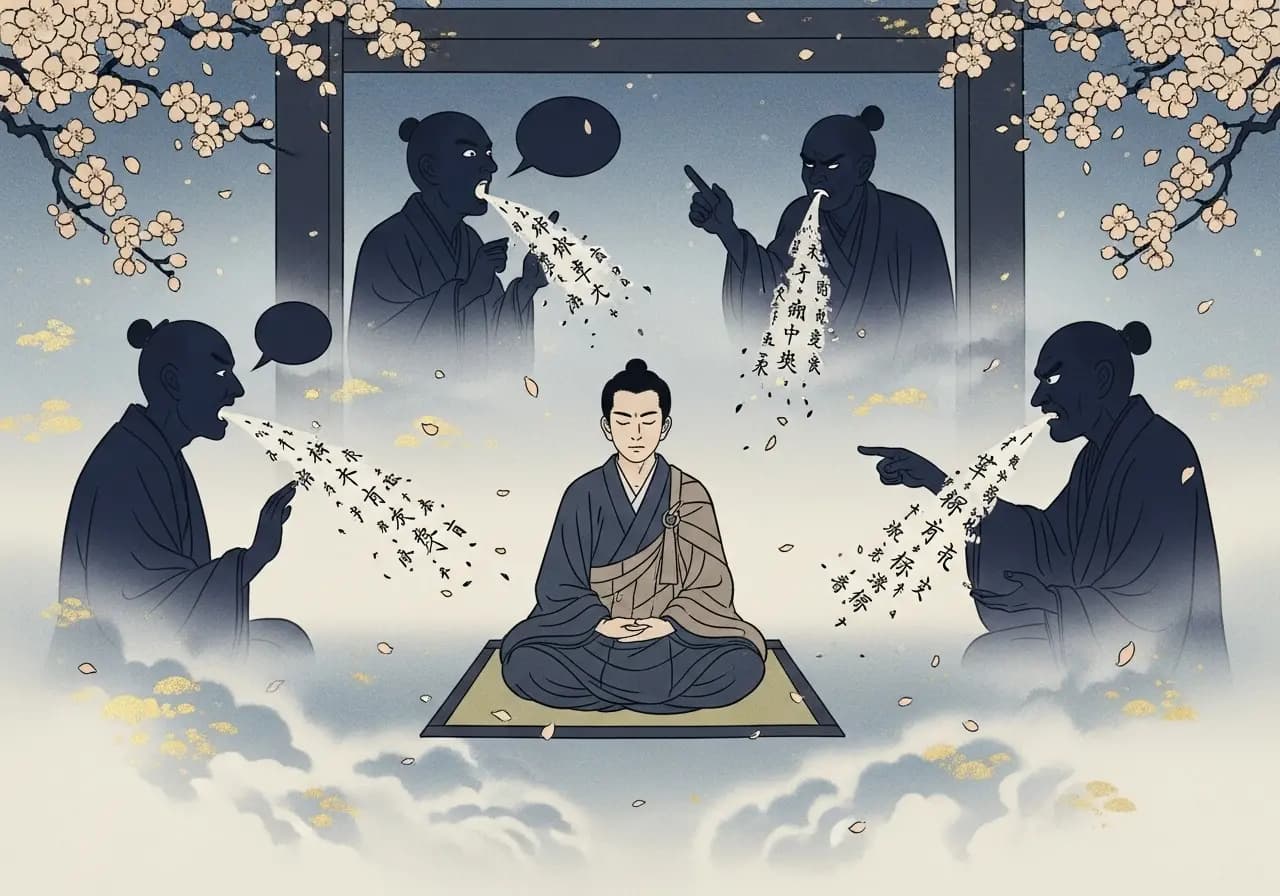
The pupils of the Tendai school used to study meditation before Zen entered Japan. Four of them who were intimate friends promised one another to observe seven days of silence. On the first day, all were silent. Their meditation had begun auspiciously. But when the night came and the oil lamps were growing dim, one of the pupils could not help exclaiming to a servant, "Fix those lamps!" The second pupil was surprised to hear the first one talk. "We're not supposed to say a word," he remarked. "You two are stupid. Why did you talk?" asked the third. "I'm the only one who has not talked," concluded the fourth.
I love that because in that one moment, you have the spiraling end of silence, right? The first one who breaks the silence, the second one who rebukes the first one for having spoken, the third one who says both of the ones who have spoken are idiots, and then there's the fourth one who needs to make sure everyone knows that he wasn't the one who talked. But in that act of wanting them to know, he breaks the silence as well.
What I like about this one, aside from it being pretty comical, is looking at the archetypes of the people we're talking about here. The first one sees a situation. In this case, the lamps needed to be fixed because they were going out. And despite the vow of being silent, it's so important to fix this scenario that he's going to have to break his silence to say something about something that arguably shouldn't have mattered. So what if the lights go out, right? I decided I'm going to sit here and be quiet. I didn't decide I'm going to sit here and be quiet only if the lights stay on. That's the first student—I cannot stay silent about this thing that's bothering me, so boom, I broke my vow of silence.
Then you have student number two. Try to see yourself in these students or people you know in these personalities. Pupil number two is the one who, when they hear somebody speaking, is going to make sure they can rebuke them. "You're not supposed to do that." Well, in the act of making sure you know that I know that you're not supposed to do that, now I just broke the rule. But it's that important for me to tell you that you're not supposed to do that. We've all been that probably at some point, or we for sure know someone who's been that. We've all been pupil one at some point, and we've probably all been pupil two at some point.
And then you've got pupil three. Pupil three is so smart, right? I mentioned this in a previous podcast episode about Facebook personalities. This is the smart aleck, the erudite person who's so smart. Now pupil three's got to come out and make sure pupils one and two know how dumb they are for what they did. Now sure, I could stay there silently and just be like, "You know what? These guys are dumb, but I'm not going to say anything." No, not when pupil three kicks in. I've got to make sure you know that I know how dumb you are. And in that process of doing so, there goes the silence.
And then of course pupil number four. This is kind of the holier-than-thou one, right? Pupil four was doing it all perfectly. He or she could have just sat there quietly and watched all of this chaos and maybe just kind of chuckled inside, maintaining the path of silence. But no, pupil four has got to make sure that pupils one, two, and three know that pupil four was not the one who was going to talk. And in the process of saying, "I'm the only one who has not talked," he breaks the silence.
I love that. I love deconstructing some of these personalities implied in pupils one, two, three, and four and asking myself, "When and how often am I one of those four?" The example given here is silence, learning to be silent. But I think you can apply this to other things. If we said, "I'm going to be kind," we'd all agree, "Yeah, we're all going to be kind." And there goes the first person who does something that's not very kind, and there goes the second person who rebukes the unkind person for not being kind, but does it in an unkind way. And then we spiral on. Pupil number three is going to jump in and call the first two morons for not being kind. Then you've got the self-righteous number four who's going to unkindly tell everyone how kind they are, right?
That's a fun one to work with—a fun one to think about. Learning to be silent. I may talk about another Buddhist concept called noble silence, but I think I'll leave that for another podcast episode to build off this one a little bit.
Wrapping Up
So those are the three koans I wanted to share with you today. The names of those three koans: the first one is called Joshu's Zen. Joshu is the old man who studied Zen. Then you have The Gates of Paradise. And the third one I just shared is called Learning to Be Silent. You can probably Google those if you want to find the sources, or if you happen to have a book of koans, I'm sure you'll find them in there because these are all common ones.
I'll share more in a future episode. It's been fun exploring these koans, and as I go through my koan book, I've highlighted all the ones that I'd like to bring up in the podcast. I have a few more I'm going to share before I'm done with this stretch of koan series that I've been exploring.
Thank you for taking the time to listen and for being a part of this journey with me. If you enjoyed this podcast episode, feel free to share it with others, write a review, or give it a rating on iTunes. And if you want to make a donation to support the work I'm doing with the podcast, you can visit secularbuddhism.com and click the donate button.
That's all I have for now, but I look forward to recording another podcast episode soon. Thank you, and until next time.
For more about the Secular Buddhism podcast and Noah Rasheta's work, visit SecularBuddhism.com