

Everything is Best
Episode 106 of the Secular Buddhism Podcast
Hello, and welcome to another episode of the Secular Buddhism podcast. This is episode number 106. I'm your host, Noah Rasheta. Today, I'm going to share three more Zen koans and talk a little bit about what they mean for me.
Keep in mind: you don't need to use what you learn from Buddhism to be a Buddhist. You can use this to learn to be a better whatever you already are.
I thought it would be fun to discuss a couple more Zen koans and specifically what they mean for me. I want to emphasize that second part—what they mean for me. If you'll recall, the whole point of a Zen koan in the Zen tradition is to be presented with a story, a question, or an idea that essentially knocks you out of conceptual thinking. It's meant to pull the rug out from under your feet. And it kind of defeats the whole point if somebody tells you the koan and then just tells you what it means. Because the truth is there is no meaning to it. There's only the meaning that you give to it, and that's your job to figure out what this means for you.
So I want to be cautious about how I approach these Zen koans because I'm not pretending in any way that I have the answers to these, or that I know what they mean, or that I have anything wise to impart when it comes to Zen koans. I just want to share what they have meant to me. I hope that you keep that in mind with not just the koans, but—I guess everything that I've ever shared on the podcast kind of falls into that category. It's like, this is what this stuff means to me. And the invitation is for you to explore and figure out what this stuff means for you. So keep that in mind as you listen to these.
The Calling Card
The first Zen koan I want to share is called "The Calling Card." The koan goes like this:
Keichu, the great teacher of the Meiji Era, was the head of Tofuku, a cathedral in Kyoto. One day, the governor of Kyoto called upon him for the first time. His attendant presented the card of the governor, which read, "Kitagaki, governor of Kyoto." "I have no business with such a fellow," said Keichu to his attendant. "Tell him to get out of here." The attendant carried the card back with apologies. "That was my error," said the governor. And with a pencil, he scratched out the words "governor of Kyoto." "Ask your teacher again." "Oh, is that Kitagaki?" exclaimed the teacher when he saw the card. "I want to see that fellow."
Now, I like this one because it's fun to imagine myself in the place of both the teacher and the governor of Kyoto. In this story, you have someone who's essentially presenting himself to visit with a teacher, and the teacher doesn't receive him because the calling card mentions his name, comma, governor of Kyoto. I like this because we go through life putting so much emphasis on the titles that we have, and I think often we fuse ourselves with our titles.
What this koan means to me is this: you have the Zen master here who sees right through that and says, "I'm not interested in talking to the governor of Kyoto. I'm not interested in your title." Then, when the governor presents himself again after having removed the title, the master says, "Oh yeah, that guy. Yeah, I want to see him."
How often do we feel like that Zen master? How often are we talking to someone we know—an acquaintance, a family member—and they're presenting themselves through the labels that are very important to them? And it doesn't have to be a big one like governor of some province or state. It's little titles, but they're still labels. The labels that we use and present ourselves with affect the way that people interact with us, essentially because we're not allowing ourselves to just be us. I think about that a lot.
I've mentioned it previously on the podcast about the time I used to identify so much with the label of being an entrepreneur. It was important for me to make sure that you knew if I was interacting with you that you're interacting with someone who is an entrepreneur because that was a label that meant a lot to me. I've done that with other labels. I think we all do. I think it's fun to kind of visit that, pause, and then ask yourself: "What are the labels that mean so much to me, and how do I use them? Why do I use them? Why do they mean so much to me?"
This is not an invitation to rid ourselves of our labels. Putting labels and having titles is a human thing that we do. I'm not trying to insinuate that we need to get rid of them. They can be useful. But what happens when we attach ourselves to our labels?
I've had labels that have meant more to me than other labels, titles that meant more to me than other titles. And I've often asked myself, "Why does this mean so much to me?" Then, usually what happens when I can spend the time and look inward, it's almost like I catch myself and I'm like, "Ah, that's what you're really after." Then suddenly, it becomes humorous that that meant so much to me. Often, it's a way of trying to prop myself up. It's a way of trying to hide an insecurity that I might have. I've found this to be the case with almost any title or any label that I proudly tried to display.
And again, it's not like I've eliminated all the titles and labels that I use about myself in my life. It's not that. For me, this koan has been an invitation to remind myself that when I'm interacting with someone, what they really appreciate is that they're just talking to me. Who am I? Me, the me that I am right now—not the me that needs to present myself with my calling card of some label of some sort. I've found this to be the case even with the podcast. I don't like to present myself as "Noah the podcaster" or things like that, but I have caught some instances. I've been able to recognize, "Oh, that's something that means something to me. Why does it mean something to me?" And then the attachment to the label minimizes and suddenly it doesn't matter anymore.
So for me, the invitation of this koan is to analyze what labels are very meaningful to me. Which labels or titles am I really proud to put on my calling card when I come present myself to you, if I were to interact with you or with anyone? In understanding that about myself, then what happens if I present myself without the label and it's just me? And I allow you to see the me that I am under the label?
Now on the flip side, as the Zen master sitting there—imagine the times, the opportunities that you've had in your life to interact with someone who presents themselves to you as raw and authentic, genuine. Someone who's not propping themselves up from behind their label or their title, or they're not attached to it, I should say. Sure, the label's there. The title's there. That's who they are. It's part of what they do. But you can tell when someone's not attached to it and they allow themselves to be seen. Man, that's a beautiful thing.
I think this is something that is growing in our culture now with all of Brené Brown's books and her work—the whole concept of vulnerability, and showing up, and allowing yourself to be seen. That to me is the embodiment of this specific koan, "The Calling Card," as a reminder for myself to look at how I allow myself to be presented to others when I'm interacting with them.
Everything is Best
Moving on to the next koan I want to share. I'm pretty sure I mentioned this one before in early podcast episodes, but this one is called "Everything is Best," and that's why the name of this podcast episode is "Everything is Best." This is one of those that when I first heard it didn't really mean much to me. But the more time that went by, the more meaningful this has become, and I really like this one.
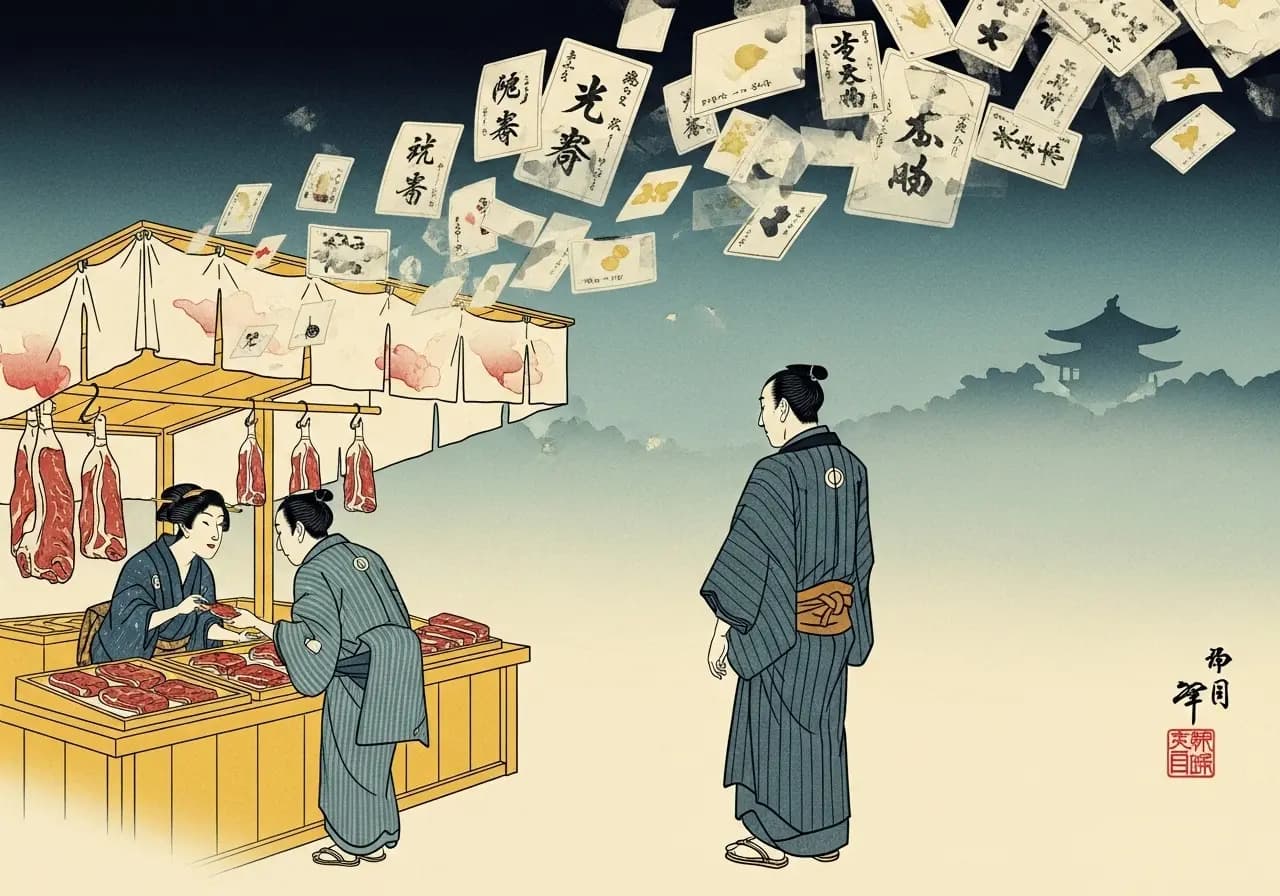
The koan goes: "When Banzan was walking through a market, he overheard a conversation between a butcher and his customer. 'Give me the best piece of meat you have,' said the customer. 'Everything in my shop is the best,' replied the butcher. 'You cannot find here any piece of meat that is not the best.' At these words, Banzan became enlightened."
Now, I like this one because I feel like in our society it's very common to get caught up in this idea of "best," ranking things, wanting to have the best that we can. I want my car to be nicer than all the other cars, or my house to be better than any other house. My job title—going back to the titles—to be more important than any other titles. That's the game that we play.
In this exchange, this koan, this butcher was trying to help the customer understand that these items are incomparable. With the butcher using the idea of meat, the insinuation there is: if you asked for ribs and you try to compare those ribs to, I don't know, some other flank of meat, sirloin or whatever it is—they're not the same thing. Now, it doesn't have to be with meat, right? You can do this with everything. It's like saying you walk into the store and say, "Hey, please give me your best fruit," and the person at the store says, "Well, this is the best banana, and that's the best apple, and that's the best grape. They're all the best."
The idea for me with this koan, as it's developed for me over time, was the realization that I, like many others, have the tendency to rank things as good, better, and best. This moment compared to that moment. This memory compared to that memory. And the koan is an invitation to see the uniqueness of each thing. The moment you can see the uniqueness of a moment, suddenly the moments don't compare anymore. There's not a good moment and a better moment because the concept of good and bad in that sense is totally irrelevant.
There's this moment, and this moment doesn't compare to that moment because that moment arrives and this moment is gone, and they're both entirely unique. They've never happened before. They'll never happen again in that same way because it's taken every event in the past to make this present moment exactly what it is. And when we can start to see life through that lens, suddenly everything becomes unique. And the beauty of the moment is the uniqueness of the moment, not the pleasantness or unpleasantness.
That was a really radical shift for me. I had those ranking phases of my life—this really unpleasant phase dealing with a bankruptcy, or dealing with marital problems, or dealing with whatever it was—ranking that phase to another phase when things were good and I didn't have this problem. And when you're playing that game, according to this koan, my understanding of it at least, is that we're not seeing things the way they really are.
When we can see the uniqueness of each moment, the pleasantness or unpleasantness of that moment suddenly takes on a different meaning.
That was, again, one of those really strong, radical shifts for me in my life—to suddenly appreciate the unpleasant, the painful, the downright miserable moments and experiences that I've had because I can see them for the uniqueness that they are. To be able to see it that way has been powerful. To be able to think, "Well, man, I would never want to go through that again," but part of me is glad that I know what that's like. Because if I encounter someone else on this path of life who is going through that, well, I get to know what that's like. I can identify with that person and show a little bit more compassion and a little bit more kindness because I've been through that same thing.
All of that arose out of this understanding of the uniqueness of the experience, not the goodness or badness, or pleasant or unpleasant. It's like, no matter what I thought of that moment, it's a unique moment. And that in and of itself carries some preciousness.
That's a powerful one for you to explore—the experiences, the emotions, the thoughts, everything it is you're going through in life from that perspective of: wow, this is a unique thing, this is a unique moment, rather than ranking it on the pleasant or unpleasant scale. So, everything is best.
Inch Time Foot Gem
That kind of leads into this third koan, and the last one I want to share in this podcast episode, which is called "Inch Time Foot Gem." This is one of those that... There are several of these that don't really make a lot of sense to me, but then there might be one or two words in the whole thing that makes sense and that's enough for me to get something out of it.
I'm going to read this one to you. It says: "A lord asked Takuan, a Zen teacher, to suggest how he might pass the time. He felt his days very long, attending his office and sitting stiffly to receive the homage of others. Takuan wrote eight Chinese characters and gave them to the man: 'Not twice this day. Inch time foot gem. This day will not come again. Each minute is worth a priceless gem.'"
Again, that's one of those where I'm like, "I'm not sure I understood any of that except the last two sentences." But these two sentences are pretty powerful: "This day will not come again. Each minute is worth a priceless gem."
That koan, the end of that koan, speaks to me, piggybacking off the concept of the other koan about everything being the best. Every moment is the best moment because the entire concept of a "best moment" is already flawed thinking. I like that each moment is a gem—a precious and unique gem—whether that's a pleasant moment, a painful moment, a joyful moment, a blissful moment. They're all the same in that sense that they're like precious gems because they're unique moments.
And again, for me, that is the power of the shift in perspective that a koan like that can do. It causes you to revisit not the event that's unfolding, but the way I'm viewing the event as it unfolds. It's allowed me to pause and then analyze: how much of my life am I going through it doing the wrong or the unskillful ranking of saying "I want the best piece of meat," like the customer at the butcher store? I want the best experience. I want the best whatever the thing is I'm going through in life.
What happens when I revisit that with this new set of lenses that allow me to see the preciousness and uniqueness of the moment? Then suddenly it all changes because I'm not after the best. I'm just trying to appreciate this for what it is because I know it's unique.
I felt that in my own life as I've tried to practice this on multiple occasions. Being stuck in a line and realizing we're not going to get on that ride because the cutoff was two people in front of us—something like that. A moment that could typically be unpleasant because you're thinking, "This isn't how it's supposed to be," turns into one of those moments where it's like, "Oh, that's interesting. I've never had that happen where I was literally two or three people away and I didn't get to get on. Interesting. What a unique thing. I've never experienced that before."
Suddenly, the uniqueness of it became part of the experience. And in a way, it's like, "Whoa, cool. I'll put that on my list of things that have happened in my life," instead of just being super upset and miserable that I didn't get past that line.
And again, with lots of things, when you start thinking of it this way, what you'll see is a shift in the way that you see things. That's how it's worked for me, and that's what I enjoy about these koans.
Closing
That's all I have for this podcast episode. But as always, thank you for listening and thank you really for being a part of this journey with me. If you enjoyed this podcast episode, you can share it with others. Write a review. Give it a rating on iTunes. And if you'd like to make a donation to support the work I'm doing with the podcast, please visit SecularBuddhism.com and click the donate button.
That's all I have for now, but I look forward to recording another podcast episode soon. Until next time.
For more about the Secular Buddhism podcast and Noah Rasheta's work, visit SecularBuddhism.com