

Open Your Own Treasure House
Episode 105 of the Secular Buddhism Podcast
Hello and welcome to another episode of the Secular Buddhism podcast. This is episode number 105. I'm your host, Noah Rasheta. Today I'm talking about another Zen koan called "Open Your Own Treasure House."
Keep in mind: you don't need to use what you learn from Buddhism to be a Buddhist. Use it to be a better whatever you already are.
What Are Koans?
I've been reading through some of my favorite Zen koans recently, and I thought it would be fun to occasionally pick some and talk about them in the podcast. Today I'm going to discuss one of these koans called "Open Your Own Treasure House."
A quick reminder: the point of a koan, which comes from Zen Buddhism, is that it's a riddle or a story meant to make you think—perhaps you could say it's meant to make you stop thinking. Sometimes it's presented as a riddle that tries to set you free from the habitual reactivity of the mind. Something that would normally make sense suddenly doesn't make sense. In that chaos or in that unsolvable riddle, there could be a moment of awareness or enlightenment. There are all kinds of koans—hundreds of them—and you can find books that talk about them and share these stories.
The Koan: Open Your Own Treasure House
I have one of those books. That's what I was reading tonight, and I thought it would be fun to talk about this specific koan. Here's how the story goes:
Daiju visited the master Baso in China, and Baso asked, "What do you seek?"
"Enlightenment," replied Daiju.
"You have your own treasure house. Why do you search outside?" Baso asked.
Daiju asked, "Where's my treasure house?"
Baso answered, "What you are asking is your treasure house."
Daiju was enlightened. Ever after, he urged his friends, "Open your own treasure house and use those treasures."
The Treasure Is the Question
That's the whole story—another quick little narrative that presents a concept. For me, the key phrase here is "What you are asking is your treasure house."
To me, this is an invitation to compare the difference between the questions I have and the answers I seek. It's an invitation to notice that the treasure I have inside—the question itself—is essentially a greater treasure for me than the answers I'm seeking, because the answers come from the outside. The questions come from the inside.
This reminds me of a phrase I've mentioned on the podcast before: "What you are seeking is who is seeking."
Again, this is an invitation to go inward and find in ourselves our own treasure house, and more importantly, to open that treasure house. To open up the questions. This has been a fun process for me in my own personal practice—to see the treasure of the question as a more valuable treasure than the value I was assigning to the answer I thought I was looking for.
The Evolution of My Own Search
I've mentioned this before: my personal journey or my spiritual quest of wanting to understand these big things evolved from prioritizing answers to seeing value in the question itself. Why do I want to know? Why does the question matter so much to me?
The more I've come to understand the questions I have, the less interested I've become in the answers. The answer almost doesn't matter anymore. I don't even know that I would care to hear an answer because the question itself has given me so much to work with, so much to digest and to understand about myself. In that process of analyzing the question, I've found something that seems much more valuable to me than the answer could have been.
I think that's at the heart of what this specific koan is trying to get at.
The Skillful Art of Questions
I like to think of this in terms of the skillful art of being introspective about our questions. It's common for us in our Western way of thinking to be inquisitive and to focus a lot on answers. I mean, in school, we're taught this from a young age, right? We have questions, and then here are the answers. Here are the formulas that you follow to go from the question to the answer. You get the answer, and it's like, "Hurray!" You get awards and you get graded on it. All the emphasis is put on the answers.
I think that's great. The fact that we can answer difficult questions has led us out of the Stone Age, so to speak, and into this digital age that we live in. Our ability to answer difficult questions and to focus a lot of attention on those answers is truly remarkable.
But I do feel like on an inner spiritual trajectory, we're paying a price for having the mindset that sees the treasure as the answer rather than seeing the treasure in the question. In my personal experience with these big, deep questions about life or questions I have about myself and others, I've found that the question itself is the treasure.
What I mean by that is: when I'm confronted with a scenario where questions arise, it can sometimes be satisfying, skillful, and useful to find those answers. But more often than not, it's the question itself that really ends up being the treasure at the end of the quest.
A Real-Life Example: The Passport
Let me give you a real-life example that happened this morning. My wife was taking a trip to go back to Utah to do some business work with her dance studio auditions. Her plan was to leave for a couple of days and then come back on Friday this week. I'm home with the kids alone.
In preparation for this trip, we've been trying to sort out the steps required for her to leave. I'm a Mexican citizen, but she's not. She's an American citizen, and she's here under a temporary residency visa. Once you obtain that and you're in the country while it's pending, you can't just leave the country without having a letter that authorizes you to leave.
She booked her ticket to go back home to the US and started the process at the immigration office to get her letter of permission to leave the country. We thought about that ahead of time, did all the paperwork necessary, and she received an email a couple days ago saying, "It's been approved. Now you just have to stop by the immigration office to pick it up."
Last night, she's packing her bags, and around 10:00 or 11:00 PM, as we're talking about the next morning, it occurs to her that she never went to pick up the letter. As you can imagine, she gets really stressed and freaked out about it. I did too because I thought, "Oh, you can't leave. If you leave, they will definitely close down your immigration case and you have to start all over."
This was a process she'd started back when we were in Utah at the Mexican consulate. I thought, "This is going to really complicate things, and it's probably not worth risking this." We started trying to find solutions because she had to wake up early and go straight to the airport, and the immigration office doesn't open until 9:00. There was no way to squeeze that in on the way to the airport.
We started looking at other flights. Of course, to leave the very next day, when you're looking at flights, they're really expensive. The cheapest option was to get another flight, but that was $1,600. It just wasn't feasible.
What we were facing at this point was the decision to cancel the trip. She was really stressed about that. Her tendency, when she's stressed, is to go really hard on herself. She was talking about how she's such a failure, why didn't she see this coming, why is she so disorganized? Just being really harsh on herself.
I was reminding her, "I know what that's like too. I've done that. I didn't think about it. I missed out on this too. We both dropped the ball."
But then the solution ended up being that she called the airline, and JetBlue said they could put her on a later flight. It totally surprised us. She became a JetBlue fan for life because they only charged her $75 to get on the later flight and made it super easy. Within minutes, they'd emailed her the new itinerary, and she would be on a later flight allowing her to have time in the morning to run to the immigration office to get the letter she needed.
We wake up this morning. She goes to pick up that letter, and I'm waiting outside. She finally gets it. That process was stressful for her because she was counting down the minutes. We needed to leave by 9:15 to make it to the airport in time. The office opened at nine, and she was running out at 9:15. You can imagine how stressed she was while she was waiting up there. She was already on edge when she got in the car. She starts driving, and again, she's just going off being really upset and down on herself.
At this point, it's becoming difficult for me because I'm thinking, "I don't want her to feel so bad." I'm also stressed about the whole ticket situation, the letter situation, everything we're dealing with, and now we're stuck in traffic racing to get her to the airport on time. I finally get there just a couple minutes past the deadline—a couple minutes after you're supposed to be there for an international flight.
I drop her off and turn around. Our youngest is three, and she's sitting in the back. She's really upset because she hasn't eaten, and she's crying, saying, "I just want to go eat." I said, "Okay, we're going to go. I'm going to pull over, and we'll find something."
Then, doing all this as I get back on the highway, my wife calls me and says, "My passport's not here."
At that point, I immediately pulled over and said, "Are you serious?" We start looking around the backseat, and no, it's not there. Then I looked in the front seat and there it is on the floor. It had slipped out of her backpack where she had all her documents. When she opened the backpack to verify she had all the documents, the backpack tipped over or something and the passport fell out.
Suddenly, I'm racing back to the airport to give her the passport. Long story short, she made the flight. It was stressful, but it all worked out.
The Real Treasure
By the end of that whole ordeal, on the drive back, my daughter's really upset and crying and really hungry, and I'm feeling flustered, feeling all these emotions arise. That was a moment where I had the opportunity to exercise the skillful art of analyzing the questions that arise in me.
Why do I feel this way?
In that moment, it occurred to me how much more skillful it was that I'm asking myself, "Why does this bother me?" It all worked out. It may not have worked out, and if it hadn't, then the trip wouldn't have happened. It wouldn't have been the end of the world. But as I'm sitting there thinking about this, I realized something: the habitual question that arises now is more along the lines of, "Why am I feeling this way?"
Instead, what could have been the older version of me—the past version that would have been thinking differently—I would have been thinking, "How can I get rid of this feeling?" Because I'm feeling really uncomfortable with the circumstances at the moment, and I would have been thinking, "How can I get rid of this? How can I distract her? What can I say? Maybe something rude like, 'Oh, you need to get your stuff together.'"
Anything that would have made me think "how do I get rid of the feeling?" would have been different than the train of thought that arose from the question of, "Why am I feeling this way? Why does this bother me?" The introspection that took place on the drive home with regard to the feeling that arose in me—that was different.
That was, for me, a fun moment to recognize the treasure, to open your own treasure house and say, "This is what we just went through. This is how I'm feeling. It's an unpleasant feeling. Now let me sit with that and ask, 'Why am I feeling this?'"
For me, this moment was actually very powerful because I was able to get several layers deeper. It's not about the passport. No, it's not about the letter. It's not about the external circumstances at all. When I dug deeper, I got to something much more meaningful.
In this specific case, it was recognizing that the discomfort I'm feeling with this whole situation as it's unfolding—the core of it was sad for me to see my wife be so harsh on herself. She texted me once she got through security, and she was apologizing profusely. She said something along the lines of, "I always mess up like this and make dumb decisions that cause stress, and it makes me hate myself inside and out."
That really stood out to me. I thought, "Wow, how could you hate yourself over something simple that anybody could have done?"
My response was: "Your only flaw is thinking that you have a flaw. Your only flaw is thinking that you're flawed."
The Pattern Beneath the Crisis
I reminded her of other instances in our lives where chaos ensued after a mistake or a poor decision. It reminded me of how I felt on our wedding day. We went to get married, and I forgot to bring the marriage license. We were getting married in a religious ceremony where you have to present the marriage license. Everything was scheduled. We had a room set apart. Everybody was there waiting. The wedding was suddenly on hold because I forgot. I didn't realize I had to have the marriage license.
Everything got delayed, but at the end, it all worked out. But I'll never forget how I felt that day. It's like, "Oh, welcome to day one of marriage with the most stressful events up until that moment."
I reminded my wife of that story. It all worked out then too.
Bringing It Back to the Koan
What I'm trying to get at with all this—pointing it back to this koan, "Open Your Own Treasure House"—to me that's a direct invitation to compare and to find the treasure we assign, the value we assign to the questions we have versus the answers we seek.
No doubt, you have your own sets of questions. You have your own sets of answers that you're looking for. How do you weigh those on the scale? Are the answers more important to you than the questions? If so, what would happen if you tried to focus a little bit of that attention on seeing some of the value in the question?
This is where Buddhism kicks in again with the non-duality aspect of this. How could the answer be so important and the question not be so important when you cannot have the answer without the question? You can't have one without the other. I love that way of thinking—the way of oneness that puts things into perspective. The question is as important as the answer.
What happens when the question becomes your treasure?
Hopefully, as I continue to practice this in my own life and the different aspects where questions arise, just as it did with the big existential questions, the question will become more valuable to me than the answer. I'm not even interested in the answer because the question tells me more about myself—which is the inside—than the answer could ever tell me. The answer always comes from the outside, something external to me.
That's what I wanted to share with you about this specific koan: "Open Your Own Treasure House."
A Koan for You to Sit With
Now, I thought it would be fun to end this podcast with one more koan. But instead of deconstructing it and telling you my opinion of what it means to me, this time I'm just going to share the koan directly as it is—and I'm not going to say anything about it. Let you stew over it for the next week and see what it means to you. I probably won't mention it in a future podcast. It'll just be a koan sitting with you.
Here it is. It's called "No Water, No Moon."
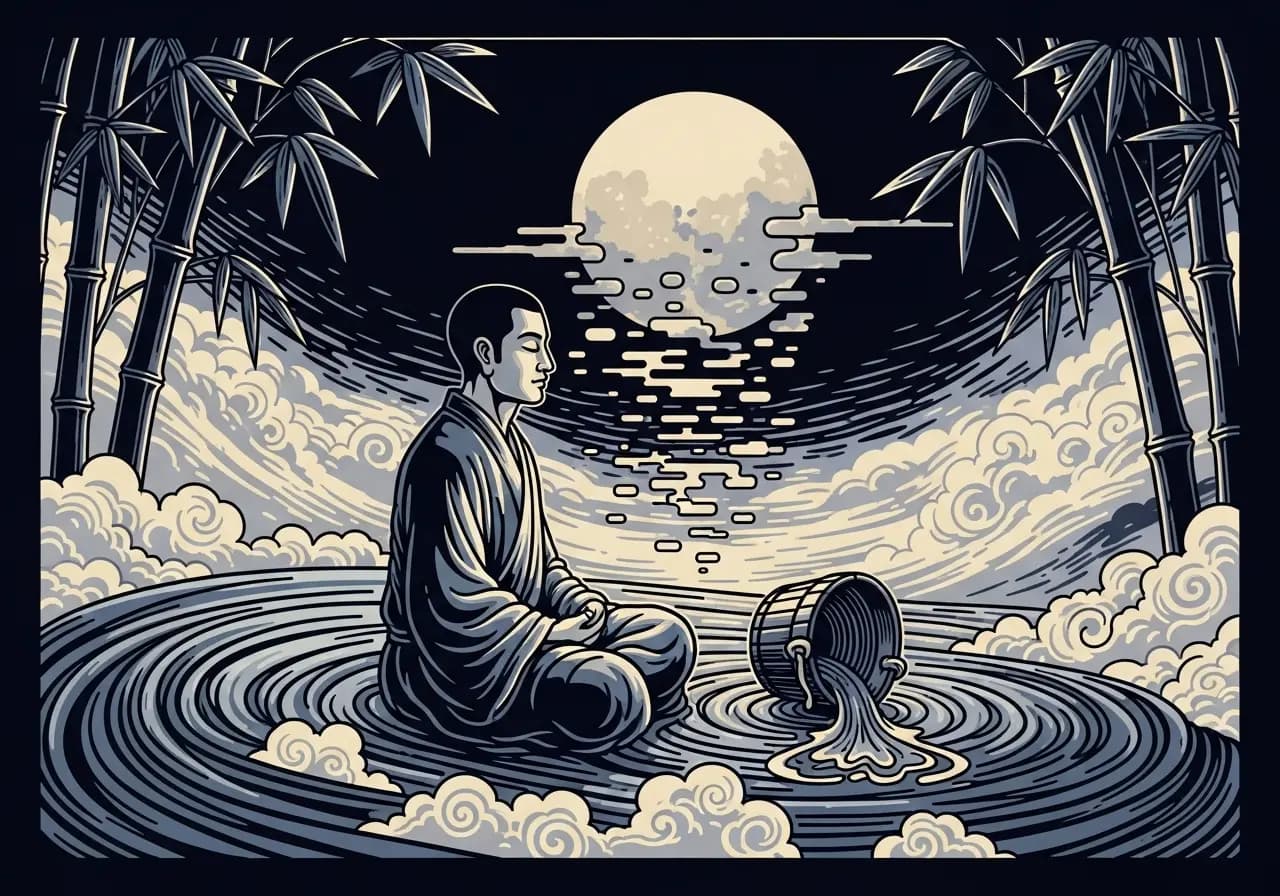
When the nun Chiyono studied Zen under Bukko, she was unable to attain the fruits of meditation for a long time. At last, one moonlit night, she was carrying water in an old pail bound with bamboo. The bamboo broke and the bottom fell out of the pail. At that moment, Chiyono was set free.
In commemoration, she wrote a poem:
In this way and that I tried to save the old pail. Since the bamboo strip was weakening and about to break, until at last the bottom fell out. No more water in the pail. No more moon in the water.
That is the poem. That is the koan: "No Water, No Moon." Have fun with that one this week.
Closing
Thank you for taking the time to listen to this podcast episode. I enjoy being able to share my thoughts and ideas with you. I really appreciate you being part of this fun journey with me.
If you want to learn more about Buddhism and mindfulness, you can always check out my books, which are listed on NoahRasheta.com. As always, if you've enjoyed this podcast episode, feel free to share it with others, write a review, or give it a rating on your podcast platform.
If you would like to make a donation to support the work I'm doing with the podcast, feel free to visit SecularBuddhism.com and click on the donate button.
That's all I have for now, but I look forward to recording another podcast episode soon. May you open your own treasure house and see the value of the questions.
Until next time.
For more about the Secular Buddhism podcast and Noah Rasheta's work, visit SecularBuddhism.com