

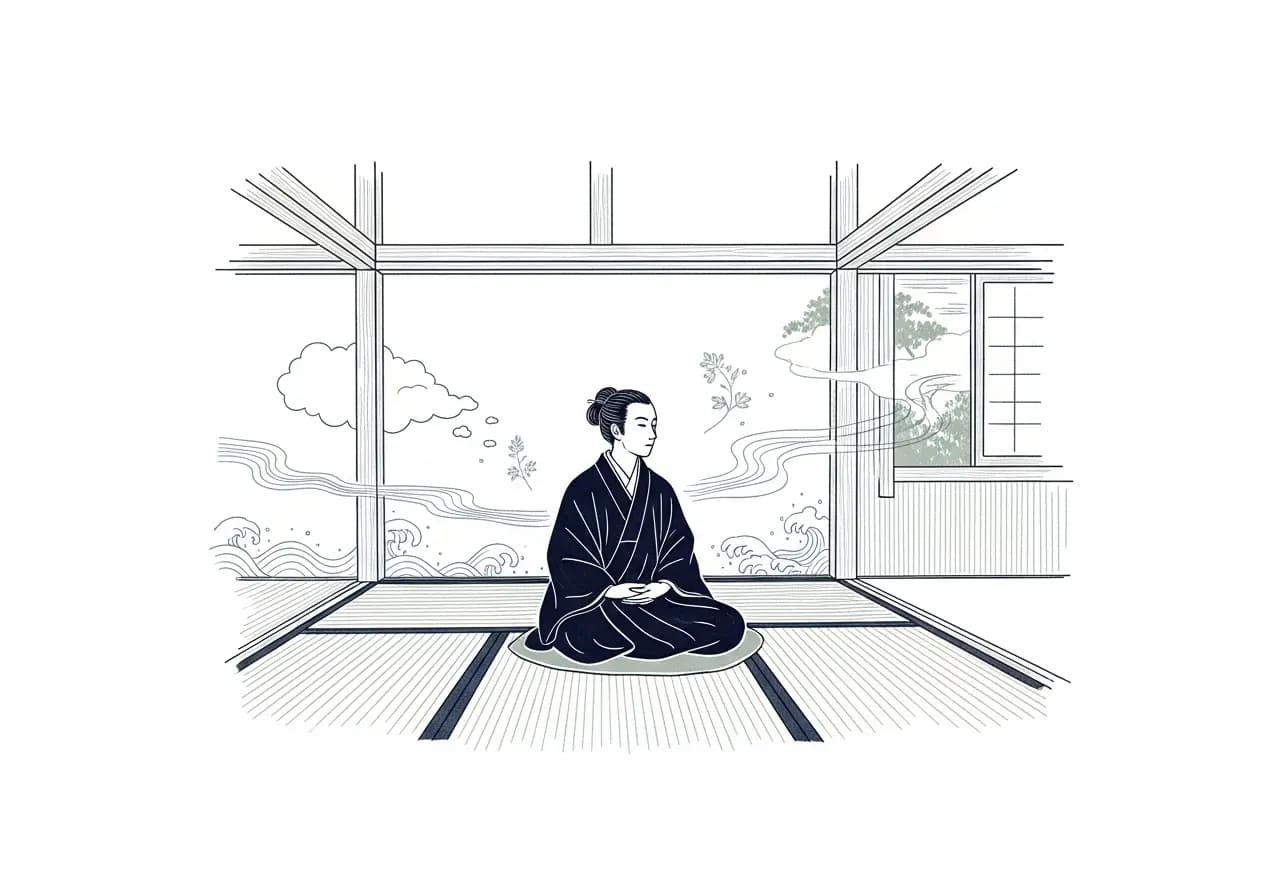
Making Time for Nothing
Episode 103 of the Secular Buddhism Podcast
Hello and welcome to another episode of the Secular Buddhism podcast. This is episode number 103. I'm your host, Noah Rasheta. Today, I'm talking about making time for nothing.
Keep in mind: you don't need to use what you learn from Buddhism to be a Buddhist. You can use what you learn to be better at whatever you already are.
The Concept of Nothing
I wanted to talk about this concept of making time for nothing. I can't remember exactly where I first heard that expression, but it stuck with me. Perhaps it was a chapter from a book I read, or it was included in a quote somewhere. Either way, I remember thinking how interesting it was to make time for nothing.
Later on, I came across a book by Thích Nhất Hạnh called Buddhism at Bedtime—one of the books I read to my kids at night. At the very beginning, it has a section about nothingness. Thích Nhất Hạnh asks this question: "Is nothing something?"
He goes on to say that yes, nothing is something, because the moment I say nothing or talk to you about the concept of nothingness, something pops into your mind. It's an idea—nothingness as the absence of something. In that sense, nothing is something. I remember exploring that idea and thinking, "What is nothingness?" And then I realized something important: the question itself changes what nothingness is.
Boredom and the Skill to Do Nothing
More recently, I came across a quote by Ethan Nichtern that really resonated with me. He says: "There might be no greater skill that comes from sustained meditation practice than the increased ability to tolerate boredom. The ability to be bored and not freak out is everything. It might be the key to surviving this technological age."
I like that because I think about this in terms of myself and my kids. One of the greatest things I can teach them—and teach myself—is how to be comfortable with boredom.
It reminds me of another quote I love from Blaise Pascal: "All of humanity's problems stem from our inability to sit quietly in a room alone." The original quote specifically says "man's inability," but I replaced that with "our" because it applies to all of us. All of humanity's problems stem from our inability to sit quietly in a room alone.
Think about that for a moment. How difficult is it for you to sit quietly in a room alone? How uncomfortable does that concept of boredom make you? When you're doing nothing, are you actually doing something? I would say the answer is yes.
What "Nothing" Really Means
I think there's a misunderstanding that happens with this way of thinking, due to how we associate the word nothing. When someone says "I'm thinking of nothing," you might assume they mean they've somehow made their mind stop thinking. You might imagine they've gained complete control over their thoughts, that all thoughts are gone, and what remains is emptiness.
This is why I love Thích Nhất Hạnh's question: "Well, is nothing something? What is the something that's there when all those thoughts aren't there?"
Because there is something there, right? The very nature of being human, of having a brain that works, means it's always going. The absence of one thought is just the mind filling itself with another thought. I think that's much closer to what I understand mindfulness meditation to actually be as a practice.
Summer, Boredom, and Restlessness
I've been thinking about this concept of boredom, especially with my kids. Some of you might feel this during summer times. I usually notice it on weekends, and especially during summer when we break away from our normal routine. Suddenly, things can become a little difficult.
You might have noticed this in your own family: after a few days of nothing—of that nothingness, which is actually somethingness—we can get a little cranky with each other. I think this is because there's a lack in our ability to be comfortable with boredom.
I find this very interesting right now in this particular phase of our lives. We just moved to a new country. We're going on four or five weeks now of being here, and everything is different. Our routine was completely smashed to pieces. And because school hasn't started yet, we haven't been able to rebuild a routine. Here we are living the days of nothingness with occasional somethingness.
The somethingness we're doing is big stuff. We went and swam with whale sharks last week. Last Sunday, I flew my paramotor fifty miles along the coast. I'm filling some of the time with big activities, but then the majority of the time we're sitting around thinking, "What should we be doing?" We're all looking at each other, bored. We don't have the TV programs we're used to. We don't have the habitual activities we're accustomed to from where we used to live. Everything's new, and it's really forcing us to sit in these moments of nothingness—these moments that are actually somethingness.
Those are moments where we're sitting and thinking, "Ah, I missed this," or the kids will say, "I missed that from home," or "I miss this friend or that cousin." Anyway, along all these lines of nothingness and becoming comfortable with boredom, I've been thinking a lot this week about how I can help the kids—and myself—to become more comfortable with boredom.
Reframing Meditation and Mindfulness
I've been practicing mindfulness meditation with my kids, but I think this is where the misunderstanding kicks in. The word itself—nothing, meditation, mindfulness—these words give us a misunderstanding of what they really are.
When we say, "Hey guys, we're going to practice our meditation tonight," or "We're going to try to be more mindful," that immediately puts an idea in their head. And whatever that idea is, I don't think it's accurate. I think this is very common for us as practitioners—anyone who's on the path, entering the path, or interested in being more mindful. You probably have an idea of what that is, and that idea may be wrong.
I wanted to couple all of this with a different notion. What if we swapped the idea of nothingness—making time for nothing—with the word suchness? It's a word I've heard before, and I like it. Suchness gives me the idea of "this is just how things are," and I'm just watching the suchness of the moment. Making time for suchness is, to me, a more powerful way of practicing what mindfulness actually is.
The Practice of Witnessing Suchness
It's the moment where I sit and I'm just observing the suchness of the moment—the suchness of whatever emotions, thoughts, or feelings I'm experiencing, including and perhaps especially the unpleasant ones.
Someone once said that boredom is just the lack of observing, the lack of seeing. I agree with that. When we're bored, we're not looking close enough. How can you be bored in a world where you can stare at any little thing and see an infinite number of interdependent connections with that thing? Whether it's in space or time, you can ask: "What did it take for this moment to arise? What causes and conditions came together to create this exact moment?"
That's a question I like to ask myself a lot in those moments when I'm feeling bored. I think that gets closer to the heart of what we're trying to practice with mindfulness. We're not trying to achieve nothingness. We're not trying to understand nothingness or see emptiness. What we're trying to see, what we're trying to observe, is the suchness of how things are in that moment.
This is how I feel. Oh, this is how I feel. Then maybe explore that a little bit. Why do I feel this way? Why does this thing, this event, trigger this feeling? What are the causes and conditions that led to this?
At the end of the day, what we're gaining is comfort with the suchness of things and, if we're lucky, a little more understanding about the causes and conditions that lead to that suchness. I think that gets closer to being at the heart of this as a practice—where the end result is skillfulness, a much more skillful way of being with whatever is in that moment.
Practicing Boredom with My Kids
Going back to the concept of boredom and my kids, I think one thing I've been trying to change now is instead of saying at night, "Hey, let's sit down and practice meditation," I've been saying, "Guys, let's sit down and practice being bored."
They're like, "Okay." We sit there, and then I ask, "What happens when we're bored?" Everyone's looking around, and suddenly it triggers this attentiveness. It's almost like they're thinking, "Wait a second, how do I know when I'm bored?"
"Well, I don't know. You tell me."
They're there paying attention to how they're feeling and looking for the signs that would say, "Oh, now I'm bored," but looking for boredom has made them struggle to find it, which is interesting. Because I think that's the whole point. You're training your awareness to something, and then going back to Thích Nhất Hạnh's question: "Is nothing something?" Absolutely. In this sense, the nothingness is the something that's actually helping them be more skillful with practicing awareness and overcoming boredom.
An Invitation for Summer
I wanted to share this because it is summer, and I'm sure many of you who have kids—or who've broken away from the standard routine of things in summer—sometimes find it difficult. There's this yearning, especially at the end of summer, to go back to whatever the ordinary routine is.
But it can be an invitation to use these moments of boredom as moments of practicing mindfulness. Sometimes it's harder to do this when we're back in routine, in the mundane flow of things, because then we're in reactivity mode. We're just doing what we do because this is the routine. We get up, we take the kids to school, we come back, we go to work or whatever that routine is.
It may be harder for some people in those moments to practice being mindful or to practice witnessing suchness because we're just in the routine, going about our thing. This is an invitation to use the boredom of summer to ask, "Well, what does this mean? How do I know when I'm bored? What does boredom look like? What does it feel like?"
Whether you're doing this with your kids or just with yourself, the more you poke around and explore what boredom is and how it feels, the more elusive it becomes. You may realize, "Wait a second, that's not boredom because now I'm interested in understanding what this is, and the very act of being interested makes it go away."
Boredom's gone. It can be a fun little mindfulness practice or technique to work with.
Closing Thoughts
That's the concept I wanted to share with you today. As always, if you want to learn more about other concepts, you can check out my books. They're all listed on NoahRasheta.com.
If you enjoyed this podcast, feel free to share it with others, give it a review or rating on iTunes or wherever you listen. If you want to support the work I'm doing with the podcast, you're welcome to make a donation on SecularBuddhism.com. Just click on the donate button.
That's all I have for now. I look forward to recording another podcast episode soon, hopefully giving you another topic to think about.
Thank you for listening. Until next time.