

I Am Never Lost
Episode 102 of the Secular Buddhism Podcast
Hello, and welcome to another episode of the Secular Buddhism podcast. This is episode number 102. I'm your host, Noah Rasheta, and today I'm talking about never being lost.
Keep in mind: you don't need to use what you learn from Buddhism to be a Buddhist. You can use what you learn to be a better whatever you already are.
Introduction to Ikkyū Sojun
Today's podcast episode is inspired by the quotes of Ikkyū Sojun, an eccentric Japanese Zen Buddhist and poet who had a great impact on the infusion of Japanese art and literature with Zen attitudes and ideals. He lived roughly from the end of the 1300s to the early 1400s in Japan.
I recently came across some of his poetry and works, and there was a specific quote that I really enjoyed. I came to find out later that it's actually a disputed quote, but it has led me to explore other quotes and poems of his that I find meaningful. I wanted to share a few of those with you today.
A Quick Note on Audio Quality
Quick housekeeping here: I'm working with a new microphone. As many of you know, I moved to Mexico, and I brought a microphone with me. In the last podcast episode, I received a few emails with feedback about the audio quality, so I'm hoping today's episode sounds better. I'm learning the settings and discovering ways to tweak the audio to make it sound better once I record it. So bear with me as I iron all this out over the next few podcast episodes.
On the Format of This Podcast
I've been thinking about the format of the podcast and how to decide on topics. In most schools of Buddhism, it's common to listen to what are called Dharma talks—these are little talks where you usually listen to a teacher or a Sensei share a message. If you go to a Buddhist congregation, you'll typically sit in meditation—silent meditation, walking meditation, and there may be some ritual aspect to it. There's usually a Dharma talk, and that's the moment when a concept or idea is shared.
That's essentially what I'm trying to do with this podcast. These are like Dharma talks, and it allows the format to be a little bit more loose. It's just sharing a topic or an idea. It doesn't have to be very formal or structured, and that makes it easier for me as I prepare podcast episodes each week, knowing that it doesn't have to be super structured or a carefully written script to follow.
The Quotes of Ikkyū Sojun
With that in mind, I've been thinking about these quotes by Ikkyū Sojun, and I wanted to share a few of them.
Quote One: Yesterday's Clarity Is Today's Stupidity
One of them is: "Yesterday's clarity is today's stupidity."
I like that one because it's an expression that reminds me that what made so much sense to me in the past, I can look at today and question. I think, "How did that ever make sense to me?"
But I think there's a deeper, more important aspect to this as well. It's recognizing that today's clarity may be tomorrow's stupidity. It's just a reminder of the ever-changing nature of things. What made so much sense to me may not make sense in the future, and what made so much sense to me in the past may not make sense today.
I'm sure you can see that in different facets and aspects of your life. This is a fun expression that we can keep at the forefront of our mind as a way of remembering that we don't have it all figured out. The clarity that we think we have one day may not seem so clear tomorrow. This kind of gets into the overarching theme that seems recurrent in Buddhist teachings: this concept of uncertainty and groundlessness, which I want to elaborate on with another quote.
Quote Two: If It Rains, Let It Rain
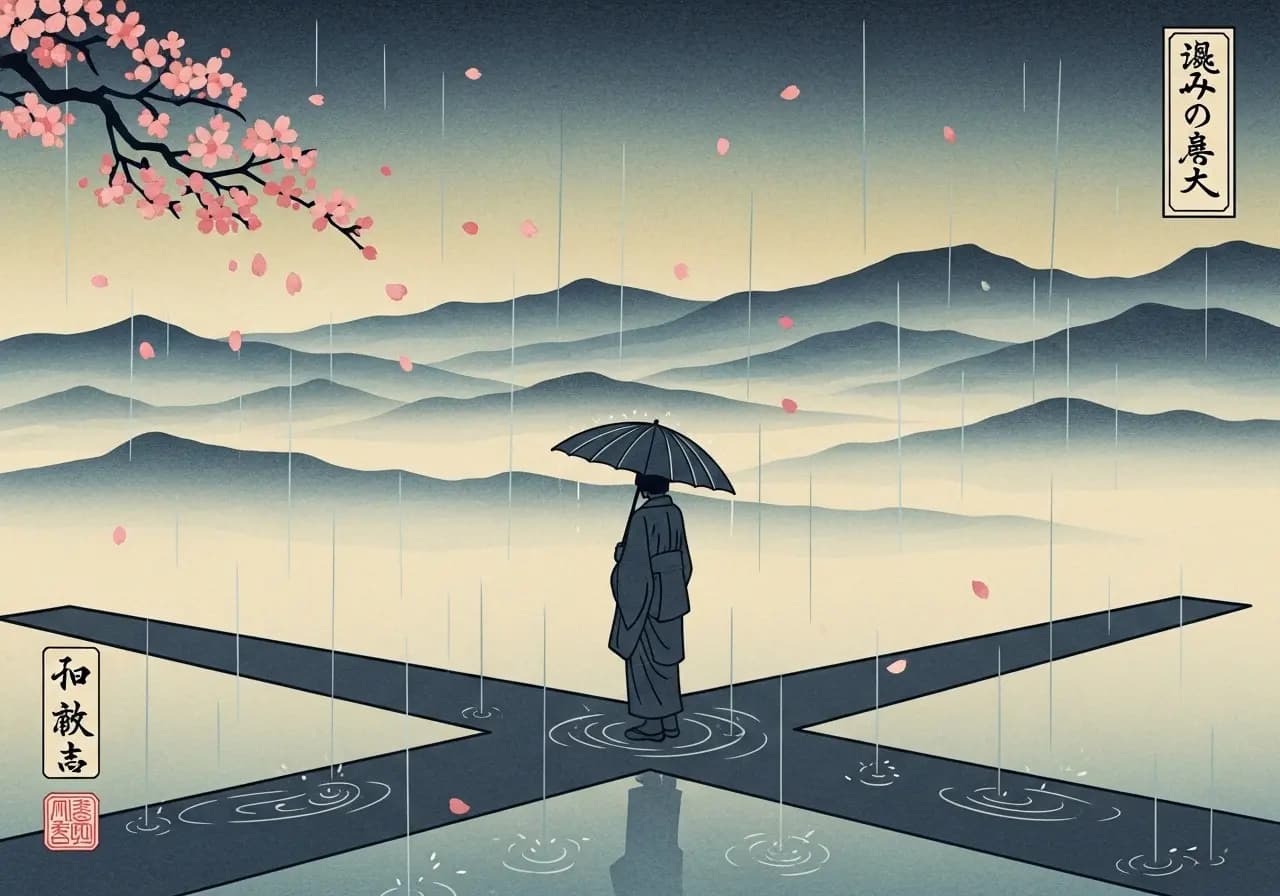
The next quote I want to share is also from Ikkyū Sojun: "If it rains, let it rain. If the wind blows, let it blow."
I like that expression. It's easy for us to visualize ourselves walking down the street when suddenly it starts to rain or the wind starts to blow. Most of us are going to use all of our energy and resources to be skillful in that moment. We either pull out an umbrella, find shelter, or get under a roof. We do the things we know we need to do to be skillful with the situation at hand.
But we don't waste any energy, effort, or time trying to stop the rain or stop the wind, to control the elements. We don't do that because we know we can't. So all of our effort goes into acting skillfully in that moment.
When I hear this expression, I think about internalizing it and applying it to the things that arise in my day-to-day life. How much energy am I exerting when an emotion arises—trying to fight that emotion or push it away—rather than just being skillful with it and thinking, "Okay, anger has arisen. Let me get under the roof, or let me open this umbrella, because I know that for the next little bit, this is the situation I'm confronting, and I want to be skillful." That will ultimately affect how I speak and what I do during these moments when I'm experiencing these emotions.
I think that gets to the heart of what Buddhist practice is all about. It's being able to be skillful with what arises. It's being able to be aware of what arises. But it's not about changing what arises.
The Western Misunderstanding of Practice
I think that gets lost in the Western approach. I see this over and over and over from the Western mindset. It's like: "Why are we doing all of this? Because we're doing this so that we can change." It's like, "I'm practicing mindfulness so that when the rain comes, I can stop the rain, or so that when the wind blows, I can make it blow a little less."
And that's not at all how it works.
In the same way that we can't control the elements, we can't always control the wind. A lot of times what arises in us—the emotions we're experiencing—we can't control. The point isn't to try to domesticate our feelings and emotions. The point is to try to understand them. Now, I think it's fascinating that the more we understand ourselves and the more we understand why certain things arise or feel the way they feel for us, the more that relationship we have with that emotion starts to change over time.
So the end result may seem like there's more peace. But that wasn't the goal. The goal is more skillful understanding—a skillful change in relationship with what arises.
I feel like that gets lost a lot in the practice the way it's perceived in the West. I encounter this over and over when somebody reaches out and wants to learn more about Buddhism or about mindfulness as a practice. It's always approached with: "Hey, how can I use mindfulness to be more peaceful in my house?"
And I'm like, "Well, I don't know that you'll be more peaceful in your house. It's not about being more peaceful. It's about understanding yourself more."
Then the secondary result of understanding yourself more is that you may have more peace with yourself, because you're more comfortable with the difficult emotions you experience when they arise. You're more skillful with what you do when you're experiencing one of those emotions. But you're not changing the emotion. You're not preventing yourself from feeling anger or other feelings.
The whole way of thinking is embodied in that expression: If it rains, let it rain. If the wind blows, let it blow.
Quote Three: Having No Destination
Now the third quote is the one I mentioned before—it's a disputed one. I shared it on social media several weeks ago, but I like this expression. It says: "Having no destination, I am never lost."
Whether he said it or not, I think it's a valid expression that's worth thinking about.
If you recall, Ikkyū Sojun is a Zen Buddhist sharing these concepts and ideas. In the Zen tradition, the concept of the koan is worth mentioning here. These are riddles, expressions, and mental puzzles that are meant to be troubling to understand.
If you hear this expression—"Having no destination, I am never lost"—some of you may hear that and think, "Wow, what a profound statement." Others may hear this and be thinking, "What a dumb statement, or what an obvious statement, or what a useless statement." All of those are fine. They're all correct because the exercise of the koan is to get you thinking and to really ponder on this.
For me, this expression points to again this concept of groundlessness. If there's nothing to grasp, I have no firm foundation that is the base for my reality, then I can't be lost. I have no destination. There's no place I need to be—there's only where I am. I like thinking that way.
In my own life, I have no destination in the sense of "I need to be here doing this for this reason." I don't have a destination like "I need to be a mindful Buddhist practitioner" or something. That's a destination. If I have no destination, I can't be lost. It's not like I'm doing it wrong because there's nothing I'm supposed to be doing. I'm just experiencing life, trying to be present, and understanding myself in the process. So I can't be lost because I don't feel there's anywhere I need to be.
A Philosophical Tangent: Heaven and Hell
Now I've been having some mental pondering. I don't know how to word it exactly. I think a lot, and I like to think about ideas—especially ideas that seem very natural to me because I was conditioned to think that way. Then I like to explore those things.
One of the ones I grew up with, and perhaps many of you have too, is the Judeo-Christian idea of heaven and hell. I was thinking about this the other day and talking to my wife about it. We have conversations from time to time about a lot of these concepts because this is a realm she inhabits as a Christian believer and a believer in concepts like heaven and hell.
So we were talking about this concept, and I said to her: "To me, there's a conundrum when we talk about heaven and hell—at least the way I understand or was taught that they exist. Heaven is this good place, and hell is this bad place. You want to go to the good place and avoid the bad place. But here's what's interesting."
I've always been taught that good people go to the good place and bad people go to the bad place. Well, what are good people? Good people are kind, compassionate, and Christ-like. But here's the interesting thought: Wouldn't the good people want to go to the bad place?
Think about it. If the people who are suffering are going to be in the bad place, then what good person who is genuinely good in their heart would want to turn their gaze away and not want to see and be with the people who need kindness and compassion the most? The people in the bad place.
What if the ultimate test to make it to the good place is that you can't want to be there? What if wanting to go to heaven is what disqualifies you from going there?
I've thought about this with expressions that have been brought up to me at times in family or friends circles. People will say, "Hey, don't you fear deviating from the right path? Don't you fear the risk of not making it to heaven?"
I've thought about that. No, I don't fear that. Telling me that is like me telling you, "Hey, aren't you losing sleep over the fact that you may not make it to Valhalla?" You'd be like, "Well, no, I'm not worried about Valhalla because Norse mythology is not the worldview I follow." And that's kind of how I feel.
But then there's this thought: Well, if there really is an afterlife and there are people who are going to be suffering in this place of suffering, isn't that where I would want to go? If I feel compassion and kindness for them, I would certainly want to be there if someone I knew was there—especially if it was a family member or a child of mine. If that's where they're going, there's no way I would want to be anywhere else but where they are.
That really puts that conundrum into perspective. Maybe wanting to go to the good place is what disqualifies you from going there. Anyway, that's a side tangent inspired by this concept of having no destination. I don't need to go to a good place or a bad place. I'll just be wherever I am.
My Own Expression: Having No Certainty
I've been listening to these quotes and thinking about concepts. I mentioned that before. I started thinking, "Well, if I had an expression like Ikkyū Sojun, what would my poetic expression of reality be for me?"
One of the ones I thought about, piggybacking off the format of his expression, is this: "Having no certainty, I am never wrong."
That's one I've been playing with all week. What does that mean? Well, if I don't have a place of certainty, if I'm trying to experience this form of groundlessness, what do I have to defend? I don't have a view to defend. I don't have a view to fight against.
It makes it interesting because I can't be right, but I also can't be wrong. I like that thought.
I think we live in a day and age where things are becoming very polarized—whether it's political ideologies, religious ideologies, opinions, whether the Earth is round or flat, whether you're a dog person or a cat person. Everything has to be a fight about who's right and who's wrong. I like this way of thinking: If I have no certainty, I am never wrong.
If I perceive others as not having certainty—if they have the illusion of certainty in their argument, but they actually have no certainty—then I don't view them as right or wrong. I only view their view for what it is. That's a fun way of practicing.
This is something I've been trying to practice in my own mindfulness practice. I've detected a really good place to do this: on Facebook or any social media. If somebody posts something we don't agree with, why do we feel such a strong need to go on there and make sure they know we disagree with them? Why do we do that?
I think a lot of us have that tendency, and I know I do. I typically don't go on and engage with anyone about anything controversial, just because—what's the point? The tendency may arise. I think about what I would type. I may think about it without ever doing it, and that's become an area where I can practice.
The Real Practice: Understanding Yourself
With this kind of practice, I want to be clear: I'm not saying we need to just tolerate or accept whatever is said or whatever belief or opinion someone has. No, certainly there may be things we want to stand firm on and say, "Well, I don't like this way of thinking," or express our view. I'm not saying we need to change that.
All I'm saying is that the practice in all of this is gaining more understanding about ourselves.
For example, if I'm browsing Facebook and I see a post that makes certain feelings arise—anger, frustration, discontent—my practice isn't to stop those feelings. It's not like, "Oh, I should tolerate that." No, that's not the practice. The practice is: "Wow, why does this evoke such a strong emotion? Why does this arise in me based on what this person posted or said?"
Again, the point isn't about the person or the expression. For me, the point is: "Oh, it's because of this or that." I learned something about myself. To me, that's the practice.
The more I do it, the better I get at understanding myself. I think sometimes we confuse the practice, like I mentioned before, with thinking: "Well, if I practice this kind of stuff, I'll be better at not feeling angry when so-and-so posts their political stuff."
That's not the thing. That's not the practice. You can't fake that. You can pretend, "Oh, I'm not going to let that bother me," but if it bothers you, why pretend that it's not bothering you? Sure, I don't have to say anything or engage. But the feeling—where did that feeling come from? Why is that feeling so strong? Why does that bother me and this other topic doesn't? Those are questions I can look at and explore and gain insight about myself.
And that allows me ultimately to have a more skillful relationship with the experiences I'm having as they unfold. But that's the extent of it.
The Point of Practice
The practice isn't so that you can change yourself or change someone else. Especially don't try to change someone else—don't go down that route. The whole practice is: now I understand myself better. And just like with the example of "if it rains, let it rain"—well, now I'm not afraid of the rain because I know I can do the skillful things I need to do when it starts to rain. I can go get under the roof. I can pull out an umbrella.
When political season comes, I can spend less time on Facebook. I can be more skillful with these things as they unfold because I know myself.
The changing is inevitable, whether we like it or not. But the more we understand ourselves, the more likely it is that the change that's going to happen is a useful, skillful change that benefits you and everyone around you because you're not so caught up in the reactivity of your own emotions. You can be skillful with discussions around sensitive topics.
That's a really powerful thing, especially in dynamics with parents or loved ones. I feel like we've gotten really bad at this in our society. We tend to want to surround ourselves with people who think the way we think. And if you don't think the way I think, there's this sense of indignation. I can't be your friend. I'm going to unfriend you or I'm going to stop seeing your posts, and then that makes it worse because now we become so sensitive that we can't be around anyone who doesn't think the way we think.
And that is not the solution.
The Power of Communication
Communication—skillful communication—is probably the most powerful tool that we can try to develop if we want to make things better.
I feel fortunate that I'm in a position where I get to practice that a lot. My wife and I have different political views, different ideological views, a lot of different cultural views. We represent two ends of the spectrum on a lot of big and sensitive topics. And it's allowed me to understand myself better, and it's allowed me to be more effective in how I communicate what is meaningful and what matters to me to her without stepping on toes or offending. And vice versa.
That to me is the heart of the practice. To be able to talk to someone you don't see eye to eye with takes a lot, and I feel like we've gotten bad at that. Some of these quotes remind me that I want to be better at that. I hope that's an aspect of the practice all of you would want to work with as well.
Again, the point here isn't to say, "Oh, I'll reach the point where I can finally tolerate uncle so-and-so who always brings up this crazy political topic." It's not that. Don't put yourself in a position where you have to fake that you're totally fine with something you're not fine with, or that you're comfortable with something you're not comfortable with. You can have your healthy boundaries and do whatever you need to do, all while knowing that the point of the practice is for you to understand yourself and have a more skillful relationship with the emotions and feelings that arise when they do.
So that you can be skillful with the situation that arises. That's it. That's the heart of the practice.
Wrapping Up
If you like some of these quotes, you can look up Ikkyū Sojun. There's not much more out there. He doesn't have any books that stood out to me that I would recommend like I do in some podcast episodes. These are just a few of the random quotes that made sense to me. To be honest, there were several other ones where I thought, "What was this guy smoking?" I think that's common with eccentric people.
Those are the quotes I wanted to share. The one I've been playing with for myself—again, this isn't his quote, this is just something I came up with piggybacking off his way of thinking—is: "Having no certainty, I am never wrong."
I try to remember that when I'm in a conversation with someone about a sensitive topic. It's like, "Yeah, but at the end of the day, what do I know? I have no certainty in this matter, so I'm disarmed because I have nothing to defend." I don't have a view like, "Well, this is the right view. Let me defend this." It's like, "I don't have a view. I have a lot of ideas that make sense to me, but just because it makes sense to me doesn't mean it's right. And it doesn't make sense that someone else's view is wrong just because it makes zero sense to me."
That's important for me to remember. I can't be wrong if I don't have certainty. And I'm not interested in certainty. I'm looking for understanding. I don't want certainty. I don't believe it's attainable. I enjoy being comfortable with uncertainty, and that really makes a lot of touchy subjects more pleasant to work with and talk about and skirt around because I don't have a certain position in it to some degree.
I mean, again, I'm not saying be wishy-washy or don't have a view to defend. I'm not saying that. I'm talking about the big, existential stuff. On the smaller scale of things, of course, I have opinions. Of course, I have political views that I like to defend—that I like to present as why I think this is the most skillful path or the most skillful approach—and do so in a way that is compatible with talking about it with someone who doesn't hold that view. I get a lot of practice on that.
Resources and Closing
As always, if you want to learn more about these concepts and ideas, you can check out the books I've written: Secular Buddhism, No-Nonsense Buddhism for Beginners, and The 5-Minute Mindfulness Journal. I also have a new idea I've been working on, and I'll present more about that probably in the coming months for a book I'm working on.
As always, if you've enjoyed this podcast episode, feel free to share it with others, write a review, and give it a rating on iTunes. If you want to make a donation to support the work I'm doing with the podcast, visit secularbuddhism.com and click the donate button.
That's all I have for now. I look forward to recording another podcast episode soon. Thank you for listening. Until next time.
For more about the Secular Buddhism podcast and Noah Rasheta's work, visit SecularBuddhism.com