

What's Your Sideshow?
Episode 101 of the Secular Buddhism Podcast
Hello and welcome to another episode of the Secular Buddhism Podcast. This is episode number 101. I'm your host, Noah Rasheta, and today I'm talking about sideshows. Specifically, I want to explore: What is your sideshow?
As always, keep in mind that you don't need to use what you learn from Buddhism to be a Buddhist. You can use it to be a better whatever you already are.
What is a Sideshow?
I've been interested in this topic for a few weeks now. The concept of a sideshow has been on my mind. The definition of sideshow is pretty straightforward: a diverting incident or issue, especially one that distracts attention from something more important. Think of it as the distraction.
In Buddhism, we talk about the Eightfold Path—that wheel with eight spokes. The first spoke on that wheel is what we call wise view or skillful view, sometimes interpreted as skillful understanding. To me, this is essentially being able to see past the sideshow, past that thing that's distracting me from what's actually important.
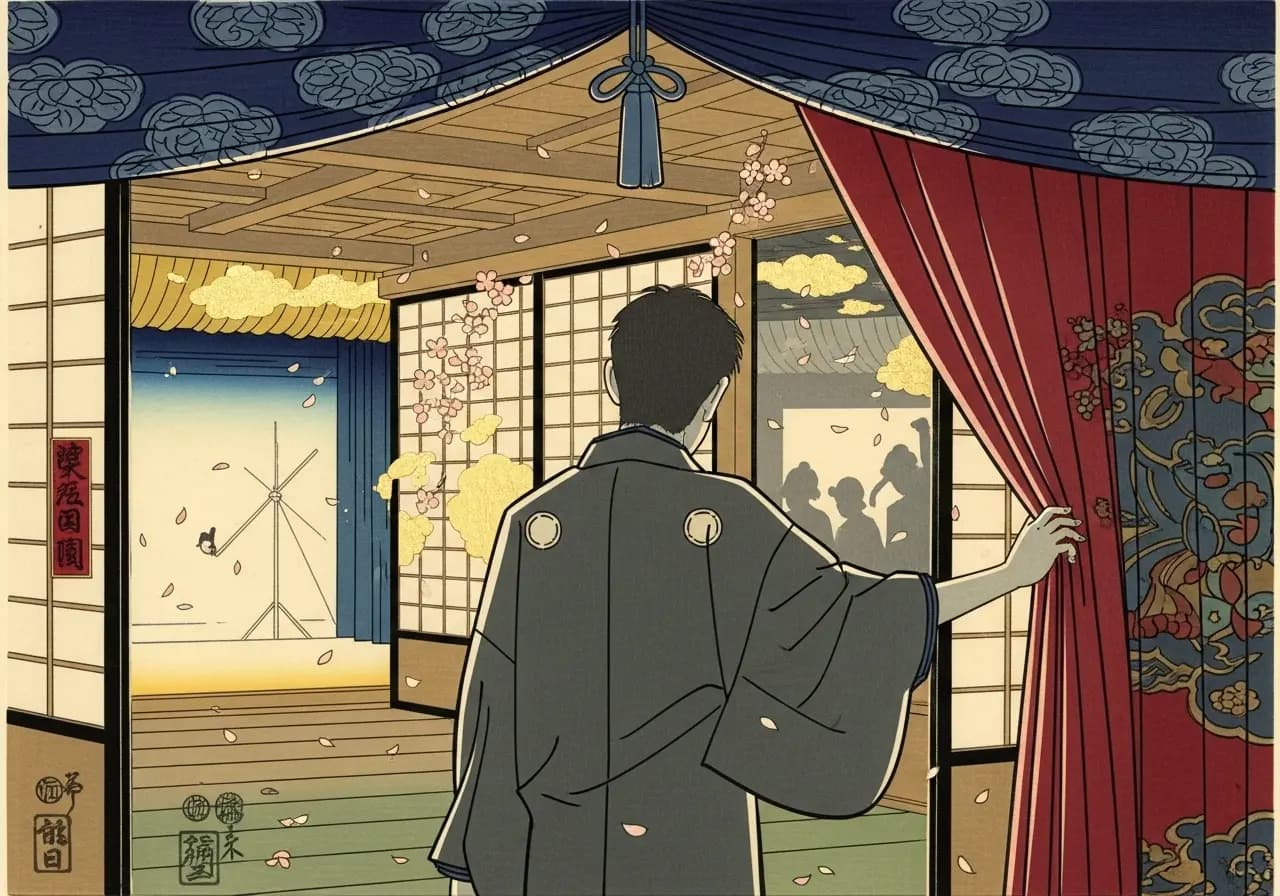
I like to apply this inwardly, as I always do. This is about understanding myself. When it comes to the things that I think, say, or do, I'm trying to understand: Is there a sideshow here? Am I running a sideshow that's distracting from something more important? Something that often goes unnoticed—not only by me, but by you as the person running it, and also by the audience who sees the sideshow without ever seeing the important show taking place behind the curtains?
I love that concept.
The Sideshow of Fear
There's a quote from Alan Watts that I want to share. He talks about this in the context of fear, but I think it's relevant to everything:
"But you must remember that the secret to all this is not to be afraid of fear. When you can really allow yourself to be afraid, and you don't resist the experience of fear, you are truly beginning to master fear. But when you refuse to be afraid, you are resisting fear, and that simply sets up a different show. Being afraid of fear and being afraid of being afraid of fear—those are two shows. When you try to obliterate fear, you're working in the wrong way. To attack fear is to strengthen it."
What really stood out to me in this quote is: "you set up a different show." A different show. That's the sideshow right there.
I think a lot of times we go through life setting up different shows without even realizing it. In this case with fear, there's the show of being afraid of fear. But then there's the sideshow—being afraid of being afraid of fear. That's a whole different thing. We may spend all of our time in that sideshow, in that spiral of meta-fear, all while unaware of the more important show, which would just be being afraid of fear and working with that directly.
Other Examples: Love
Let me give you another example. When I was in middle school—and some of you may know this—I'm a twin. My twin brother seemed interested in dating and girls long before I did. It took me a while to warm up to that.
I remember an incident in middle school with a girl who liked one of us. I may be remembering the details wrong, but the basic story is: she liked one of us, and it didn't work out, so then she liked the other one. I remember when she liked me, I had this concern. She said, "Oh, I love you"—this is middle schooler talk, so it wasn't a big deal. But when she said that, I remember asking her: "How do you know that you love me? Is it that you love me, or maybe you're just in love with the idea of being in love?"
That gets right to the heart of the sideshow, doesn't it? How often do we go through life doing similar things, thinking "Oh, I'm in love," when really we're just in love with the idea of being in love? Those are two completely different shows.
The Sideshow of Beliefs
Another area where this manifests—and it did for me—is recognizing the comfort we feel concerning our worldview. Through observation, I've come to understand that people are often comforted by their beliefs. But more often, I think people are comforted by the fact that they have beliefs, regardless of what those beliefs actually are.
On the surface, it may seem there's a really strong connection between a person and their belief. But in reality, the connection is to the illusion of certainty that comes from having a belief. It's something firm to stand on, solid ground that gives a sense of certainty—the hope that I know how the world works or how the universe operates because I believe this is how it works.
It's not necessarily the belief that's comforting me. It's the fact that I have something to stand on that's comforting me. I've recognized this in my own life in different instances with different views and beliefs. But again, it's setting up a sideshow. The important show is recognizing that I'm comforted by the belief itself. The sideshow is analyzing the belief and why it comforts me, as if the specific content matters. When really, it doesn't matter what the belief is—I'm just comforted because I have something to believe. That's the secondary thing. That's the other layer, the sideshow.
When Sideshows Emerge
For me, this has been a fascinating topic to explore. I've found that these sideshows often emerge in moments when I'm feeling strong emotions. Something happens, my emotional response arises, and I pause and ask myself: "Why is this bothering me so much? Why do I feel such a strong emotional response to this situation?"
Then I follow that up with exploration: "Is there a sideshow here? Is there something I'm unaware of? If I peek behind the curtains, will I see the real show that's taking place?" Because all of this that seems so real may not be real at all. What I'm experiencing may just be the sideshow.
I first came across this concept reading Rebel Buddha by Dzogchen Ponlop. But then soon after, I attended a weekend workshop—a seminar series called Landmark, specifically their program called the Forum. In the Forum, they talked about a lot of Buddhist teachings but used different language. One concept I really enjoyed was "running a racket."
Running a Racket
The idea is essentially this: back in the old days, think of mobsters in the 1920s or 1930s running their operations. They would have a storefront—let's say a laundromat—and the front they put on is that this is a legitimate laundromat where they do laundry. That's the appearance, the front.
But you go past the first set of doors, and there, they're doing laundry. You go past the second set of doors, and in the back, they're laundering money or doing something entirely different from what's taking place in the front of the store. That's the racket—what's taking place in the back.
In Landmark Education, they talk about how we're all running rackets. We're all putting up storefronts, fronts that say: "This is what I'm doing. This is why I'm acting this way. This is why I'm upset at you. This is why I took this job." Whatever the reason, that's the front.
If you can be skillful and honest enough with yourself, you can open those back doors and see what's really happening behind the scenes. You can see what racket is actually going on. That was a really powerful concept for me.
I remember when I first went to the Landmark Forum—it was unnerving. It was a bit embarrassing, honestly, to realize: "Wow, what racket am I running?" I was confronted with a situation right there on the spot. I remember thinking, "Why am I even here? Well, it's because my wife is this, this, and that. She's hard to communicate with," or whatever the reason I told myself. But then I had to look behind that. And look behind that again. Suddenly, I realized I was running a racket. I was caught up in the sideshow, and it was very liberating to get to the heart of the real matter.
Using the language of sideshow—the diverting incident or issue distracting from something more important—I think we all encounter situations where unknowingly, we're caught up in the sideshow. We're caught up in the front that we put up for people.
Discovering My Own Sideshows
I've done this in my career. I've told myself I'm in this career for a certain reason, and then I dig deeper and realize, "No, that wasn't really the reason." The real reason was something deeper that I didn't even understand.
I've alluded to this before with entrepreneurship. I convinced myself I was doing it for one reason, but then I discovered there was a deeper reason. I was really trying to prove my sense of self-worth. That was the real show. I just didn't know that was the real show. I was running the racket, running the sideshow. I was caught up in it.
Now here's what I find interesting. When we approach Buddhist practices, it's common to encounter this pattern: you start to understand the teachings, the concepts, and there's this moment of: "Oh wow, I'm really peaceful. I'm really getting this." If you're like me—and I remember this early on when I was really diving into all this—there was this part of me that thought, "I need to make sure the world knows that I'm getting all this."
And there I was, caught up in the sideshow. The sideshow was all about how people perceive me. If I was understanding Buddhist teachings, what mattered was that you see that I'm understanding Buddhist teachings.
To be quite honest, that may have even been the catalyst for my first few books and the first podcast episodes. I don't know at what point in that entire process I was finally able to see: "Uh-oh, I'm caught up in my own sideshow. Why am I really doing this?"
That was a pivotal moment for me. It happened early on in the podcast. I was able to see that part of me was doing it because I wanted to be looked at as someone totally peaceful, content, mindful, zen. The moment I was able to see that, the game was over. It's like looking directly at the magician pulling the strings. "Ah, I see you."
It's like that cat-and-mouse game I've talked about before—I caught myself. "Ah, okay. Well, now that I see that, I know the sideshow I'm running. Now I'm not going to take myself so seriously because I know what I'm trying to do."
Digging Deeper
And then I started to dig deeper. "Well, where does that come from? Why would I feel the need for that in the first place?"
The more I was able to be honest with myself and dig deeper and deeper and deeper, the more I got to know myself. And the more I know myself, the harder it becomes for me to one-up myself where I think, "I know why I'm really doing this." It's really skillful to know that.
I don't view it as: "Oh, I'm surpassing my ego and I'm going to overcome it." No, I don't see it that way. I'm trying to catch myself in the act. "Why do I do, and say, and think the things that I think?"
That's what has fascinated me so much about this entire journey. The more I practice, the more I understand myself, and the more I see that rascal behind the curtains—the thing running the show. And then it's not running the show anymore. And then sometimes it is again. And then it's not. Because you're constantly peeking behind the curtains, catching yourself.
That has been absolutely fascinating. And as I've said multiple times, this is just an inward journey. I'm not trying to be anything to anyone. I'm just trying to understand myself.
The End Goal
The end result of all this, the cycle of catching myself, then trying to one-up myself, then catching myself again—that cat-and-mouse game that's taking place—the ultimate result is contentment, peace, joy, and serenity. It's almost a sense of humor as I realize the ridiculousness of it all.
In the middle of all that, here I am just living life, doing my thing. I've let go of so much of the image I wanted to put out there. I've noticed this specifically with career choices. I used to say things like, "I will only do this. I will never do that." Silly things like that.
Now I feel like: "It doesn't matter what it is. I'm just fine. Whatever life throws my way, we got it, and it's going to be good."
A Life Update
Speaking of which, here's a quick update. Some of you may know this if you follow me on social media: I recently completed a move to a new country. I've been living in Kamas, Utah, where my wife is from. Since we first got married, we've been talking about giving our kids the experience of living overseas, specifically somewhere Spanish-speaking.
My mom is Mexican. I'm a Mexican citizen, and I had the opportunity to grow up doing my formative years of schooling—all of my middle school and high school—in Mexico in Guadalajara. It was Spanish-speaking, and I felt like: if I don't do something about it, my children's connection to Mexico, the culture, and the language will end. It'll end at their generation.
I wanted to try to get it one more generation, so we've moved to Mexico. We now live in Playa del Carmen, which is south of Cancun. Our plan is to live here for at least a year. Our kids are going to school in Spanish—all Spanish. Our whole family will be heavily immersed in Spanish for the next year. It's going to be beneficial for my wife who wants to improve her Spanish, and for my kids so they feel a sense of connection to the culture and language they're inheriting from my side of the family.
As part of that whole process, I've passed along Mexican citizenship to them, so they are dual citizens now, just like I am.
I say all that because that's where we are now, and that's why I've been a bit absent for the last couple of weeks. It was a long move. It took 3,100 and some odd miles of driving, and I drove the whole way. My family flew down, but I drove for five days—long days, 10 to 12-hour days—so that was long and draining. I finally got here, we moved into the house, and I've just had a lot going on.
But we are totally settled in a new place now, living this experience down here for a year. If any of you ever find yourselves in the Riviera Maya, in the Cancun or Yucatan Peninsula part of Mexico, reach out. Let me know. It would be fun to meet up and say hi, and I can take you to some cool sites around here that might be a little bit off the beaten path.
Your Invitation
Going back to the main topic: the sideshow. What is your sideshow? This is what's fun about all this. You get to spend time with yourself and figure out what your sideshow is.
I've figured out a lot of my sideshows, and I'm getting better and better at detecting them. "What are the sideshows and what are the real shows?" The real show is the cool one. That's where you really want to spend time. The sideshow is just a distraction.
My invitation to you with this episode is to spend time asking yourself: "What is my sideshow?"
When you're feeling really upset or emotional about something, it may be hard to do right there on the spot. But be introspective about it. It might take hours, days, or weeks in the aftermath of a conversation, an argument, or an instance where you felt really strong emotions. See if you can detect whether there's anything happening on the sideshow. Was it a sideshow, or was it the real show?
This applies not just to you, but to others as well. If somebody comes up to you and you get really skillful with this, you may be able to see right through someone else's show. You see that they're totally caught up in their sideshow, not catching the important show taking place behind the curtains.
I find it's a little bit easier to have sympathy and empathy toward people who are caught up in their own sideshow. It's like: "Yeah, yeah. Here I am with you, but hopefully one day, you'll see what's really happening in the show behind. I don't think this is the show you're experiencing. You're caught up in your sideshow."
Not from a place of judgment, but from a place of understanding. Because I find that you and I are always caught up in our sideshows. Then we start seeing other people who are always caught up in theirs. It's been really fascinating to focus a little bit more energy and attention on the real show—the important show that's happening, often behind the curtains, unbeknownst to us because we've been so caught up with the distraction of the sideshow.
That's my invitation: What is your sideshow? Explore that a little bit. See if you can find any aspects of your life where you've been caught up in a sideshow, distracting you from the important show taking place behind.
Fear and Being Intimate With It
I want to end with another quote about fear. Earlier I shared one by Alan Watts. Here's one by Pema Chödrön:
"Usually, we think that brave people have no fear. The truth is that they are intimate with fear."
I love that. As I was doing my drive down here to Mexico, I can't tell you how many people reached out—family and friends—with messages of support but also concern. "Aren't you scared taking your family down to Mexico? I would never go down there. Why are you driving? Why are you driving alone? Aren't you afraid?"
In five days of driving, I had a lot of time to think about this concept of fear. "Is it scary to move to a new country?" Yeah. "Is it scary to drive through pretty much the entire country from north to the very south of Mexico?" Yes, there's definitely an element of that.
Would I say it was scary? I'm not sure I'd use that word exactly. But do I ever experience fear? Sure. I'm always doing things that evoke a sense of fear. I fly. I'm a paragliding pilot and a paramotor pilot, and every time I'm up there, I look at those strings I'm attached to, and I have that moment every single time where I think: "The only thing that's holding me up is a bunch of strings."
Yeah, I've become intimate with the fear. But that doesn't mean I'm fearless when I do these things. I think that would be unskillful, especially with flying. If you fly without fear, you're not respecting the fact that you're doing something dangerous. I tell my students that all the time when they ask, "Is this a dangerous sport?"
I say: "Of course it is. You're flying. You're in the air. There's an amount of risk and danger involved with doing something like that." But you can be skillful with that fear. That fear will remind you of your limits. It keeps you honest.
I think that applies to other aspects of our life too. We can become more intimate with fear. One of the big fears we have is the fear of letting go of the sideshow and getting to the more important show. For some reason, we're afraid to open the curtains and show the world the real show. So we allow the world to just experience our sideshow.
My hope is that you can get intimate with that fear. Draw the curtains back. Show yourself the real show. And then show the world the real show. Don't be so caught up in the sideshow that you're presenting to the world.
Closing
Thanks again for listening. Now that I'm settled down here permanently for the year, at least, I've got my microphone and computer all set up, so I'm going to be caught up on podcast episodes going forward.
As always, if you want to learn more about Buddhism and mindfulness, you can check out my books. No-Nonsense Buddhism for Beginners is a good starting point. Visit NoahRasheta.com for more info on that.
If you enjoyed this podcast episode, feel free to share it with others, write a review, and give it a rating on iTunes or wherever you listen. All those things help.
If you want to make a donation to support the work I'm doing with the podcast, you can visit SecularBuddhism.com and click the Donate button.
That's all I have for now, but I look forward to recording another podcast episode soon.
Thank you for listening. Until next time.
For more about the Secular Buddhism Podcast and Noah Rasheta's work, visit SecularBuddhism.com