

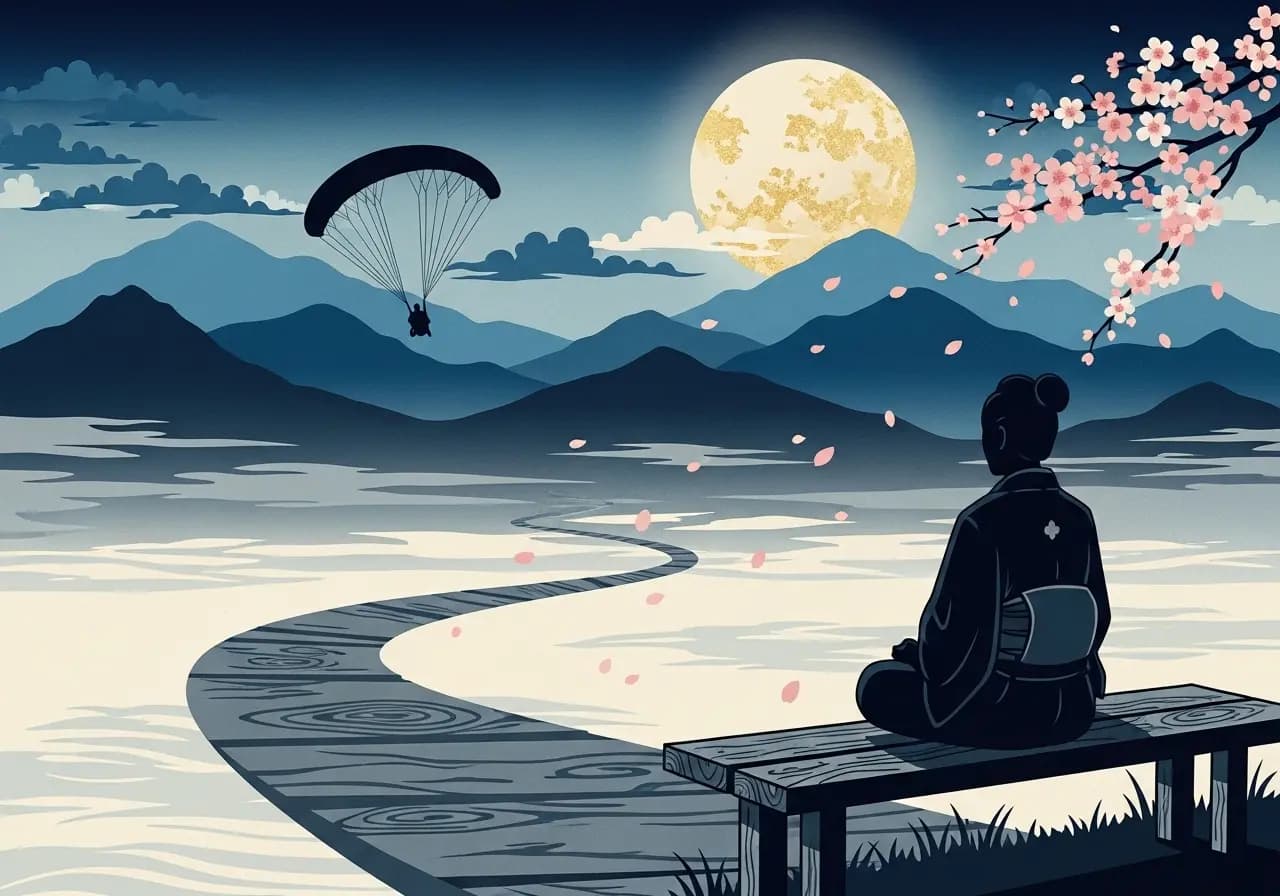
Keep Going
Episode 100 of the Secular Buddhism Podcast
Hello and welcome to another episode of the Secular Buddhism podcast. This is episode number 100. I'm your host, Noah Rasheta, and today I'm talking about the Buddhist teaching of keep going.
Keep in mind you don't need to use what you learn from Buddhism to be a Buddhist. You can use it to be a better whatever you already are.
A Moment of Gratitude
As I record this episode—episode 100 of the podcast—I'm feeling a lot of gratitude for all of you who listen. One of the reasons I enjoy having a podcast is that it allows me to share my thoughts in an open and public way. It lets people that I know and people that I love get a glimpse into the way I see life, the way I understand reality.
And it's sad, but it's true, that in most of our ordinary day-to-day communications, even with those we're closest to, we rarely dig deep. We communicate with each other usually on a superficial level. Sure, it may happen from time to time that in the right circumstances we get into deeper conversations about life and things that matter. But for the most part, I think we spend a considerable amount of time just exchanging pleasantries and superficial exchanges about what we've been up to and how things are going. We don't really dig deep.
I get it, though. I mean, most of the time, it would make people uncomfortable if you asked the standard "Hey, how are you doing?" and they responded with something like, "Well, you know, let's spend a few hours here. I have some very deep thoughts I need to get off my chest." Most people would be backing away.
But that's what I love about the podcast. It allows me to do just that. I get to share some of my deepest thoughts and explore some of the topics and ideas that are most profound for me. And I get to do this knowing that some of the most meaningful things for me are going to be heard or listened to by people that I know and people that I love at some point in the future.
I think about my kids and their kids, and who knows how many others from that chain alone who might one day encounter these words. They might hear them and say, "Okay, well that's how my dad thought. That's how my grandpa used to think about life." And that's a fun one for me, especially given the various ideologies that are expressed and viewed in my kids' lives. It's meaningful to know that they will get to peek into my mind and listen and hear about topics and learn about me and the way I see the world.
The Strangers Who Know Me Best
I do think it's a little strange to admit that some of the people who know me best—who know how I view the world, how I make sense of the world—some of those people are you, the ones listening to this podcast. Many of you are total strangers to me. I don't know you or anything about you, and yet I feel a total connection to you because you do know me beyond that ordinary layer that, honestly, many of my closest friends and even closest family members only know me at that more superficial level.
They see what I post on social media and the exchanges we have at Sunday family dinner. Those are always the more superficial pleasantries I was talking about earlier. But then there's this whole unique audience out there—those of you who have listened to the podcast since the beginning. I feel you know me at a deeper level. You understand a lot of the inner workings of my mind. And that's kind of trippy to think about: some of the people I spend the most time with don't get me or understand me at that level, and yet there are a lot of people out there in the world who do.
Based on the podcast numbers, it's actually a big audience of total strangers who know me really well. And that's fun to think about.
My parents listen to the podcast and we talk almost every day. It's been fun because this has opened up a channel to have a much more meaningful conversation about life other than the typical pleasantries like, "Oh, how's life? How are the kids?" We get to talk about deeper things because they listen to this podcast and I'm always expressing some of these deeper thoughts. Same with my twin brother. He doesn't necessarily listen to the podcast—I think he does from time to time—but he and I have always had deeper exchanges when it comes to talking about life.
But other than my parents and my twin brother, I don't know many others, even in my close circles, who I've ever sat down to talk to about Buddhism in general, much less the deeper aspects of some of these concepts that I get into in the podcast. I think that's interesting because I don't talk about these deep and meaningful things with others in my life, but I love knowing that all this information is out there.
And perhaps someday some of my closest friends, maybe even my spouse—I've mentioned this before, she doesn't listen to the podcast—my cousins, other family members, especially my own kids, one day all this information is out there and it's available. They'll be able to listen and engage with me without having to sit through what may be awkward for them: sitting with me and saying, "Hey, let's talk about life." That can feel intense.
When someone doesn't share your same views, you typically don't want to sit and explore and understand those views. That's kind of the case I'm in. If they want to understand me, they can listen on their own terms and on their own time to the podcast, and they would understand a lot of my views. So in that sense, recording this podcast is a lot like journaling, but I'm doing it in public.
I often think how cool it would be to be able to get inside the mind of people I know and understand their deepest views and their deepest ideas. Like my grandpa, who I didn't know that well—he passed away when I was young. Or his parents, or his brother, or some random person I'm connected to but don't really know. How cool would it be to discover all of their journals and their deepest thoughts out there somewhere? It would be fun to explore that. And that's kind of what I'm doing.
A Message for the Future
So here I am, celebrating episode number 100 of the podcast, and I'm in a position to share my thoughts and allow others to have that glimpse deep into my mind. And what do I want to share? While I want to share everything I'm sharing in the podcast, today I want to talk about three things. I want to say three things. And I want to say again, this is a message to anyone listening in the future, but perhaps especially to my own kids who might encounter this one day.
I want to say: keep going.
I want to say: get used to the bumps.
And I want to say: keep a beginner's mind.
Let me talk about each of those three things.
Keep Going
The lesson of keeping going is something I first learned from my friend Reverend Gyomay Kubose, who runs the Bright Dawn Way of Oneness Buddhism. That's where I trained doing the lay ministry program. Through reading his books and the books that his father wrote, I encountered this teaching—this concept of keep going—and it really resonated with me when I first heard it.
The idea of keep going is that, as Reverend Kubose would say, we have a tendency of putting periods at the end of everything. That's what structures the sentence. The sentence is over and now we move on to the next one. It's useful, but reality doesn't work that way. You get to where you think you were going, and when you get there, you discover there's no there there. Because it's just here. Wherever you are, that is here.
In that same way, the idea of keep going is a reminder that whatever you're expecting to arrive at, you don't arrive there. You get there and then you keep going, because the path itself is the goal. This sentiment is echoed over and over in Buddhist teachings: the path itself is the goal.
When I think of the term keep going, I'm thinking: the day that I think I finally got it, then my reminder is, "No, you didn't. Keep going, because everything's changing. The circumstances are changing. Time goes on. Everything changes. I'm changing." You don't ever get there. Keep going is a reminder for me when times are difficult—keep going, they're going to change. When times are good and you think, "I finally did it," nope, keep going. It's going to change.
The expression of keep going is a reminder for me to not make the mistake of thinking I've ever arrived, because I'll never arrive. This journey, this experience of being alive, goes on and on and on until the journey's over. And even then, there's a lot of unknowing. I don't know what happens next. I don't know. It's just infinite possibilities. And it's fun to know that whatever it is, I'll just keep going.
Get Used to the Bumps
The second thing I wanted to share is: get used to the bumps. I really enjoy this one. There's a term that we use in paragliding and paramotoring that I really like: bump tolerance. The idea is that as your experience and your skill increases in the sport, your bump tolerance increases, too.
When you're flying a paraglider or a paramotor, you're flying around on a piece of fabric that's essentially acting as a wing. You can really feel the bumps. There's bumpy air and there's smooth air. When the day starts to heat up and thermal activity develops—pockets of areas where air is rising—next to the air that's rising is air that's sinking. As you go through these spots, you hit what we call bumps. You're flying along, and some flights are really nice and smooth, and others are bumpy. Based on the conditions, the terrain, or the time of day, the bumpiness can be quite unpleasant.
When you start out as a new student, you're learning to fly in pleasant circumstances. It's always the nice smooth air you're flying in. But then as time goes by, you start to fly on your own. You get out there and start hitting some bumps, and you're like, "Oh, that's scary. I better land."
What happens is, with time, skill, and experience, your tolerance for these bumps also increases. I experienced this drastically in my flying career. When I went from being a new student to deciding I wanted to become a flight instructor, I wanted to do everything I could to become a safer, more skillful pilot. So I enrolled in an SIV course—Safety In Flight, where you simulate incidents that may happen in flight.
You get towed behind a boat, usually over water. You have your main paraglider wing that you're flying under and two reserve parachutes that you pack with you. You get up really high and you're on a radio with an SIV instructor, and they talk you through various emergency scenarios. You do things like collapse half of your wing or let the full wing collapse. You learn to recover, you learn the proper maneuvers and techniques to recover safely from these incidents that could happen in flight.
After going to that course, my bump tolerance level increased quite drastically. Any little bump would scare me because I didn't want my wing to collapse. But once you know how to handle a wing collapse and you realize you've done it over and over and over in one of these courses, then you realize, "Oh, okay, I know how to recover from that." Well, your bump tolerance naturally goes up.
That's a concept I like sharing about life in general. Life gets bumpy. The problem isn't that life gets bumpy. The problem is that life gets bumpy and we don't like the bumps that are unpleasant for us. And that's the nature of life: it's bumpy, and then it's smooth, and then it's bumpy again, and then it's smooth again. This cycle goes on and on and on until one day the ride is over.
The problem is that we believe it's supposed to be smooth. We believe it's not supposed to be bumpy. We spend so much time and energy in our lives trying to make it smooth. Sure, there are things we can do to make it more smooth, but there's nothing we can do to prevent the bumpiness entirely. Sometimes it's just the circumstances, the terrain, the time of day. The causes and conditions arise for bumpy conditions to arise, and that's just part of being alive.
There will be days when you will be sick in bed. There will be days when you will be sad about something that someone said or did. There will be days when you feel deep sadness and sorrow because someone you love has died. There will be days when you feel like you're in trouble, and days when you feel lost, and days when you feel like you're not on the right path. And these are all a normal part of the bumpy days of life.
There will also be smooth days. Days where everything seems to be going your way. Days where you get the job that you wanted. Days where you're out driving and you're getting all the green lights. Days where you feel like everything is enough. And this is all part of the ride of being alive.
You can enjoy the smooth days because you know that they won't always be smooth. Every time I go flying, if I hit a day where the air is just butter smooth, I just have a smile on my face because I know I'm enjoying something that's unique. It's not always that smooth and that nice, so I try to enjoy it. We can do the same. We can smile on the bumpy days because they remind us to enjoy those days where things are going smooth.
But here's the thing: most of your growth—just like with paragliding—happens on the bumpy days. You learn to handle those bumps and your skill increases, your experience increases. That's what happens for us in our day-to-day practice with being mindful. That's when you really get to know yourself—when you're in those bumpy conditions. You begin to understand what you're truly capable of handling. You'll find strength and courage in knowing that you're capable of handling the bumps that will inevitably come your way.
Here's what I think is most important: just like in paragliding, as your bump tolerance increases, what you're gaining is a deeper sense of confidence in yourself. Not confidence that the sky is going to be doing what I want it to do, or that my wing is going to be performing the way I need it to. At the end of the day, it's a deeper sense of confidence. It's confidence in my ability to handle whatever life is going to throw my way.
There's a story I want to correlate this to from Buddhist teachings. It comes from Shantideva. The story is that there's a man trying to cover the world in leather so that he could walk around comfortably and wouldn't have to worry about some of the sharp and prickly places in the world. The teaching was that you'll never find enough leather to cover the world, but you can find enough leather to cover the soles of your feet. And with that, now you can walk on all those jagged and sharp places. It's not the place that changed—it's your ability to walk on it because now you're wearing shoes.
The quote from Shantideva is:
Unruly beings are as unlimited as space. They cannot possibly all be overcome. But if I overcome thoughts of anger alone, this will be equivalent to vanquishing all foes. Where would I possibly find enough leather with which to cover the surface of the earth? But wearing leather just on the soles of my shoes is equivalent to covering the earth with it. Likewise, it is not possible for me to restrain the external course of things, but should I restrain this mind of mine? What would be the need to restrain all else?
I really like that analogy. Me wanting to make the world and the skies smooth so I can enjoy it when I fly my paraglider is a lot like me wanting to cover the world in leather so I can walk around barefoot and not have to worry about what I'm stepping on.
As silly as that sounds, isn't that what we do? We go around wanting to cover the world with leather. "There's this prickly person. Oh, let me cover you in leather so that I can be comfortable around you. Oh, here's this controversial person. Oh, I better cover you in leather so that I can be comfortable when I'm around you." When in reality—and this is what I love about Buddhism in general—it turns that focus back inward.
Where can I patch some leather? I keep brushing up against you. Let me put some leather here on this side of my arm. Now when I brush up against your prickliness, it doesn't hurt me, and you're allowed to remain prickly rather than me trying to change you. I love that concept.
I find myself at times—like on Facebook, for example—wanting to cover it in leather, wanting to curate the list, get rid of the people who say things I don't like. That's me wanting to cover it with leather. I get that to some degree, of course. But again, just picturing going to the extreme here: am I wanting to cover the world in leather for my comfort? Or can I spend time finding the leather that I need to cover my own feet?
So that's the second thing: get used to the bumps. Develop your bump tolerance. Build confidence not in external circumstances changing, but in your ability to handle whatever comes your way.
Keep a Beginner's Mind
The third thing I wanted to share is: keep a beginner's mind. This is a concept that I really, really enjoy about Buddhism. It's the permission that we have to speculate, to doubt, and to be ready to doubt.
Throughout your life, you're going to be making a lot of choices. Choices about what to study, where to work, what kind of career, where to live, who you're going to live with, what to eat, what to believe. So many other important choices. And the time will come where you might question some of these choices.
We're conditioned to think that doubting is a bad thing, a scary thing. I think we've been taught that the opposite of faith is doubt. And I don't think that's accurate. I think it's more accurate to think of the opposite of faith as rigidity. It's certainty.
Going back to the first point—keep going—you think you got it, but you didn't. You've got to keep going because everything's changing. In our culture sometimes, we equate a sense of faith to a sense of permanence. "This is how it is, and now I know it, and I'm going to hold fast to this." That's just not how life works.
The ability to step back and say, "Well, wait a second. I want to have a beginner's mind. I want to question this a little bit. Is this really what it is, or is this just how I want it to be? Why do I feel this? Why do I believe this?" The ability to question things is a really useful skill in the practice of mindfulness and in Buddhism, it's a revered thing. You want to doubt. You want to have the beginner's mind. You want to question everything.
Imagine how powerful that would be as a skill—to be able to question your own thoughts. "Well, this is what I think. But why do I think this?" And to dig a little deeper, to have a more skillful relationship with your thoughts, your feelings, and your emotions. That's kind of the premise behind this concept of having a beginner's mind or doubting. It's been really useful for me.
I've encountered big aspects and topics in my life that I've doubted. The beliefs of my upbringing—that was a very big thing to question. But it doesn't stop there. I question everything. I'm trying to instill this in my kids—the ability to stop and ask a deeper question.
We were watching the new Karate Kid not long ago, and my son and my daughter were talking. There's a scene where the character is practicing chi or learning chi. My daughter said to my son, "Riko, did you know that you can..." something with chi. And Riko, without even thinking, said, "You know that she's not real, right?" My daughter was like, "No." And then he said, "Yeah, it's not real." Then I chimed in and asked, "Riko, how do you know that it's not real?"
It forced him to pause. He's like, "Well, I don't know. Maybe? Is it?" Then he asked me and I said, "I don't know."
But the point was, it was one of those invitations to question, to doubt. I think it's a useful skill to doubt everything. Not just the things you believe, but even the things you don't believe. "Well, this is real." Well, is it? "Well, this isn't real." Well, is it? I like to do that.
I'm always questioning beliefs, but I'm also questioning the counter beliefs. When someone says, "Oh, no, that thing that so-and-so believes, that's not true," I'm like, "How do you know?" Because again, for me, the skill of the beginner's mind—the curious mind, the open mind that's always receptive to things that I don't know that I don't know—I think that can be a useful skill in navigating with people in life.
A common scenario that I think we all encounter is when someone says or does something to you and you instantly know why they did it. I use the analogy all the time of the car and the jerk driving the car. There's certainty in that statement: "That jerk cut me off." But we do that in the little things too. Your spouse says this and you immediately assume that. And there it is. That's the invitation to say, "Well, is it? Is that really why they did that?"
What if there's something that I don't understand here? What if it's just that they didn't eat enough? "Go eat something and you'll be happier." Or it can be so many things. The thing is, I don't know. I allow myself to make my habitual way of responding one of openness: "Well, that's what was just said or done. I don't know where that came from, but now how do I handle that? How do I navigate the situation I'm in now because of this?"
I think that's been a useful skill because it allows me to have separation between what's happening and how I'm reacting to what's happening.
So that's the premise of keep a beginner's mind. The obvious beginners are kids, right? They're learning about life. They're just very curious. They're always asking why. And it's even a stereotype that with a toddler, you're going to get fed up with them asking why. "Why, why, why? Why this? Why that?" You answer it and then, "Why," right? It's always countered with why.
We slowly try to stamp that out of kids because it's inconvenient. The truth is we get to the point where we don't know those answers. So we just say, "Stop asking" or "It's because it is." And that's it.
I try to encourage in myself that attitude of the beginner's mind—the kid that's always asking why. I'm going to keep asking why. Then I'm going to ask, "Why do I keep asking why?" And it goes on and on.
What Comes Next?
So those are the three things I wanted to share: keep going, develop your bump tolerance and get used to the bumps, and keep a beginner's mind.
I think it's fun to know that we've hit this milestone with episode 100. And what's going to happen? Nothing's going to happen. We're going to keep going. I'm going to keep going until I'm not doing this. But I enjoy talking and sharing thoughts and ideas.
I hope that some of the people I know who are close to me will one day maybe get to glimpse into my mind and how I think. I hope to be able to do the same back. I would love to spend time with the people I'm close friends with, talking about deep things. Rather than just the superficial pleasantries, really dig in. What's bothering you in life? Why does that bother you? Where does this come from? What are the factors of conditioning that affect how we are? Those are the things I would love to spend time with. But obviously, you just don't do that sitting with someone at lunch. So this is the platform where I kind of get to do that.
Thank you to all of you who have come along for this ride. I know many of you have been listening since episode one, and many of you are new. Many of you may be listening to this as the first episode, and you can go back and catch up, or you don't, or you just listen from here on forward. Every episode kind of holds its own.
But thank you for being here as part of the ride. Thank you for listening, for allowing me to share with you. Many of you have reached out and shared emails with me. Unfortunately, it's reached the point where I have so many that I just can't keep up. I can't catch them all, and they're still in my to-do list. It may be weeks before you get a response from me, but thank you for reaching out and sharing things with me. I really enjoy the connection I have with a lot of you.
Closing Thoughts
That's all I have for this podcast episode. As always, if you want to learn more about Buddhism or mindfulness in general, you can check out my books: No-Nonsense Buddhism for Beginners, The Five-Minute Mindfulness Journal, and my original book, Secular Buddhism. You can visit NoahRasheta.com to find links to those books.
If you enjoyed this podcast episode, feel free to share it with others, write a review, or give it a rating on iTunes. All of that helps. If you would like to make a donation to support the work I'm doing with the podcast, you can visit SecularBuddhism.com and click the donate button.
That's all I have for now, but I look forward to recording another podcast episode soon. Thank you for listening. Until next time.
For more about the Secular Buddhism podcast and Noah Rasheta's work, visit SecularBuddhism.com