

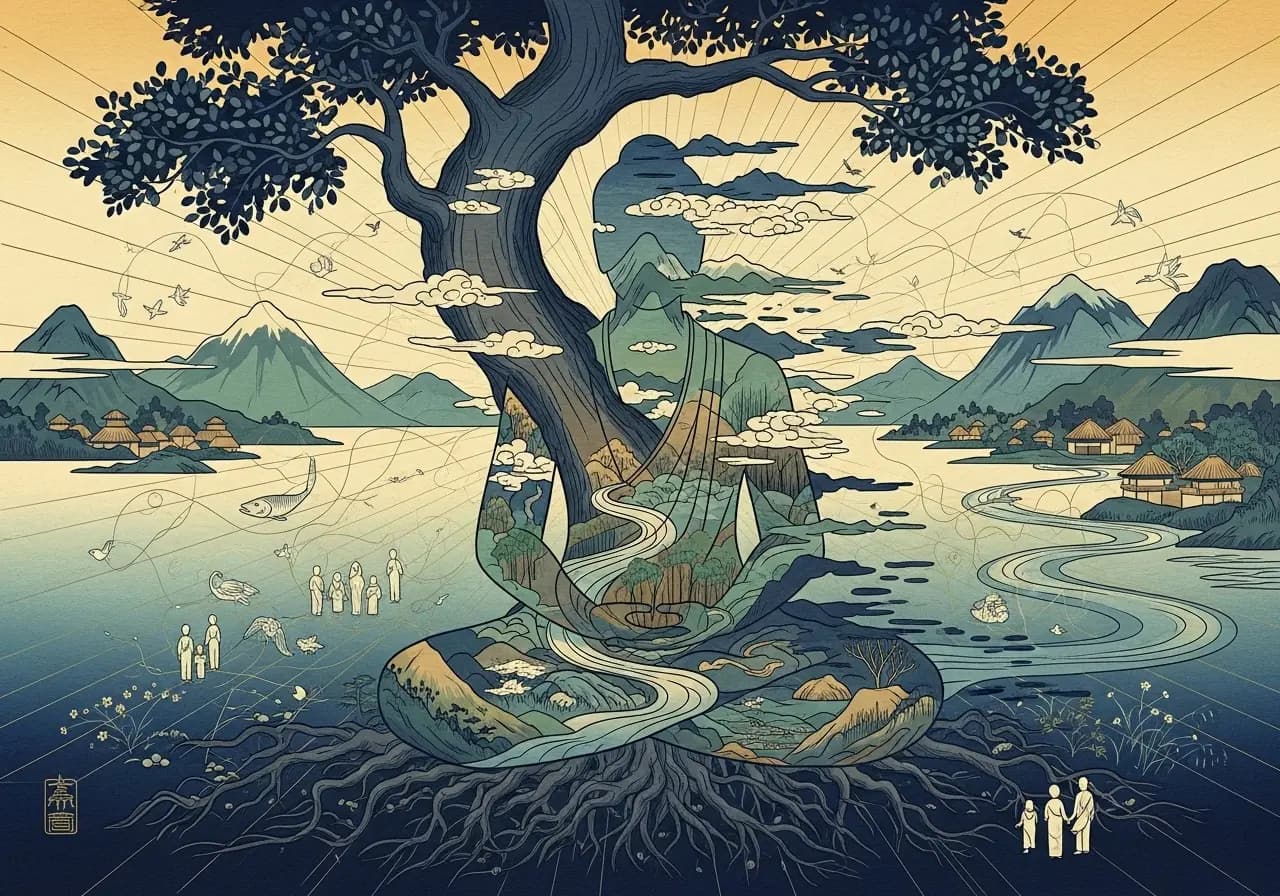
True Selflessness
Episode 10 of the Secular Buddhism Podcast
Hello. You are listening to The Secular Buddhism Podcast, and this is episode number 10. I'm your host, Noah Rasheta, and today I'm talking about selflessness. So let's get started.
Welcome and Milestone
Hey, I'm excited to talk about the topic of selflessness today. And before jumping into the topic, I wanted to take a minute to thank you for listening to this podcast. This is a fun milestone for me to announce that, as of today, we have over 25,000 downloads. And this is in a relatively short amount of time, because this podcast has only been around for two months now. This is really exciting for me.
My intention when I started the podcast was really just to share the knowledge that I've been studying and learning as I've walked this path of studying Buddhism myself. I'm currently in a Buddhist Lay Ministry program, and in the summer of 2017 when I graduate, I'll be an actual Lay Minister teaching this regularly. In the process of studying, it's been very important for me to learn how to teach the Dharma effectively—in other words, how to teach Buddhism.
On Secular Buddhism
Of course, I've chosen to teach this through a secular lens. And I know that sometimes that can be a little disconcerting for Orthodox or Traditional Buddhists who see the words "Secular Buddhism" and think, "What is that? What are you taking away from what the Buddha taught?" I wanted to clarify that for a minute and be clear that I only see the teachings of the Buddha as one set of teachings—what the Buddha taught. And then to interpret that and to express the Dharma, I think there are various ways to do that.
I read a book a couple years ago called The Five Love Languages. The premise—I'm sure many of you have heard of this—is that we communicate love through different languages. For some, it's touch. For some, it's affection. For some, it's receiving gifts. There are different ways to communicate affection and love. These are known as the five love languages. Well, I think that way of thinking extends to almost everything.
When you take something as broad as what the Buddha taught, I think it can be distilled down to a couple of key points: the world is impermanent, and all things are interdependent. But the way that you learn and express what is collectively known as the Dharma—what the Buddha taught—I think there are love languages that are more effective.
We talk about love languages in terms of how we communicate with each other in relationships. I think the love languages that apply to teaching kindness and compassion, or wisdom and compassion, include the language of Zen, the language of Tibetan Buddhism, the language of the Japanese schools of Buddhism like Jodo Shinshu. And I think there's a valid argument that one of these languages is Secular Buddhism—a language that's communicated clearly to people who are secular-minded. And in the West, I think there is a tendency to understand things more through a secular lens.
But what's being communicated throughout any of these schools of thought is really the same thing. All of it boils down to trying to communicate, in the best language possible, what the Buddha taught. Which for me, in my personal understanding, is that all things are interdependent and all things are impermanent. Along with that, there are several other key teachings—the Four Noble Truths, the Eightfold Path—and how all of this relates to us in our day-to-day life. I think this can be communicated effectively in a language that makes sense to you. And for some people, given their personality, that might be Zen. For others, it might be Jodo Shinshu. And so on.
For me, as I was learning all this, it made a lot of sense to learn this through a secular understanding. And that's why I teach Secular Buddhism. That's why I'm interested in explaining the Dharma in the secular vernacular, because that's how it makes sense to me. And I know there are other secular-minded people who are interested in learning about Buddhist philosophy. And that's why I explain it through this very same lens.
I wanted to communicate that mostly to be clear: I don't believe that there's such a thing as Zen Buddhism being any different from Secular Buddhism, or any different from Jodo Shinshu Buddhism. I think what's being communicated is the same thing, expressed through different languages—much like the love languages. When one person in a couple communicates their love for their spouse by consistently taking out the trash and keeping the house clean, that's really not that different from the person in the relationship who expresses love through touch and affection. It's just two different love languages. But they can both love each other. I think this is similar. What's being communicated is wisdom and compassion, but it can be expressed in a language that makes more sense to someone else who also happens to speak that specific love language.
I wanted to clarify that. At least from my perspective, I don't see myself at odds with teaching Secular Buddhism and any of the other schools of Buddhism. I happen to really enjoy Tibetan Buddhism. I happen to have a lot of close friends who are in the Jodo Shinshu Buddhist tradition. And I think I've learned a lot from them—being able to communicate certain things in ways that hadn't occurred to me before, because the way that it's taught in that tradition doesn't necessarily speak to me naturally. And it's just a fascinating thing to realize: we're all communicating the same thing; we just express ourselves a little differently. I wanted to be clear about that. I don't see this as being completely separate from any of the other schools of Buddhism. They're all just expressed slightly differently in different languages, like love languages.
And I like the idea of love languages because I think Buddhism is about wisdom, compassion, and love—kindness. It's like Buddhism is a love language, or Secular Buddhism is one of the love languages. That's how I view it.
Why I Do This
The next thing I wanted to clarify: I've been asked before why I do this. Why do I do these podcasts? I have three different businesses and three children right now. I'm in a very busy stage of my life. And it takes time to record these podcasts. It takes time to prepare. I teach lessons almost every Saturday at my office, and people come to those, and it takes time to prepare those. The reason I do it is because this topic is incredibly rewarding to me. It's very fascinating to be able to teach something that helps inspire people to be better people. And ultimately, in my view, this makes the world a better place.
About four years ago, I found myself in a very dark, difficult part of my life. I was going through a marriage crisis and I was going through a faith crisis. As I was trying to figure things out, I got caught up in this way of thinking. I thought, "How did I mess up? Where did I mess up in life?" Something was wrong. And I think naturally we have a tendency to view ourselves sometimes as finished products. We're constantly evaluating ourselves and others as finished products, thinking, "Well, you did this wrong or this right. You turned out good; you turned out bad"—as if we're finished products. When the reality is that we're continually works in progress. And I wasn't able to see myself as a work in progress. I had messed up in life. Something went wrong. I got it wrong. And that way of thinking was very detrimental. It was a difficult time in my life.
That's when I came across Buddhism and Buddhist studies, and it was so refreshing and liberating to understand that all things are impermanent and that we're constantly becoming. There is no way to say, "Oh, where did I mess up in life?" It's like—you haven't messed up because you're alive.
I came across this teaching that I really enjoyed ever since. It's about a rose and limitations. The idea here is that the only limitation of the rose is that the rose is not a daisy, but it doesn't care, so it doesn't matter. That resonated with me because here I was in a specific phase of life, thinking, "I didn't get this right. My marriage isn't what it's supposed to be. Or my way of having faith isn't what it's supposed to be. Somewhere I messed up in this process." And I couldn't figure out why. Nothing made sense.
Then, what made the most sense was realizing that there is no milestone like "this is it—you got it; you did it right." And there's no "well, you did this, so there you got it wrong." There is just what is. And what was at that specific phase of my life is what it was at that specific time in my life. That's all it was. Buddhism was able to convey that in a way that made sense to me. I remember that experience—one day where I had that moment of letting it go and realizing that all the stress, all the weight was off my shoulders. There was only the experience of being. And I thought, "This is something that makes a lot of sense to me. And this is something that I want to teach." That's where the motivation came from.
I think ever since then—and this is almost four years now—I feel like I've been in a continual state of almost bliss, thinking, "I'm just excited to be alive now. There's no way to mess up life because you're just going through it."
In the Dhammapada, there's a section that says: "Just as a farmer irrigates a field, an arrow smith fashions an arrow, and a carpenter shapes a piece of wood, so the sage tames himself." I remember when I read that, thinking that's what Buddhism should be for me. It's the process by which I can shape myself. I can take my own mind and find a way to live peacefully and happily. And it had nothing to do with how I need to convince others to be. It's a very personal process. It's all about being the best version of you that you can be.
I once saw this little meme or cartoon. It shows a man whose head is a Rubik's Cube, all twisted out of its pattern, hiking up this tall, tall mountain. At the top of the mountain, you see another stick figure sitting in meditation, and his head is also a Rubik's Cube, but it's all assembled in the right pattern—each side has its own solid color. I thought that was really funny, and I think that's how the intention of the Dharma works. You can take yourself and realize, like the Rubik's Cube, that with the right moves and the right spins and twists, your own mind becomes settled and organized and at peace.
And that's what this process has been like for me. The only reason I like to share it is because I want others to have that same kind of peace. It's not about converting anyone to anything, because there's nothing to convert to. There's nothing to convert away from. Buddhism isn't necessarily a philosophy or religion of belief. It's a philosophy or religion that's a way of life. And if anything, I would argue that it's about unbelief. It's about taking the concepts that we've been given since the moment we're born as children and start acquiring meanings, concepts, labels, and beliefs. What Buddhism is trying to do is strip us of those things and help us realize that they can blind us from seeing life as it is.
I think in a nutshell, there's what is, and then there's the story we create about what is. And this applies in the present, past, and future. There's whatever happened in life, and then there's the story we create around what happened in life. A lot of suffering can be found within the story we create about what happened. Or if we're talking about the present, there's what is, and then there's the story we create about what is. A lot of our pain and suffering comes from the story we've created about what is. Buddhism is trying to help us strip ourselves of the stories, the labels, the meanings, and the beliefs around what we think is. When we can do that, then you're only left with what is. And it's a fascinating process to train the mind to be with what is and not be caught up in the meanings. As the Dhammapada says, the sage tames himself. It's a very introspective process. It's a contemplative process that involves you and only you. And what you find is that you are your greatest teacher. It's not necessarily about anything other than that.
The Concept of Selflessness
With that, I wanted to talk about this concept of selflessness—selflessness as explained through the Buddhist lens. Typically, when we're talking about selflessness, what we think of is the standard way of viewing selflessness: it's about thinking less about yourself and more about others. It's typically associated with being generous and kind or being altruistic—it's the opposite of being selfish. And that's how we typically view selflessness. I want to present this in a slightly different light. Because through the Buddhist lens, I think there's a little bit more to this concept of being selfless.
I want to start with a quote from the Tibetan poet Tenzin Gyatso. He says: "Whatever joy there is in the world arises from wishing for others' happiness. Whatever suffering there is in the world arises from wishing for your own happiness." And I think this still falls in line with the typical concept of selflessness and its opposite—selfishness—that we understand. But what I really want to share in this podcast episode comes from an essay by Reverend Gyomay Kubose in his book Everyday Suchness. These are Buddhist essays on everyday living. He has an essay on selflessness. And I want to read most of it, or quote most of it, because it's a fascinating essay where he talks about this concept of selflessness.
He talks about how in our present day, in this society, we live in a very—a society that's very engulfed in the idea of self. And I think if any of us were to look at ourselves honestly, we'd realize it's all about the self, right? We live in a time of self-education, self-development, self-improvement. Everything revolves around the idea of there being a self.
And what he mentions is that when we stop and think about what self is, we'll see a whole different picture of the self. Because we'll realize there is no self really without the other. It's the understanding that self exists because there is other—then self is a relative thing. The real self, outside of relativity, the real self exists in a selfless state. A state of selflessness. What does that mean?
The Buddha taught that the essence of all things is selfless. And what we usually think of as the self is actually temporary—it's an illusion. Again, in this essay, Reverend Kubose says: "Most people think I is the most important thing. I believe this, I believe that, I have the right, et cetera. But I is the sum total of all other people and things." Think about that for a minute. This is really fascinating. He goes on to say:
"My body is given to me by my parents. All the food that I eat to maintain myself and my growth—the food is produced and provided by others. All the clothing that I wear to protect myself—these are products of other people. Our shelter and our belongings—these are not of our own making. The language that I speak, I've learned this. This has been given to me. The way that I think—this has been learned. This has been given to us by our society, by our culture, by the specific time that we live in. Our parents, our teachers, all the other people who have taught me—all this makes me what I am. So all that I am is the sum total of others."
This is something I highlighted in the essay because I think it's fascinating: the concept that all that I am is the sum total of others. I think that's very profound. Therefore, there is no I that exists apart from others.
I thought it was interesting as I was reading this and trying to process this understanding of the self in relation to others—and how we exist in relative terms. I thought, "This is just fantastic. The understanding that there is no self without other, and that real self exists in the state of selflessness, makes a lot of sense to me." Because what this is communicating to me is the understanding of interdependence, right? We think of ourselves as something that exists independently of all others. There's self, and then there's all other. But the reality is that everything's interdependent. We wouldn't exist if it wasn't for someone else.
There's not one single person alive today who said, "I want to exist; I want to exist now." Every single one of us suddenly exists because of somebody else, somebody else's actions. And that—the way that you look, the way that you think, everything about you—everything that becomes this very strong sense of self really—what does it have to do with yourself? You didn't choose any of this. You didn't choose to exist. You didn't choose to look the way that you do. I didn't choose the color of my hair. This is—I suddenly came into existence because of causes and conditions that were completely out of my control. And now here I am. And I exist. And yet, I have this tendency to associate myself with all these things that, for me, are so personal. But none of these things were of my choosing. This is just how I suddenly exist.
When we can see all things as interdependent, the idea of an independent self becomes easier to let go of. And I love the description of I as the sum total of all other people and things. I think this understanding of selflessness is really refreshing.
And it falls in line with this recurring theme that I come across in Buddhism: things are simple and profound. If you pause for a minute, I think it's incredible to think that you are listening to this podcast, and I am recording this podcast on a technological platform that didn't exist 50 years ago. And I'm sitting in my office in a country—this country didn't exist 250 years ago—and yet it's an integral part of my identity. I am an American. And this is something that didn't exist 250 years ago. I'm communicating to you in a language, English, that did not exist about 1,000 years ago. And we're discussing topics that didn't exist 3,000 years ago. And yet, all of these things are very important parts of how I identify myself, my sense of self. And I think that's fascinating.
These are all parts of how I identify myself in the world. And all of this comes from sources that have nothing to do with me. I've inherited all of these things. I've inherited my genetics. I've inherited the way that I think. I am the sum total of all others. How fascinating is that?
The Nature of Self
The Buddha, going back to this essay, did not consider the I or self to be an eternal, independent, categorical entity—like the Atman or the soul in Hinduism or Christianity. He presented the concept of life as a form of continuous becoming, a form of continuously changing. Therefore, the state of I, the sense of self, is always changing.
And you think about this, for example, in my own life. I am a father because I have children. I am a husband because I have a wife. I am a teacher because I have students. One day I will be old because I will be compared to young. What you find is that it's all relative existence. All relative existence.
Pause for a minute and think about the sense of self that you have now. Think about the things that you identify with that are integral parts of your self-identity. Think about how these have changed over time. Go back and think to how you were 10 years ago, five years ago, or maybe just a month or two months ago. At any point in the past, look at what meant the sense of self to you and look at how they are now. See how they've changed. What you'll discover is what Reverend Kubose talks about in this essay: it's all relative existence.
And then the essence or nature of life is actually selfless. You see, it's only when we're in this selflessness—this state of selflessness—that we start to have real peace, we can see real beauty, and have real happiness. And it's this sense of selflessness that is the true self. The true self is selfless, because there is no such thing as a self that's completely independent of everything else. Because, as I've mentioned before in other podcasts, we're completely interdependent with everything else.
Think about the relationship between a mother and her child, or between a parent and their child. And what you'll find is, at least in my own experience with my kids, there's this sense of self—there's me. And sometimes we have this tendency to think, "Well, what's most important in life is first me and my survival and how I am, and then how I relate to everything else." This sense of self in others is ingrained in us. But then when you have kids, at least in my experience, all of a sudden it's like there's an extension of the self. And my kids are just as important to me, if not more, than I am to myself. And I see this with my wife too—the bond, the motherly bond between mother and child, I think is the ultimate expression of selflessness in the sense that to her and to me, our kids are an extension of who we are. And they become the fulfillment of our life. It's not that there's self in other; they become just as important as the sense of self is, because it's a continuation of the self.
Imagine that way of thinking extending beyond just your kids. And you can start to see this with people who are very passionate about whatever it is that they do. And this is common, I think, among artists. When you think of the painter who paints or the musician who composes or a singer who sings, they do this not because—it's typically not just "oh, I want to go paint because this will be fun." This is a part of who they are. The action of painting or the action of singing or the action of performing—they do it in a state of selflessness because they've moved beyond their self doing something. They become one with the process. I think that's the notion of selflessness that's explained in this essay: when we're doing something with everything that we have, we become one with that process.
Just like when you have love for your children—and this can happen with your partner or your spouse as well—but when that love transcends the sense of self, the sense of self grows. And it's not just self; there's us. There's we. And that's how I feel with my family. It's well, there's me, but then there's we, and we is more important than me. That's that sense of selflessness. It's no longer just the self. There's my family, and my family to me is more important than me.
It's an interesting and fascinating thing to experience. And it can happen with hobbies and careers too. What you do is greater than yourself. You become one with that process. That's the sense of selflessness that I think is being conveyed in this essay. And that's the sense of self that I think is taught typically in Buddhism.
When we put our whole self into whatever it is that we do—into how we love, how we live, how we work, whatever it is that you do—there can be a sense of selflessness.
The Essence of Selflessness
And I want to finish this with the final passage from this essay on selflessness in Everyday Suchness:
"Flowers bloom selflessly. Wind blows selflessly. Water flows selflessly. And children are selfless in their words and acts, and that's what makes these things beautiful. The Buddha taught selflessness as one of his basic teachings, and it's our mistake and ego, selfishness the opposite, that causes human troubles and suffering."
And this goes back to the quote from Tenzin Gyatso: "Whatever suffering there is in the world arises from wishing for your own happiness." And I want to flip that: it's when we think that there's a sense of self that's independent of other, there's going to be suffering. But when we understand that the sense of self that we experience is actually interdependent with other—it only exists because of other—then you realize what there is is oneness. And it's in this sense of oneness, or in selflessness, that we can have joy. That's where joy and happiness arise from.
He says: "We do not realize that we are literally able to live and enjoy life only because of other people and things. And when one really understands this truth, we cannot help but to become humble and to appreciate others."
And that's Buddhism. That's the way of selflessness. That's how I view Buddhism in general. Secular Buddhism, of course, as I teach it. And specifically, the Dharma—the teachings of the Buddha—are about selflessness. It's about this understanding: in life, there's the sense of self that we experience, but it's an illusion because we don't exist independently of other people and other things. We exist interdependent with all other people and all other things.
Reflection and Closing
I hope you can take a minute to pause and really reflect on this. Think about the aspects of yourself that you identify with very greatly. Maybe it's "I am an entrepreneur" or "I am a parent" or "I am a dad"—whatever it is. Ask yourself, "I am a ___," and then fill in the blank. See what you identify with in a really, really strong way. And then try to break that down and realize how illusory that can be, because it's relative. This is relative existence we're talking about. The way that you exist now is relative. And when that really connects with you and when you understand that, all of a sudden what's left is this strong sense of love towards other people and other things. Because you realize, wow, I'm completely interdependent with all these things.
In my own experience, I always thought it was interesting—the sense of pride that we get from patriotism. A few weeks ago, we were at an assembly at my son's school, and the flag was being brought into the room by the Boy Scouts. There's a song playing in the background. And I thought, "How fascinating that I sense such pride for my citizenship to this country." And this is a unique thing for me because I am a citizen of two countries. I am a Mexican citizen, and I am also an American citizen. I have two passports, and I get that sense of allegiance to both. And I thought, "One doesn't take away from the other." Because I've had this same experience before, growing up in school in Mexico. We had an assembly, the flag was being raised, and we were singing the National Anthem. And it's this sense of pride for belonging and having citizenship to this country. And I felt that for both. And I thought, when I'm in the US and I feel that for being an American citizen, it doesn't take away from what I feel as a Mexican citizen. I just happen to feel it twice now.
I think the only other place where that can really be experienced is with kids. You have your first child, and you're like, "Wow, I thought I knew what it was like to love. But now I know what it's like to love because I have this child, and they mean everything in the world to me. And it's not possible to love anyone more than I can love my child." And that's how you think it is until you have another child. And you realize, "Oh my gosh, I love the second child just as much as I love the first child. But it didn't take away at all from the amount of love I had for the first child. I just feel it twice. I didn't know it could be multiplied." And then you do that with a third. I only have three, but there are people who have several kids, and I assume the process just goes on and on.
I think this alludes to what the Buddha taught as love as one of the immeasurables. It's something that can't be measured because there is no end to it. What you think is the most you could ever love someone, you find out—oh, it doesn't end. It can actually double in the blink of an eye by having another child. It doubles, and now you feel it towards two people. And Buddhism, as I mentioned before, is this path of selflessness. It's taking that kindness, that love, that compassion and learning that it's in the state of interdependence, the state of selflessness, that it can grow. And it's immeasurable. It's not finite. It's not this finite thing where I better not love you too much because I need to save enough of that love for my own family or for my own in-group—my tribe, so to speak.
What it's trying to convey here is that with the proper understanding—that's where wisdom comes in. With the proper perspective, all of a sudden what we're left with is true kindness and compassion, which is immeasurable. And this can be extended out to everyone when we truly understand interdependence.
And that's how I wanted to talk about selflessness in this podcast. I think the understanding of what it means to live a selfless life is not focusing more on others than I do on myself. It goes beyond that. It's realizing that there is no sense of self without other. All there really can be is a sense of oneness. It's realizing yeah, I'm experiencing life through the lens of me. But what that really means is that there's only we. I'm experiencing life in the state of we, through the lens of me, if that makes sense. That's what I wanted to share with you. That's the topic of selflessness. And this has been a very meaningful thing for me in my own life. And I hope that this makes a difference for you in your life.
Thank you for joining me today. I look forward to presenting another topic to you next week. Thank you.
For more about the Secular Buddhism podcast and Noah Rasheta's work, visit SecularBuddhism.com