

What is Secular Buddhism
Secular Buddhism Podcast | Episode 1
Hello. You are listening to the Secular Buddhism podcast. This is episode number one, and I am your host, Noah Rasheta. Today we're talking about what is secular Buddhism. This is intended to be an introduction to secular Buddhism and an introduction to the Secular Buddhism podcast, so let's get started.
Welcome to the Podcast
If this is your first time listening, thank you for joining us. Secularbuddhism.com is my website and blog, and this podcast goes along with it. The Secular Buddhism podcast is produced every week and covers all of the major philosophical topics within Buddhism and general Eastern philosophy. I also plan on interviewing other guests—authors, teachers, scientists, and really anyone who's interested in philosophy, secularism, humanism, and Buddhism.
Come back often, and feel free to add the podcast to your favorite RSS feed or through iTunes. You can also follow me on Twitter and Facebook at Noah Rasheta (that's N-O-A-H R-A-S-H-E-T-A), or visit us on secularbuddhism.com. Any links mentioned in the show will be available in the show notes. Now let's jump into this week's topic.
The Birth of a Podcast
This is episode number one of a brand-new podcast, the Secular Buddhism podcast, and I'm really excited to be involved with this. I've been running the secularbuddhism.com website and blog for quite some time now, and the community there has grown. I see that there's a lot of interest in understanding Buddhism—the philosophical aspects of Buddhism—through the lens of secular understanding. That's very interesting to me, because that's the way I understood it and the way it made sense to me.
Buddhism itself is a non-theistic tradition, so it makes sense for there to be a secular understanding of it that is completely disconnected from any of the dogma or from any of the worldviews within Buddhism that are connected to anything supernatural. I decided to start this blog with the intention of sharing with you the things that I'm learning in my own personal studies and in my own journey of studying Buddhism.
A Little About Me
I started studying Buddhism about five years ago and became a teacher teaching Buddhism, meditation, and mindfulness about two years ago. I have a local group in the Park City, Utah area. I live in a little town called Kamas in Utah with my family. I'm married and have three little kids—a six-year-old, a three-year-old, and a newborn who's three months old. It's a really exciting time in my life.
I'm also an entrepreneur. I own a couple of companies manufacturing photography accessories for smartphones and tablets, professional tripods for professional photographers, and action camera accessories like GoPro gear. I love photography. I love the outdoors. I love adventure. I'm into paramotoring and paragliding. I've always been very adventurous by nature, and secular Buddhism is kind of a new area where I'm being adventurous.
The Core Theme: How We See Changes What We See
Something I learned early on in my studies from Mingyur Rinpoche when I was studying Tibetan Buddhism really stuck with me. He said, "When we take the time to look at the way we see things, the way we see things changes." This is going to be the overarching theme throughout the podcast and the various series, as well as on the website and blog. It's that when we take the time to look at how we see things, that's when we can understand how things really are. The whole purpose in Buddhism is to arrive at a place where you can see reality as it is. That's kind of the purpose of this podcast. We're going to explore various topics, discuss various teachings, interview authors, and explore these concepts in depth—always through the secular lens.
Another quote I want to share with you is from the Dalai Lama, Tenzin Gyatso. He says, "Do not try to use what you learn from Buddhism to be a Buddhist; use it to be a better whatever you already are." The secular approach to Buddhism, for me, really entails this one concept. It doesn't matter what you are—if you're a believer, a non-believer, or a believer in a specific type of belief, whether you're Christian, Hindu, or Muslim. It doesn't matter, because these concepts can help you become a better whatever you already are.
The intention here is not to convert people to Buddhism, to secularism, or to secular Buddhism. It's to present philosophical concepts and ideas that can help you be a better human being. That's really the intention behind this blog and behind this podcast.
The Empty Cup
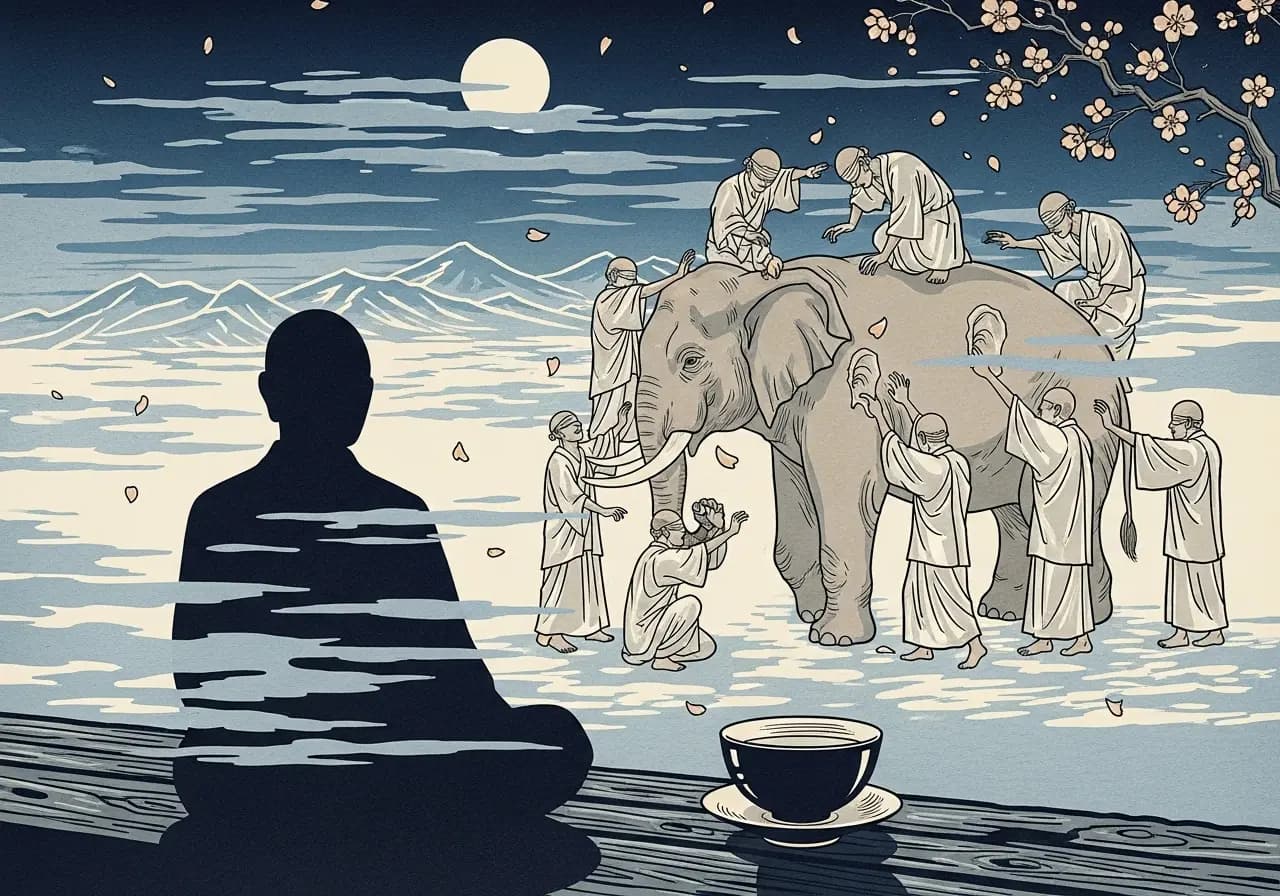
There's a famous Zen teaching of a master approached by a student who asks, "How can I learn more? I want to understand enlightenment. I want to reach this point where I can be enlightened." The master says, "Sit down. Let's talk about this. Let me pour you a cup of tea."
He starts pouring tea into the cup and continues until it's overflowing. The student looks on, not sure how to react, as the master continues pouring. The tea spills everywhere. Finally, the student says, "Hey, this is full. Quit pouring tea into here."
The teacher stops and looks at him and says, "You are like this cup of tea. Once you are full, you can't fit more tea, no matter how much is being poured in. And for you to approach me seeking to understand what enlightenment is, you already have a concept of what it is, so you're not going to be able to accept any new information. Go empty your cup and come back once it's empty."
This is a great mentality to have when approaching not just Buddhism, but life in general—this idea of being an empty cup. The moment we think that we know, we can't learn something new. This concept has always been really fascinating to me. It's the idea that there are things we know, and then there are things we know that we don't know. For example, I know English. Maybe not that well, but I know I can speak English. I know that I cannot speak Russian. That's something I know that I don't know. It's there, and I know that I don't know it.
But Buddhism really delves into this third realm—the arena of things we don't know that we don't know. This is really important, because any form of learning, any form of enlightenment or awakening, comes from learning things we didn't know we didn't know. The only way to ever arrive at a place where you can start learning about the things you don't know that you don't know is to be awake. It's to be enlightened. It's to have our eyes open to understanding things we didn't know we didn't understand.
Keep that in mind as you listen to this podcast, as you explore these topics, and if you visit the website and follow the blog. Try to keep that teacup empty and approach everything with a beginner's mind—the idea that I don't know what I don't know, and I'm here willing to learn. I promise that I will have that same disposition in everything I do as I present these things.
Beyond Labels
Mark Epstein says, "What is the difference between a Buddhist and a non-Buddhist? The non-Buddhist thinks that there's a difference." I want to be very clear about my approach with all of this: I genuinely believe there is no difference between a Buddhist and a non-Buddhist, between a human being and a non-human being. This is a topic that I'm going to dedicate a whole podcast just to—the idea of labels and concepts.
The idea here is that what we are, at the end of the day, is human beings. That's all we are. If we're a human being who tends to believe this or not believe that, that may contribute to how I am, but it's not who I am. Everything we're going to approach in the exploration of these topics is with the underlying understanding that we're all the same. We are human beings. Anything we're going to add to that is a concept—an idea or a belief. What we're trying to do is see through all of those things and arrive at just the basic understanding: first, that we are human beings.
What is Spirituality?
Spirituality is a hot topic, and it's kind of funny to be talking about spirituality from a secular standpoint. A lot of secular-minded individuals don't want to have anything to do with spirituality, religion, or anything that sounds like that. Well, secular Buddhism is an interesting concept there.
The spirituality we're talking about, I want to present this in a way that helps you understand, is that everybody is spiritual. All of us. It's our spirituality that makes us tend to be religious. It's our spirituality that also tends to make us be atheistic or non-theistic. All of it is driven by this underlying spirituality—this sense of spirituality that we all have.
We're going to approach spirituality from the understanding of spirituality being these two things.
First, it's how we relate to anything greater than ourselves. This could be, for some people, how you relate to a creator or to God. For others, it might be how you relate to the cosmos, to the universe in which you reside. You can get this sense of realizing that there's something greater than me, whatever that is. It can be science. It can be information. It can be the cosmos. It can be religion. It can be God. It's our sense of spirituality and how we relate to something greater that connects us to those things.
The second component of spirituality is how we find meaning in life. To be clear, what I'm not talking about is the meaning of life. It's how we find meaning in life. Those are two separate things. The secular Buddhist approach here is going to emphasize: what things do you find that give you meaning in life? That naturally entails the understanding that they are different for different people.
The sense of meaning in life for you may be different than the meaning of life for me. Furthermore, it evolves and changes over time. The meaning I find in life right now as the parent of three young kids is probably different than the meaning I'll have when I'm older, retired, and my kids are all grown and out of the house.
So the meaning I find in life and the connection I feel to anything greater than myself—those are the two key components to spirituality. When we talk about spirituality in these podcasts or throughout the blog, it's always with the understanding that it's those two things and nothing more.
Spirituality as Essential Sustenance
Another way this is explained that I really like comes from the Dalai Lama in his book Beyond Religion. He talks about spiritual sustenance being like water. Everyone has to have it. We die without water. The base is water, but people can add to that. You can add tea or any form of flavoring. The flavoring would be a specific religion, and that flavor might work well for you. It's a flavor you like. It makes sense to you. Ultimately, the sustenance comes from something deeper—that sense of spirituality, the connection to something greater than yourself and the meaning you find in life.
The implication with this understanding is that everybody is spiritual. It's our spirituality and the flavor we add to it that could lead us to religion or lead us away from religion. It could lead us to understand things from a secular mindset, an atheistic mindset, or from a believing mindset or anything in-between.
Faith, Devotion, and the Unknown
Other concepts relevant here are things we're going to be talking about, like faith. Faith, in this context, is faith in life. It's the uncertainty of certainty. "I don't know" is the only true statement the mind can make. Alan Watts says, "Faith, above all, is openness, an act of trust in the unknown." So when we're talking about faith—and we'll address all of these topics individually in future podcasts—these are topics that will be explored.
Faith is faith in life, faith in the unknown. Devotion is devotion to life, devotion to living. We'll explore each of these in much greater depth as this podcast series continues.
Why We're Not Focusing on Historical Buddhism
One of the areas that we won't necessarily go into—there are other podcasts that explore early Buddhism, who said what, how it was said, and under what context. This podcast is not really dedicated to that. This podcast is more about specific topics: How do they apply to everyday life for someone who has a secular mindset or a secular view of the world?
Think of algebra, for example. Many of the central topics in Einstein's Theory of Special Relativity can only be understood using algebra. That's how important algebra is. For instance, if you're traveling on a spaceship near the speed of light, time actually slows down for you relative to your friends back on Earth. In other words, if you were to fly in a spaceship near the speed of light for whatever amount of time, then return to Earth, you would find that you had aged very little while your friends on Earth would have aged a great deal.
Albert Einstein coined this phenomenon time dilation, and it can easily be calculated using only algebra. This effect isn't theoretical—it can actually be measured. In fact, all of the GPS systems of satellites in the sky that military and police use depend on and must take into account the effect of time dilation. Otherwise, the system wouldn't work at all. Because satellites are moving in orbit around the Earth at speeds much smaller than the speed of light, the time dilation involved is very small, but it still needs to be accounted for or the system wouldn't work. Algebra is a key component to understanding something that involves your everyday life—satellites. Imagine life without satellites. It would be very different than it is now.
However, when we talk about algebra, how many of us actually know who the father of algebra was? His name was Al-Khwarizmi. He was the father of algebra, and we spend very little time needing to look into his life. Who was he? What did he say about algebra? How did he say it? What he was able to present to the world is more important than who he was.
I tend to view the same relationship with algebra and Al-Khwarizmi—the founder of algebra—as I do with Buddhist philosophical concepts and the Buddha. I have a very big interest in the story of the Buddha, and I study and learn about that, but it's not as important as studying what are the implications of these concepts applied to my everyday life. So we're going to explore those concepts in further episodes, but we may not necessarily spend a lot of time on who the Buddha was or the historical aspect of his teachings. Those can be explored in other areas.
Facts Versus Truth
As you listen to and approach the topics found within this podcast, I want to be clear about the distinction between facts and truth. What we're looking for in anything we listen to is always the truth, not necessarily the fact.
For example, when I listen to Aesop's Fables and the story of the tortoise and the hare, the facts are completely irrelevant. Does it matter if there really was a tortoise and a hare who raced? No. You can extract the truth—the moral of the story—aside from the facts.
In Buddhism, there are a lot of stories. There are a lot of things that can be learned if you're looking for the truths. I would say that this is relevant to life in general. Any story you listen to has two separate things going on: one is the truth, and one is the fact. If you can understand that those two things can be separate, I would invite you to always search for what truths you can learn through these stories and don't get hung up on the facts. Most of the time, the facts are not true—they're not factual—and that's okay. It doesn't need to be factual to still extract truth from a story.
The Blind Men and the Elephant
An ancient parable relates the story of a king who gathers all the blind men of the city and brings in an elephant, asking the men to approach it and describe it. This parable was later converted to a poem in the 19th century by John Godfrey Saxe, and it's called "The Blind Men and the Elephant." I really enjoy the poem version. I believe the poem does a wonderful job illustrating the moral of the original parable.
So the poem goes like this:
It was six men of Indostan, to learning much inclined, Who went to see the Elephant, though all of them were blind, That each by observation might satisfy his mind.
The First approached the Elephant, and happening to fall Against his broad and sturdy side, at once began to bawl: "God bless me! But the Elephant is very like a wall!"
The Second, feeling of the tusk, cried, "Ho! What have we here So very round and smooth and sharp? To me 'tis mighty clear This wonder of an Elephant is very like a spear!"
The Third approached the animal, and happening to take The squirming trunk within his hands, thus boldly up and spake: "I see," quoth he, "the Elephant is very like a snake!"
The Fourth reached out his eager hand, and felt about the knee. "What most this wondrous beast is like is mighty plain," quoth he; "'Tis clear enough the Elephant is very like a tree!"
The Fifth, who chanced to touch the ear, said, "E'en the blindest man Can tell what this resembles most; deny the fact who can? This marvel of an Elephant is very like a fan!"
The Sixth no sooner had begun about the beast to grope Than, seizing on the swinging tail that fell within his scope, "I see," quoth he, "the Elephant is very like a rope!"
And so these men of Indostan disputed loud and long, Each in his own opinion exceeding stiff and strong, Though each was partly in the right and all were in the wrong.
So oft in theologic wars the disputants, I ween, Rail on in utter ignorance of what each other mean, And prate about an Elephant not one of them have seen.
Keeping in mind this story—this wonderful poem about what is truth from the perspective of six blind men trying to describe the elephant they're feeling—the secular Buddhist approach to understanding truth is very similar.
Truth can be extracted from many stories because we all grasp and understand things from a unique vantage point that no other person can comprehend. The vantage point from which I am experiencing life is completely unique to me. Nobody else will ever experience life the way I am experiencing it. But that also implies that I will never be able to understand the way you are experiencing life, because your vantage point is unique to you.
That applies to both time and space. No one will ever live in the exact same space you have lived or experience life the way you did in the span of time you experienced it. Where you live and when you live are both completely unique.
So it's really interesting to open your mind to try to understand that life, as far as learning truths, can never be grasped as a whole by one person. It can only be grasped by you through your unique perception and from your perspective, but never in its totality. Just like the six blind men trying to explain to each other what an elephant is—it could never be grasped. Even if you took all six perspectives and combined them, that gets you closer, but that's still not the whole thing, because that was only six different perspectives.
The secular Buddhist approach to understanding truth—this big capital-T Truth—is very similar to this parable. The idea is that you can't grasp it in totality. So we're going to understand what we can from our unique perspective and combine that with other perspectives that may be relevant and add to it. But always under the assumption that you're never going to get to the point where you say, "Okay, now I have the truth in its totality. We finally got there." Because we can't get there. That's part of the whole point. Knowing that we can't get there makes it great.
Looking Forward
I'm really looking forward to doing this podcast and exploring these topics. I hope that you not only listen and enjoy but that you'll be willing to reach out to me and contribute to the conversation, whether that be through the comments on the blog, comments on the podcast, or by emailing me. If you're interested in ever being on the show, I'd love to have people on with me where we discuss these topics together.
I'm excited to develop this over time and see what it turns into. I really want to contribute to the secular Buddhist conversation—Buddhist philosophy and Buddhist wisdom that can be explained and looked at by people like me who are secular-minded and trying to understand this from a secular point of view.
So thank you for joining me today. I cannot wait to do the next episode, and we're going to see where all this goes.
Listen, Learn, and Grow
Visit secularbuddhism.com for more information, show notes, and additional resources.